

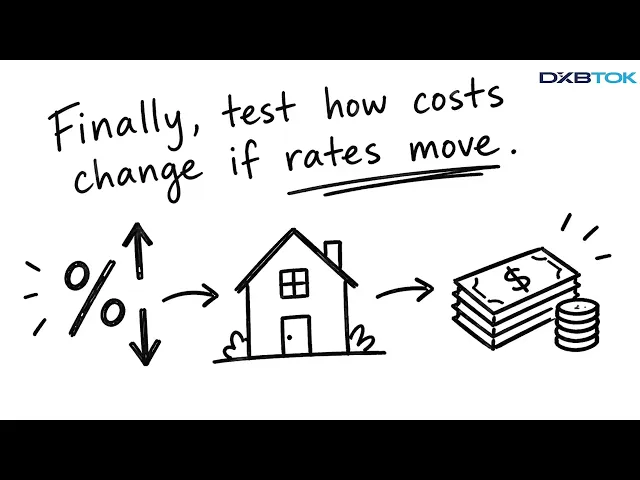
Two home loans can start with similar monthly payments yet cost very different amounts over the years. A short promotional period, a benchmark reset or an additional bank charge can alter the balance. This comparison helps Dubai buyers judge financing offers using the full repayment picture rather than the opening rate alone.
Dubai Mortgage Rates and Buyer Financing Choices
Comparing Dubai mortgage interest rates requires more than looking at the lowest percentage advertised by a bank. The actual financing cost depends on how the rate is calculated, how long it applies, which fees accompany the loan and how repayments may change during ownership.
Some UAE home loans offer an introductory fixed-rate period followed by variable pricing. Other products use a benchmark-linked rate from the start. Differences in the lender's margin, repayment term, insurance requirements and settlement conditions can materially affect what a buyer ultimately pays.
For buyers choosing between mortgage offers, the important question is not simply which bank advertises the lowest rate today. It is which written financing offer provides a suitable balance of affordability, cost certainty, flexibility and financial risk over the intended ownership period.
1. How Do Dubai Mortgage Interest Rates Work?
Dubai property mortgages are provided by UAE banks and other appropriately authorised financing institutions. The rate charged depends on the selected product and the lender's assessment of the borrower and property.
For conventional mortgages, interest is normally charged on the outstanding loan balance under the agreed repayment structure. As the balance is gradually repaid, the interest component and principal component of each instalment may change.
Islamic home finance uses different contractual arrangements and profit-payment terminology. Its cost and repayment obligations still need to be understood in financial terms.
Mortgage pricing may also change during the life of the facility, particularly where a variable-rate period applies.
Buyers should distinguish the initial quoted rate from the complete financial conditions that determine future payments.
2. What Determines the Mortgage Rate a Buyer Is Offered?
There is no single mortgage rate available to every Dubai property buyer.
Pricing can vary according to several factors:
Borrower profile: documented income, credit history, financial commitments and income stability.
Residency status: whether the applicant is a UAE resident or an eligible overseas borrower.
Property: the lender's assessment of the selected home, its value and financing eligibility.
Loan amount: the financing requested relative to the property's acceptable value.
Rate structure: introductory fixed pricing, variable pricing or a combination of both.
Account conditions: salary transfer or other banking requirements tied to a particular offer.
Financing term: the proposed repayment period and applicable lender criteria.
Two borrowers interested in the same apartment may therefore receive different offers from the same bank.
Even when advertisements show similar rates, the final approved pricing may differ once the lender reviews the application.
3. Fixed Versus Variable Dubai Mortgage Rates
The distinction between fixed and variable mortgage pricing is central to comparing offers.
A fixed rate normally remains unchanged for the specific period stated in the contract. That can provide greater predictability of the financing rate during that period, assuming the relevant product conditions are met.
A variable rate changes in accordance with the agreed pricing mechanism. This may involve an external benchmark and the lender's contractual margin.
Many products combine both structures. A mortgage may begin with fixed introductory pricing and later move to a variable rate.
Buyers should therefore distinguish a rate described as fixed for a limited introductory period from a facility that genuinely fixes its pricing for the entire contractual term.
The first option can create considerable uncertainty once the introductory period expires.
4. Why the Fixed-Rate Period Matters
A lower introductory mortgage rate can be attractive because it may reduce early financing payments.
But buyers should consider what happens when the fixed period ends.
The subsequent rate may depend on market benchmarks, the bank's agreed margin and the precise reset provisions in the loan agreement.
For someone planning to keep a property for many years, the period following the initial offer can represent a substantial part of the financing commitment.
For someone expecting to sell earlier, settlement charges, property-market conditions and the possibility of a delayed sale may also influence the decision.
A short fixed-rate offer is not necessarily unsuitable. It is unsuitable when the buyer assumes its initial payment will remain unchanged without reviewing the later contractual pricing.
5. What Is EIBOR and Why Does It Affect Dubai Mortgages?
EIBOR stands for Emirates Interbank Offered Rate. It is an interest-rate benchmark published for specified maturities in the UAE financial market.
Some variable-rate home loans use EIBOR as a reference for calculating the borrower's contractual interest rate.
In those products, the mortgage rate may be expressed as the applicable EIBOR tenor plus a lender margin.
For example, a contract might reference three-month EIBOR plus a separately agreed margin. The resulting rate is not necessarily recalculated every day; the applicable review dates and contractual calculation method determine when the borrower's rate changes.
EIBOR is not itself an individual mortgage offer. Buyers cannot assume that the published benchmark is the amount they will pay their lender.
The margin, any contractual minimum, applicable reset frequency and financing conditions are critical to the final rate.
Our Dubai mortgage options for UAE residents guide explains the broader lender, eligibility and financing considerations affecting resident buyers.
6. What Does EIBOR Plus a Bank Margin Mean?
When a mortgage uses benchmark-linked pricing, the final contractual rate generally includes the agreed reference benchmark and an additional bank margin.
Consider a purely hypothetical arrangement in which the selected EIBOR benchmark is 4% and the agreed margin is 1.5 percentage points.
The combined rate would be 5.5%, subject to any other contractual provisions.
If the relevant benchmark later changed, the applicable mortgage rate could also change at the contract's reset date.
These numbers are examples of the calculation method, not current EIBOR fixings or available lender quotations.
Buyers should also consider whether the offer includes a rate floor, minimum margin or other provision affecting how changes are passed through.
Two products using the same benchmark can still have different borrowing costs because their margins and review arrangements are not identical.
7. Why EIBOR Tenor and Reset Dates Matter
EIBOR is published for several maturities, including commonly referenced one-month, three-month and six-month periods.
A mortgage may specify which benchmark tenor applies and how frequently the lender reviews the rate.
A product linked to three-month EIBOR is not automatically equivalent to one linked to six-month EIBOR, even if the initial total rates happen to be close.
The applicable benchmark value and the date on which it is applied can affect repayments.
Buyers should understand whether the contract has scheduled quarterly, semiannual or other rate reviews and whether changes are reflected in the monthly payment, remaining loan term or another permitted arrangement.
The key point is not to predict exactly where EIBOR will move. It is to understand how any change would affect the borrower's own financing obligations.
8. How Can Buyers Compare Current Dubai Mortgage Rates?
Current advertised mortgage rates are useful for identifying potential financing options, but they need context.
A bank's public rate may apply only to a specified product, customer category, financing amount or promotional period. It may exclude some fees or assume additional banking conditions.
For a meaningful comparison, borrowers should use written information that identifies the date and conditions of each offer.
At minimum, the comparison should distinguish:
The applicable introductory interest or profit rate.
The length of any fixed-rate period.
The variable-rate formula after that period.
The benchmark tenor and lender margin.
The disclosed Annual Percentage Rate.
The fees and other financing costs.
The proposed loan term and repayment obligations.
The Central Bank of the UAE publishes official EIBOR information, but benchmark movements should not be mistaken for changes in every lender's advertised mortgage price.
No single advertised rate is guaranteed to be available to every buyer or to remain valid indefinitely.
9. What Is APR and Why Is It Different From the Headline Rate?
APR stands for Annual Percentage Rate. It provides a more comprehensive annualised measure of borrowing cost under the applicable disclosure method than a headline interest rate considered alone.
Depending on the relevant calculation and product, APR reflects applicable borrowing charges as well as the interest or profit component.
UAE Central Bank consumer-protection standards require licensed financial institutions to provide clear credit-product disclosures, including applicable financing costs and the basis of the rate.
That makes APR useful when comparing loan offers that contain different bank charges.
However, APR does not establish the exact future cost of every variable-rate mortgage. Where rates can change, the calculation depends on stated assumptions and contractual terms.
APR also does not necessarily include every property-purchase expense, such as all registration, furnishing or ownership costs.
Buyers should examine the disclosed calculation and assumptions rather than treating an APR figure as a guarantee that the total cost cannot change.
10. Does Mortgage Pre-Approval Lock in the Interest Rate?
Not necessarily. Preliminary approval can indicate that a lender is willing to consider financing a buyer, but it may not establish a binding commitment to provide a specific rate for the final transaction.
A rate indication can depend on the lender's product availability, the offer's validity period, credit checks and the selected property.
The mortgage's final terms may also depend on the valuation and remaining lender requirements.
Buyers should distinguish an indicative financing illustration from an offer confirming the applicable rate and the conditions under which it will be honoured.
Our Dubai mortgage pre-approval guide explains what preliminary approval does and does not establish before a buyer commits to a property.
A buyer should not sign a binding property commitment on the assumption that an informal quote will remain unchanged until completion.

11. Do UAE Residents and Non-Residents Receive the Same Rates?
Not necessarily. Banks may offer different financing products and pricing structures according to the borrower's residence, accepted income, documentation and broader credit profile.
Some UAE institutions finance qualifying overseas buyers, while others restrict particular products to residents or specific customer categories.
A non-resident may therefore encounter a different choice of lenders and loan conditions from a UAE-based salaried applicant.
Before comparing interest rates, an international buyer needs to know whether the relevant bank will actually consider their residence and income profile.
Our non-resident Dubai mortgage guide explains the broader lender and eligibility considerations affecting overseas purchasers.
An attractive product advertised to UAE residents should not be treated as an available offer to an overseas purchaser without lender confirmation.
12. How Do Mortgage Rates Affect Monthly Repayments?
The interest or profit rate is one of the main factors influencing a mortgage's ongoing payments.
For an otherwise identical repayment mortgage, a higher rate generally increases the amount required to repay the debt over the same period.
The effect depends on the outstanding principal, remaining term, repayment method and the way the lender applies rate changes.
For a loan that switches from an introductory fixed rate to variable pricing, a later rate increase can create payments higher than those originally shown in the sales illustration.
Conversely, a decrease in the applicable benchmark may reduce payments where the contract passes that reduction through, subject to its rate provisions.
A responsible mortgage decision should therefore remain affordable beyond the most attractive introductory scenario.
13. Why the Loan Term Changes the Total Financing Cost
The repayment period also affects the financial comparison.
A longer mortgage term can reduce the monthly payment required for an otherwise comparable amortising loan, but it can extend the period over which financing costs are incurred.
A shorter term may increase monthly repayment pressure while reducing the duration of borrowing.
Neither option is automatically better for every buyer.
A household prioritising monthly affordability may evaluate terms differently from a buyer expecting significant future income or an early sale.
The decision should also reflect the borrower's employment stability, other obligations, age-related lending limits and expected ownership horizon.
The same interest rate can lead to meaningfully different total financing costs when loan terms differ.
14. Which Mortgage Fees Should Be Compared?
A bank's interest rate is only one component of the financing expense.
Depending on the product and transaction, a buyer may also face:
Processing or arrangement fees.
Property valuation charges.
Mortgage registration and transaction-service expenses.
Required insurance or takaful costs.
Applicable account or administrative charges.
Permitted early-settlement or refinancing charges.
Other clearly disclosed financing-related costs.
Some expenses arise once at purchase, while others continue throughout ownership. They should not be combined without distinguishing their timing.
Buyers should also separate the lender's charges from the wider cost of acquiring a property in Dubai.
Our full cost of buying Dubai property guide explains the wider transaction and ownership costs buyers should assess alongside mortgage financing.
Where a bank offers to waive a particular fee, the buyer should consider whether other terms change in exchange for that benefit.
15. Is the Lowest Advertised Mortgage Rate Always the Best Choice?
No. The lowest headline rate can be a useful starting point, but it is not a complete assessment of financial value.
One offer may provide particularly attractive pricing for a limited period before resetting to a higher margin over a benchmark.
Another may have a less competitive introductory rate but lower applicable fees, a longer period of rate certainty or more suitable early-settlement conditions.
The preferable arrangement depends on the buyer's intended holding period and tolerance for future payment changes.
A purchaser planning long-term ownership should not compare only the first year of payments.
Similarly, a buyer expecting to sell within a few years should not ignore fees and settlement conditions merely because the introductory rate is low.
Buyers should compare financing structures on consistent terms rather than select the smallest percentage in a promotional advertisement.
16. Does Salary Transfer Influence Mortgage Pricing?
Some UAE lenders attach specific mortgage offers to customers who transfer their salary to the institution or maintain certain banking arrangements.
Such conditions may affect pricing or access to selected products.
However, the buyer should understand what obligations accompany the advertised benefit.
Employment changes, a move into self-employment or the decision to use another bank could affect whether the original conditions continue to be satisfied.
The written offer should explain any relevant ongoing requirements and the consequences of changes.
A salary-transfer incentive may be commercially useful, but it is only one element of the overall mortgage comparison.
Borrowers should avoid accepting an account arrangement they do not understand solely to obtain a slightly lower introductory rate.
17. How Should Buyers Think About Islamic Home Finance Rates?
Islamic home finance uses contractual structures intended to comply with Shariah principles, so the terminology may differ from conventional mortgage lending.
Depending on the product, customers may see references to profit rates, rental payments or financing arrangements involving sale or partnership structures.
The economic commitment still needs to be evaluated carefully.
Buyers should understand which payments are fixed, which can change, how future pricing is determined and what settlement or default conditions apply.
A lower advertised profit rate should not automatically be treated as cheaper financing without considering the relevant fees and total payment obligations.
Conventional and Islamic products may also use different documentation and contractual mechanisms that require appropriate explanation.
For buyers considering both forms of finance, the comparison should focus on the actual written commitments as well as any personal preference about financing structure.
18. Cash Purchase Versus Mortgage: Does the Rate Change the Decision?
For buyers with sufficient available capital, the mortgage rate can influence whether borrowing is economically attractive compared with purchasing entirely in cash.
Using finance may preserve some cash for other needs or investments. However, it introduces interest or profit costs, repayment obligations and additional transaction coordination.
Paying cash avoids mortgage repayments but concentrates a greater amount of capital in the property.
The preferable route depends on the buyer's liquidity needs, risk tolerance, financial opportunities and intended holding period.
Our cash buyer versus mortgage buyer comparison explains the trade-offs between preserving liquidity and taking on financing costs and repayment obligations.
A buyer should not treat mortgage borrowing as automatically beneficial simply because the offered rate appears relatively low.
19. How Do Rate Changes Affect Investment-Property Buyers?
A buyer financing a Dubai rental investment faces additional considerations because the mortgage repayment is only one part of the property's financial performance.
Service charges, management fees, maintenance, vacancy and other ownership expenses affect the cash remaining from rent.
If financing rates increase, the investment's monthly cash flow may weaken even if its contracted rental income remains unchanged.
An investor should not assume that rental income will increase quickly enough to offset a higher mortgage payment.
Equally, the ability to refinance at a lower rate in the future should be treated as a possibility rather than a guaranteed outcome.
A suitable financed property purchase needs sufficient financial capacity to withstand periods of lower rent or higher costs.
Mortgage pricing should therefore be evaluated alongside the property economics, not separately from them.
20. When Does Refinancing or Mortgage Buyout Make Sense?
Refinancing involves replacing an existing mortgage with another arrangement, potentially to obtain different pricing, repayment terms or other product conditions.
A lower advertised rate from another bank does not automatically make refinancing worthwhile.
Buyers should consider permitted settlement charges on the existing facility, processing expenses for the new loan, valuation costs, insurance arrangements and the conditions of the replacement mortgage.
The amount of debt outstanding and the expected remaining ownership period also matter.
For example, a buyer expecting to sell relatively soon may have less time to benefit from reduced monthly financing costs after paying the expenses of switching.
Refinancing may be suitable in some circumstances, but it requires a full comparison rather than a reaction to a new promotional rate.
21. What Are the Main Warning Signs in a Mortgage Rate Offer?
A financing offer deserves additional scrutiny when its attractive headline terms are not supported by clear documentation.
Important warning signs include:
A very low promotional rate with unclear pricing after the introductory period.
No clear explanation of the EIBOR tenor or lender margin.
Uncertainty about when a variable rate can change.
Fees or required insurance not reflected in the buyer's budget.
APR or Key Facts Statement information missing or inconsistent.
A rate indication presented as guaranteed without a formal written commitment.
Early-settlement conditions that do not fit the buyer's intended holding period.
Monthly repayments that are only affordable under the initial pricing assumptions.
An offer that relies on a mortgage approval or property valuation that has not been completed.
These concerns do not automatically make a mortgage unsuitable. They indicate that the buyer needs clearer evidence before accepting the financing commitment.
22. How Should Buyers Compare Two Dubai Mortgage Offers?
Suppose two banks provide offers to finance the same eligible Dubai property.
One lender advertises a lower introductory rate but switches to benchmark-linked pricing after a relatively short period.
The other offers different initial pricing, a longer fixed period or more flexible settlement provisions.
To compare them fairly, the buyer needs to consider the same borrowing amount and repayment period, then assess:
The written initial interest or profit rate.
The duration of the introductory period.
The rate formula that applies afterwards.
The APR and disclosed financing charges.
The repayment if benchmark rates rise.
The total expected cost over a relevant ownership period.
The cash required at completion.
The terms for early settlement, refinancing or sale.
Any conditions that could affect the offered rate or final approval.
A useful financing comparison highlights differences rather than allowing each bank's promotional material to define what matters.
There is no universally best mortgage independent of the borrower and the intended property transaction.
23. Dubai Mortgage Rates: Final Buyer Considerations
Dubai mortgage interest rates influence affordability, but the best financing choice cannot be identified by one advertised percentage.
Buyers should understand the difference between fixed and variable pricing, the EIBOR benchmark, the lender's contractual margin and the disclosed Annual Percentage Rate.
They should also consider mortgage fees, the repayment period, future rate changes and the financial consequences of selling or refinancing.
For overseas buyers and UAE residents alike, a mortgage quote becomes meaningful only when the borrower and the selected property are eligible and the full financing conditions are understood.
DXBTOK helps buyers compare selected Dubai property opportunities with clearer commercial information and structured support. Appropriately licensed banks and qualified finance professionals handle mortgage offers, lending decisions and regulated financing advice.
Buyers should choose a property financing arrangement that remains understandable and affordable throughout the intended ownership period rather than focusing only on the most attractive headline rate.
Related DXBTOK Guides
How to Compare Total Cost Between Dubai Properties →
Dubai Property Mortgage vs Developer Payment Plan →
Dubai Property Currency Risk for International Buyers →
Dubai Off-Plan vs Ready Property: Which Is Better for Buyers? →


