Learn how to compare two Dubai properties using the same cost assumptions across acquisition, service charges, maintenance, financing, currency conversion, management, furnishing and recurring ownership expenses.
How to Compare Total Cost Between Dubai Properties
Two Dubai properties can have the same asking price and still cost very different amounts to buy and own.
That is because the headline price is only one part of the decision.
A better comparison is:
purchase price → transaction costs → financing/currency costs → recurring ownership costs → property-specific operating costs
The goal is to compare the total financial commitment of each property on the same basis.
1. Do not compare asking price alone
If Property A costs AED 2 million and Property B also costs AED 2 million, they are not automatically equal-cost options.
The final cost can differ because of:
registration-related costs
service charges
maintenance
furnishing
financing
currency conversion
management
insurance
property-specific fees
future operating requirements
Start with the headline price, but do not stop there.
2. Separate one-time costs from recurring costs
This is the first major comparison.
One-time or transaction-stage costs
These can include:
purchase price
registration-related charges
trustee or processing charges where applicable
mortgage setup costs where relevant
valuation costs
brokerage-related costs where applicable
developer administration charges where applicable
furnishing or setup
currency conversion and bank-transfer costs
Recurring ownership costs
These can include:
service charges
maintenance
insurance
property management
utilities
cooling or other building-specific charges
furnishing replacement
finance costs where applicable
A cheaper purchase can become the more expensive ownership option if its recurring cost structure is much higher.
3. Compare transaction costs on the same date and same assumptions
Do not compare one property using today's actual costs and another using old estimates.
Build both comparisons using:
the same date
the same buyer profile
the same financing assumption
the same currency assumption
the same intended use
the same ownership period
This makes the comparison more meaningful.
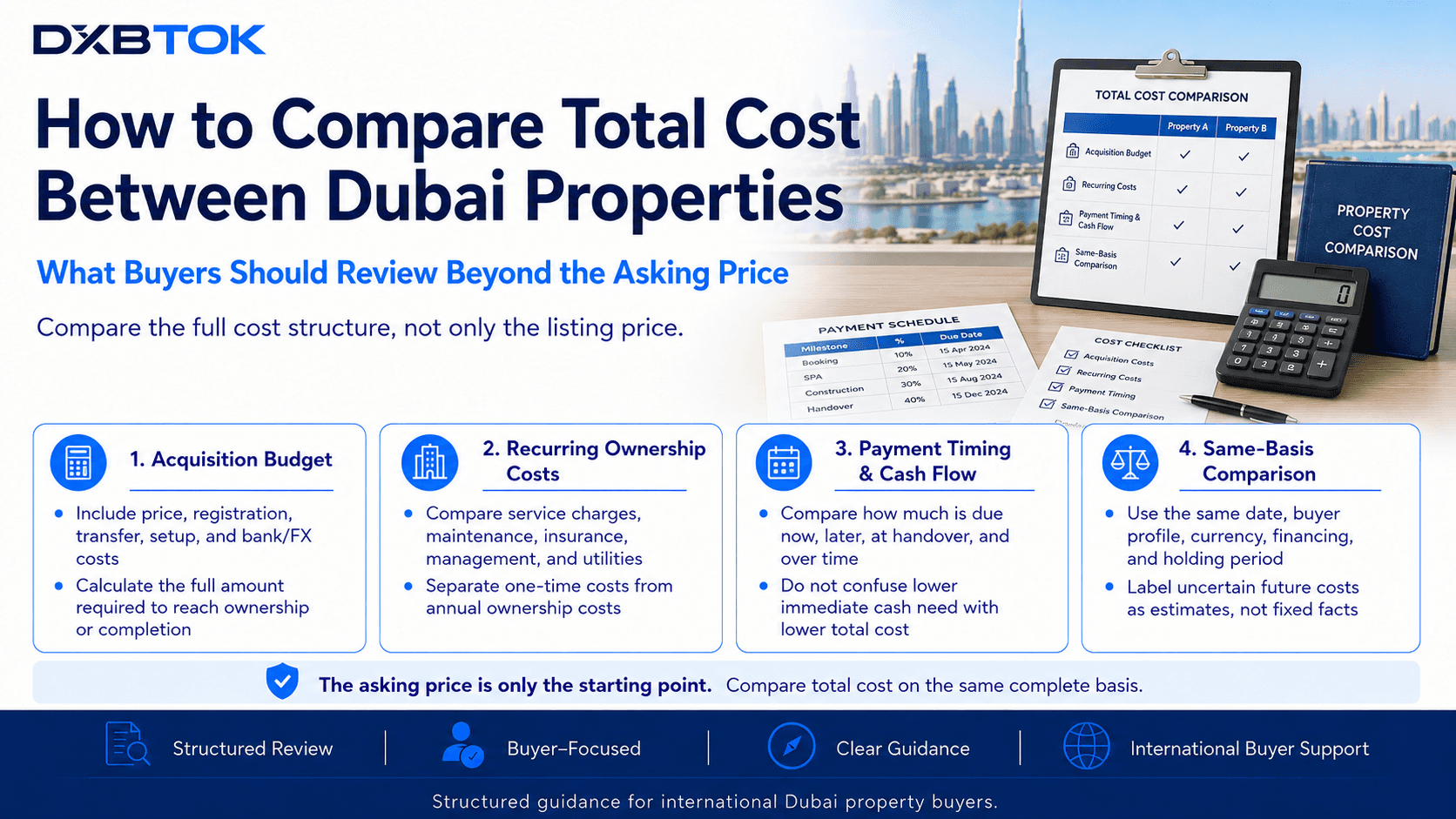
4. Start with the complete acquisition budget
For each property, calculate the amount required to reach ownership or completion.
Include:
purchase price
initial deposit or reservation amount
registration-related costs
transfer or trustee costs where applicable
financing-related setup where applicable
bank and FX costs
immediate furnishing or setup
other transaction-specific charges
Use the full cost of buying Dubai property guide when building the broader acquisition budget.
5. Compare official registration-related costs separately from property price
Registration costs are transaction costs, not part of the property's asking price.
Dubai Land Department's current completed-property sale registration service separates the sale value from registration and service-related fees. Exact charges can depend on the transaction route and should be checked against the current DLD service at the time of purchase.
For comparison purposes, apply the same verified registration assumptions to both properties where the transaction type is equivalent.
6. Off-plan and ready properties may have different cost timing
A ready property and an off-plan property can have very different cash-flow patterns.
A ready property may require a larger amount around transfer or completion.
An off-plan property may spread payments across:
reservation
SPA
construction milestones
handover
post-handover installments where applicable
Do not confuse lower immediate cash requirement with lower total cost.
Compare both the amount and the timing.
7. Payment timing has a financial effect
Two properties with the same total price may still affect the buyer differently.
For example:
one requires most of the money now
one spreads payments over two years
one has a large handover payment
one includes post-handover installments
The comparison should therefore show:
how much is due
and
when it is due
8. Compare service charges using the exact building or project
Service charges can create a meaningful difference between otherwise similar apartments.
Dubai Land Department's Service Charge Index allows buyers and owners to check approved service fees for jointly owned properties by project, use and year.
Do not compare properties using a generic Dubai-wide assumption.
Use the Dubai property service charges guide when reviewing this recurring-cost layer.
9. Convert service charges into an annual ownership number
A rate per square foot is useful, but buyers should also calculate the approximate annual amount.
For each property, record:
service-charge basis
chargeable area
annual amount
what the charge appears to cover
whether additional operating fees exist
The annual figure is easier to compare across properties.
10. Higher service charges are not automatically worse
A higher service charge may support:
more amenities
higher staffing levels
larger common areas
concierge or hospitality services
more complex building systems
The correct question is not:
“Which service charge is lower?”
It is:
“What am I paying for, and does it match the ownership experience I want?”
11. Compare maintenance separately from service charges
Service charges do not remove all unit-level maintenance.
A buyer may still be responsible for:
air-conditioning components
plumbing
electrical work
appliances
paint
fixtures
furniture
private outdoor areas
pools or landscaping in some properties
Use the Dubai property maintenance costs guide to keep building-level and unit-level costs separate.
12. Property type changes the cost structure
An apartment, townhouse and villa can have very different operating costs.
A villa may involve more direct responsibility for:
external areas
private pool
landscaping
additional AC equipment
gates
roof or façade elements
An apartment may shift more common-area responsibility into the building's managed structure.
Neither is automatically cheaper.
The cost structure is simply different.
13. Compare furnishing and setup requirements
One property may be ready to use.
Another may require:
furniture
curtains
lighting
appliances
kitchen equipment
outdoor furniture
smart-home setup
decorative work
If the intended use requires immediate occupancy or rental, these costs should be included in the initial comparison.
14. Compare financing on the same basis
If one or both properties will be financed, compare:
required down payment
loan amount
interest structure
valuation
bank fees
insurance requirements
monthly payment
total financing cost over the expected holding period
Do not compare a cash purchase with a mortgage purchase as though the financing cost does not exist.
Use the non-resident Dubai mortgage guide if financing is part of the comparison.
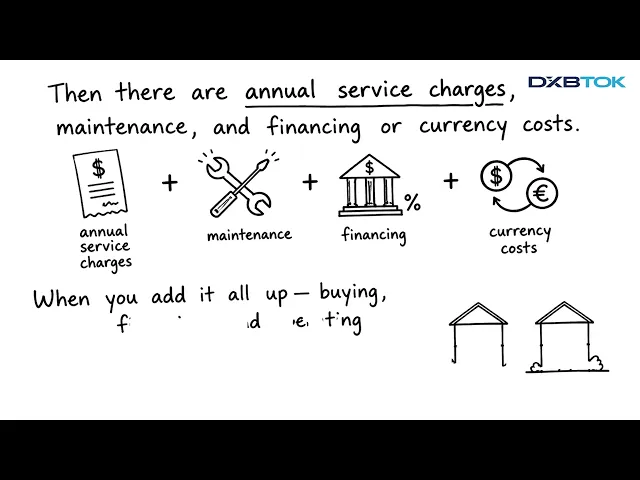
15. Currency conversion can change the buyer's real cost
An international buyer may think in:
EUR
GBP
USD
CHF
CAD
AUD
another home currency
If the obligation is in AED, the buyer's real cost in home currency can change between payment dates.
Compare:
exchange rate
provider spread
transfer fees
conversion timing
number of future payments
Use the currency exchange guide for Dubai property buyers from Europe where relevant.
16. Compare bank-transfer costs and payment friction
Repeated international transfers can create:
sending-bank fees
intermediary charges
receiving-bank charges
FX costs
administrative work
For a staged payment plan, small transfer costs can repeat several times.
They may not drive the entire purchase decision, but they belong in the complete comparison.
17. Compare property-management requirements
If you will live outside Dubai, ask whether either property needs local management.
Costs can vary depending on whether you require:
periodic inspection
tenant management
maintenance coordination
key management
cleaning
reporting
emergency access
A property that is harder to manage remotely may create higher operating costs even if the purchase price is lower.
18. Compare rental-related operating costs separately
If the property will be rented, model the operating structure.
Depending on the rental model, costs may include:
property management
leasing-related costs
cleaning
furnishing replacement
maintenance
utilities during vacancy
guest or tenant turnover
platform or operating costs where relevant
Do not compare properties only using expected gross rent.
19. Compare insurance requirements
Insurance costs may vary depending on:
property type
contents
landlord use
financing requirements
insurer
coverage level
Use actual quotations when the decision is close enough for insurance to matter.
20. Compare utility structures
Different properties can have different operating arrangements.
Check:
electricity and water
district cooling where applicable
gas where applicable
internet
building-specific charges
usage pattern
A buyer who uses the property only occasionally may care about these differently from a full-time resident.
21. Compare branded and hospitality-related fees carefully
A branded or hospitality-linked residence may have additional service or management layers.
That can include:
premium service structures
branded management
optional hospitality services
furnishing standards
operator-related fees
Do not assume the brand premium is contained only in the purchase price.
22. Compare completed-property condition
Two resale apartments with similar prices can have very different immediate costs.
Check whether either property requires:
repainting
AC work
appliance replacement
bathroom repairs
flooring
furniture replacement
balcony work
snagging or defect rectification
A lower-priced unit may require more capital immediately after transfer.
23. Compare off-plan handover requirements
For off-plan property, budget for what may happen at completion.
Possible cost categories include:
final installment
registration or completion-related charges
snagging
furnishing
utility activation
property management setup
insurance
initial maintenance
Do not treat the SPA purchase price as the complete handover budget.
24. Compare the same holding period
A property that looks inexpensive over one year may look different over five years.
For a cleaner comparison, choose a working holding period such as:
3 years
5 years
10 years
Then estimate the costs that are likely to occur during that period.
This is not a forecast of investment performance.
It is a cost-planning tool.
25. Separate fixed costs from uncertain costs
Some costs can be verified before purchase.
Others are estimates.
Create two categories.
More directly verifiable
purchase price
current service charges
documented transaction fees
current financing terms
current management quotation
More uncertain
future maintenance
future service-charge changes
future interest costs on variable financing
future FX rates
future insurance premiums
Do not present uncertain future costs as fixed facts.
26. Build a base-case comparison
For each property, create a simple total-cost table.
Property A
purchase price
transaction costs
financing/FX costs
first-year service charges
estimated maintenance
furnishing/setup
management
other known costs
Property B
Use the same categories.
This makes missing cost categories visible.
27. Add a recurring annual-cost comparison
After acquisition cost, compare annual ownership.
For example:
Annual ownership cost = service charges + maintenance allowance + insurance + management + fixed operating costs + financing cost where relevant
Do not mix one-time acquisition costs into the annual total.
28. Compare cost per usable benefit, not just cost per square foot
Price per square foot can be useful.
But it does not capture:
better layout
superior view
stronger privacy
better management
lower recurring costs
included services
better parking
more suitable amenities
The cheaper cost per square foot is not automatically the better total-cost decision.
29. Check whether one property includes items the other does not
A higher-priced property may include:
furniture
appliances
parking
storage
service package
maintenance period
owner privileges
If the other property requires you to buy those separately, adjust the comparison.
30. Do not count incentives twice
Developer incentives can reduce cost, but only if they genuinely replace something you would otherwise pay.
Examples may include:
fee contribution
furnishing package
service-charge contribution
payment-plan benefit
Record the incentive once.
Do not subtract it from the price and then subtract the same value again elsewhere.
31. Compare total cash required, not only total accounting cost
For liquidity planning, record how much cash must actually leave your account.
This can differ from the broader economic cost.
For example, mortgage financing reduces immediate cash required but creates financing cost over time.
Both figures matter.
32. Keep investment return separate from cost comparison
This article is about comparing cost.
It is not a return model.
Do not offset uncertain future:
capital appreciation
rental growth
resale premium
against today's verified costs just to make one property appear cheaper.
First understand the costs.
Then evaluate potential return separately.
33. Use a three-level comparison
A practical structure is:
Level 1 — Acquisition Cost
What does it cost to buy and complete?
Level 2 — Annual Ownership Cost
What does it cost to hold each year?
Level 3 — Property-Specific Cost Risk
Which property has more uncertain or potentially variable costs?
This is more useful than comparing two asking prices side by side.
Dubai Property Total Cost Comparison Checklist
Purchase
Asking price recorded
Negotiated price recorded
Payment schedule understood
Transaction costs added
Financing and Currency
Mortgage cost included where relevant
FX assumptions stated
Bank-transfer costs considered
Ownership
Service charges checked
Maintenance estimated
Insurance considered
Management cost included where needed
Utility structure reviewed
Property-Specific
Furnishing requirement assessed
Immediate repairs assessed
Handover/setup costs considered
Branded or operator fees reviewed
Comparison
Same assumptions used for both properties
One-time and recurring costs separated
Holding period defined
Uncertain costs labelled as estimates
How DXBTOK Approaches Total-Cost Comparison
The comparison should not be:
Property A price vs Property B price
A stronger process is:
acquisition cost → annual ownership cost → financing/currency cost → property-specific operating cost → uncertainty
The objective is to understand which property creates the better cost structure for the buyer's actual ownership plan.
Final Takeaway
The cheapest Dubai property on the listing page is not necessarily the cheapest property to own.
A proper comparison should account for:
purchase price
transaction costs
service charges
maintenance
furnishing
financing
currency conversion
management
insurance
property-specific operating costs
The key question is:
“If I compare both properties using the same assumptions, what will each one actually cost me to buy and own?”
Need Help Comparing the Total Cost of Dubai Properties?
DXBTOK helps international buyers compare Dubai properties using a structured cost framework that looks beyond the asking price and separates acquisition costs from recurring ownership costs.
Contact DXBTOK and let us help you compare the options more clearly before moving forward.
Related DXBTOK guides
Full Cost of Buying Dubai Property: What International Buyers Should Budget →
Dubai Property Service Charges Explained for Buyers →
Dubai Property Maintenance Costs: What Buyers Should Expect →