
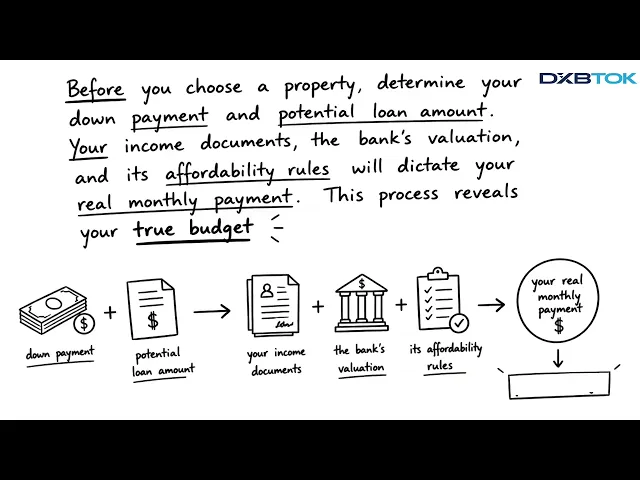
Learn how non-resident Dubai property buyers can review mortgage options by checking lender eligibility, property acceptance, valuation, financing limits, borrower documents, transaction costs, cash contribution and transfer timing.
Mortgage Options for Non-Resident Dubai Buyers
Buying property in Dubai without UAE residency does not automatically mean the purchase has to be made entirely in cash.
Some UAE lenders offer mortgage options to non-resident buyers, subject to their own eligibility rules, property criteria, income assessment, documentation and financing limits.
For an international buyer, however, the important question is not simply:
“Can I get a mortgage in Dubai?”
It is:
“Can the mortgage structure actually support this specific property purchase, with the cash, documents and timing I have available?”
A useful framework is:
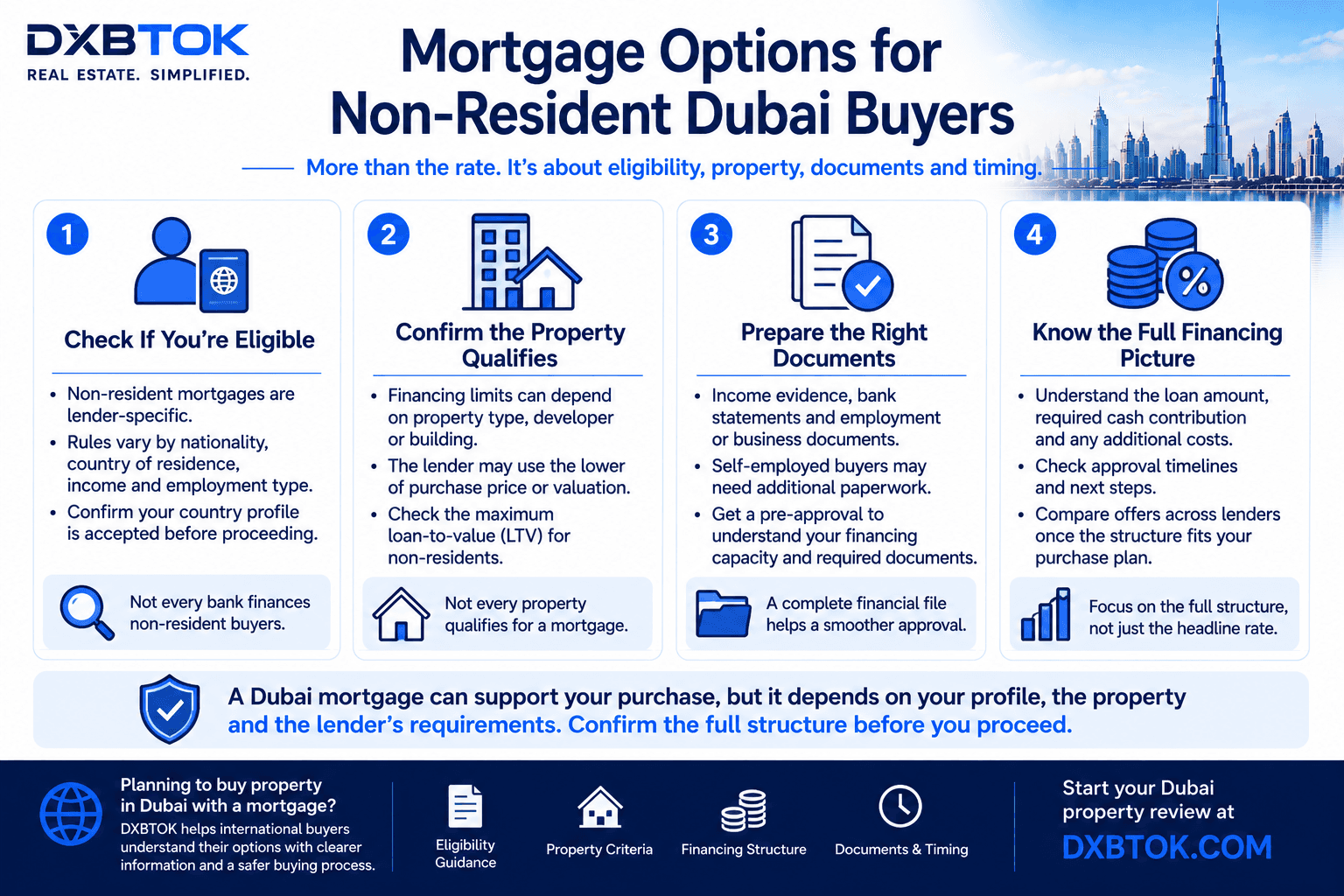
buyer eligibility → property eligibility → financing limit → documentation → approval timing → cash required alongside the loan
Start with the transaction, not the advertised mortgage rate
A headline mortgage rate can attract attention.
But the rate is only one part of the financing decision.
A non-resident buyer should first understand:
whether the lender accepts non-residents
whether the buyer profile qualifies
whether the property qualifies
how much the lender may finance
how much cash the buyer must contribute
what documents are required
how long approval may take
what additional mortgage costs apply
Only then does rate comparison become useful.
1. Non-resident mortgages are lender-specific
Not every bank follows the same non-resident policy.
Differences may include:
accepted nationalities
country of residence
minimum income
employment type
self-employed requirements
age limits
property type
approved developers or buildings
minimum or maximum loan size
financing percentage
term
Do not assume a mortgage structure offered by one lender will be available from another.
2. Residency status affects the application
A UAE resident and a non-resident may be assessed differently.
A non-resident lender may require more evidence because the buyer's:
income is earned abroad
bank accounts are outside the UAE
employment or business is outside the UAE
credit history may sit in another jurisdiction
That can make documentation and verification more important.
3. Start by confirming whether your country profile is accepted
Before discussing a specific property, ask the lender:
Do you finance buyers resident in my country?
Do you accept my nationality?
Do you accept my employment structure?
Do you lend to self-employed applicants?
Are there restrictions on where income is earned?
This can prevent wasted work later.
4. Income evidence is central to approval
A lender will normally need evidence that the mortgage is affordable.
Depending on the applicant, that may include:
salary certificates
employment contracts
payslips
bank statements
tax documents
company accounts
business ownership documents
proof of other liabilities
The exact list depends on the lender and borrower profile.
Do not prepare only property documents.
Prepare the buyer's financial file as well.
5. Self-employed buyers may need a different document set
Business owners and self-employed applicants may be asked for additional evidence.
Possible items may include:
company registration
ownership records
audited accounts
business bank statements
personal bank statements
tax records where applicable
The lender needs to understand the sustainability and source of the income.
6. Pre-approval is useful, but it is not final mortgage approval
Pre-approval can help indicate:
whether the buyer appears eligible
approximate financing capacity
likely documentation requirements
But the final loan may still depend on:
the exact property
valuation
legal checks
lender credit approval
final documents
Do not treat pre-approval as a guarantee that any property can be financed.
7. Ask how much of the property the lender will finance
A buyer should identify the financing limit before property selection becomes too advanced.
Ask:
What percentage of the property value can be financed?
Is the percentage based on purchase price or valuation?
Does it differ for residents and non-residents?
Does property type affect it?
The exact answer should come from the lender.
Do not rely on a general online percentage.
8. Purchase price and valuation may not be the same
This is particularly important.
Suppose the agreed price is higher than the bank valuation.
The lender may calculate financing using the lower valuation basis, depending on its policy.
That can increase the buyer's required cash contribution.
For example:
agreed purchase price ≠ bank valuation ≠ amount lender will finance
That gap should be understood before transfer.
9. Build the cash requirement around the lender's actual offer
A mortgage buyer still needs substantial cash.
Possible cash requirements can include:
reservation or deposit
buyer equity contribution
registration costs
mortgage-registration costs
trustee fees
bank fees
valuation costs
brokerage or professional fees where applicable
setup and ownership costs
Use the broader full buyer budget rather than treating the mortgage as the whole financial plan.
10. Mortgage costs belong in a separate budget layer
The loan itself may create additional costs.
Depending on the lender and transaction, these may include:
valuation fee
processing or arrangement fee
mortgage-registration fee
insurance requirements
bank account or administrative costs
Always ask for a written schedule of charges.
11. Compare the effective financing structure, not only the rate
Two mortgage offers can have similar headline rates but different overall structures.
Compare:
interest-rate structure
fixed-rate period
variable-rate basis
loan term
arrangement fees
valuation fees
insurance
early repayment terms
refinancing terms
monthly payment
total cash required at completion
The lowest headline rate is not automatically the most suitable transaction structure.
12. Fixed and variable rate structures should be understood separately
A mortgage may include:
a fixed introductory period
a variable period afterward
another pricing structure defined by the lender
Ask:
How long is the fixed period?
What happens afterward?
What benchmark or margin applies?
When can the payment change?
Buyers should use qualified mortgage or financial advice where appropriate.
For personal finance decisions, use qualified mortgage or financial advice where appropriate.
13. Mortgage term affects cash flow
A longer term may reduce the monthly payment but extend the financing period.
A shorter term may increase monthly payments.
The buyer should compare the loan term with:
income stability
ownership plan
expected holding period
age limits
future liquidity
Do not choose the term based only on the lowest monthly payment.
14. Property eligibility can restrict your shortlist
A lender may not finance every property.
Potential considerations can include:
ready versus off-plan status
developer
project
building
property value
construction stage
legal status
property type
Before relying on financing, confirm that the exact property is acceptable.
15. Ready properties and off-plan properties may require different financing routes
A completed property can often be assessed through:
title records
valuation
property condition
transfer documentation
An off-plan property may involve:
construction status
developer arrangements
project eligibility
payment-plan structure
different financing timing
Use the dedicated mortgage vs developer payment plan guide when comparing these routes.
16. Do not reserve a property based only on an assumed mortgage
Before paying a non-refundable amount, understand:
financing status
mortgage condition in the agreement where relevant
expected approval timing
required cash contribution
consequences if finance is not approved
The reservation decision and financing decision should be coordinated.
17. Approval timing matters
A mortgage introduces several steps that a cash purchase may not require.
These can include:
application
document review
credit assessment
valuation
final approval
offer letter
mortgage documentation
transfer coordination
Build enough time into the transaction.
18. The property valuation can become a transaction bottleneck
The lender may appoint an approved valuer.
The valuation may need:
property access
documents
building information
comparable-market evidence
If the valuation comes in lower than expected, the buyer may need more cash or a different financing structure.
That should be treated as a real transaction risk.
19. Coordinate the mortgage timeline with the transfer timeline
For a ready-property purchase, the buyer, lender, seller and transfer process have to align.
Ask:
When is final approval expected?
When is the bank ready to release funds?
What documents must the seller provide?
What must the buyer pay directly?
When will the transfer appointment occur?
A mortgage that is theoretically approved but not operationally ready can still delay the transaction.
20. Keep the property-document file ready
Mortgage lenders may require property-related documents in addition to borrower documents.
Depending on the transaction, these may include:
reservation document
MOU or SPA
title documentation
developer information
property details
payment evidence
Use the dedicated property documents checklist to keep the wider transaction file organized.
21. Source of funds remains important
The buyer may need to show where the cash contribution comes from.
Possible evidence can include:
bank statements
savings history
investment-sale proceeds
property-sale proceeds
income records
business distributions
The lender and transaction parties may have separate compliance requirements.
22. International buyers should plan the currency side as well
A non-resident may receive income and hold savings in another currency while:
the property is priced in AED
the mortgage is denominated in AED
deposits and fees are payable in AED
That creates a currency-management question alongside the mortgage.
For European buyers, use the dedicated currency exchange guide for the conversion side of the transaction.
23. Do not assume the mortgage covers transaction fees
A buyer may be approved for financing against the property while still needing to fund fees separately.
Confirm in writing:
what the bank finances
what the buyer pays personally
when each payment is due
This is one of the most important cash-flow checks.
24. Monthly payment affordability is only one test
A buyer may technically afford the monthly mortgage payment but still have insufficient liquidity for:
deposit
equity contribution
fees
transfer costs
furnishing
ownership costs
Mortgage affordability and transaction liquidity are different.
25. Stress-test your own cash position
Do not calculate only the minimum amount required to complete.
Consider whether you would still have adequate liquidity after:
deposit
transfer
mortgage fees
setup
furnishing
first service-charge payments
maintenance reserve
This is personal financial planning and should be handled conservatively.
26. Consider how the mortgage affects remote ownership
A non-resident buyer may also need to manage:
bank communication
mortgage statements
insurance
UAE accounts
property management
maintenance
Use the broader buying Dubai property remotely process to make sure financing is integrated into the ownership plan.
27. Ask about early repayment before signing
The buyer should understand the lender's rules for:
partial prepayment
full settlement
refinancing
sale of the property
associated charges
Do not wait until you want to sell or refinance to discover these terms.
28. Ask what happens when the fixed period ends
If the mortgage has an introductory fixed rate, understand the post-fixed-period pricing before accepting it.
Ask:
What does the rate become?
What benchmark applies?
What margin applies?
Can the loan be refinanced?
What costs would refinancing create?
The full financing structure matters more than the opening rate alone.
29. Keep approval expiry dates visible
Mortgage approvals or offers may have validity periods.
If the transaction takes longer than expected, the buyer may need:
updated documents
renewed approval
new valuation
revised pricing
Track the expiry date alongside the property transaction timetable.
30. Compare at least the structure, even if you use a broker
A mortgage broker may help compare lenders.
But the buyer should still understand:
lender name
loan amount
rate structure
term
cash contribution
fees
early settlement rules
approval conditions
Do not outsource understanding of the loan you will sign.
31. Use the non-resident mortgage test
Before relying on a mortgage, answer six questions.
1. Buyer eligibility
Does this lender accept my residency, income and employment profile?
2. Property eligibility
Will the lender finance this exact property?
3. Financing limit
How much will the lender actually provide?
4. Cash requirement
How much must I fund myself?
5. Timing
Can approval, valuation and release of funds fit the transaction deadline?
6. Ongoing structure
Do I understand the rate, term, fees and repayment conditions?
If any of these remains unclear, the financing is not yet fully understood.
Non-Resident Dubai Mortgage Checklist
Buyer
Residency country confirmed
Nationality eligibility checked
Income requirements reviewed
Employment structure accepted
Age requirements checked
Documents
Passport prepared
Address evidence prepared
Income documents ready
Bank statements ready
Tax/business documents available where required
Source-of-funds evidence prepared
Property
Exact property accepted by lender
Ready/off-plan status confirmed
Valuation requirement understood
Developer/building eligibility checked
Financing
Loan amount confirmed
Buyer cash contribution confirmed
Rate structure understood
Term reviewed
Monthly payment reviewed
Early settlement rules checked
Costs
Valuation fee confirmed
Arrangement/processing fees confirmed
Mortgage-registration cost checked
Insurance requirements confirmed
Transaction fees budgeted separately
Timing
Pre-approval validity checked
Valuation timing checked
Final approval timing checked
Transfer deadline coordinated
Funds-release process understood
How DXBTOK Approaches Non-Resident Mortgage Review
DXBTOK does not recommend a specific mortgage product or provide financial advice.
The DXBTOK non-resident mortgage review moves through:
buyer eligibility → property eligibility → financing amount → cash contribution → approval timing → transaction completion
That keeps the mortgage connected to the property purchase rather than treating it as a standalone banking product.
Final Takeaway
A non-resident mortgage can be a useful financing route for some international Dubai property buyers.
But approval depends on more than the headline interest rate.
Before relying on financing, confirm:
lender eligibility
buyer documentation
property eligibility
financing percentage
valuation
cash contribution
bank fees
mortgage-registration costs
approval validity
transfer timing
repayment conditions
The key question is not:
“Can I get a Dubai mortgage?”
It is:
“Can this mortgage structure finance this exact property and complete the transaction with the cash and timing I have available?”
Need Help Reviewing a Dubai Property Purchase as a Non-Resident?
DXBTOK helps international buyers review suitable Dubai properties, understand the transaction stages and coordinate the practical questions that should be resolved before moving forward.
Contact DXBTOK and let us help you structure the Dubai property buying process more clearly.
Related DXBTOK guides
Full Cost of Buying Dubai Property →


