Buying a Dubai property with cash and buying with a mortgage create different trade-offs. This guide compares the amount of capital required, mortgage eligibility and valuation, transaction timing, completion risk, retained liquidity, financing costs, documentation and international-buyer considerations so buyers can decide which purchase route better fits their circumstances without assuming that either option is universally better.
Cash Buyer vs Mortgage Buyer in Dubai: What Buyers Should Compare
Buying a Dubai property with cash and buying with a mortgage can lead to very different transaction experiences.
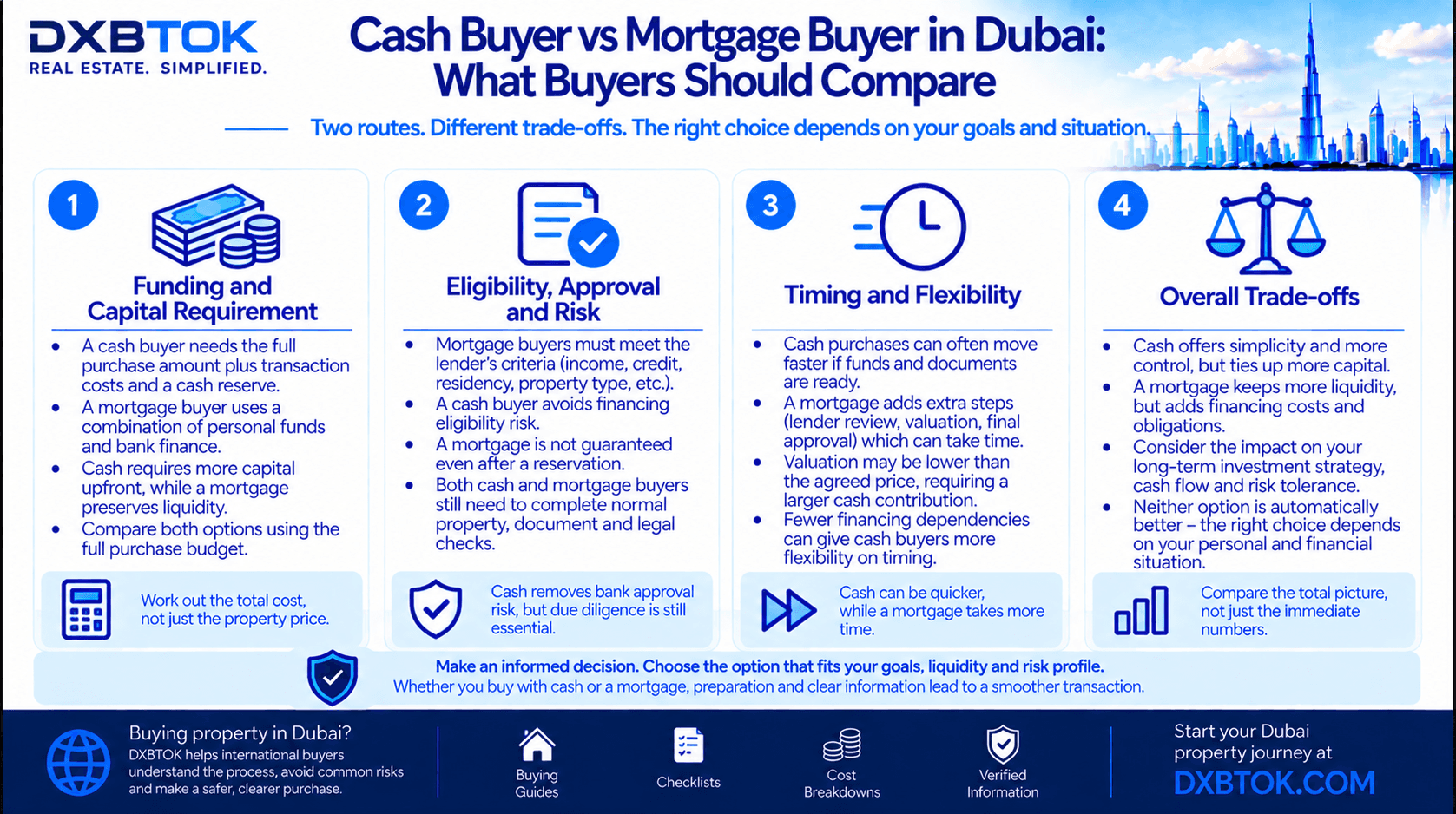
Cash can reduce financing steps and give the buyer more control over timing, but it requires more capital upfront. A mortgage can preserve liquidity, but it adds eligibility checks, valuation, lender approval, documentation and financing cost.
Neither route is automatically better. The right choice depends on the buyer’s cash position, financing eligibility, timing, risk tolerance and the type of property being purchased.
1. Start With the Funding Question
The first comparison is simple: how much of the purchase price are you prepared to fund directly?
A cash buyer generally needs to have the full purchase amount available, together with transaction costs and a sensible cash reserve.
A mortgage buyer uses a combination of personal funds and bank finance, which can reduce the amount of capital tied up in the property at completion.
Before comparing routes, work out the full purchase budget using our full cost of buying Dubai property guide.
2. Cash Requires More Capital Upfront
The main advantage of cash is simplicity.
The main disadvantage is the amount of capital required at once.
A cash buyer should consider whether paying the full property price would leave enough liquidity for:
transaction fees
furnishing
maintenance
service charges
other investments or business needs
unexpected personal expenses
Using all available cash for the purchase can create a different risk from using finance.
3. A Mortgage Preserves More Liquidity
Mortgage finance can allow a buyer to retain more cash after the purchase.
That may be useful for a buyer who wants to:
keep a larger emergency reserve
retain capital for another property or investment
keep business working capital available
avoid concentrating too much cash in one asset
The trade-off is that retained liquidity comes with financing obligations and additional transaction steps.
4. Mortgage Buyers Must Qualify
A mortgage is not simply a payment method chosen at the end of the transaction.
The buyer, property and financing request all need to meet the lender’s criteria.
Depending on the buyer profile, a bank may review:
income
employment or business history
existing debt
credit profile
residency status
property eligibility
age and loan term
For international buyers, see our mortgage options for non-resident Dubai buyers.
5. Cash Buyers Avoid Financing Eligibility Risk
A genuine cash buyer does not need the bank to approve the purchase price or the buyer’s borrowing profile.
That removes one major source of uncertainty.
But cash buyers still need to complete the normal property, document, payment and registration checks.
Cash should never be treated as a reason to skip due diligence.
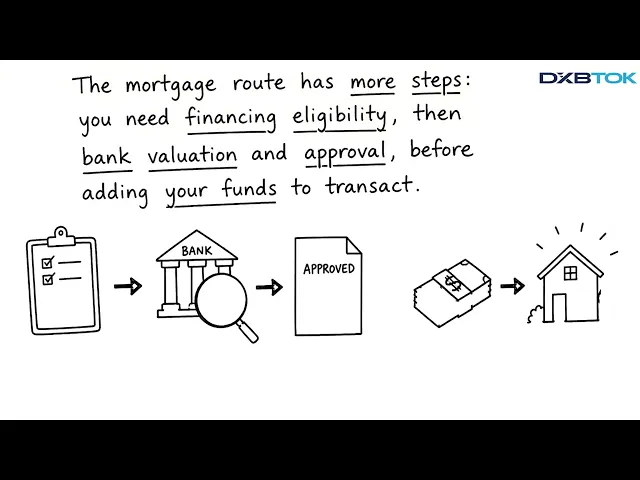
6. Mortgage Approval Adds Time
A mortgage purchase normally includes financing steps that a cash purchase does not.
These can include:
initial lender review
document submission
pre-approval
property valuation
final approval
bank documentation
completion coordination
That extra process can affect how quickly a buyer can move from offer to completion.
7. Cash Can Be More Flexible on Timing
If the funds are ready and the transaction documents are in order, a cash buyer may be able to move more quickly.
This can matter where:
the seller wants a short completion period
the property has competing buyers
the buyer wants to reduce financing uncertainty
Faster does not always mean better, but fewer financing dependencies can make the transaction easier to schedule.
8. Mortgage Buyers Depend on the Valuation
For a mortgage purchase, the lender will normally require a valuation of the property.
If the bank’s valuation is lower than the agreed purchase price, the buyer may need to contribute more cash than originally expected or reconsider the transaction.
This creates an important difference:
The purchase price is negotiated between buyer and seller, but the mortgage amount is also influenced by the bank’s assessment.
9. Reservation Risk Can Differ Between Cash and Mortgage Buyers
A buyer should not make commitments that assume mortgage approval is guaranteed.
Before paying a reservation amount or signing a binding document, a mortgage buyer should understand:
whether financing approval is still pending
whether valuation is still pending
what happens if finance is declined
what deadlines apply
whether the deposit is refundable under the agreed terms
A cash buyer does not face lender approval risk, but still needs to understand reservation and cancellation terms.
10. Mortgage Costs Must Be Added to the Comparison
A mortgage buyer should compare more than the property price.
Financing can involve costs such as:
interest
bank arrangement charges
valuation charges
mortgage registration-related costs
insurance requirements where applicable
early settlement or restructuring costs depending on the facility
These should be evaluated against the benefit of keeping more cash available.
11. Cash Also Has an Opportunity Cost
Paying cash avoids interest, but it also ties up capital.
The buyer should ask what that money would otherwise be used for.
That might include:
another property purchase
business capital
investment reserves
personal liquidity
The comparison is therefore not simply “interest versus no interest.” It is also capital tied up versus capital retained.
12. International Buyers Should Consider Currency Exposure
For an overseas cash buyer, the purchase may require a large one-time currency conversion.
A mortgage buyer may need less capital upfront, but can still face currency exposure on the deposit, fees and future mortgage payments if income is earned in another currency.
For that separate issue, see our currency exchange guide for Dubai property buyers.
13. Documentation Is Heavier With a Mortgage
Mortgage buyers should expect more paperwork.
The lender may require financial and personal documents in addition to the normal property documents.
For non-residents, this can include extra coordination because income, banking and identity records may come from another country.
A cash purchase can be operationally simpler, but the buyer still needs proper identification, source-of-funds information where required and transaction documentation.
14. Property Type Can Affect the Decision
Not every property is equally straightforward to finance.
A buyer considering a mortgage should confirm that the exact property is acceptable to the lender before assuming finance will be available.
This can be especially important where the property is:
off-plan
newly completed
unusual in structure
subject to specific developer or project conditions
15. Do Not Confuse a Mortgage With a Developer Payment Plan
A mortgage and a developer payment plan solve different financing problems.
A bank mortgage is lender finance secured against the property.
A developer payment plan is a contractual payment schedule with the developer.
If you are comparing those two routes, use our Dubai mortgage vs developer payment plan guide.
16. Completion Risk Is Different for Each Route
A cash buyer mainly needs the funds and transaction documents ready for completion.
A mortgage buyer must also make sure the lender is ready.
That means more parties need to align:
buyer
seller
broker or transaction coordinator
bank
valuer
registration parties
More moving parts can create more timing risk.
17. Cash Can Strengthen an Offer, but Price Still Matters
Some sellers may prefer a buyer who can complete without financing uncertainty.
That can make a cash offer operationally attractive.
But being a cash buyer does not automatically mean you should overpay.
Property quality, comparable value, condition, legal status and the seller’s position still matter.
18. Mortgage Buyers Should Stress-Test the Monthly Commitment
A buyer using finance should be comfortable with the repayment obligation, not only the initial approval.
Consider how the mortgage would fit alongside:
existing debt
household expenses
property management costs
maintenance
service charges
currency risk where income is not in AED
Service charges are only one ownership-cost component; for the exact building-review process, see our Dubai property service-charge review guide.
19. When Cash May Be More Practical
Cash may be more practical when the buyer:
already has sufficient available capital
wants a simpler transaction
wants to avoid financing approval risk
needs faster completion
does not want monthly debt obligations
is buying a property that may be difficult to finance
Those factors do not automatically make cash the better financial choice. They simply make the transaction route more practical in certain circumstances.
20. When a Mortgage May Be More Practical
A mortgage may be more practical when the buyer:
qualifies comfortably for finance
wants to retain liquidity
does not want to commit all available capital to one purchase
is comfortable with the financing cost
has enough time for bank approval and valuation
wants to preserve cash for other priorities
The mortgage should fit the buyer’s wider financial position, not only the property purchase.
21. Use a Cash-vs-Mortgage Decision Checklist
Capital: How much cash can I commit without weakening my liquidity?
Eligibility: Am I likely to qualify for the mortgage I need?
Timing: Does the transaction allow enough time for approval and valuation?
Valuation: What happens if the bank values the property below the agreed price?
Costs: What is the total financing cost compared with buying in cash?
Documentation: Am I prepared for the lender’s paperwork and verification?
Non-resident position: Does my overseas income or residency affect financing practicality?
Liquidity: How much cash do I want to retain after completion?
Completion risk: Which route gives me the most reliable path to completion?
Ownership budget: Can I comfortably carry the property after purchase?
Final Takeaway
The cash-versus-mortgage decision in Dubai is mainly a trade-off between simplicity, capital commitment, financing cost, liquidity and transaction certainty.
Cash can make the purchase process simpler and remove lender approval risk, but it ties up more capital. A mortgage can preserve liquidity, but it introduces approval, valuation, timing and repayment obligations.
The better route is the one that fits your available capital, financing eligibility, timing and wider financial position without creating unnecessary transaction risk.
Buyers should confirm mortgage terms and suitability with an appropriately licensed lender or financial adviser.
Need help comparing Dubai property purchase routes? DXBTOK can help international buyers organise the key property, transaction and cost information before moving forward.
Start your Dubai property review at DXBTOK.com.
Related DXBTOK guides
Mortgage Options for Non-Resident Dubai Buyers →
Full Cost of Buying Dubai Property: What International Buyers Should Budget →
Currency Exchange When Buying Dubai Property from Europe →
Dubai Property Mortgage vs Developer Payment Plan →
Dubai Property Service Charges: How Buyers Should Review Them →