Dubai Mortgage Options for UAE Residents: What Property Buyers Should Compare


UAE residents buying property in Dubai can access different mortgage products, but living in the UAE does not automatically qualify a buyer for a particular loan amount, rate or repayment term. Banks and Islamic finance providers assess income, employment or business stability, existing debt, available equity and the property being financed. Two lenders may evaluate the same buyer differently. A competitive introductory rate, a high advertised financing percentage or a convenient salary-transfer arrangement does not necessarily mean the mortgage offers the lowest total cost or the best flexibility over time. Before committing to a Dubai property, resident buyers should compare lender eligibility, financing structures, initial cash requirements, repayment exposure and final approval conditions. This guide focuses on choosing between mortgage options—not simply obtaining preliminary approval or chasing the lowest advertised interest rate.
Dubai Mortgage Options for UAE Residents: What Property Buyers Should Compare
UAE residents buying property in Dubai can access different mortgage products, but living in the UAE does not automatically qualify a buyer for a particular loan amount, rate or repayment term. Banks and Islamic finance providers assess income, employment or business stability, existing debt, available equity and the property being financed.
Two lenders may evaluate the same buyer differently. A competitive introductory rate, a high advertised financing percentage or a convenient salary-transfer arrangement does not necessarily mean the mortgage offers the lowest total cost or the best flexibility over time.
Before committing to a Dubai property, resident buyers should compare lender eligibility, financing structures, initial cash requirements, repayment exposure and final approval conditions. This guide focuses on choosing between mortgage options—not simply obtaining preliminary approval or chasing the lowest advertised interest rate.
1. What Mortgage Options Are Available to UAE Residents?
UAE residents may have access to several forms of property finance, depending on their nationality, financial circumstances and intended purchase.
The main categories include:
Conventional home mortgages: bank loans secured against eligible residential property, with interest charged under the agreed terms.
Islamic home finance: Shariah-compliant financing arrangements, with contractual structures and profit-payment obligations differing from conventional lending.
Fixed-introductory-rate mortgages: products with an initially fixed interest rate, followed by another contractual rate structure.
Variable-rate mortgages: financing where the applicable rate can change according to the agreed reference rate and lender margin.
Mortgage refinancing or buyout: replacing an existing mortgage with another financing arrangement, subject to eligibility and costs.
Selected off-plan financing: lending for eligible properties under construction, subject to more specialised project and disbursement conditions.
These are not equally available to every resident or every property. A suitable comparison begins with the products the buyer and intended property can actually qualify for.
2. Does UAE Residency Automatically Qualify You for a Mortgage?
No. A UAE residence visa or Emirates ID can satisfy part of a lender's applicant-identification requirements, but it does not establish credit approval.
Lenders consider whether the applicant has acceptable income, sustainable employment or business activity, sufficient personal funds and a financial record that supports the requested borrowing.
Residency status also does not remove distinctions between UAE nationals and expatriates under the applicable mortgage rules.
For example, the regulatory maximum loan-to-value ratios for certain qualifying first-home purchases differ between UAE nationals and expatriates. Individual lenders may apply more restrictive financing limits.
Resident buyers should therefore avoid assuming that two applicants earning the same salary will receive the same mortgage decision.
3. How Do Mortgages Differ for Salaried and Self-Employed Residents?
Banks commonly distinguish between applicants receiving documented employment income and those earning income through a business or self-employment.
For a salaried employee, the assessment may focus on employment continuity, recognised monthly income, salary records, bank statements and existing financial obligations.
For a business owner or self-employed resident, the lender may place greater emphasis on trading history, documented business performance, company bank statements, ownership records and the sustainability of personal income.
Variable earnings, dividends or irregular transfers may not be treated in the same way as a consistent salary. A profitable company does not automatically establish the owner's personal mortgage affordability.
Some lenders have specific minimum trading-history or documentation requirements for self-employed borrowers. Others may assess the same business profile differently.
The relevant comparison is therefore not simply which bank advertises the lowest rate, but which lender can assess the buyer's actual income structure on acceptable terms.
4. How Much Can a UAE Resident Borrow Against a Dubai Property?
The Central Bank of the UAE sets maximum loan-to-value ratios for residential mortgages. These limits help determine the maximum proportion of an eligible property's value that may be financed.
Under the applicable regulatory categories, the maximum ratios include:
Expatriate first-home owner-occupier, property valued at AED 5 million or less: up to 80%.
Expatriate first-home owner-occupier, property valued above AED 5 million: up to 70%.
Expatriate second or subsequent home, or investment property: up to 60%.
UAE national first-home owner-occupier, property valued at AED 5 million or less: up to 85%.
UAE national first-home owner-occupier, property valued above AED 5 million: up to 75%.
UAE national second or subsequent home, or investment property: up to 65%.
Eligible off-plan mortgage financing: a maximum of 50% under the relevant category.
These represent regulatory maximums rather than guaranteed financing amounts. The lender's valuation, underwriting decision, the property's classification and the buyer's circumstances can result in a lower approved amount.
Buyers should confirm which regulatory category applies to their actual purchase instead of assuming that the highest published percentage is available to them.
5. Compare the Down Payment With the Total Cash Required
A mortgage can reduce the portion of the property price that the buyer needs to pay from their own funds, but it does not eliminate the financial commitment.
Consider an expatriate buyer purchasing an eligible first owner-occupied Dubai home for AED 1 million. At an approved 80% financing ratio, the mortgage would cover AED 800,000 and the buyer would contribute AED 200,000 toward the price.
That is an illustration, not a financing offer. It also excludes purchase-related fees, mortgage charges and other cash requirements.
The Central Bank's mortgage regulations expect the down payment to come from the borrower's own resources rather than being funded through separate personal loans or credit cards.
Importantly, retaining enough cash after completion may matter just as much as satisfying the minimum contribution.
Our cash buyer versus mortgage buyer comparison explains the wider trade-offs between personal capital commitment, financing and retained liquidity.
6. How Does Existing Debt Affect Mortgage Eligibility?
Mortgage affordability is not based on income alone. Lenders assess the applicant's existing repayment obligations alongside the proposed mortgage.
Personal loans, car finance, credit cards and other liabilities may reduce the amount a bank is prepared to lend.
UAE mortgage lending rules impose debt-burden limits and require appropriate affordability assessments. The Central Bank also expects lenders to consider financial commitments and stress-test borrowing against less favourable interest-rate conditions.
For expatriate borrowers, the general debt-burden limit is 50% of qualifying gross monthly income. The applicable framework for UAE nationals differs. Actual lender calculations and the treatment of income and liabilities may be more restrictive.
A buyer should not interpret the regulatory maximum as a recommended repayment target. A mortgage that technically satisfies lender criteria can still leave insufficient flexibility for ordinary living costs, family obligations or unexpected expenses.
7. Conventional Mortgage or Islamic Home Finance?
UAE residents may be able to choose between conventional bank mortgages and Islamic home finance offered by suitably authorised institutions.
A conventional mortgage typically involves interest charged on a loan secured against the property.
Islamic home finance uses structures designed to comply with Shariah principles. Depending on the product, the contractual arrangements may involve sale, lease or partnership concepts, with financing returns expressed as profit or rental payments rather than conventional interest.
The terminology and contractual mechanics can differ, but both options create financial commitments that the buyer must understand.
For a meaningful comparison, consider the total amount payable, rate or profit-reset provisions, early-settlement terms, fees, property-security arrangements and consequences of late or missed payments.
Neither option is automatically cheaper or more flexible. The correct comparison is between the actual written offers rather than broad labels.
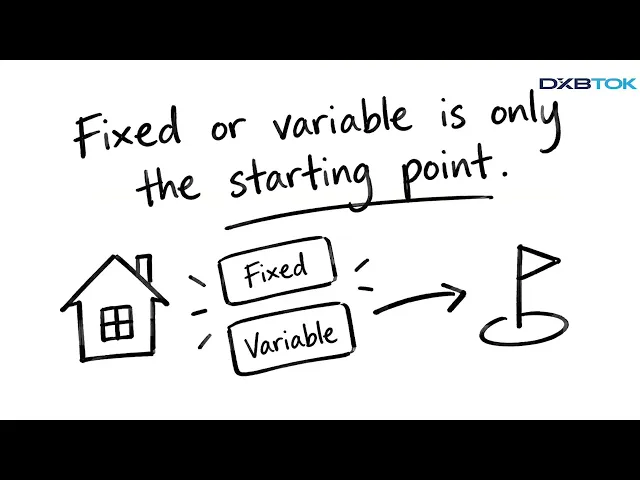
8. Fixed-Rate, Variable-Rate or Hybrid Mortgage?
The way a mortgage rate changes over time can materially affect future repayments.
Some UAE mortgage products offer an introductory fixed-interest period, after which a variable rate applies. Others use a variable-rate structure from the beginning.
A variable mortgage may be linked to an agreed benchmark such as the Emirates Interbank Offered Rate (EIBOR), plus a lender margin. Its payment obligations can change when the relevant reference rate is reviewed.
Buyers comparing these options should establish:
How long any fixed introductory period lasts.
Which rate structure applies afterwards.
What benchmark and lender margin determine future pricing.
How frequently the applicable rate can change.
What the repayment would look like if rates increased.
An attractive introductory payment should not be confused with the cost of financing over the full intended holding period.
The aim is to understand repayment exposure, not to predict future interest rates or assume that an introductory offer will remain available indefinitely.
9. Why the Advertised Mortgage Rate Is Not the Whole Cost
Mortgage marketing often highlights a headline interest or profit rate. That figure is important, but it does not necessarily capture all charges or the lifetime cost of the product.
The Central Bank's consumer-protection standards require disclosure of the applicable Annual Percentage Rate (APR) and relevant product costs, allowing borrowers to assess offers on a more consistent basis.
Buyers should distinguish the headline rate from the disclosed APR, applicable processing fees, valuation costs, required insurance and contractual charges.
A lender offering a slightly higher initial rate could still present more suitable total terms if another offer includes materially different charges or repayment conditions.
Conversely, a lower introductory rate might become less attractive after its fixed period ends.
Rates can change and vary according to borrower eligibility. Comparing dated, personalised lender offers is more reliable than relying on an undated list of supposedly current mortgage rates.
10. Does Salary Transfer Change the Mortgage Offer?
Some UAE lenders provide different mortgage packages depending on whether the applicant transfers salary to the institution.
These arrangements may affect pricing, account requirements, associated services or eligibility for particular offers.
However, a salary-transfer requirement can create practical considerations if the buyer later changes employment, receives income from multiple sources or wants to maintain their primary banking relationship elsewhere.
Buyers should establish whether salary transfer is mandatory for the quoted offer, whether the terms differ without it and what happens if the salary-transfer conditions are no longer met.
The initial benefit should be assessed alongside the complete financing obligations rather than treated as a stand-alone reason to select a lender.

11. Why Do Different Banks Offer Different Mortgage Amounts?
Mortgage lenders operate within common regulatory limits but have their own credit policies, acceptable borrower profiles and property criteria.
Two banks may calculate qualifying income differently, apply different assessments to variable business earnings or reach different conclusions about the same applicant's existing liabilities.
They may also offer different repayment periods, financing margins, fixed-rate structures or conditions for particular buildings and projects.
This means a borrower who receives a lower financing indication from one institution should not automatically assume every lender will reach the same decision.
Equally, a larger potential loan amount is not necessarily a better offer. Borrowers should weigh the lender's conditions and the amount they can comfortably repay.
12. What Is the Role of Mortgage Pre-Approval?
Before choosing a property, buyers may seek a preliminary lender assessment of their borrowing eligibility.
Pre-approval can help establish an indicative budget and identify documentation or affordability issues before the buyer enters a transaction.
But preliminary approval does not guarantee that a particular Dubai property will qualify, that its valuation will support the proposed loan or that the bank will provide the indicated amount at completion.
Final financing depends on the lender's remaining checks, property assessment and applicable conditions.
Buyers should therefore avoid making a non-refundable property commitment on the assumption that preliminary approval is equivalent to an unconditional mortgage offer.
The important distinction is between being provisionally acceptable as a borrower and obtaining completed approval for the actual property purchase.
13. Which Documents Do Resident Mortgage Lenders Usually Require?
Documentation varies by lender and borrower category, but resident mortgage applications typically require evidence supporting identity, income, financial obligations and the proposed transaction.
Common requirements may include:
Passport, Emirates ID and relevant UAE residency information.
Salary certificates, employment records or equivalent evidence of earnings.
Personal bank statements.
Existing credit or financing information.
For self-employed applicants, company ownership and licensing records, business bank statements or financial statements.
Property and transaction documents when an identified purchase is being assessed.
Source-of-funds evidence for the buyer's contribution.
The precise requirements can depend on the bank, income structure, loan amount and property involved.
Applicants with unusual or irregular income should not assume that the same documents accepted by one lender will satisfy another institution.
14. Ready-Property Mortgages Versus Off-Plan Financing
Financing a completed apartment or villa differs from financing a unit that remains under construction.
For a ready property, the bank may assess the existing building, ownership documentation, property valuation and transaction arrangements before finalising the loan.
For off-plan property, lenders may have additional requirements concerning the developer, project, stage of construction, contract and timing of disbursement.
Some lenders offer financing for selected eligible off-plan projects. That does not mean every development or payment schedule can be funded by a bank.
The developer may require contractual instalments before mortgage funds can be drawn or before the lender's conditions are satisfied.
A buyer considering a staged developer payment arrangement should distinguish it from a regulated mortgage product. Our mortgage versus developer payment plan guide
15. What Happens if the Bank Valuation Is Lower Than the Purchase Price?
A seller's agreed price and a lender's property valuation are not necessarily identical.
If a bank values the property below the agreed purchase price, the available mortgage could be lower than the buyer expected.
For example, a buyer may agree to purchase an apartment at a particular price, while the lender concludes that the acceptable valuation supports a smaller financing amount.
The buyer may then need additional personal funds, subject to the lender's financing decision and the transaction terms.
This risk matters even when the buyer has already received preliminary borrowing approval based on income.
It is also a reason to evaluate the actual property rather than relying only on an asking price, a broker's estimate or an assumed financing percentage.
16. Compare Mortgage Fees and Ownership Costs Together
The purchase budget should account for both the property transaction and the financing arrangement.
Potential costs include:
Dubai property-registration and transaction-service charges.
Mortgage registration and lender-processing fees.
Property valuation expenses.
Insurance or takaful obligations where applicable.
Brokerage and professional charges where relevant.
Banking and currency-conversion expenses.
Initial furnishing, maintenance and ownership reserves.
These charges may differ according to the institution, property and transaction structure.
A loan that appears affordable based on monthly repayment can still create a larger immediate cash requirement than expected.
Our full cost of buying Dubai property guide
17. How Do Early Repayment and Mortgage Buyout Options Compare?
A buyer may plan to retain the mortgage for many years, but circumstances can change.
The property might be sold, the borrower may receive additional funds or another lender may offer a refinancing arrangement.
Different mortgage contracts can contain specific conditions for partial early repayment, full settlement and transferring the outstanding loan to another lender.
The financial effect depends on applicable permitted fees, remaining loan balance, new financing expenses and the terms of the replacement product.
Buyers should not assume that an attractive new introductory rate makes refinancing financially worthwhile after all costs are included.
Equally, someone expecting to sell or repay early should pay particular attention to settlement flexibility when choosing the original mortgage.
The Central Bank's consumer-protection rules require relevant early-settlement terms and permissible charges to be disclosed.
18. Choosing a Mortgage for a Home Versus an Investment Property
A resident buying a home to occupy personally may have different financing objectives from a buyer purchasing a rental investment.
An owner-occupier may place greater weight on long-term repayment stability, the ability to retain the property and the impact of monthly payments on household finances.
An investor may be more concerned about holding costs, periods without rental income, net cash flow and the ability to manage loan obligations without relying on optimistic rental projections.
Importantly, the regulatory financing category may differ between a qualifying first owner-occupied home and a subsequent or investment property.
A borrower should not assume that a financing ratio advertised for a first home can be applied to an investment purchase.
A responsible comparison also considers whether the mortgage remains manageable if actual rental income is lower than anticipated.
19. What Risks Should Residents Consider Before Accepting a Mortgage?
Mortgage borrowing creates ongoing obligations that continue regardless of short-term movements in the property market.
Important considerations include:
Income risk: employment or business earnings may change during the loan term.
Rate risk: future repayments may increase under variable-rate or reset arrangements.
Property risk: the property may fall in market value or require unexpected maintenance.
Liquidity risk: too much personal capital may be tied up in the deposit and initial transaction.
Exit risk: selling or refinancing may involve additional costs or take longer than expected.
Completion risk: a planned purchase may not qualify for the amount of financing initially anticipated.
A suitable mortgage is not simply one that a bank is prepared to approve. It is a financing commitment that remains realistic under the buyer's circumstances and reasonable adverse scenarios.
20. How Should Buyers Compare Two UAE Mortgage Offers?
Consider two mortgage offers for the same qualifying property. One may advertise a lower initial rate but offer less certainty after the introductory period. Another may have different upfront fees, longer rate stability or more flexible settlement provisions.
Comparing only the first monthly instalment would give an incomplete picture.
A stronger side-by-side assessment considers:
The amount of financing the bank will actually approve.
The buyer's total required cash contribution.
The introductory and subsequent pricing arrangements.
The disclosed APR and financing-related charges.
The impact of a possible future rate increase.
The repayment period and total expected financial commitment.
Salary-transfer or other ongoing account conditions.
Early repayment and refinancing flexibility.
Property eligibility and remaining completion requirements.
The preferable offer depends on the borrower's finances, intended ownership period and need for payment stability or flexibility.
A lower advertised rate does not establish that one mortgage is automatically better than another.
21. When Should a Buyer Reconsider the Financing Choice?
There are circumstances where the proposed mortgage may not be suitable, even if a lender is willing to consider it.
Warning signs include:
The deposit and transaction expenses would exhaust available savings.
The buyer would struggle to afford repayments after a modest rise in rates.
The mortgage depends heavily on irregular or uncertain future income.
The bank's final valuation or property acceptance is being assumed.
Important loan fees or rate-reset conditions remain unclear.
The buyer is comparing mortgages without understanding the differences in their full contractual terms.
A property reservation requires a commitment before financing conditions are sufficiently understood.
These concerns do not necessarily mean a Dubai property purchase must be abandoned. They indicate that the property budget, financing arrangement or transaction timing may need reconsideration.
Our Dubai property buyer due-diligence guide
22. Make the Mortgage Decision Around the Property and Your Finances
Dubai mortgage options for UAE residents can provide different ways to finance an eligible home or investment property. However, the appropriate product depends on more than residency status, headline interest rates or the maximum amount a bank advertises.
Buyers should compare borrowing eligibility, their actual personal contribution, conventional and Islamic financing structures, rate exposure, transaction costs and the conditions that must be satisfied before completion.
A mortgage that appears attractive during the initial offer stage may not remain the best choice once fees, future repayment changes and ownership risks are considered.
DXBTOK helps international and UAE-based buyers compare selected Dubai property opportunities with clearer commercial information and structured buyer support, while appropriately licensed banks and finance professionals handle mortgage applications and regulated lending decisions.
The objective is not to borrow the largest available amount. It is to select a suitable property with financing that the buyer understands and can responsibly maintain.
Related DXBTOK Guides
How to Compare Total Cost Between Dubai Properties →
Dubai Property Documents Checklist for International Buyers →
Dubai Property Currency Risk for International Buyers →
Dubai Property Payment Safety Checklist →
Dubai Off-Plan vs Ready Property: Which Is Better for Buyers? →


