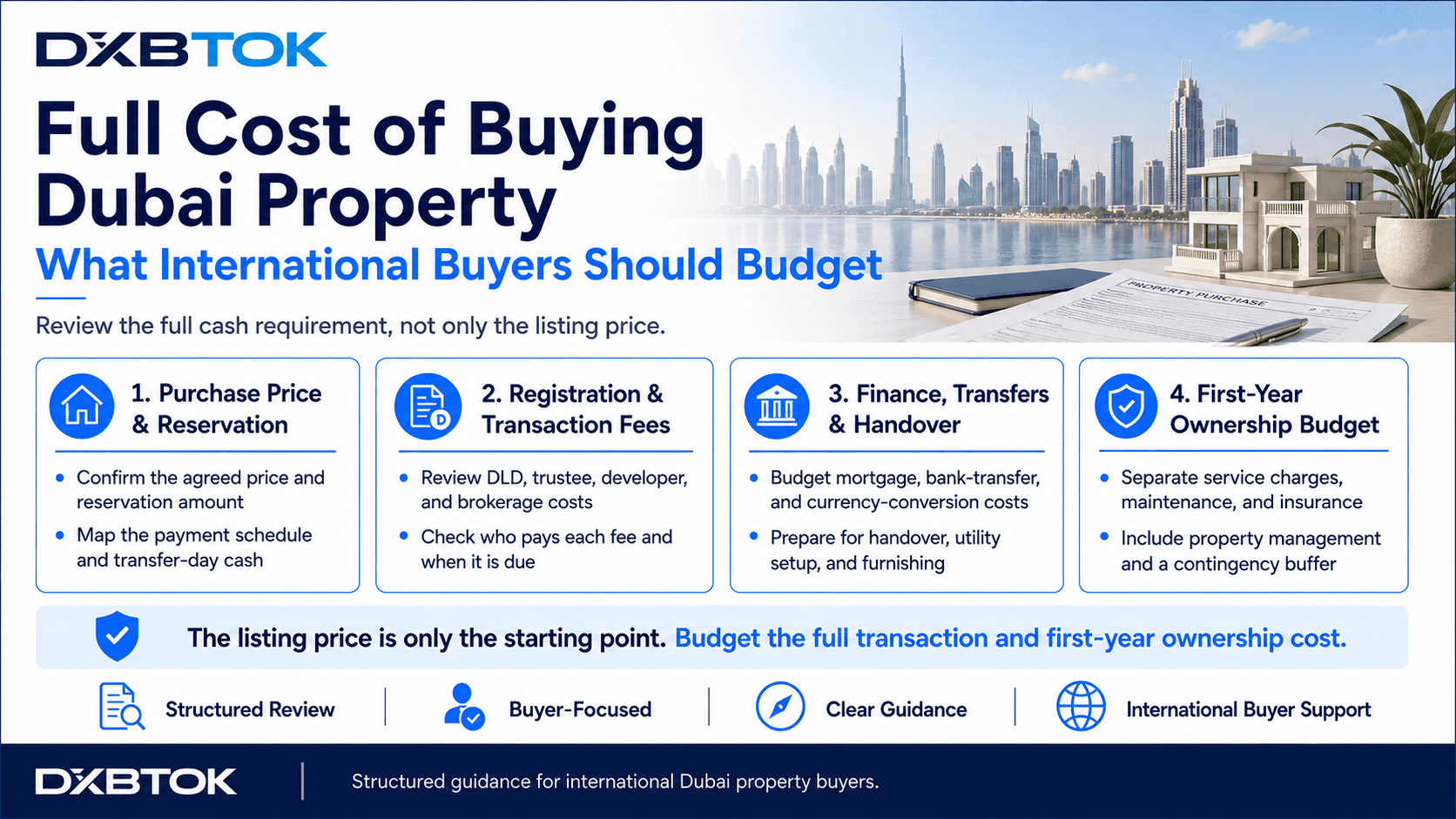
Full Cost of Buying Dubai Property: What International Buyers Should Budget


Learn how to budget for a Dubai property purchase by separating the purchase price, DLD registration and trustee fees, mortgage costs, developer or transaction charges, international transfer costs, handover expenses and first-year ownership costs.
Full Cost of Buying Dubai Property: What International Buyers Should Budget
The advertised property price is not the same as the full amount an international buyer may need to complete a Dubai property purchase.
A proper buyer budget should separate:
the purchase price
reservation or booking money
property-registration costs
trustee or transaction-service fees
mortgage costs where applicable
developer or administrative charges
brokerage or professional costs where applicable
currency-conversion and bank-transfer costs
handover payments
furnishing and setup
service charges
maintenance and remote-management costs after purchase
For an international buyer, the useful framework is:
purchase price → transaction costs → financing costs → handover/setup → ownership buffer
The objective is not to estimate every future expense perfectly.
It is to avoid committing to a property before understanding the cash required to complete and operate the purchase.
Start with the total cash requirement, not the listing price
Assume a property is advertised at AED 2 million.
That does not necessarily mean AED 2 million is the only amount the buyer needs available.
Depending on the transaction, there may also be:
registration fees
trustee fees
mortgage-registration charges
bank costs
brokerage costs
developer administration
transfer-related charges
furnishing
utilities
first service-charge payments
property-management setup
The correct buyer question is:
“How much cash do I need from reservation until the property is fully operational?”
That creates a much stronger budget.
1. Separate fixed costs from variable costs
A useful budget starts by classifying every cost.
Fixed or formula-based costs
These can include official registration or mortgage fees whose calculation is published by the relevant authority.
Transaction-specific costs
These may depend on:
property price
mortgage amount
developer
broker agreement
ready versus off-plan purchase
building
bank
buyer location
Optional or ownership-choice costs
These can include:
furnishing
upgrades
property management
insurance
additional inspections
legal review
renovation
Do not combine all three groups into one rough percentage.
2. Understand the DLD sale-registration fee
Dubai Land Department currently lists the registration fee for a property sale as:
seller: 2% of the sale value
buyer: 2% of the sale value
That produces a total registration charge equal to 4% of the sale value. DLD also lists additional title-deed, map and service-partner fees.
This point needs careful interpretation.
The official DLD service page shows a 2% seller / 2% buyer allocation, but the parties may agree differently in the transaction documentation.
Therefore, an international buyer should not simply assume:
“I always pay 4%.”
Instead ask:
What does the SPA or MOU say?
Which party is paying which portion?
What amount must I personally fund on transfer day?
That is the amount that belongs in your budget.
3. Budget the registration-service fees separately
DLD currently lists additional fees for property-sale registration, including:
AED 250 for title-deed issuance
AED 250 for a villa or apartment map
AED 10 knowledge fee
AED 10 innovation fee
For transactions through Real Estate Registration Trustee Centers, DLD currently lists service-partner fees of:
AED 4,000 + VAT where the sale value is AED 500,000 or more
AED 2,000 + VAT where the sale value is below AED 500,000
These are separate from the percentage-based registration fee.
A buyer budget should therefore have individual lines rather than one vague entry labelled “DLD.”
4. Do not use a percentage shortcut without checking the transaction
Buyers sometimes hear statements such as:
“Add 6% or 7% to the property price.”
That may be useful as a very rough conversation starter.
It is not a transaction budget.
The real amount depends on:
who pays the registration fee
mortgage or cash purchase
brokerage arrangement
developer charges
bank fees
transfer method
ready or off-plan property
furnishing and setup requirements
Build the budget line by line.
5. Reservation money is normally part of the purchase price — but verify it
A reservation or booking payment should not automatically be treated as an additional purchase cost.
In many transactions it forms part of the agreed property price.
But the buyer still needs to confirm:
exact reservation amount
whether it is credited toward the purchase price
refund or cancellation conditions
payment recipient
payment deadline
what document confirms the payment
Use the dedicated reservation process before sending money.
This matters because cash timing and total cost are two different things.
A payment may not increase the total purchase price while still requiring substantial cash immediately.
6. Off-plan buyers should build the budget around the payment schedule
An off-plan buyer may not pay the entire purchase price at once.
Review the exact off-plan payment plan before calculating how much liquidity you need at each stage.
Instead there may be:
reservation amount
initial instalment
construction-linked payments
timed instalments
handover payment
post-handover payments where applicable
The off-plan payment plan determines when the buyer needs liquidity.
Two properties with the same price can create very different cash-flow requirements.
For an international buyer, budget both:
total amount
and
payment dates.
7. Ready-property buyers need a transfer-day budget
A ready-property transaction can concentrate more costs around completion.
The buyer may need funds for:
remaining purchase price
registration fees
trustee fees
mortgage-related charges where applicable
brokerage or professional fees
developer-related transfer charges where applicable
immediate property setup
Build a dedicated transfer-day cash figure rather than relying on the advertised price.
8. Mortgage buyers need a separate cost layer
Mortgage finance adds another set of possible costs.
Dubai Land Department currently lists the mortgage-registration fee at 0.25% of the mortgage value. DLD also lists title-deed and service-partner charges for mortgage registration.
DLD currently lists service-partner fees of AED 4,000 plus VAT for ordinary mortgage registration and AED 5,000 plus VAT for provisional/Oqood mortgage registration.
The buyer may also face bank-specific costs such as:
valuation
arrangement or processing fees
insurance requirements
account-related charges
early-settlement terms
These vary by lender.
Do not estimate them without the actual bank offer.
9. Mortgage value and property price are not the same calculation base
The DLD mortgage-registration fee is based on the mortgage value, not necessarily the full purchase price.
For example, if part of the property is paid in cash and part is financed, the mortgage-registration calculation relates to the financed amount.
That distinction should be reflected in the budget.
10. Bank pre-approval does not tell you your full purchase cost
A bank may tell you how much it is willing to lend.
That does not answer:
how much deposit you need
how much of the registration cost you must pay
whether fees can be financed
valuation costs
transfer-day cash
furnishing requirements
post-purchase ownership costs
Finance availability and total buyer budget are separate questions.
11. Brokerage fees should be confirmed before the transaction
Do not assume the brokerage arrangement.
Ask in writing:
Is there a buyer-side brokerage fee?
What is the amount?
Is VAT applicable?
When is it payable?
Which company receives it?
Different transaction structures may create different answers.
Only include the fee once it is confirmed.
12. Developer administration fees can vary
A developer may charge administrative or processing fees connected with certain transaction steps.
These can relate to matters such as:
NOC issuance
resale processing
assignment
administration
documentation
The exact amount can depend on the developer and transaction type.
Do not copy a figure from another project.
Ask for the current fee schedule for the exact property.
13. Off-plan registration needs exact project confirmation
Off-plan transactions use provisional registration processes rather than the same completion route as a ready resale property.
Dubai Land Department's current provisional-sale registration service materials include Oqood-related registration procedures and published service fees for certain transactions.
But the buyer should confirm:
which registration cost applies
who is contractually responsible
whether the developer collects the amount
when it is payable
Do not assume every developer handles it identically.
14. Legal or conveyancing support is transaction-specific
Some buyers choose additional independent professional review.
Possible services may include:
SPA review
MOU review
title or ownership checks
POA preparation
transaction coordination
These costs are not universal.
If you choose professional legal or conveyancing support, request the fee before engagement.
Buyers should obtain independent legal or financial advice where appropriate.
15. International bank transfers can create hidden costs
A buyer sending money from outside the UAE should budget for more than the AED amount shown on the invoice.
Possible costs include:
sending-bank fee
intermediary-bank fee
receiving-bank fee
currency conversion
exchange-rate spread
A small percentage difference on a large property payment can become meaningful.
Ask:
How many units of my home currency must leave my account for the full AED amount to arrive?
That is the more useful number.
16. Do not send an amount that arrives short
If the seller or developer must receive a precise AED amount, bank charges can sometimes create a shortfall.
Before sending, confirm:
beneficiary
currency
required net amount
bank charges
payment reference
deadline
Use the dedicated payment safety checklist before transferring material funds.
17. Currency movement is part of the cash budget
An international buyer may earn or hold money in:
EUR
GBP
USD
CHF
CAD
AUD
another currency
The property obligation is usually denominated in AED.
That means exchange-rate movement can alter the amount of home currency required between reservation and later instalments.
Do not treat future conversion rates as guaranteed.
Instead maintain a reasonable liquidity buffer.
18. Handover can create another cash event
For an off-plan property, handover can involve more than collecting keys.
Depending on the project, the buyer may need to prepare for:
final scheduled payment
registration-related costs
service-charge requirements
utility setup
snagging or inspection
furnishing
property-management setup
Use the dedicated handover process so these amounts are not discovered at the end.
19. Service charges are recurring ownership costs
Service charges should not be confused with one-time acquisition costs.
They relate to ongoing building or community operation.
The applicable amount can differ considerably by property.
Use the dedicated service charges guide to understand:
what they support
how they are calculated
why they vary
how they affect ownership
For budgeting, keep them in a separate recurring-cost section.
20. Maintenance is separate from service charges
Service charges do not mean the owner will never have private-unit maintenance costs.
Depending on the property, a buyer may still need to budget for:
appliances
air-conditioning issues
plumbing
interior repairs
pool or garden work for some properties
furniture replacement
periodic inspections
Use the dedicated maintenance costs guide for that part of the ownership budget.
21. Furnishing can materially change the first-year budget
A property that looks affordable at purchase can create a substantial setup bill if it is delivered unfurnished.
Possible costs include:
furniture
curtains
lighting
appliances
kitchen items
electronics
linen
outdoor furniture
installation
delivery
Do not leave furnishing as a vague future problem.
Create a realistic setup allowance before buying.
22. Inspect what is included in the purchase
Ask for an exact inclusion list.
For example:
kitchen appliances
wardrobes
lighting
curtains
furniture
outdoor items
smart-home equipment
The more that is included, the smaller the setup budget may be.
But confirm through documents rather than marketing photographs.
23. Utility setup should have its own line
A newly acquired property may require utility or service setup.
Possible items depend on the building and property type.
Ask the building, developer or manager:
what accounts need opening
what deposits apply
what cooling arrangement exists
what internet or telecom setup is needed
Do not assume the same structure applies to every property.
24. Property management is a real cost for many overseas owners
An international buyer may need someone locally to handle:
inspections
tenant coordination
access
cleaning
maintenance
emergencies
contractor appointments
A structured property management for overseas owners arrangement should therefore appear in the budget where relevant.
This is particularly important if the property will sit vacant for periods.
25. Insurance should be checked rather than assumed
Depending on the property and financing structure, different insurance requirements or preferences may apply.
Mortgage lenders may impose requirements.
Owners may also decide to arrange separate cover.
Confirm:
what the building covers
what the owner needs
what the bank requires
annual premium
Do not duplicate coverage unnecessarily.
26. Keep acquisition costs separate from annual ownership costs
A useful budget has two totals.
Total A — Cash required to acquire the property
This may include:
deposit
purchase payments
registration
trustee
mortgage
bank
brokerage
developer administration
professional support
Total B — First-year ownership budget
This may include:
service charges
maintenance
property management
insurance
utilities
furnishing
vacancy-related costs
This separation prevents the buyer from underestimating the first year.
27. Build a contingency line
Not every small cost can be predicted perfectly.
A buyer may encounter:
additional bank charges
revised service amounts
minor repairs
setup items
document-related expenses
Rather than assuming the exact budget will never change, maintain a sensible contingency.
The amount should reflect the property and the buyer's own financial position.
This is a budgeting control, not an investment recommendation.
28. Do not use your entire liquidity for the purchase
The amount you can technically transfer is not necessarily the amount you should commit.
The property may still require money after completion.
A buyer should preserve capacity for:
ownership costs
maintenance
travel
currency movement
unexpected expenses
For individual financial planning, use qualified financial advice where appropriate.
29. Ask for a written transaction-cost sheet
Before committing, ask the relevant licensed parties to provide the expected transaction costs in writing.
The sheet should identify:
cost
amount or calculation
recipient
due date
whether refundable
whether included in the purchase price
This is much more useful than being told:
“There are some fees later.”
30. Update the budget when the transaction changes
A budget created before mortgage approval may become outdated.
A budget created before final price negotiation may become outdated.
A budget created before the exact property is chosen may become outdated.
Update it when:
property changes
price changes
financing changes
developer changes
payment plan changes
transfer structure changes
Treat the budget as a working transaction document.
The International Buyer Budget Checklist
Property price
Agreed purchase price confirmed
Deposit/reservation amount confirmed
Remaining payment schedule mapped
Registration
DLD registration allocation confirmed
Title-deed/map fees checked
Trustee/service-partner fee checked
Finance
Mortgage amount confirmed
Mortgage-registration charge calculated
Bank valuation checked
Bank processing costs confirmed
Insurance requirements checked
Transaction
Brokerage arrangement confirmed
Developer administration confirmed
Legal/conveyancing costs confirmed where used
NOC or transfer-related costs checked where relevant
International payment
Exchange rate reviewed
Transfer cost checked
Recipient verified
Required net AED amount confirmed
Handover
Final payment confirmed
Inspection/snanging budget considered
Utility setup considered
Service-charge start point checked
Ownership
Furnishing budget created
Service charges reviewed
Maintenance allowance considered
Property management considered
Insurance reviewed
Contingency retained
How DXBTOK Approaches Buyer Cost Review
DXBTOK separates the buyer budget into stages rather than presenting one headline percentage.
The DXBTOK buyer-cost review moves through:
purchase price → payment schedule → official transaction fees → finance-specific costs → handover/setup → first-year ownership
That gives an international buyer a clearer picture of the actual cash commitment before proceeding.
Final Takeaway
The full cost of buying Dubai property is not one universal percentage.
Some costs are official and formula-based.
Others depend on:
transaction structure
financing
developer
broker arrangement
property type
building
buyer location
ownership plan
The key question is not:
“What percentage should I add to the property price?”
It is:
“What exact payments will I personally need to make, to whom, and at what stage from reservation through ownership?”
Build that budget before committing.
Need Help Reviewing the Full Buyer Budget?
DXBTOK helps international buyers compare suitable Dubai properties, understand the transaction stages and identify the cost items that should be confirmed before proceeding.
Contact DXBTOK and let us help you structure the property review and buying process more clearly.
Related DXBTOK guides
Dubai Property Service Charges Explained for Buyers →


