Off-Plan Mortgages in Dubai: Financing Eligibility, Timing and Buyer Risks


A small booking payment can make an unfinished Dubai home appear affordable, even when the largest financial obligation comes years later. This guide examines the gap between a developer's instalment schedule and bank funding, including how changing lending decisions could affect your ability to complete the purchase.
Off-Plan Mortgages in Dubai: Financing Eligibility, Timing and Buyer Risks
An off-plan mortgage in Dubai can help an eligible buyer finance a property before or around completion, but it does not work like an ordinary mortgage on an already completed home. The lender must consider not only the applicant's income and creditworthiness but also the developer, the project, its construction status and the stage at which funds can be released.
Some financing arrangements are available for selected projects during construction, while other buyers may need to fund developer instalments themselves and seek a mortgage nearer handover. Even an early financing indication does not guarantee that money will be available when a contractual payment becomes due.
Before reserving an off-plan property, buyers should compare the mortgage amount potentially available, how much cash they must contribute, the project's lender eligibility, the timing of disbursement and the consequences if financing is reduced, delayed or declined. This guide focuses on those risks so buyers can distinguish a financeable property purchase from a payment schedule that only appears affordable.
1. Can You Get a Mortgage for Off-Plan Property in Dubai?
Yes. Mortgage financing is available for certain off-plan property purchases in Dubai, subject to the applicable regulatory framework and the lender's requirements.
However, not every bank finances properties under construction, and not every off-plan project is acceptable to lenders.
Availability can depend on the buyer's circumstances, developer, project, construction stage, registration status and financing arrangements.
In some cases, financing may be considered during construction through an eligible bank-and-developer arrangement. In others, the purchaser may need to rely on personal funds for construction-stage instalments and seek mortgage finance closer to completion.
It is therefore misleading to assume that any buyer who qualifies for a mortgage on a completed Dubai apartment can automatically obtain the same financing for an unfinished one.
The relevant question is whether a lender will finance the exact property, for the exact buyer, at the stage when payment is required.
2. Why Is Off-Plan Mortgage Financing Different From a Ready-Property Mortgage?
A completed property generally provides a physical asset that the lender can assess using its present condition, ownership records and an appropriate valuation.
An off-plan property introduces additional uncertainty because the development is incomplete and the final asset has yet to be delivered.
The lender may need to evaluate:
The developer and its project history.
The project's official registration and construction status.
Whether the development is approved for financing.
The buyer's contractual rights to the unit.
The property's expected delivery and registration arrangements.
How and when the bank will release mortgage funds.
The borrower's ability to meet outstanding developer instalments.
The buyer also faces a practical difference: a mortgage may not be available when the developer requires an early construction payment.
Off-plan mortgage suitability must therefore be judged against both the borrower's finances and the development's actual funding timetable.
3. What Is the Maximum Mortgage Loan-to-Value Ratio for Off-Plan Property?
The Central Bank of the UAE's mortgage regulations set a maximum loan-to-value ratio of 50% for properties being purchased off-plan, regardless of the relevant borrower category, property value or purchase purpose.
This means that, under the off-plan mortgage category, a buyer cannot assume financing above half of the property's relevant value.
For example, if an eligible off-plan property is valued at AED 2 million for financing purposes, the regulatory ceiling would be AED 1 million. The buyer would need to fund at least the balance of the purchase commitment, together with applicable expenses.
However, the 50% figure is a maximum, not a guarantee of lending.
A lender may offer less, decline the property or make financing conditional on further construction progress.
If financing is originated once a property qualifies as completed, different mortgage categories and lender conditions may become relevant. Buyers should not assume which rules or percentage will apply without confirmation from the lender.
Off-plan loan limits, cash contributions and financing timing must all be assessed together.
4. Is a Developer Payment Plan the Same as an Off-Plan Mortgage?
No. They are fundamentally different financial arrangements.
A developer payment plan sets out when the buyer must pay portions of the agreed purchase price. It is normally part of the property's contractual purchase terms.
A mortgage is a financing facility from an authorised bank or other permitted lender, subject to credit assessment, security, repayment terms and regulatory requirements.
A developer may advertise a property with a 10% booking payment and additional instalments spread over construction. That does not mean a bank has approved finance for the remaining 90%.
Likewise, a buyer who has paid 50% of the property price has not automatically become eligible for a mortgage covering the remainder.
The important distinctions include who provides the funds, when the money is due, which conditions control payment and what happens if financing does not become available.
Our Dubai mortgage versus developer payment plan guide explains the main differences between bank financing and developer instalment structures.
For an off-plan purchase, the critical issue is whether bank financing and contractual developer instalments can realistically work together.
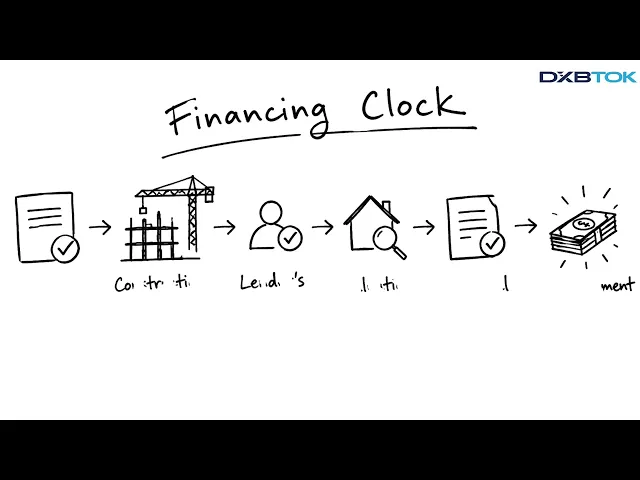
5. At What Construction Stage Can an Off-Plan Mortgage Become Available?
There is no universal construction percentage at which every Dubai off-plan property becomes eligible for mortgage financing.
Availability depends on the relevant lender's policies, the project, its approval arrangements and the buyer's circumstances.
Some financing arrangements have been introduced for selected developments during construction. Other mortgage products may not become available until a later project stage or closer to handover.
A developer may advertise financing from a particular construction milestone, but that statement should be understood as a condition of the relevant arrangement rather than a market-wide rule.
Buyers should distinguish the construction progress required for a bank to consider financing from the amount of the purchase price the buyer must already have paid.
A property might satisfy one condition but not the other.
Even when both conditions are met, the buyer still needs to qualify and the lender must complete its assessment.
A project reaching a particular percentage of construction does not automatically release mortgage funds to every purchaser.
6. Are Banks Offering Earlier Off-Plan Financing in Dubai?
Selected UAE banks and Dubai developers have introduced financing arrangements intended to provide buyers with earlier clarity or access to mortgage facilities during the off-plan purchase journey.
These developments show that off-plan financing is not limited to a single standard model.
Examples announced by banks include:
ADIB and DAMAC: in March 2025, Abu Dhabi Islamic Bank announced an arrangement involving financing for eligible UAE residents purchasing qualifying DAMAC properties after a specified construction milestone.
Emirates NBD and Sobha Realty: in April 2026, the bank announced an off-plan financing partnership intended to support eligible purchasers of selected Sobha developments.
Emirates NBD and Dubai Holding Real Estate: in April 2026, an initiative was announced covering potential integrated financing across developments associated with Meraas, Nakheel and Dubai Properties.
Emirates NBD and H&H Development: in October 2026, the bank announced tailored financing for eligible buyers of selected developments, including an arrangement associated with reaching a 50% payment milestone.
These are dated examples of specific arrangements, not a list of universally available mortgage products.
Eligibility, included projects, construction conditions, financing limits and availability must be confirmed directly with the bank and relevant licensed parties at the time of the proposed purchase.
Buyers should not interpret a bank–developer partnership announcement as approval for their own mortgage application.
7. Can You Obtain Mortgage Pre-Approval Before Selecting an Off-Plan Unit?
A lender may assess a buyer's financial circumstances before the final property has been chosen.
Such an assessment can provide useful information about potential borrowing capacity, income acceptance and outstanding credit requirements.
However, borrower pre-approval does not necessarily mean the lender has agreed to finance any particular off-plan project.
The selected development may still need to meet project-specific requirements, and the timing of the proposed loan may remain unresolved.
Preliminary approval may also expire before the relevant financing stage arrives. A buyer planning to purchase a property scheduled for completion years later should not assume that today's assessment remains valid until handover.
Our Dubai mortgage pre-approval guide explains what preliminary lender approval establishes before a property is selected.
For off-plan property, buyers need clarity on both personal borrowing eligibility and the bank's willingness to finance the specific development when funds are required.
8. What Borrower Requirements Do Lenders Consider?
Off-plan mortgage eligibility involves many of the same borrower-related considerations as other residential mortgage applications.
A lender may assess:
Income: verified employment earnings, qualifying self-employment income or other acceptable financial sources.
Financial stability: continuity of employment or business activity.
Existing debt: repayment obligations and available borrowing capacity.
Credit history: information supporting the borrower's repayment profile.
Personal contribution: funds available for the buyer's portion of the purchase.
Residency and nationality: whether the lender accepts the applicant's category.
Property eligibility: whether the selected development is within the lender's permitted financing arrangements.
Some banks may require additional financial documentation or apply more restrictive criteria to borrowers with variable business earnings.
Meeting personal income requirements does not establish that the property itself is acceptable.
Conversely, purchasing within a bank-supported development does not establish that every buyer in the project will receive approval.
9. Does UAE Residency Improve Off-Plan Mortgage Availability?
UAE residents may have access to a broader selection of domestic mortgage products than some overseas applicants, but residence alone does not guarantee off-plan financing.
Lenders may differentiate between salaried employees, self-employed residents, UAE nationals and expatriate residents.
A salaried resident with regular documented income may be assessed differently from a business owner whose earnings vary throughout the year.
For example, one bank may recognise particular income sources or business records that another lender treats more conservatively.
Buyers should consider which institutions accept their actual financial profile and whether their proposed property is eligible under those institutions' off-plan financing arrangements.
Our Dubai mortgage options for UAE residents guide explains the broader lender, eligibility and financing considerations affecting resident buyers.
10. Can Non-Residents Get a Mortgage for Off-Plan Property in Dubai?
Some UAE lenders offer mortgage products to qualifying non-residents. However, availability can be more restrictive for off-plan property than for eligible completed homes.
A lender may limit non-resident financing to particular applicant profiles, countries, property categories or approved developments.
For buyers living overseas, the assessment may involve foreign employment income, business records, credit documentation and international banking arrangements.
Funding also needs to account for currency conversion and the timing of payments from abroad.
A non-resident buyer should not assume that a bank advertising mortgage finance for completed Dubai properties will also finance an off-plan unit under the same conditions.
Our non-resident Dubai mortgage guide explains the broader eligibility and lender considerations affecting overseas purchasers.
For an off-plan purchase, the additional question is whether finance is available for the specific project and at the stage required by the developer's payment schedule.
11. Why Does the Developer and Project Matter to the Bank?
For off-plan property, a financing institution is considering an asset that has not yet reached its final completed condition.
The developer's identity, project documentation, construction status and contractual arrangements can therefore influence the lender's decision.
Depending on the product, the bank may restrict finance to developments satisfying its approved-project criteria.
A well-known developer name does not automatically mean that all projects under that brand are eligible.
Likewise, a bank's involvement in one development should not be interpreted as approval of every unit or subsequent launch by the same company.
Buyers should distinguish a general developer relationship from confirmation that the specific property is acceptable as security for the proposed loan.
Project approval, borrower approval and final mortgage disbursement are separate decisions.
A buyer comparing several off-plan opportunities should assess their financing accessibility alongside the property price, unit quality and contractual obligations.
12. What If Construction Progress Is Different From the Sales Presentation?
Construction progress may matter when a lender's financing arrangement depends on the development reaching a specified milestone.
However, a progress estimate used in a marketing presentation should not automatically be treated as the official or lender-accepted figure.
Dubai Land Department provides project-status information that can include completion progress and other development details.
The bank may also apply its own requirements for confirming that a project satisfies financing conditions.
Buyers should understand which evidence the lender relies on and whether further project approval is required.
A difference between the developer's expected completion date and the actual construction progress can have practical financing consequences.
For example, a buyer expecting a mortgage at a future milestone may need additional personal funds if the financing stage is delayed but contractual payments remain due under the agreed terms.
Construction schedules and financing expectations should therefore be treated as related, but not automatically identical, timelines.
13. How and When Does the Bank Release Off-Plan Mortgage Funds?
Mortgage approval and mortgage disbursement are not the same event.
A lender may indicate that a buyer qualifies for a financing arrangement while requiring additional conditions to be satisfied before releasing the money.
Depending on the bank and approved arrangement, disbursement may be linked to construction progress, project documentation, registration or a later purchase milestone.
For a buyer, the timing is critical.
A developer may require an instalment on a contractual date even when the bank has not yet released the expected funds.
The buyer should understand:
When the bank expects to release funds.
Which conditions must be satisfied beforehand.
Whether the lender will pay an eligible project recipient directly.
Whether disbursement will be staged or concentrated at a later milestone.
Which instalments remain the buyer's responsibility.
What happens if the loan is reduced, delayed or not released.
A financing arrangement is commercially useful only if its timing and amount are compatible with the actual purchase obligations.
14. How Does Dubai's Escrow System Relate to Mortgage Financing?
Dubai's real-estate escrow framework is an important part of off-plan development transactions.
Dubai Land Department explains that funds collected from purchasers of off-plan units, including relevant financed purchase amounts, are deposited into the project's escrow account under the applicable framework.
This helps connect project payments to the specific registered development and its regulated payment arrangements.
However, the existence of a project escrow account does not itself guarantee mortgage approval, completion of the development or the value of an individual unit.
It also does not mean that every payment instruction received by a buyer is correct.
Buyers should distinguish the project's escrow arrangements from the lender's separate decision to advance funds under a residential mortgage.
Our Dubai escrow accounts for off-plan property guide explains how project escrow arrangements relate to off-plan buyer payments.
The key financing question remains whether the authorised payment and loan-disbursement arrangements match the property and contractual milestone.
15. Why Do Off-Plan Registration and Oqood Documents Matter?
Dubai uses a provisional property-registration system for qualifying off-plan transactions, commonly associated with Oqood.
Dubai Land Department provides services covering the registration of initial sales and relevant mortgage interests associated with provisional property records.
These formal arrangements are separate from marketing brochures, initial payment receipts or an informal statement that the unit has been reserved.
For mortgage financing, the bank may require sufficient evidence of the buyer's recognised interest, the development and the relevant contractual obligations.
Registration and mortgage-document requirements can depend on the transaction type, the stage of construction and the specific financing structure.
A buyer should therefore not assume that signing a reservation form automatically creates every property right needed for mortgage lending.
Appropriate licensed transaction professionals and financing institutions should confirm the relevant registration and security requirements.
Clear documentation helps establish what the buyer owns or is entitled to acquire, and whether the proposed financing can be completed under the applicable legal arrangements.
16. Example: Financing a Dubai Off-Plan Property Worth AED 2 Million
Consider a hypothetical off-plan apartment purchased for AED 2 million.
Its contractual payment schedule is:
Booking: 10% — AED 200,000.
During construction: 40% — AED 800,000.
At handover: 50% — AED 1,000,000.
The purchaser plans to contribute the first AED 1 million and seek mortgage financing for the final AED 1 million.
At first glance, the structure appears to match a 50% buyer contribution and a 50% potential loan.
But the purchase only works as planned if a lender accepts the buyer and property, provides the required amount and releases the funds when the handover instalment is due.
If financing is declined, the buyer could face a significant shortfall despite having already paid half of the property price.
If financing is approved for only AED 800,000, the buyer would need to provide the additional AED 200,000 personally, as well as any other outstanding expenses.
The figures are illustrative, not a lender quotation. They show why a payment schedule and assumed mortgage amount should never be treated as a guaranteed funding plan.
17. What Happens if the Bank Valuation Is Lower Than the Purchase Price?
The contracted off-plan purchase price does not necessarily establish the value a lender will accept for mortgage purposes.
The bank may require an appropriate property valuation or other collateral assessment as part of its financing decision.
If the lender's accepted value or lending criteria result in a lower loan amount than expected, the buyer may need to contribute more personal funds.
This risk can be especially important when an off-plan unit was reserved substantially before the anticipated financing date.
Market conditions, property characteristics and lender policy can change during the construction period.
A buyer should therefore avoid relying on a maximum financing percentage as if it were a promise to lend that percentage of the original purchase price.
Valuation, borrower eligibility and the applicable financing category each influence the amount ultimately available.
An investment or home purchase that depends on every assumption remaining favourable may be financially vulnerable.
18. Can Mortgage Eligibility Change Before Construction Is Complete?
Yes. A buyer who appears eligible when reserving an off-plan property may face different circumstances when financing is actually assessed or disbursed.
Several factors can change:
Employment status or business earnings.
Existing borrowing and financial commitments.
Credit history.
Lender policies and available mortgage products.
Interest or profit-rate conditions.
Accepted project status or property valuation.
Personal cash reserves and financial obligations.
Preliminary mortgage assessments may also have expiry dates.
A buyer should not assume that a financing indication obtained early in construction creates a permanent right to borrow the same amount years later.
This makes financial flexibility important. The purchase should remain realistic if the lender requests updated documents, offers a smaller loan or applies different terms at the relevant financing stage.
The longer the gap between property reservation and final funding, the more important it becomes to understand that uncertainty.
19. What Are the Main Mortgage Risks at Handover?
Handover can create a significant financial concentration for off-plan buyers.
A developer may require a substantial final instalment, while the purchaser is expecting a mortgage to finance all or part of that amount.
If bank funds are unavailable, delayed or lower than expected, the buyer may face a contractual payment obligation that cannot be satisfied from available cash.
Other issues can arise when the property's completed condition, documentation or valuation differs from what the lender requires.
Buyers should understand whether the financing arrangement is connected to a completed property or an off-plan purchase and what conditions apply at the actual time of borrowing.
Contractual default or cancellation consequences depend on the specific sale documents and applicable law; they should not be assumed from a general marketing statement.
A buyer should also consider whether ongoing mortgage repayments remain affordable after service charges, furnishing, insurance and other ownership expenses.
Handover finance should be treated as a material transaction dependency, not a guaranteed future administrative step.

20. What Costs Should Buyers Include Beyond the Mortgage Deposit?
Mortgage finance may cover part of the property purchase value, but a financed off-plan buyer can face additional expenses.
Depending on the transaction, these may include:
Dubai Land Department registration-related charges.
Applicable provisional-sale or mortgage-registration charges.
Bank processing and financing fees.
Property valuation expenses.
Required insurance or takaful, where applicable.
Currency conversion and international transfer costs.
Developer administration or contractual fees where properly applicable.
Handover, furnishing and initial ownership costs.
The exact charges and payment dates depend on the property and financing arrangement.
Buyers should distinguish recurring mortgage obligations from one-time transaction costs and ensure the entire purchase budget is supported by available funds.
A property advertised with convenient instalments can still require substantial additional cash at registration, financing or handover.
A sound financing decision looks at the complete capital commitment rather than only the maximum loan amount.
21. When Should Buyers Reconsider an Off-Plan Mortgage Strategy?
Some buyers may find an eligible off-plan mortgage useful. Others should reconsider when the financing plan depends on assumptions that have not been supported by the lender and transaction documentation.
Important warning signs include:
A salesperson promises that every buyer can obtain mortgage financing.
The exact project has not been confirmed as eligible for the proposed product.
The buyer relies on a general bank advertisement rather than an assessment of their circumstances.
A developer instalment is due before the bank is expected to release money.
The required cash contribution would exhaust available reserves.
The purchase depends on a future valuation supporting the original asking price.
Pre-approval is treated as an unconditional commitment to lend at handover.
Construction progress or registration requirements remain unclear.
The buyer cannot reasonably fund a shortfall if financing is reduced.
The payment schedule relies on assumed future income, rental receipts or resale proceeds.
These warning signs do not automatically mean the property is unsuitable.
They indicate that the proposed funding arrangement may not yet be sufficiently certain to support the purchase commitment.
A strong transaction should be understandable even when some financing assumptions prove less favourable than originally expected.
22. Off-Plan Mortgages in Dubai: Make the Financing Decision Before Committing
Off-plan mortgages in Dubai can make selected property purchases more accessible for qualifying buyers. However, the availability of financing depends on the lender, borrower, project, applicable regulatory limits and the stage at which funds are required.
The most important distinction is between an attractive developer payment schedule and a mortgage arrangement that can actually finance the required obligations.
Buyers should understand the amount they must contribute personally, the lender's project requirements, the financing conditions that remain outstanding and the consequences if money is not released on the expected date.
A bank–developer financing partnership may improve access for eligible purchasers, but it should not be treated as a guarantee of approval or completion.
DXBTOK helps international buyers compare selected Dubai property opportunities with clearer commercial information and structured buyer support. Appropriately authorised banks, lenders, licensed brokers, developers and qualified professionals handle the regulated financing and transaction decisions.
Buyers should select an off-plan property whose purchase obligations and financing conditions can realistically work together, rather than commit first and hope that mortgage finance becomes available later.
Related DXBTOK Guides
Dubai Off-Plan vs Ready Property: Which Is Better for Buyers? →
Dubai Project Launches: How Remote Buyers Should Approach Them →
Dubai Property Payment Safety Checklist →


