

International buyers may agree to a fixed Dubai property price in AED while holding their savings or earning income in another currency. This guide explains how currency exposure can affect reservation payments, off-plan instalments, mortgage deposits, handover balances and other transaction costs, and how buyers can plan each payment using realistic exchange-rate scenarios and adequate contingency without trying to predict the FX market.
Dubai Property Currency Risk for International Buyers
International buyers often compare Dubai property prices in their own home currency.
But the property obligation itself is usually priced and paid in UAE dirhams.
That creates an extra layer of transaction risk: the amount a buyer needs in euros, pounds, dollars or another home currency can change before the next property payment is due.
The practical objective is not to predict exchange rates. It is to understand where currency exposure enters the purchase and make sure the transaction remains affordable if rates move against you.
1. Start With the Currency of the Property Obligation
First identify the currency in which the actual property payment must be made.
For most Dubai purchases, the buyer needs to think in AED when reviewing:
purchase price
reservation or booking payment
developer instalments
handover balance
registration-related costs
other transaction charges
Your home-currency equivalent is useful for budgeting, but the AED obligation is what ultimately needs to be funded.
2. Currency Risk Appears When Your Money Is Held Elsewhere
If your income, savings or investments are mainly held in another currency, the cost of the Dubai purchase can change before you convert the money.
For example, a fixed AED instalment can become more expensive in your home currency if the exchange rate moves unfavourably before payment day.
The property price may not have changed at all, while your real home-currency cost has.
3. Do Not Budget Using One Exchange Rate for the Entire Purchase
A common mistake is to calculate the full property price at today’s exchange rate and assume that figure will remain valid.
That may be unrealistic when payments are spread across months or years.
A better approach is to separate the transaction into actual payment dates and calculate how much exposure remains at each stage.
4. Off-Plan Payment Plans Create Repeated Currency Exposure
With off-plan property, the buyer may make several payments over the construction period.
That means currency exposure is not a one-time event.
Each instalment may require a new conversion from your home currency into AED.
Before committing, review the actual schedule using our Dubai off-plan payment plan guide.
5. The Longer the Payment Schedule, the More Dates Matter
A payment plan can make the purchase easier from a cash-flow perspective, but it also extends the period during which exchange rates can affect your home-currency cost.
Review:
booking date
early instalments
construction-linked payments
date-linked payments
handover balance
post-handover payments where applicable
The key question is not only how much is due, but when you must convert the money.
6. Headline Payment Percentages Can Hide Currency Timing
A payment plan may look attractive because the initial percentage is low.
But the later instalments can still be large, and their home-currency cost can move before they are due.
Our Dubai payment plan marketing guide explains why buyers should look beyond the headline percentage and review the full obligation.
7. Build Your Budget in Both AED and Your Home Currency
A useful property budget should show both numbers.
For each major payment, record:
AED amount due
expected payment date
home-currency amount at the rate you are using for planning
extra contingency if the exchange rate moves
This makes the risk visible before you sign.
8. Use More Than One Exchange-Rate Scenario
Do not build the transaction around only one rate.
Test at least:
your current planning rate
a moderately less favourable rate
a more conservative stress case
The purpose is not to forecast the market.
It is to see whether the property remains affordable if the conversion becomes more expensive.
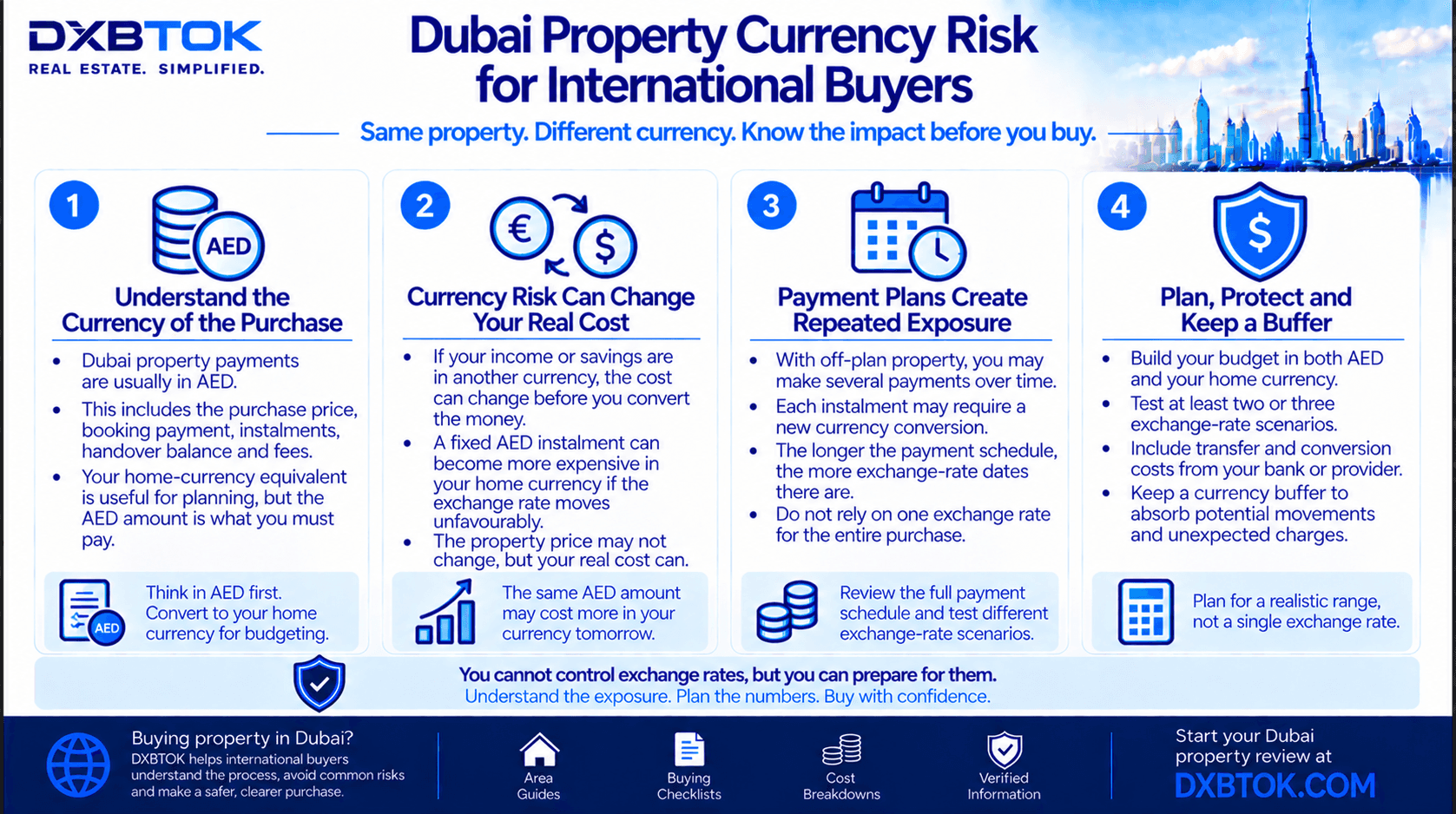
9. Keep a Currency Buffer Separate From the Property Price
International buyers should consider keeping a contingency above the exact amount required at today’s rate.
That buffer can help absorb:
exchange-rate movement
bank transfer costs
conversion spreads
unexpected transaction charges
small timing differences
A property purchase becomes fragile if it only works at one exact exchange rate.
10. Transfer and Conversion Costs Also Matter
The visible exchange rate is not always the final effective rate received by the buyer.
Depending on the bank or payment provider, costs may include:
conversion spread
transfer fee
intermediary-bank fee
receiving-bank fee
same-day or urgent-payment cost
These costs should be included when comparing how much home currency is actually needed to deliver the required AED amount.
11. Large One-Time Payments Need More Planning
Ready-property purchases, large handover balances and cash purchases can create concentrated currency exposure.
If a large AED amount must be paid within a short period, even a relatively small exchange-rate movement can materially change the home-currency requirement.
Plan the funding route before reaching the final payment window.
12. Mortgage Buyers Still Have Currency Exposure
A mortgage does not automatically remove currency risk.
International buyers may still need to fund:
deposit
fees
valuation-related costs
cash shortfall between purchase price and approved finance
other upfront amounts
Use our mortgage options for non-resident Dubai buyers guide when calculating how much cash may still need to be converted into AED.
13. Compare Financing Structure With Currency Exposure
Different purchase structures create different conversion patterns.
A ready-property mortgage may concentrate more cash around one transaction period.
A developer payment plan may spread the conversions across multiple dates.
Neither is automatically better from a currency perspective.
The better structure is the one whose payment timing you can comfortably fund.
14. Include Currency Risk Inside the Full Buyer Budget
Currency should not be treated as a separate issue after you have already calculated the property cost.
It belongs inside the full purchase budget.
Our full cost of buying Dubai property guide can help you place currency conversion alongside the other transaction and ownership costs.
15. European Buyers Should Separate Exchange Mechanics From Property Selection
Buyers funding a Dubai purchase from Europe may need to plan repeated EUR-to-AED or other currency conversions.
The exchange process should support the property decision rather than drive it.
For a deeper practical treatment of conversion timing, see our currency exchange guide for buying Dubai property from Europe.
16. Do Not Try to Turn the Property Purchase Into an FX Trade
A property buyer does not need to predict whether a currency will rise or fall.
Trying to wait for the “perfect” exchange rate can create a different risk: missing a property payment deadline.
The priority should be:
knowing the amount due
knowing the payment date
having enough liquidity
allowing for reasonable exchange-rate movement
avoiding last-minute transfers
17. Match Currency Planning to Your Income and Savings
Your exposure depends partly on where your future money comes from.
A buyer with most savings already in AED or a currency closely linked to it has a different position from someone whose future instalments depend entirely on income earned in another currency.
Map the source of funds for each major payment rather than treating all future money as interchangeable.
18. Review Currency Exposure Before Reservation
The best time to identify currency risk is before you commit.
Before reserving, know:
AED obligation: What is the exact amount due at each stage?
Home currency: Which currency will fund each payment?
Timing: When will each conversion need to happen?
Stress case: Can I still afford the payment if the rate moves against me?
Fees: What conversion and transfer costs may apply?
Buffer: Do I have contingency above the minimum requirement?
Financing: How much cash must I still provide if I use a mortgage?
Liquidity: Is the required money available before the payment deadline?
Final Takeaway
Currency risk does not mean international buyers should avoid Dubai property.
It means the home-currency cost of a fixed AED obligation can change while the transaction is still in progress.
Plan each payment in AED, map the home currency that will fund it, test less favourable exchange-rate scenarios and keep enough contingency so the property remains affordable without relying on a perfect future exchange rate.
Need help structuring the numbers around a Dubai property purchase? DXBTOK can help international buyers organise the key property, payment and cost information before moving forward.
Start your Dubai property review at DXBTOK.com.
Related DXBTOK guides
Currency Exchange When Buying Dubai Property from Europe →
Dubai Off-Plan Payment Plans Explained →
Dubai Payment Plan Marketing: What Buyers Should Understand →
Mortgage Options for Non-Resident Dubai Buyers →
Full Cost of Buying Dubai Property: What International Buyers Should Budget →


