

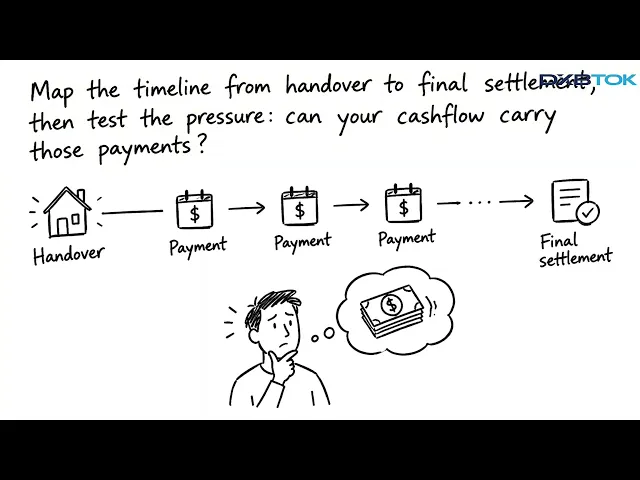
A home may be ready to occupy while part of its purchase price remains unpaid. That changes the economics of owning, renting or selling the unit. Buyers need to know whether later instalments fit their budget, what rights apply before full settlement and how a change of plans could affect their options.
Dubai Post-Handover Payment Plans: Buyer Trade-Offs
Some Dubai developers offer buyers the opportunity to continue paying for a property after its scheduled completion. This arrangement can reduce the amount of the purchase price due before the home is delivered, but it also means the buyer may have significant financial commitments during the first years of use.
The main attraction is payment flexibility. The central risk is that access to the property and completion of the purchase price may occur at different times, with ownership documentation, rental income, future resale and continuing expenses all requiring separate consideration.
For international buyers, a post-handover payment plan should be assessed as a long-term financial obligation attached to a particular property and agreement, not simply as an attractive instalment offer. The correct comparison is what the buyer receives at handover, what remains unpaid and what financial and contractual restrictions continue afterwards.
1. What Is a Post-Handover Payment Plan in Dubai?
A post-handover payment plan is a developer purchase arrangement in which part of the property's agreed price remains payable after its scheduled handover.
Instead of collecting the entire purchase price before or upon delivery, the developer permits a specified balance to be paid over a later contractual period.
This arrangement is commonly associated with off-plan developments, although the exact structure depends on the project and the developer's offer.
The buyer may begin using the property under the agreed handover conditions while remaining responsible for further instalments.
However, receiving the keys, acquiring unrestricted registered ownership and paying the full purchase price are not necessarily simultaneous events.
The sale agreement determines the obligations, while Dubai's property-registration framework governs the relevant registered rights.
2. How Is Post-Handover Different From an Ordinary Off-Plan Payment Schedule?
An off-plan payment schedule can divide the purchase price among booking, construction and handover stages.
Under a conventional arrangement, the buyer may need to settle the agreed final balance by the time the property is delivered.
A post-handover arrangement extends some purchase-price obligations beyond that point.
The financial distinction matters because the buyer may start facing building service charges, utilities, maintenance or property-management expenses while still owing the developer.
Our Dubai off-plan payment plans guide explains how booking payments, construction milestones and handover balances fit together within a standard developer purchase schedule.
For a post-handover buyer, the most important additional question is what happens during the period after the property becomes usable but before the final developer instalment is paid.
3. How Does a Dubai Post-Handover Payment Plan Work?
A developer may agree to collect a defined percentage of the price before or at handover, with the remaining percentage payable over an additional period.
For example, consider a hypothetical apartment priced at AED 1.5 million under a 60/40 arrangement:
Before or at handover: 60% of the purchase price, equivalent to AED 900,000.
After handover: 40%, equivalent to AED 600,000.
Illustrative settlement period: 30 equal monthly instalments after handover.
Illustrative monthly developer payment: AED 20,000, excluding other expenses.
The arrangement may reduce the amount required to settle the price before handover, but it does not reduce the agreed AED 1.5 million purchase price.
These figures are examples only. Actual payment percentages, instalment frequencies, handover conditions and additional charges depend on the signed contract.
A buyer should assess affordability against every payment obligation, not only the booking amount.
4. Does Handover Mean You Already Own the Property Outright?
Not necessarily. This is one of the most important questions in a post-handover purchase.
Dubai Land Department distinguishes provisional registration of off-plan purchases from the final registration of completed property.
Its published guidance describes the transfer of completed, fully paid units into the Real Estate Registry and the issuance of title deeds. Where payments remain outstanding, the buyer should not assume that collecting keys automatically establishes unrestricted title.
Different contractual arrangements may involve continued provisional registration, a registered security interest, a restriction or another legally recognised arrangement.
The exact position must be confirmed for the property and contract.
Buyers should understand which rights are registered at handover, whether a title deed can be issued before final settlement and what restrictions, if any, remain until all payments are completed.
A marketing promise of immediate ownership should not replace confirmation of the actual registration position.
5. Can Buyers Move In Before Paying the Final Instalment?
Some post-handover arrangements permit the buyer to take possession and occupy the completed property while a balance remains outstanding.
That can be attractive to purchasers who intend to use the apartment as a residence or second home.
However, handover and possession depend on the property's completion, the developer's contractual conditions and the satisfaction of any required payments or documents.
The agreement should establish what rights of occupation are granted, when they become effective and whether the buyer must meet continuing conditions to retain them.
Buyers should not assume that all post-handover plans give the same possession or occupancy rights.
Even when occupation is permitted, the buyer remains responsible for the deferred purchase-price obligations and applicable ownership-related expenses.
6. Can You Rent Out a Property While Still Paying the Developer?
Depending on the registered rights, contractual arrangements and any applicable restrictions, a buyer may be permitted to rent out a handed-over property while continuing payments to the developer.
However, this is not a universal entitlement under every plan.
The buyer should confirm that the property can lawfully be let, that the relevant tenancy arrangements can be registered where required and that the developer's remaining interest does not prevent the intended rental use.
For a holiday-home strategy, separate licensing, building and management requirements may apply.
The existence of a post-handover payment plan does not automatically establish that the apartment can be rented immediately or that a particular rental model is permitted.
Buyers considering rental income should establish the property's actual permitted use and the practical timing of tenancy or licensing before including rent in their financial assumptions.
7. Is a Post-Handover Payment Plan Interest-Free?
Some developer offers describe their post-handover instalments as interest-free.
That can mean the payment schedule does not separately charge conventional mortgage interest on the deferred purchase-price balance.
It does not necessarily mean that the arrangement is economically cheaper than another purchase offer.
The advertised purchase price may already reflect the value of the extended payment terms. Administrative conditions or charges may also apply under the written agreement.
A buyer should compare the total price offered with deferred settlement against any available alternative pricing for a comparable unit.
Our Dubai payment-plan marketing guide explains how buyers can assess promotional payment terms against the actual contractual commitment.
A genuinely useful interest-free arrangement still needs a competitive property price, clear contract terms and instalments the buyer can comfortably sustain.
8. Does a Smaller Upfront Payment Make the Property More Affordable?
A smaller initial payment can improve short-term liquidity, but affordability depends on the entire period over which the property price must be settled.
A buyer who can comfortably pay a modest booking amount may still struggle with substantial monthly or quarterly developer instalments after completion.
The property may also require spending on furnishing, utilities, repairs, insurance, management and building charges.
The true financial question is whether the purchaser can support the remaining balance alongside normal living or investment expenses.
A payment arrangement is not automatically affordable because it delays some of the purchase cost.
It is affordable only if the buyer has a credible source of funds for every obligation, including periods when other circumstances become less favourable.
9. Monthly Instalments Versus Larger Scheduled Payments
Post-handover plans do not all spread payments in the same way.
Some may require smaller, regular monthly amounts. Others may contain quarterly instalments, substantial annual payments or a larger final balance.
Two plans with the same deferred percentage can place different demands on the buyer's cash flow.
A monthly arrangement may appear easier to manage but require consistent liquidity over a long period.
A less frequent schedule may provide more time between payments while creating larger individual funding requirements.
Buyers should distinguish the average amount payable each month from the actual dates on which money must be available.
The best schedule is not necessarily the one with the smallest recurring amount. It is the arrangement whose timing and overall cost fit the buyer's financial circumstances.
10. Can Rental Income Cover the Developer Instalments?
Rental income can help support property ownership, but it should not be treated as a guaranteed source for meeting deferred purchase-price payments.
Consider the illustrative AED 1.5 million apartment with AED 20,000 due to the developer each month after handover.
That represents AED 240,000 in annual developer instalments.
Even if the apartment could generate AED 110,000 in annual gross rent, that hypothetical rental income would fall substantially short of the contractual developer payments before service charges, vacancy and other expenses.
The figures are illustrative rather than an estimate of achievable rent for a particular property.
The example demonstrates why an income-producing asset does not necessarily finance its own acquisition.
A buyer relying on rent needs to distinguish the timing and amount of collected income from the fixed obligation to the developer.

11. Compare Post-Handover Instalments With a Mortgage Repayment
A developer payment plan and a bank mortgage can both spread property payments over time, but they are not the same financial product.
Developer instalments represent scheduled payments of the purchase price under the sale agreement. Mortgage repayments arise from a separate financing arrangement with an authorised lender.
The repayment period may also differ significantly. A developer might require the remaining purchase balance over a relatively short period, creating larger payments than a longer-term mortgage would require.
A mortgage introduces interest or profit costs, lender conditions, affordability checks and security arrangements.
A post-handover plan may avoid some conventional bank-financing features, but it does not remove the need to settle the contractual balance.
Buyers should compare the full cost, required cash contributions, payment flexibility and consequences of non-payment rather than treating both arrangements as interchangeable.
12. Can You Replace a Post-Handover Plan With a Mortgage Later?
A buyer may hope to obtain bank financing after handover to settle the developer's outstanding balance.
That can be a possible financing strategy in some circumstances, but it should not be treated as guaranteed.
The bank must consider the borrower's income, credit position, property eligibility, valuation, title and registration arrangements and the proposed transaction structure.
Unpaid developer obligations or restrictions affecting the property may also influence what financing can be arranged.
A mortgage that appears available today may not be offered on the same terms when the buyer actually needs it.
If financing is declined or approved for less than expected, the developer instalments may remain payable under the agreed contract.
A purchaser should not enter a substantial deferred-payment commitment on the assumption that refinancing will automatically solve a future cash shortage.
13. Can You Sell the Property Before the Plan Is Fully Paid?
Reselling a property while developer instalments remain outstanding can be more complicated than selling a property whose purchase price has been settled.
The buyer's ability to transfer the relevant rights may depend on the registration position, contractual transfer provisions, developer approvals and the outstanding financial balance.
Some arrangements may permit a sale subject to settlement of unpaid amounts or a properly authorised transfer structure. Others may impose restrictions until specified conditions have been satisfied.
A potential purchaser may also need clarity on whether any unpaid developer obligation must be discharged before transfer or can be addressed through an approved arrangement.
It is unsafe to assume that a new buyer can simply take over the existing instalment schedule.
For someone who may relocate, liquidate an investment or change plans during the repayment period, resale flexibility is a major consideration.
14. Why Developer Approval and Outstanding Balances Matter
Where transfer restrictions or unpaid purchase-price obligations remain, the developer may play an important role in an intended resale.
The transaction could require confirmation of the amount outstanding, the seller's contractual position and any applicable no-objection or release conditions.
A buyer selling before full settlement should not assume that the advertised resale price will become fully available as cash proceeds.
Part of the consideration may be needed to satisfy obligations connected to the original purchase.
For an incoming buyer, the purchase should not proceed on the assumption that an existing owner's unpaid balance will automatically disappear or transfer.
The registered ownership position and the approved settlement structure determine what can lawfully be completed.
These restrictions can materially reduce an investment's flexibility even if the apartment has appreciated in market value.
15. What Happens if a Post-Handover Instalment Is Missed?
Missing a contractual payment can have serious consequences. The nature of those consequences depends on the agreement, the applicable legal framework and the property's registration and completion status.
Potential issues include contractual default, late-payment provisions, restrictions on transfer or enforcement of outstanding purchase obligations.
Dubai law also establishes specific procedures for purchaser defaults under qualifying off-plan sale agreements, including the developer's notification to Dubai Land Department and formal purchaser-notice requirements.
Those statutory procedures must be interpreted in the context of the actual agreement and legal status of the unit. They should not be treated as a universal penalty schedule for every completed property sold under deferred-payment terms.
A missed instalment should therefore not be assumed to produce either an automatic cancellation or a guaranteed right to continue without consequence.
Buyers should have a qualified professional review the consequences of non-payment before accepting a long deferred settlement period.
16. What Costs Continue After Handover Apart From the Instalments?
Once a property is delivered and in use, ownership-related expenditure can begin even while the developer is still receiving purchase-price payments.
Depending on the property, those costs can include:
Building service charges and community expenses.
Utilities and cooling-related costs.
Insurance where applicable.
Furnishing and initial property setup.
Maintenance, repairs and appliance replacement.
Property-management and letting fees.
Periods without rental income.
Applicable financing or contractual administration charges.
The deferred balance should not be considered the buyer's only financial obligation after handover.
Our full cost of buying Dubai property guide explains the wider transaction and ownership costs buyers should include alongside post-handover instalments.
These additional expenses can determine whether an apparently comfortable payment plan remains manageable in practice.
17. Why Service Charges Matter During the Repayment Period
Post-handover purchasers need to account for the building's operating costs during the same years that the developer's instalments remain payable.
Service charges can vary between buildings, unit categories and approved annual budgets.
A buyer who considers only the outstanding purchase-price percentage may underestimate the cost of keeping the property operational.
Our Dubai property service-charge guide explains how buyers can assess building-level charges and their effect on ongoing ownership costs.
For a rental investment, these expenses also reduce the income available to the owner.
A payment schedule that appears manageable without service charges can create financial pressure once the full ownership cost is included.
18. How Can International Buyers Manage the Currency Exposure?
International purchasers may fund Dubai property instalments from income or savings held in euros, pounds, Indian rupees or another currency.
Even where the contractual purchase price is fixed in AED, the equivalent cost in the buyer's home currency may change over the post-handover repayment period.
That risk is especially relevant when payments continue for several years.
An amount that appears affordable at the exchange rate prevailing when the sale agreement is signed may require more home-currency funds later.
Buyers should also consider international transfer charges and the timing of payments reaching the correct recipient.
For payment security, our Dubai property payment safety checklist explains the checks buyers should make before sending property-related funds.
Overseas buyers need a funding plan that works throughout the repayment period rather than relying only on today's exchange rate.
19. What if Handover Is Delayed?
A post-handover payment plan is often marketed using an expected delivery date. The buyer should distinguish that forecast from the legal payment triggers established in the agreement.
Some obligations may be linked to a defined handover event, while others may depend on calendar dates or other contractual conditions.
A construction delay could therefore affect when the buyer can occupy or rent the property and, depending on the actual agreement, when particular payments are due.
It should not automatically be assumed that every scheduled amount moves forward by the same number of months as the project delay.
A buyer planning to fund later payments using rental income may be particularly exposed if the property becomes usable later than expected.
The purchase should remain financially realistic under a less favourable delivery timeline, rather than depend entirely on the projected handover date.
20. Compare Two Post-Handover Offers on the Same Terms
Suppose two otherwise comparable Dubai apartments are offered with different settlement structures.
Property A requires a larger payment before handover and a smaller balance over the following year. Property B requires less money initially but leaves a much larger balance payable over three years.
Property B may offer more immediate liquidity. However, it may also create a longer period of financial commitments and restrictions affecting the property.
A meaningful comparison should consider:
The complete purchase price rather than the initial percentage alone.
The actual amount due before and at handover.
The timing and size of every post-handover obligation.
Whether the agreed price includes a payment-flexibility premium.
The rights granted at handover and the timing of final title registration.
Whether renting, selling or refinancing is restricted.
The costs of ownership while the balance remains unpaid.
The legal and financial consequences if payments cannot be completed.
The better offer depends on the buyer's circumstances, not simply on the longest available payment period.
21. When Is a Post-Handover Payment Plan Unsuitable?
A buyer should reconsider a post-handover offer when the financial or contractual commitments are not sufficiently clear or realistic.
Important warning signs include:
The monthly instalments would absorb an excessive proportion of available income.
Future rental income is assumed to cover payments without supported evidence.
The property price is materially higher because of the payment arrangement, without sufficient justification.
Ownership and title-registration conditions remain unclear.
The buyer expects unrestricted resale before full payment without contractual confirmation.
A future mortgage is being treated as guaranteed.
Late-payment consequences are not understood.
Handover timing or outstanding balances are inconsistent across the sales documents.
The buyer lacks reserves for service charges, maintenance or income interruptions.
These concerns do not make every post-handover offer unsuitable. They indicate that the proposed property commitment may not match the purchaser's financial capacity or intended use.
A longer payment period is valuable only when it provides flexibility without creating an unacceptable level of risk.
22. Dubai Post-Handover Payment Plans: Final Buyer Considerations
Post-handover payment plans can help eligible Dubai property buyers spread the purchase price beyond delivery, making some properties accessible through a different cash-flow structure.
However, the arrangement should be evaluated as an ongoing financial and contractual commitment, not simply a reduced initial payment.
Buyers need clarity on what remains payable, which rights exist at handover, when ownership can be fully registered and whether they may rent, refinance or resell the property while a developer balance remains outstanding.
Rental income, future financing and resale proceeds should never be assumed to cover contractual instalments without reliable evidence.
DXBTOK helps international buyers compare selected Dubai property opportunities with clearer commercial information and structured support, while appropriately licensed developers, brokers and qualified legal or financial professionals handle the relevant transaction requirements.
Buyers should choose a property and settlement arrangement that remain financially practical after the keys are collected, rather than one that only appears affordable on the day of reservation.
Related DXBTOK Guides
Dubai Escrow Accounts for Off-Plan Property Explained →
Dubai Off-Plan vs Ready Property: Which Is Better for Buyers? →
Dubai Property Buyer Due Diligence Checklist →
Dubai Project Launches: How Remote Buyers Should Approach Them →


