

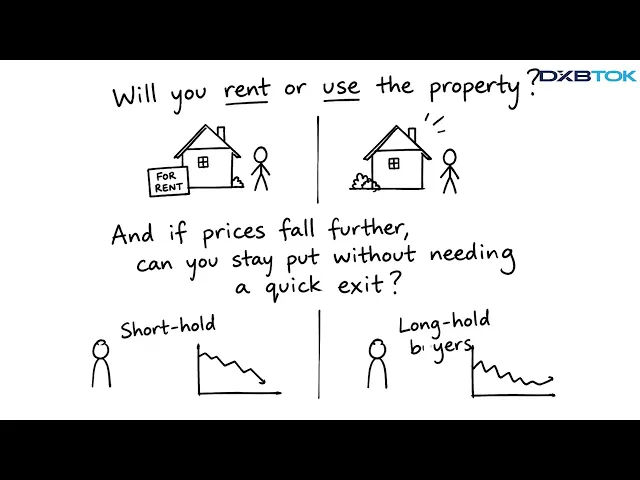
A lower asking price is not automatically a bargain if a buyer needs to sell early or fund future instalments. Market shifts can affect completed and off-plan homes differently. This guide weighs when waiting, negotiating or proceeding could fit your budget, ownership horizon and capacity to handle uncertainty.
Dubai Property Market Downturns and Buyer Timing
Headlines about a possible Dubai property market crash can make buyers feel they must either rush to secure a bargain or stop searching altogether. Neither reaction is a reliable basis for purchasing a home or investment property.
Property markets can experience periods of slower sales, softer asking prices, changing rental demand and declining transaction values. These developments do not necessarily occur together, and they can affect different Dubai communities and property types in very different ways.
For international buyers, the useful question is not whether someone can predict the lowest point of the market. It is whether the proposed purchase remains affordable, appropriately priced and suitable if values weaken, financing conditions change or the property must be owned longer than originally planned.
1. What Does a Dubai Property Market Downturn Mean?
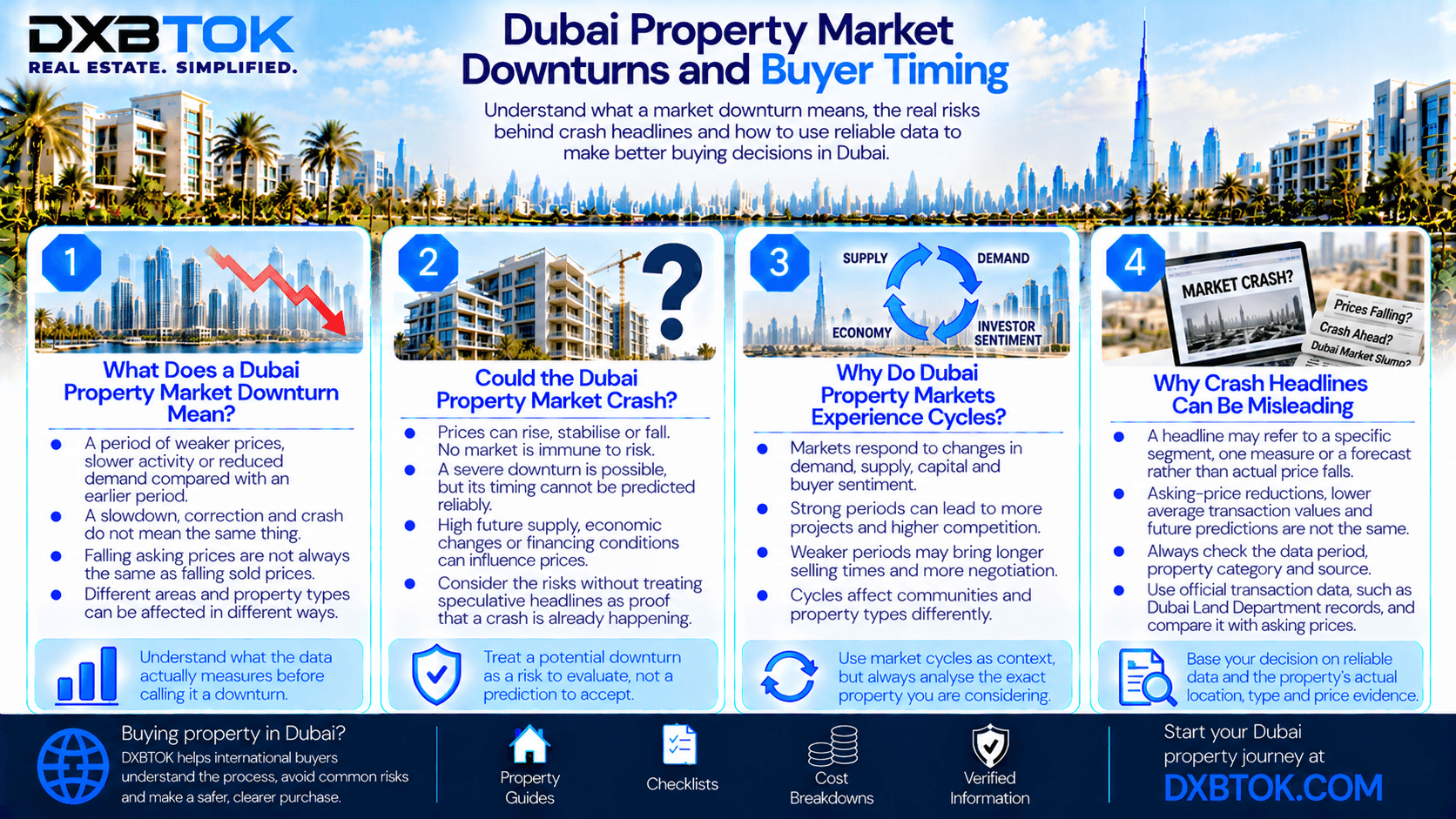
A property market downturn generally describes a period in which prices, activity or other relevant indicators weaken compared with an earlier period.
However, the term can refer to different developments. A reduction in the number of sales is not the same as a fall in comparable property values. A decline in advertised asking prices is not necessarily evidence that completed transactions have fallen by the same amount.
A buyer may also encounter terms such as correction, slowdown and crash.
Slowdown: transaction activity or price growth may weaken without necessarily producing falling property values.
Price correction: prices decline from an earlier level, potentially in selected areas or market segments.
Market crash: a description usually reserved for a severe and widespread fall, although there is no single universal legal threshold that determines when Dubai's property market must be called a crash.
These labels should not replace evidence about what is happening to the particular property a buyer is considering.
2. Could the Dubai Property Market Crash?
Dubai property prices can rise, stabilise or fall. No residential market is immune to changing economic conditions, shifts in supply, financing costs or changes in buyer demand.
That does not mean a severe downturn is inevitable or that its timing can be predicted reliably.
A meaningful assessment should distinguish potential risks from confirmed market conditions.
For example, a large pipeline of planned residential units may create concern about future competition. But planned units are not identical to completed properties already available for occupation or resale.
Similarly, weaker buyer sentiment may influence negotiations without immediately changing all registered sale prices.
A responsible buyer should consider possible adverse conditions without treating speculative headlines as proof that a crash is underway.
The possibility of a downturn is a risk to evaluate, not a prediction to accept as fact.
3. Why Do Dubai Property Markets Experience Cycles?
Property markets respond to changes in the relationship between demand, supply, available capital and buyers' willingness to pay.
Dubai's market can be influenced by residential development, population and employment trends, international investment demand, mortgage financing, investor expectations and wider economic conditions.
During stronger periods, buyers may compete for desirable units and developers may launch more projects. During weaker periods, purchasers may negotiate harder, some owners may postpone selling and certain properties may take longer to find buyers.
Those changes do not affect every segment equally.
A completed family home in an established community may experience different demand conditions from a small off-plan investment apartment in an area with substantial incoming supply.
Market cycles are therefore useful context, but they are not a substitute for understanding the exact property's competitive position.
4. Why Market-Crash Headlines Can Be Misleading
An article claiming Dubai property prices are falling may be describing a particular segment, a change in one statistical measure or a forecast rather than an observed price decline.
Consider three different statements:
More sellers are reducing their asking prices.
The average value of registered transactions was lower last month.
An analyst expects some prices to decline next year.
These statements describe different conditions and levels of certainty.
Asking-price reductions reflect seller expectations and negotiations. Average transaction prices can move because different types of homes were sold. Forecasts express possible outcomes, not completed events.
Buyers should pay attention to the data period, property category and source behind a claim before assuming it describes the wider Dubai market.
A dramatic headline can attract attention without providing enough information to support a purchase or postponement decision.
5. What Evidence Should Buyers Trust When Prices May Be Falling?
Market conditions are easier to assess when buyers separate official transaction evidence from advertising and opinion.
Dubai Land Department provides public access to registered real-estate transaction data, including transaction dates, property categories, areas and recorded amounts.
Its official real-estate data service can support an assessment of completed market activity, provided the correct transaction category, location and observation period are considered.
However, even official citywide statistics do not tell a buyer what one apartment or villa should cost.
Registered off-plan transactions and sales of completed homes may represent different kinds of purchases. New premium developments can also change an area's average transaction price.
The relevant evidence should therefore be recent, comparable and connected to the type of property being purchased.
Buyers should distinguish what the available records show from what sellers, brokers or market commentators expect to happen next.
6. Does a Fall in Sales Activity Mean Prices Must Fall?
No. Transaction activity and property prices are related, but they do not move in exactly the same way.
A period with fewer transactions may indicate weaker demand, reduced available supply, greater uncertainty or sellers choosing not to accept lower offers.
Some owners may be willing to wait rather than reduce their asking prices. Others may need to sell and become more flexible.
As a result, lower activity can occur before widespread price adjustments, alongside stable values or within a market where different segments are moving in opposite directions.
Similarly, a strong number of registered transactions does not establish that every property is increasing in value.
For buyers, transaction volume should provide context rather than a mechanical signal to buy or wait.
7. How Can Future Property Supply Affect Prices?
New residential supply can increase the number of alternatives available to tenants and buyers.
Where substantial numbers of similar apartments become available within a short period, owners may face greater competition on rent, sale price, furnishing or payment terms.
However, the effect depends on actual delivery timing, the type and quality of properties being completed and the demand for those homes.
A development pipeline does not automatically translate into an immediate oversupply of completed units.
Additional homes can also support community development by attracting more residents and encouraging retail, services and infrastructure.
The important question is whether supply growth is likely to exceed the demand for the specific type of property the buyer is considering.
A citywide construction forecast should not be used as though every Dubai neighbourhood has the same exposure.
8. Would a Downturn Affect Every Dubai Area Equally?
Unlikely. Dubai contains distinct residential submarkets with different price levels, available stock, tenant profiles and development conditions.
A community with substantial new apartment construction may experience different pricing pressure from a mature area with limited directly comparable properties.
Likewise, premium waterfront homes, compact investment apartments and family villas may attract different buyer groups and respond differently to financial conditions.
Individual buildings can also perform differently within the same neighbourhood because of their condition, management, layout and service charges.
The Dubai property area-selection guide explains how community maturity, transport, amenities and competing supply influence the suitability of different locations for owners and tenants.
For market-timing decisions, the key is to understand whether a possible downturn is relevant to the actual area, building and unit rather than treating Dubai as one uniform market.
9. Does Falling Price Growth Mean Property Values Are Declining?
Not necessarily. Slower growth and falling prices are different outcomes.
Suppose a property segment previously recorded strong annual price increases but later experienced only a modest increase. Prices would still be rising, even though the rate of growth had slowed.
A market moving from rapid appreciation to flat prices may represent stabilisation rather than a decline in nominal property values.
To establish a price fall, the measurement needs to show a reduction over a clearly identified period using an appropriate and consistent basis.
Buyers should therefore avoid interpreting phrases such as cooling, slower momentum or weaker growth as direct evidence of a price crash.
The distinction matters when deciding whether to delay a purchase in expectation of a lower entry price.
10. Is It a Good Time to Buy a House in Dubai?
The right time to purchase depends partly on the buyer's circumstances, not solely on the direction of market prices.
An owner-occupier with stable finances, a long intended holding period and a suitable property may view the decision differently from an investor who expects to resell within two years.
A buyer needing immediate accommodation may also place value on the ability to occupy a completed home rather than wait for uncertain future prices.
Before deciding, consider:
Whether the property serves a genuine current need.
How long the buyer expects to own it.
Whether the asking price is supported by comparable transactions.
How much cash remains after purchase.
Whether mortgage payments are sustainable.
Whether the buyer can tolerate a period of weaker market value.
How much financial pressure an early sale would create.
No general market forecast can resolve all of those personal and property-specific considerations.
11. Should Buyers Wait for Dubai Property Prices to Fall?
Waiting can be reasonable when current offers are overpriced, financing remains uncertain or the buyer has not found a suitable property.
It can also be reasonable when the buyer expects greater flexibility from sellers and has no urgent need to purchase.
But waiting has costs and uncertainties of its own.
A renter may continue paying rent, a desirable property may no longer be available and financing or currency conditions can change. Prices may also remain stable or rise rather than decline as expected.
The decision should not depend on knowing the exact market bottom, which cannot be identified reliably in advance.
The more useful comparison is between the terms of a credible property available today and the uncertain financial benefits and costs of postponement.
12. Why a Lower Purchase Price May Not Mean a Better Financial Deal
An advertised discount can reduce the capital required to acquire a property, but purchase price is only one part of the financial commitment.
Other costs may include registration, financing, repairs, service charges, insurance, management, furnishing and periods without rental income.
A property reduced by AED 100,000 may still be less attractive than another apartment if its condition requires substantial repairs or its recurring ownership costs are significantly higher.
Similarly, an initially lower off-plan price does not establish better value if the purchase involves a less suitable completion date or a payment schedule the buyer cannot comfortably fund.
Our guide to comparing total costs between Dubai properties explains how acquisition expenses, financing and recurring ownership charges can change the financial comparison between competing homes.
During weaker market conditions, buyers should negotiate the property and transaction terms as a whole rather than concentrate only on the percentage discount.
13. How Does a Market Downturn Affect Mortgage Buyers?
Mortgage financing adds a separate layer of risk to a property purchase.
A lender assesses the borrower and the property under its applicable financing criteria. A buyer's expectations about market prices do not determine the amount a bank will approve.
If the bank's valuation is lower than the agreed purchase price, the buyer may need more personal funds to complete the transaction.
After purchase, a fall in property value does not automatically reduce the outstanding loan balance or the contractual repayment obligations.
Variable-rate products can also create repayment exposure if financing rates change.
A buyer should therefore evaluate whether the mortgage remains affordable if the property's market value weakens, the buyer's income changes or the property must be retained longer than intended.
A large deposit and sufficient cash reserves may provide more flexibility, but they do not eliminate the underlying market risk.
14. Why Holding Period Is Critical During a Downturn
A buyer intending to own a property for two years faces different risks from one intending to hold it for ten years.
Shorter ownership periods can leave less time to absorb transaction costs or recover from temporary price weakness.
If the buyer must sell during an unfavourable market, the achievable price may not cover the original purchase commitment and associated costs.
A longer intended holding period may provide more flexibility to postpone a sale, although it also means continuing to fund maintenance, service charges and any mortgage obligations.
Neither a short nor a long holding period is automatically suitable for every buyer.
The Dubai property resale guide explains how entry price, building quality, buyer demand and ownership expenses affect the practical ability to sell a property when circumstances change.
Market timing becomes particularly important when the buyer has little flexibility over the future sale date.
15. Ready Property Versus Off-Plan During a Weaker Market
A downturn can affect completed and off-plan properties in different ways.
With a completed home, the buyer may be able to assess the actual condition, current surroundings, building operation and recent comparable resales.
A seller who needs to complete a transaction may also be willing to discuss price or other contractual terms.
An off-plan purchase involves a different timetable. The buyer may commit today but receive the completed property much later, when market conditions and competing supply could be different.
Developer payment plans can spread the financial commitment, but they do not remove construction or delivery uncertainty.
A buyer should not assume that a discount on an unfinished unit guarantees a favourable value at handover.
The choice should reflect the evidence available today, the funding schedule and how much uncertainty the purchaser can accept.
16. Can Developer Promotions Indicate a Softer Market?
Developers may use payment plans, fee incentives, furnishing packages or other commercial terms to attract buyers.
Such promotions can sometimes accompany more competitive selling conditions. However, they can also form part of a normal launch or marketing strategy.
An incentive does not independently establish that Dubai property prices are falling.
Buyers should compare the complete price and contractual conditions rather than assign a fixed financial value to promotional language.
A longer payment schedule may be valuable for cash flow, but it can still involve a higher total purchase price or significant future obligations.
Similarly, a contribution toward registration expenses does not prove that the underlying unit is attractively priced against completed comparable homes.
Market weakness should be assessed through a wider body of evidence, not inferred from one sales campaign.
17. How Could a Downturn Affect Rental-Property Investors?
An investment buyer should consider both the potential change in capital value and the performance of rental income.
A weakening sales market does not automatically mean rents will fall by the same percentage or at the same time.
Rental outcomes depend on tenant demand, competing completed supply, lease conditions, the exact building and the property's operating costs.
A landlord may continue receiving contracted rent while market sale prices change. Conversely, an investor may face a vacant property even when reported sale prices remain comparatively strong.
Service charges, repairs and mortgage repayments can place financial pressure on an investment during periods of reduced income.
Investors should consider whether the property remains affordable if achievable rent is lower than initially projected or if reletting takes longer than expected.
The critical question is whether the buyer can carry the property without relying on perfect rental conditions.
18. Are Guaranteed Returns Protection Against a Property Crash?
Not automatically. A property offer may include a contractual rental-income arrangement or a promotional statement about guaranteed returns.
Such arrangements must be understood according to their actual parties, conditions, duration and payment obligations.
A guaranteed rental payment, where genuinely enforceable, does not necessarily guarantee the property's future resale value.
It may also depend on the financial capacity of the party responsible for making the promised payments.
Our guide to guaranteed returns in Dubai property explains why buyers should assess the contractual counterparty, calculation basis, excluded costs and guarantee period before relying on an advertised income promise.
A buyer should evaluate the property's underlying suitability and price even where a separate income commitment forms part of the offer.
19. Can Buyers Negotiate More Effectively During a Market Downturn?
More competitive selling conditions may improve a buyer's ability to negotiate, particularly where a seller has a genuine reason to complete promptly.
However, there is no universal discount available simply because the wider market is described as cooling.
An attractive unit with strong demand may continue to receive interest, while an overpriced or poorly maintained property may require a substantial reduction.
Buyers can assess whether the asking price is justified by comparable sales, the unit's condition and the seller's actual contractual requirements.
Negotiation can also involve terms other than price, including completion timing, furnishing, permitted inspections or the treatment of documented obligations.
A commercially useful negotiation should be supported by evidence and a clear understanding of what the buyer is accepting.
A large advertised price reduction does not automatically create a good transaction.
20. How Should International Buyers Account for Currency and Funding Risk?
Buyers funding Dubai property from outside the UAE may face financial changes unrelated to local property prices.
A home priced in dirhams can become more or less expensive in the buyer's own currency between reservation and completion.
That matters especially when off-plan payments are spread over several years or when the buyer expects to fund a future mortgage deposit from overseas income.
During an uncertain property market, currency movements can increase the financial pressure created by changes in personal income, financing conditions or unexpected costs.
A buyer should understand both the property's AED price and the actual currency in which the purchase will ultimately be funded.
The ability to meet every contractual payment is more important than assuming exchange rates will move favourably before the next instalment.
21. Example: Two Buyers Facing the Same Market Decline
Consider two hypothetical buyers purchasing similar Dubai apartments for AED 1.6 million each.
After their purchases, assume comparable market values fall by 10%. Each property would then have an illustrative market value of AED 1.44 million.
This is a scenario, not a forecast of Dubai property prices.
Buyer A plans to keep the apartment for many years, has sufficient reserves, uses the property as intended and can continue meeting all ownership expenses.
Buyer B expects to sell within 18 months, has limited cash reserves and depends on a favourable resale price to fund another financial commitment.
Both buyers face a decline in the indicative market value of their asset. But the practical consequences are different.
Buyer A may have greater flexibility to defer a sale, although the fall in value remains an economic loss relative to the original price.
Buyer B may be under pressure to sell at an unfavourable time and absorb transaction costs in addition to the lower resale proceeds.
The example illustrates why personal financial flexibility can be as important as the direction of the market.
22. What Should Buyers Verify Before Acting on a Market Forecast?
Market forecasts can help identify possible economic risks, but they should not replace verification of the property being considered.
Before accepting a purchase commitment, the buyer should understand the exact unit, seller or developer, ownership route, current property status, contractual obligations and payment requirements.
The relevant documents should accurately reflect the agreed property, price, instalment schedule and any material conditions.
For off-plan property, project registration, construction status, applicable escrow arrangements and future payment obligations may be particularly important.
For completed property, condition, ownership documentation, occupancy and the seller's authority can be central concerns.
Our Dubai property buyer due-diligence checklist explains how to assess the property, transaction parties, documents, ownership evidence and payment route before committing funds.
Even an accurately predicted price movement would not make a poorly documented or unsuitable transaction a sound purchase.
23. When Is Waiting the Better Decision?
Waiting can be preferable when important financial, property or transaction questions remain unresolved.
Examples include:
The asking price cannot be supported by relevant comparable evidence.
The buyer has insufficient funds for acquisition costs and reasonable reserves.
Mortgage eligibility or final financing remains materially uncertain.
The proposed purchase requires an early resale at a higher price to succeed.
The unit has significant unresolved condition or ownership issues.
Off-plan payment obligations depend on uncertain future income.
The buyer's intended holding period is too short for the risks involved.
Important promises appear in marketing but not in the operative documents.
These concerns can justify postponement even in a strong property market.
Waiting does not necessarily mean waiting for a market crash. It can simply mean waiting until a suitable property and a workable financial position come together.
24. When Might Buying During Uncertainty Still Make Sense?
A property purchase can remain reasonable during a period of market uncertainty if the buyer has a clear purpose, a supportable price and the resources to maintain ownership.
A completed home may be attractive to someone who needs to live in Dubai and expects to own it for a substantial period.
An investment property may merit consideration where rental assumptions are realistic, expenses are understood and the buyer can tolerate vacancy or weaker resale conditions.
In both cases, the decision should remain viable without relying on a guaranteed recovery, rapid appreciation or perfect financing conditions.
Market uncertainty does not automatically make buying wrong. Equally, the possibility of a discount does not make buying right.
The decision should rest on the actual property, contractual terms, financial exposure and the buyer's ability to handle a less favourable outcome.
25. Dubai Property Market Downturns: Final Buyer Considerations
A possible Dubai property market crash is not something buyers can confidently time from a headline or a general forecast.
Market conditions can change, and the effects may differ across communities, completed homes, off-plan developments and property types.
Buyers should distinguish registered sales evidence from asking prices and predictions, then assess how a potential decline would affect their own financing, cash reserves, intended ownership period and future sale options.
A lower price is useful only if the property remains suitable and the full financial commitment is manageable.
DXBTOK helps international buyers compare selected Dubai property opportunities using clearer commercial information and structured buyer support, while appropriately licensed brokers, developers, lenders and qualified professionals handle the relevant regulated transaction requirements.
Buyers should make a purchase decision that remains defensible even if market conditions do not develop as expected, rather than trying to predict the perfect moment to buy.
Related DXBTOK Guides
Dubai Off-Plan vs Ready Property: Which Is Better for Buyers? →
Cash Buyer vs Mortgage Buyer in Dubai: What Buyers Should Compare →
Dubai Property for Remote Ownership: What Buyers Should Check →


