

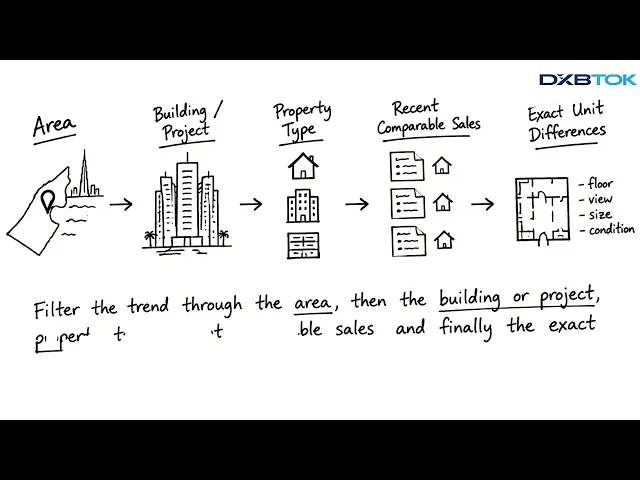
A headline saying Dubai homes have become more expensive may reflect a shift toward larger or premium properties rather than a rise in comparable unit values. This guide helps buyers read dated transaction data, separate ready and off-plan sales and judge whether a reported trend is relevant to the particular home they are considering.
Dubai Property Price Trends: What Buyers Should Evaluate
Dubai property price headlines often describe the market as rising, cooling or reaching new records. Such statements may summarise genuine changes in registered transactions, but they do not automatically tell a buyer whether a particular apartment, villa or off-plan unit is fairly priced.
Reported trends can change depending on which properties are included, whether figures refer to completed sales or advertised asking prices, and how the calculation accounts for size, location and different types of transactions.
For international buyers, the useful question is not simply whether the Dubai property market increased last month. It is whether the available price evidence supports the purchase being considered, at the price being offered and for the intended ownership period.
1. What Do Dubai Property Price Trends Actually Measure?
Dubai property price trends describe changes in prices or values across a defined group of properties and period of time.
However, different reports can measure different things. One may track average sale prices, another may show median price per square foot, while a third may use a price index that attempts to account for changes in the types of properties sold.
Those figures are not interchangeable.
For example, an increase in the total value of residential transactions can result from more sales, larger properties being sold or higher prices. It does not necessarily prove that the value of a comparable apartment has risen.
Buyers should understand which market measurement a report uses before treating it as evidence of appreciation or overpricing.
2. Asking Prices and Sold Prices Tell Different Stories
A property listed for AED 2 million has not necessarily sold for that amount.
Asking prices express what sellers or developers are seeking. Registered sale prices reflect transactions recorded under the applicable registration framework.
Advertised listings are useful for understanding current competition and seller expectations. But an asking-price increase does not establish that buyers are accepting those prices.
Similarly, a reduction in a seller's listing price is not, by itself, proof that an entire neighbourhood has declined in market value.
When considering a purchase, buyers benefit from distinguishing the current asking price, evidence from completed comparable transactions and the amount they are actually being asked to commit.
3. Where Does Official Dubai Property Transaction Data Come From?
Dubai Land Department (DLD) maintains records of registered real-estate transactions and provides public access to property-market information.
Its official real-estate data service includes transaction dates, transaction amounts, areas, property categories, registration types and other information relevant to market analysis.
These records are an important foundation for evaluating Dubai sold property prices because they concern registered transactions rather than marketing claims.
However, the existence of a transaction record does not establish that every home in the same area has an equivalent value.
Property characteristics, registration categories and the period being reviewed still matter. Different reporting services may also process the official records differently, including excluding outliers or grouping properties into broader market segments.
Source: Dubai Land Department — Real Estate Data.
4. What Were Dubai Property Prices Showing in September 2026?
One dated illustration comes from Dubai Real Estate Data's September 2026 report, which analyses registered DLD transaction records.
Published on 15 October 2026, using records available as of 12 October, the report estimated a median of AED 1,734 per square foot for apartments and villas sold during the 12 months ending 30 September 2026.
Its calculation represented an increase of approximately 5.9% compared with the preceding 12-month period. The report also recorded 11,033 residential sales for September in its publication snapshot, noting that late registrations can subsequently change monthly totals.
These figures are independently calculated from DLD records, not a statement that the DLD's own price index rose by the same percentage.
They are also not a forecast or proof that a particular property appreciated by 5.9%.
The meaningful interpretation is narrower: using this source's defined residential dataset, methodology and observation period, the measured median price per square foot was higher than in the preceding comparison period.
Dated source: Dubai Property Market Report — September 2026, published 15 October 2026.
5. Why Can Dubai Property Price Reports Show Different Figures?
Two reputable reports may publish different price movements without necessarily contradicting one another.
One might include only completed apartments and villas. Another could include off-plan registrations, land or commercial property. A third might focus on a particular community.
Reports can also differ in whether they use the mean, median, price per square foot or a quality-adjusted index.
The comparison period matters as well. A single month may produce a different picture from a rolling 12-month measure.
Before concluding that one figure is wrong, buyers should understand whether the reports describe the same property categories, timeframe and calculation method.
A headline is useful only when its underlying definition is clear.
6. Average Sale Price Versus Median Sale Price
An average price is calculated from the total value of the relevant sales divided by the number of transactions.
A median represents the middle value when the transactions are ordered from lowest to highest.
Both can provide information, but they respond differently to expensive properties.
For example, a small number of ultra-luxury villa sales can raise an area's average transaction price even when the typical apartment sells for a similar amount to earlier periods.
The median can reduce the influence of extreme transaction values, but it is not immune to changes in the mixture of properties being sold.
If more premium apartments enter the dataset, the median may rise even when the price of a comparable existing unit remains unchanged.
For purchase decisions, neither figure should replace evidence concerning properties genuinely similar to the one being considered.
7. Why Price Per Square Foot Is Useful but Incomplete
Dubai property price charts frequently express residential prices as AED per square foot.
That helps buyers compare properties of different sizes more consistently than comparing their total prices alone.
For example, an apartment priced at AED 1.6 million with 1,000 square feet of measured space would imply AED 1,600 per square foot.
A property priced at AED 1.2 million with 800 square feet would imply AED 1,500 per square foot.
On that measurement, the first property is more expensive per square foot, despite the difference in total property size.
However, that does not establish which apartment offers better value.
View, floor, layout efficiency, balcony allocation, building quality, condition and surrounding development can justify differences in the price buyers are willing to pay.
The calculation is meaningful only when the area measurement is appropriate and comparable between properties.
8. What Is a Dubai Property Price Index?
A property price index is designed to track price movement across a defined market or segment over time.
Depending on its methodology, an index may seek to reduce the effect of changes in the kinds of properties being transacted.
That makes an index conceptually different from a simple average or median of the properties sold in a month.
Some indexes are based on repeated transactions, while others use valuation or statistical methods to account for differences between properties.
Buyers should understand the particular index's base period, property coverage, update frequency and methodology before interpreting its movement.
An index level of 150, for example, cannot be read as a property price of AED 150 or as a 150% annual increase without understanding its base and calculation.
Indexes are market indicators. They do not determine the correct price of an individual unit.
9. How Should Buyers Read a Dubai Property Prices Graph?
A property-price graph can create a strong impression of growth or decline depending on the period and measurement displayed.
A chart showing several years of prices may indicate a broad market cycle. A chart covering only three months may capture a temporary change in sales composition.
Several details affect the interpretation:
Time period: whether the graph covers months, quarters or several years.
Price measurement: total price, AED per square foot, median, average or index.
Property coverage: apartments, villas, ready homes, off-plan units or mixed categories.
Observation date: when the source last incorporated registered transactions.
Comparison base: whether the stated change is month-on-month, year-on-year or over a rolling period.
Data treatment: whether outliers, late registrations or other records have been adjusted.
A graph can be mathematically accurate yet commercially misleading if its labels or property coverage are not understood.
10. Why Monthly Price Movements Need Caution
Month-to-month market figures can fluctuate because the properties sold in one month are not identical to those sold in the next.
One month may include more large premium apartments, while another contains a greater proportion of smaller units or transactions in less expensive communities.
New project launches can also affect the number and mix of off-plan sales recorded during a period.
Late registration of transactions may change recent monthly totals after an initial report has been published.
For these reasons, a one-month rise or fall should not automatically be interpreted as a sustained price trend.
Buyers can gain more useful perspective from consistent measurements across several periods, alongside recent evidence from the relevant property segment.
11. Why Off-Plan and Ready-Property Prices Must Be Separated
Off-plan purchases and completed-property resales involve different assets, pricing conditions and transaction stages.
An off-plan price may reflect a future unit, staged developer payments, project positioning and anticipated delivery conditions.
A ready-property price relates to an existing asset whose physical condition, building operation and immediate surroundings can generally be assessed more directly.
Combining their transaction prices into a single average can hide these differences.
In addition, off-plan registration activity may reflect newly launched supply rather than a change in the value of existing homes.
Our Dubai off-plan versus ready property guide explains the main differences between completed and off-plan purchases when comparing price evidence.
Buyers should therefore confirm whether a price trend describes the same route through which they intend to purchase.

12. Do Higher Transaction Volumes Mean Property Prices Are Rising?
Not necessarily. Sales activity and price movement measure different things.
A market can record many transactions because developers launch new projects, investors change portfolios or more owners choose to sell.
Higher transaction volumes may indicate active buyer and seller participation, but they do not independently prove that comparable property prices have increased.
Likewise, lower transaction volumes do not automatically mean prices are falling.
Total transaction value is influenced by both the number and the price of properties sold.
A market report showing a new record for total value should therefore be interpreted separately from a report measuring average or index-based price appreciation.
The buyer's focus should remain on whether the price of the specific property is supported by relevant recent transactions.
13. Why Dubai Area-Level Price Trends Can Differ
Dubai contains residential markets with different property types, demand drivers, supply conditions and price ranges.
A change in citywide prices does not imply that every district experienced the same change.
Even within one community, apartment prices can move differently from villa prices, and premium buildings may perform differently from older developments.
An area with substantial new construction can show different transaction characteristics from a mature district dominated by existing-home resales.
For buyers comparing neighbourhood suitability rather than price measurements alone, our Dubai property area-selection guide explains the wider location factors that can affect a purchase decision.
A citywide trend is useful background, but it cannot replace the evidence for the buyer's intended area and property type.
14. Why Building-Level Comparisons Matter More Than Headlines
Two apartments in the same neighbourhood may have very different prices for reasons unrelated to the overall property market.
One could have a better view, larger usable rooms or a newer building. Another might require refurbishment or face higher ownership expenses.
The building's management, age and physical condition can affect what buyers are willing to pay.
A new development may command a premium because of its specification or marketing position, while an older building may trade at a discount even in the same location.
That is why the relevant property comparison should consider the exact building and unit characteristics rather than assume the district's reported average represents fair value.
A price that looks low relative to the area can still be expensive for an unsuitable or poorly maintained property.
15. Can a Dubai Property Price Increase Be Caused by Sales Mix?
Yes. Changes in the types of properties sold can affect market-wide pricing statistics.
Imagine that a district records more premium waterfront sales this year than last year. Its average sale price may rise even if comparable apartments in existing buildings have changed little in value.
The reverse can also happen. If more smaller or lower-priced properties are sold, the reported average may decline despite stable prices for similar units.
This is often called a sales-mix effect.
It is one reason why buyers should distinguish unadjusted transaction statistics from measures designed to compare like-for-like property prices over time.
The distinction matters particularly in Dubai, where residential developments can vary greatly in property type, size, completion stage and premium positioning.
16. What Do Dubai Property Price Falls Actually Tell Buyers?
A reported fall in property prices requires the same care as a reported increase.
The buyer should understand what declined: the median transaction price, price per square foot, a specific index or the price of comparable homes.
It also matters whether the movement was confined to one segment or visible across a broader group of properties.
A declining average does not automatically mean every seller is willing to accept less money. A rising citywide median does not prevent a particular building from experiencing weaker demand.
Buyers considering a purchase during a potential downturn should also assess their budget, risk tolerance, holding period and financing exposure.
Price data can inform that decision, but it cannot determine it by itself.
17. How Can Buyers Distinguish Market Value From a Developer's Launch Price?
A developer's launch price is an offer for a defined property under particular commercial terms.
It may reflect the project's location, specification, payment schedule, branding, delivery period and the developer's pricing strategy.
It does not independently establish the market value of the future completed home.
A newly launched development can be priced above existing comparable properties for commercial reasons, including newer facilities or anticipated future conditions.
Whether those differences justify the premium depends on what the buyer is actually acquiring.
Buyers should not assume that a developer increasing prices between launch phases proves that every earlier purchaser has already achieved a realisable capital gain.
Until an appropriate transaction or valuation supports the comparison, the apparent increase may be a change in the developer's asking terms rather than a completed market sale.
18. Why Transaction Date and Property Status Matter
A price record is most useful when the buyer understands when the transaction occurred and what was sold.
Market reports may use transaction-registration dates, while sale contracts and property completion can occur at different stages.
For off-plan transactions, the registered purchase may concern a unit that will not be delivered for some time.
For completed homes, the transaction may involve an existing building with a more observable condition and ownership history.
A buyer comparing prices from different periods should consider whether the broader market or property circumstances changed between those dates.
Older transactions can offer useful historical context, but they may be less relevant to a current purchase than recent genuinely comparable records.
The right interpretation depends on both the timing and nature of the transaction.
19. Why the Cheapest Price Per Square Foot May Not Be the Best Value
A lower price per square foot can appear attractive, but it does not automatically mean a buyer is purchasing a better asset.
A unit may be cheaper because of its layout, building age, location within the project, condition or ownership obligations.
Two properties offered at similar prices may also require different amounts of money for registration, financing, furnishing, repairs and continuing service charges.
Our guide to comparing total costs between Dubai properties explains how acquisition expenses and ongoing ownership costs can change the comparison between apparently similar properties.
Price data should help establish whether an offer is reasonable. It should not be used as a substitute for understanding what the buyer will own and the financial obligations attached to it.
20. How Do Price Trends Affect Potential Resale Value?
Historical price movements can provide context for a property's future resale prospects, but they cannot guarantee the price another buyer will pay.
Resale value depends on market conditions when the owner decides to sell, the building's condition, the actual unit, competing properties and the terms available to future buyers.
A property purchased during a period of rising reported prices may still be difficult to resell profitably if its original price included a substantial premium.
Likewise, a property acquired during a weaker market could remain unsuitable if its condition or ownership costs limit demand.
Our Dubai property resale guide explains the factors buyers should consider when assessing future resale flexibility.
Price trends can inform the resale assessment, but the property itself determines which part of the market the owner will ultimately compete in.
21. What Should International Buyers Consider When Comparing Prices?
International buyers often compare Dubai property prices with the value of properties in their home countries.
That can provide general context, but the markets may have different ownership costs, financing arrangements, building characteristics and transaction conditions.
A Dubai apartment that appears relatively inexpensive compared with a home in another city is not necessarily fairly priced within its own building or neighbourhood.
Buyers funding a purchase in euros, pounds or another currency also face exchange-rate exposure when converting their available capital into AED.
For off-plan purchases, the home-currency cost of future instalments can change even when the contractual price in dirhams remains fixed.
The practical comparison should therefore consider both local Dubai price evidence and the buyer's total funding requirements.
22. What Makes a Dubai Property Price Claim Unreliable?
Some price claims are too broad or poorly supported to inform a significant purchase decision.
Warning signs include:
A claimed percentage increase without an identified time period.
Asking prices described as completed sale prices.
A citywide average used to justify a premium for one apartment.
Off-plan and ready-property figures combined without explanation.
A price graph without a source, units or calculation method.
Historical figures presented as though they were current.
Market-wide appreciation used to promise a specific property's future return.
One unusually expensive transaction used as evidence that every unit in a building has increased in value.
Claims about a property-price index without identifying which index is being quoted.
These weaknesses do not automatically mean a seller's price is unreasonable. They mean the price argument is not yet supported by sufficiently relevant evidence.
23. How Should Buyers Use Property Price Data Before Committing?
Market reports are most valuable when they provide context for a specific purchase rather than become the entire reason for buying.
A reasonable price assessment considers recent comparable transactions, relevant property characteristics, the transaction type and the total commitment required.
The buyer should also understand whether the available figures are registered prices, asking prices, index movements or projections.
Our Dubai property buyer due-diligence guide explains the wider property, ownership and transaction checks buyers should complete before committing.
A market trend can explain the wider environment, but it cannot compensate for unresolved property-specific financial or legal concerns.
24. Dubai Property Price Trends: Final Buyer Considerations
Dubai property prices are shaped by many different transactions, property categories and market conditions. A change in a citywide average, median or index can provide useful information, but none of those measurements automatically establishes the value of an individual home.
Buyers should understand the source and date of the data, separate asking prices from completed sales, and distinguish off-plan activity from ready-property transactions.
Most importantly, they should compare genuinely relevant properties rather than relying on a broad market headline to justify the price being offered.
DXBTOK helps international buyers compare selected Dubai property opportunities using clearer commercial information and structured buyer support. Appropriately licensed brokers, developers, valuers and qualified professionals handle the matters requiring their specific expertise.
Buyers should make a property purchase decision supported by meaningful price evidence and a realistic understanding of the property being acquired, rather than trying to predict the next market movement.
Related DXBTOK Guides
Dubai Secondary Market vs Off-Plan Market: What Buyers Should Compare →
Full Cost of Buying Dubai Property: What International Buyers Should Budget →
Dubai Property Service Charges: How Buyers Should Review Them →
Dubai Property Currency Risk for International Buyers →
Dubai Property for Remote Ownership: What Buyers Should Check →


