Learn what to check when buying Dubai property for remote ownership, including property type, building management, access, maintenance, service charges, local support, rental use, handover and ongoing owner control.
Dubai Property for Remote Ownership: What International Buyers Should Check
Buying a Dubai property while living abroad is not only a purchase decision.
It is also an ownership-operating decision.
The property may look attractive when you compare:
location
price
layout
view
developer
amenities
But if you expect to spend most of the year outside Dubai, another question becomes important:
How easy will this exact property be to own, maintain and control from another country?
A useful framework is:
property → building/community → access → maintenance → management → costs → use → handover → reporting → resale
1. Remote ownership should influence the property you buy
Some buyers choose the property first and only later think about how it will be managed.
For an overseas owner, it is better to reverse that logic.
Before buying, ask:
Who will access the property when I am abroad?
Who handles maintenance?
How are building issues communicated?
What recurring costs apply?
Who can inspect the property?
What happens during an emergency?
If I rent it, who coordinates the tenant?
If I leave it vacant, who checks it?
The answers can affect whether the property fits your ownership model.
2. Remote ownership is different from remote buying
These are separate stages.
Remote buying
How you:
choose the property
review documents
reserve
sign
pay
complete the transaction
Remote ownership
How the property functions after you own it.
That includes:
access
maintenance
inspections
service charges
utilities
tenants
property management
reporting
emergencies
A smooth remote purchase does not automatically mean the property will be easy to own from abroad.
3. Start with your intended use
Before choosing the property, decide how you expect to use it.
For example:
personal Dubai residence used several times a year
second home
long-term rental
short-term/holiday-home use where permitted
primarily vacant property
combination of personal use and rental
Each model creates different operational requirements.
4. A property used personally requires a different setup from a rental property
If the property is mainly for your own visits, you may care more about:
key access
cleaning before arrival
air-conditioning
utility continuity
maintenance while vacant
furnishing
periodic inspection
If it is rented, you may additionally need:
tenant communication
lease administration
maintenance coordination
inspection arrangements
rent collection processes
handover between occupancies
Choose the property with the intended ownership use in mind.
5. Property type affects management complexity
An apartment, townhouse and villa can all be owned remotely.
But their operational demands can differ.
An apartment may place more building-level maintenance under the wider managed property structure.
A villa can give you more control but may also leave more individual components for the owner to monitor, such as:
external areas
landscaping
private pool where applicable
roof or façade elements
additional air-conditioning equipment
gates and outdoor systems
This does not mean apartments are always better for remote owners.
It means the maintenance responsibility should be understood before buying.
6. Review what the building manages and what the owner manages
This is one of the most important checks.
Ask what is managed through the building or community and what remains your individual responsibility.
Examples can include:
Common-property responsibilities
lobby
lifts
corridors
shared pool
common landscaping
security
common mechanical systems
Unit-owner responsibilities
internal air-conditioning components
appliances
plumbing inside the unit
furniture
internal electrical issues
private outdoor areas where applicable
The exact division depends on the property.
Do not assume.
7. Building management quality matters more when you are abroad
If you live locally, you can personally chase problems.
A remote owner has less direct control.
You may therefore want to understand:
who manages the building
how residents contact management
how maintenance requests are handled
how access is authorized
how building notices are communicated
whether an owner portal or structured communication system exists
A well-organized operating environment can reduce friction for an overseas owner.
8. Review access arrangements
Someone may eventually need access while you are outside Dubai.
This could include:
maintenance technician
property manager
tenant
cleaner
inspector
furnishing contractor
Ask:
How is access granted?
Can building reception assist?
Are access cards involved?
Can keys be securely managed?
Is owner authorization required?
Can a representative access the property?
Remote ownership becomes difficult if every small issue requires your personal presence.
9. Think about emergency access before an emergency happens
Examples could include:
water leak
air-conditioning failure
electrical problem
damaged appliance
access issue
neighbour complaint
The important question is:
Who can act if I am not in Dubai?
You should know that before you need the answer.
10. Decide whether you need a local property manager
Not every overseas owner needs full property management.
The level of support may depend on:
how often the property is occupied
whether it is rented
property complexity
your ability to coordinate remotely
whether trusted local support already exists
Use the dedicated Dubai property management for overseas owners guide to understand the operational-management layer after purchase.
11. Understand exactly what a property manager would do
Do not treat “property management” as one standard service.
Possible responsibilities can include:
inspection
maintenance coordination
tenant communication
access control
utility coordination
reporting
key management
contractor supervision
rental administration
Ask for the scope in writing.
12. Separate property management from building management
These are not necessarily the same thing.
Building/community management
Deals mainly with the broader property or jointly owned development.
Your property manager
May act specifically for you and your unit.
A remote owner should understand which party handles each issue.
13. Service charges matter to remote owners
Service charges are recurring ownership costs associated with jointly owned properties.
They can fund elements such as common-area operations, management and maintenance according to the applicable property structure.
Dubai Land Department provides a Service Charge Index that allows users to inquire about approved service fees for jointly owned properties through DLD/Mollak/Dubai REST.
Use the Dubai property service charges guide when reviewing recurring building-level costs.
14. Do not compare remote-ownership properties only by service-charge rate
A lower figure is not automatically better.
Also understand:
building quality
amenity level
management
common-area condition
maintenance requirements
what the charge covers
The goal is not simply to minimize cost.
It is to understand the ownership package.
15. Maintenance is a separate cost layer
Service charges do not remove your individual maintenance responsibilities.
Depending on the property, you may still need to budget for:
air-conditioning maintenance
plumbing
electrical repairs
appliances
furniture
paint
fixtures
private pool or landscaping
replacement items
Use the Dubai property maintenance costs guide to separate unit-level upkeep from wider building charges.
16. Remote owners should plan preventive maintenance
Waiting for something to fail can be particularly inconvenient when you are abroad.
A property may benefit from periodic checks of areas such as:
air conditioning
plumbing
water leaks
appliances
seals
balconies or terraces
electrical equipment
The exact schedule should reflect the property and professional recommendations.
17. Vacant property still needs attention
A property is not maintenance-free simply because nobody is living in it.
If you leave a Dubai home vacant for long periods, consider:
periodic inspection
air-conditioning settings
water/plumbing checks
cleaning
pest control where needed
appliance condition
mail or building notices
emergency access
The property still exists operationally while you are abroad.
18. Think about climate when leaving the property unused
Dubai's heat means that an overseas owner should not treat a vacant property like a home in a cooler climate.
The correct treatment of:
cooling
ventilation
plumbing
furnishings
electronics
depends on the exact property and professional guidance.
Avoid simply shutting everything down without understanding the consequences.
19. Utilities need an ownership plan
Understand who will handle:
electricity/water account
district cooling where applicable
internet
gas where relevant
other property-specific services
Ask:
Which accounts need to remain active?
How are bills received?
Can they be paid digitally?
Who notices if there is an unusual bill or service interruption?
20. Dubai REST provides owners with digital property services
Dubai Land Department describes Dubai REST as a smart real-estate platform through which property owners can access their properties and services.
DLD states that the application includes a real-estate wallet with information including property details and service charges, and provides access to various owner-related services.
Digital access can make remote administration easier, but it does not eliminate the need for someone to handle physical issues when necessary.
21. Create a document system
A remote owner should be able to locate important documents without searching through old chats.
Keep organized copies of:
title documentation
purchase documents
service-charge records
insurance documents where applicable
management contracts
tenancy documents if rented
utility information
maintenance records
warranties
furnishing inventories
access records
The goal is to create an ownership file, not just a purchase file.
22. Keep important contacts together
Maintain a current list containing:
building management
security/reception
property manager
maintenance provider
developer where relevant
utility providers
tenant if applicable
local representative
emergency contact
Do not wait until something goes wrong to find the right number.
23. Decide who has authority to act
A local person may be able to inspect something.
That does not necessarily mean they are authorized to:
approve expensive repairs
sign documents
collect keys
deal with tenants
manage payments
represent you formally
Define the authority clearly.
Where formal authorization or legal representation is required, confirm the appropriate process with the relevant authority or professional.
24. Set approval limits for maintenance
If you use a property manager, consider creating a practical approval process.
For example:
minor maintenance can be handled within an agreed limit
larger work requires owner approval
emergency action has its own procedure
The exact arrangement is contractual.
The important point is to avoid having every small repair delayed because you are in another time zone.
25. Ask how maintenance is documented
Remote owners need evidence.
A useful process can include:
photographs
quotations
invoices
before/after images
maintenance reports
You should be able to understand what work was performed even when you were not there.
26. Think about furnishing from an ownership perspective
Highly customized interiors can look attractive.
They can also be more complicated to maintain remotely.
Consider:
replacement availability
appliance brands
custom furniture
fragile finishes
imported materials
specialist repair requirements
A remote owner's ideal property may prioritize practicality differently from a buyer who lives there full time.
27. Premium amenities can increase operational complexity
Features such as:
large pools
extensive landscaped areas
private facilities
hotel-style services
premium common areas
may improve the ownership experience.
They can also influence recurring costs and management complexity.
Review the full operating proposition rather than assuming more amenities are automatically better.
28. Consider how frequently you expect to visit
A property you use every month may require a different operating setup from one you visit twice a year.
Ask yourself:
How long will the property normally remain empty?
Will somebody inspect it between visits?
Do I want it prepared before arrival?
Who handles cleaning?
Who handles maintenance discovered during my absence?
The ownership system should match your actual travel pattern.
29. If you plan to rent, decide the rental model separately
Do not buy a property only because someone says:
“You can rent it easily.”
Determine whether you are considering:
conventional long-term tenancy
short-term/holiday-home use where applicable
no rental at all
Each model involves different operational responsibilities.
Use the Dubai holiday home vs long-term rental guide if rental strategy is part of your ownership plan.
30. Rental income is not the same as remote simplicity
A property can generate rental income and still require substantial management.
Depending on the rental model, an owner may need coordination around:
tenants or guests
cleaning
maintenance
furnishing
access
vacant periods
administration
Do not choose the rental model only by looking at headline income potential.
31. Tenant management needs a clear responsibility
If you use a long-term tenant, establish who handles:
tenant questions
maintenance
access
lease administration
renewal coordination
property inspections
move-in/move-out issues
Being abroad should not leave the tenant without a practical contact.
32. Think about handover before buying off-plan
Remote ownership of an off-plan property starts with handover.
Ask in advance:
Who will inspect the property?
Who will perform snagging?
Who will collect keys if permitted?
Who checks defects?
Who arranges utilities?
Who receives documents?
Who prepares the property for use or rental?
Use the Dubai property handover guide to understand the wider handover process before deciding who will handle it on your behalf.
The handover stage can determine whether remote ownership starts smoothly or chaotically.
33. Do not rely only on the developer handover inspection
A developer may provide its own handover process.
That does not prevent the buyer from considering an independent snagging or inspection service where appropriate.
For an overseas buyer, independent inspection can provide an additional set of eyes when personal attendance is not practical.
34. Completed property creates different remote-ownership questions
If you buy a ready property, you can assess the operating condition immediately.
Review:
current maintenance state
appliances
air conditioning
plumbing
furnishings where included
building condition
management quality
service-charge status
You are inheriting an existing property condition rather than waiting for future handover.
35. Understand building access for contractors
Some buildings have specific processes for:
maintenance access
contractor registration
move-in permits
delivery access
renovation approval
This can matter considerably when the owner is not present.
Ask how these procedures work before assuming your contractor can simply enter.
36. Check whether the property is overly dependent on you personally
A remote-friendly property should not require the owner to solve every issue manually.
Look for an ownership setup where:
information is accessible
responsibilities are clear
access can be arranged
payments can be administered
maintenance can be coordinated
problems can be escalated
The goal is not zero involvement.
It is controlled involvement.
37. Review the micro-location for ownership practicality
Location affects more than lifestyle.
For a remote owner, consider access to:
maintenance services
retail
transport
building management
property-management providers
tenant demand if renting
A property can be visually attractive but operationally inconvenient for your use case.
38. Newer does not automatically mean easier
A new development may have:
modern systems
newer equipment
warranty periods
structured management
But it may also experience:
early building-management adjustments
active defect rectification
surrounding construction
incomplete community infrastructure
Assess the exact development rather than assuming age alone determines ownership difficulty.
39. Older does not automatically mean difficult
An established building may offer:
proven management
mature community
known service-charge history
established maintenance providers
But it may also require more physical upkeep.
Again, evaluate the exact property.
40. Review service history where possible
For a completed property, useful questions can include:
What repairs have been performed?
How old are key appliances?
Has the AC been maintained?
Has there been water damage?
Are there recurring issues?
Is documentation available?
Remote ownership becomes harder when you inherit problems you did not identify beforehand.
41. Insurance may need review
Depending on the property and ownership setup, buyers may consider appropriate insurance for:
contents
landlord exposure
property-related risks
Coverage and requirements vary.
Discuss the appropriate policy with an insurer or qualified professional rather than assuming the building's arrangements cover your individual property and possessions.
42. Understand who monitors service-charge notices
Service-charge obligations do not disappear because the owner lives abroad.
Determine:
where invoices or notices are sent
who reviews them
how they are paid
whether your contact details are current
DLD's Service Charge Index can be used to inquire about approved fees for jointly owned properties, but the owner's actual account position and invoices should still be reviewed separately.
43. Keep owner contact information current
If your:
email
phone
address
representative
changes, make sure the appropriate parties have the correct details.
Missing an important notice because the building has an old email address is an avoidable ownership problem.
44. Remote ownership should include financial controls
If another person manages expenses for you, define:
who can authorize spending
who can receive refunds
how invoices are checked
where payments are made
how records are retained
Do not give broad financial authority without understanding the scope.
45. Separate operational convenience from investment quality
A property can be easy to manage remotely but still be unsuitable for your broader buying objective.
Likewise, an attractive property may require more management effort.
The remote-ownership question should sit alongside:
location
property type
budget
use case
recurring costs
resale flexibility
It should not replace them.
46. Resale should also be considered
Eventually, you may sell while still living abroad.
A clean ownership history can make that process easier to organize.
Keep:
property records
maintenance records
access information
tenancy documentation
service-charge information
relevant management documents
Remote ownership is easier when the property file remains orderly throughout the holding period.
47. Use the remote-ownership suitability test
Before buying, answer eight questions.
1. Access
Can someone reliably access the property when I am abroad?
2. Maintenance
Who will identify and coordinate repairs?
3. Building
Is the building/community management structure clear?
4. Costs
Do I understand service charges and unit-level maintenance costs?
5. Control
Do I know who is authorized to act for me?
6. Use
Does the property suit my personal-use or rental strategy?
7. Handover
If off-plan, who will inspect and take operational control at completion?
8. Reporting
Can I receive enough information to know what is happening without being there?
If several answers are unclear, the remote-ownership setup needs more work before you commit.
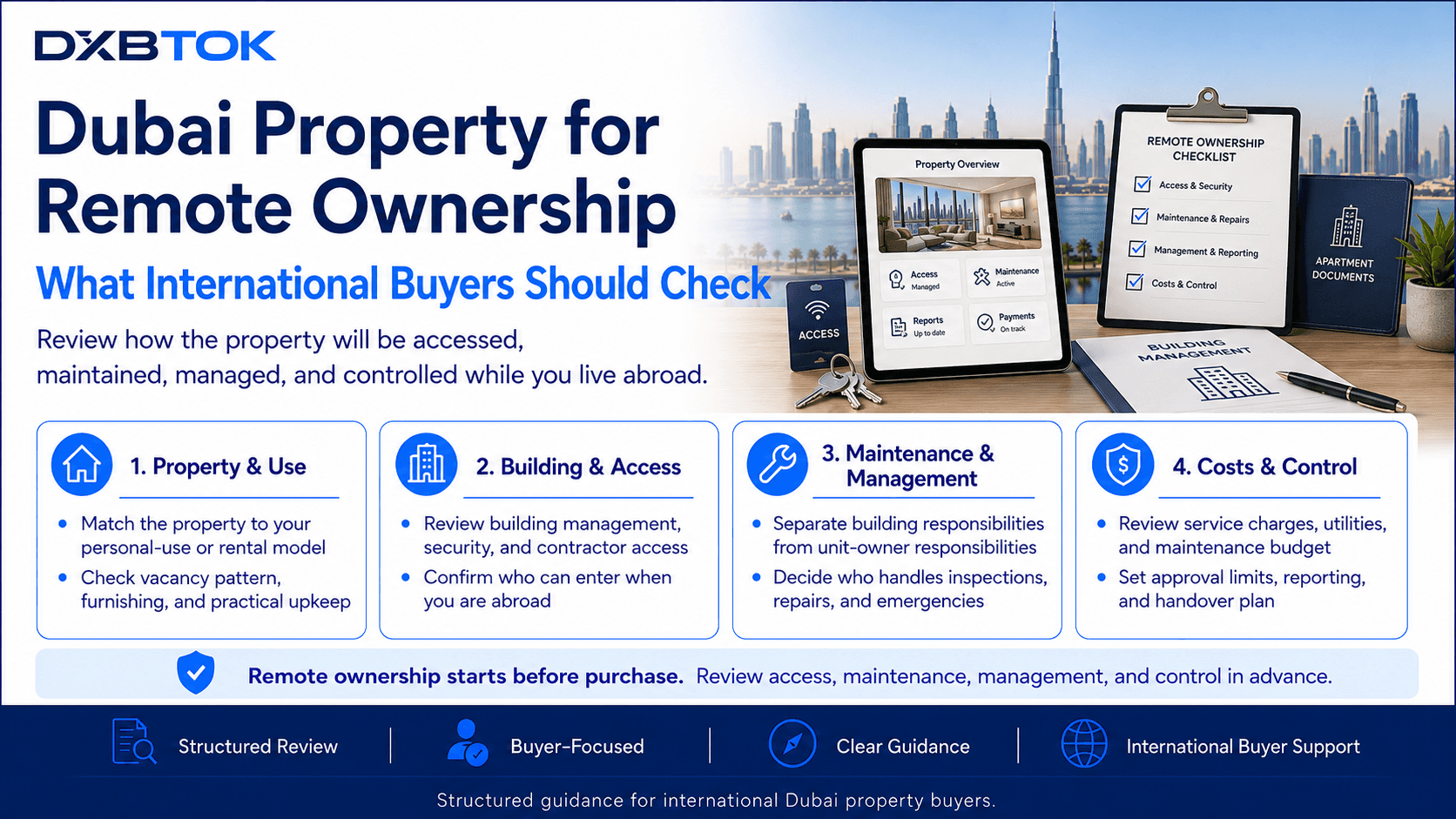
Dubai Remote Ownership Property Checklist
Property
Property type suits remote ownership
Exact maintenance responsibility understood
Unit condition reviewed
Furnishing complexity considered
Access arrangements checked
Building / Community
Building manager identified
Owner communication process understood
Security/access process reviewed
Contractor procedures checked
Service charges reviewed
Local Support
Property-management need assessed
Maintenance provider identified
Emergency contact arranged
Inspection process planned
Spending authority defined
Documents
Ownership file established
Service-charge records retained
Utility details stored
Maintenance records retained
Management contracts documented
Use
Personal-use plan defined
Rental strategy defined if applicable
Vacancy periods considered
Arrival/cleaning process planned
Handover
Snagging plan prepared
Key collection arranged
Utility setup planned
Property inspection responsibility defined
Financial Control
Recurring-cost budget prepared
Maintenance authorization process defined
Invoice verification process established
Payment records retained
How DXBTOK Approaches Property for Remote Ownership
A remote-owner property should not be selected using only:
location → price → view → buy.
A stronger process is:
define how you will use it → understand the maintenance responsibilities → review building operations → calculate recurring costs → establish local access → plan management → prepare handover → confirm how the property will be controlled from abroad
The objective is not to find a property that requires no work.
That property does not really exist.
The objective is to choose a property where the work can be understood, delegated and monitored.
Final Takeaway
Dubai property can be owned from abroad.
But buyers should think about remote ownership before the transaction rather than after handover.
The most important questions include:
Who can access the property?
Who handles maintenance?
What does building management cover?
What recurring costs apply?
Do I need a property manager?
How will emergencies be handled?
What happens if the property is vacant?
Who manages handover?
How will I receive evidence and reporting?
The key question is not:
“Can I own Dubai property while living abroad?”
It is:
“Is this exact property operationally suitable for the way I intend to own it from abroad?”
Need Help Comparing Dubai Property for Remote Ownership?
DXBTOK helps international buyers compare Dubai properties from a remote-owner perspective, including property type, practical management needs, recurring costs, handover considerations and the questions that should be clarified before moving forward.
Contact DXBTOK and let us help you compare properties that fit your ownership model more clearly.
Related DXBTOK guides
How to Verify a Dubai Real Estate Broker →