Buying Buy-to-Let Property in Dubai: How Investors Should Select the Right Unit


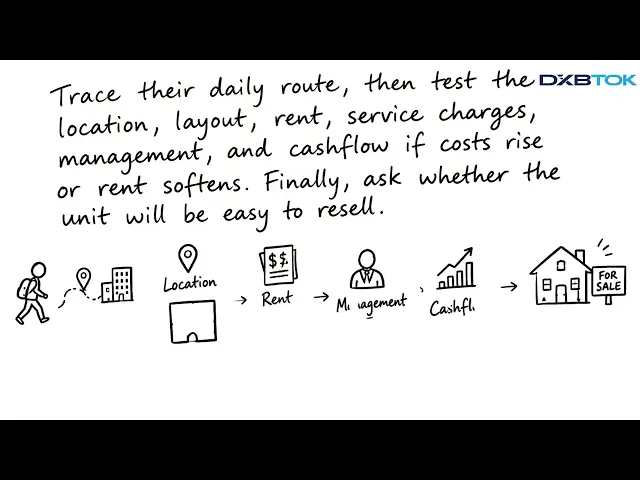
A beautiful apartment can be a weak rental purchase if it attracts the wrong tenant, costs too much to maintain or becomes difficult to resell. This guide approaches Dubai buy-to-let as a unit-selection decision, weighing the future occupant, building operation and ownership constraints before committing capital.
Buying Buy-to-Let Property in Dubai: How Investors Should Select the Right Unit
Buying a property in Dubai to rent out is different from choosing a home for personal use. A visually attractive apartment may not offer the location, configuration, operating costs or flexibility that make it suitable for a particular tenant market.
Two units in the same building can have very different rental prospects. Their floor plans, views, purchase prices, service-charge exposure and appeal to future tenants may be sufficiently different to affect both the income an owner can realistically collect and the ease of selling the property later.
For international investors, the useful question is not simply which Dubai apartment is advertised with the highest rental return. It is which specific unit offers a credible match between tenant demand, purchase commitment, ongoing management and the investor's intended holding period.
1. What Is Buy-to-Let Property in Dubai?
Buy-to-let property is residential real estate purchased primarily to generate rental income rather than serve as the owner's main home.
A buyer may purchase a completed apartment with an existing tenancy, a vacant unit intended for immediate letting or an off-plan property expected to become available for rent after handover.
Each route creates different practical and financial considerations.
An already rented apartment may provide an existing income arrangement, but the purchaser must understand the tenancy terms and whether the rent reflects current market conditions.
A vacant completed apartment offers more direct evidence of the physical property but may require time, furnishing or expenditure before a suitable tenant is secured.
An unfinished property introduces delivery risk and a waiting period before any rental operation is possible.
The buyer's decision must therefore begin with the exact asset being acquired, not with a general promise about Dubai rental demand.
2. Start With the Tenant You Want to Attract
A buy-to-let apartment should be selected with a realistic future tenant in mind.
Dubai has different residential audiences, including professionals living alone, couples, families, residents seeking proximity to employment centres and tenants who prioritise larger homes in established communities.
These groups do not necessarily want the same apartment or building.
A compact unit with efficient access to transport may appeal to someone who values convenience and manageable monthly housing costs.
A family may place greater importance on bedroom configuration, storage, parking, nearby schools and the availability of outdoor space.
A premium apartment may serve another audience entirely, but the higher purchase price must be weighed against the depth of demand for that category.
The strongest property is not the one designed to appeal to everyone. It is the one whose features make sense for a sufficiently credible tenant audience.
3. Why Tenant Demand Must Be Evaluated Locally
General statements about a growing Dubai population or a strong rental market cannot establish demand for one building.
Rental demand is influenced by location, affordability, competing units, building quality and the needs of residents in that particular market segment.
Two neighbouring buildings may have different leasing outcomes because one has more efficient layouts, better management or significantly higher asking rents.
Buyers should distinguish advertised rental listings from evidence of completed leases and actual occupancy.
Dubai Land Department maintains rental-related information and a Rental Index that can provide regulatory context, particularly for rent-increase assessments.
However, the index is not a guarantee of the amount a newly purchased apartment can achieve with a new tenant.
A credible rental estimate should reflect the specific property and current comparable leasing evidence, rather than simply reproducing an area's advertised average.
4. Which Dubai Locations May Suit Buy-to-Let Investors?
Location matters because it affects which tenants a property can serve and how easily it competes with available alternatives.
Different Dubai locations can offer very different characteristics:
Established central districts: proximity to offices, lifestyle amenities and existing services may attract tenants who value convenience.
Master-planned residential communities: communal facilities and family-oriented environments may appeal to residents seeking a defined neighbourhood experience.
Emerging development areas: newer homes may offer different entry prices, but the timing of additional supply and amenities deserves attention.
Waterfront and premium districts: location and lifestyle can support a higher-end proposition, although the acquisition cost and tenant audience may also be more specialised.
None of these location types guarantees stronger rental performance.
The relevant comparison is whether the property suits the tenant profile at a purchase price that leaves room for operating expenses and market uncertainty.
A buyer should not choose an area merely because it appears on a list of high-yield neighbourhoods.
5. Studio, One-Bedroom or Two-Bedroom: Which Unit Works Best?
Unit configuration is one of the most important factors in a Dubai rental-property purchase.
Studios can have a lower total purchase price than larger apartments within the same project, but that does not automatically make them the better investment.
One-bedroom apartments may appeal to individuals or couples who want separate living and sleeping space.
Two-bedroom units can serve households requiring an additional bedroom, a home office or more flexibility.
Three-bedroom apartments and villas may target families and larger households with different affordability and location priorities.
Each configuration has its own purchase cost, tenant audience, likely maintenance requirements and resale competition.
The better choice depends on whether the property's design and location create credible demand for the intended tenant type.
6. Why the Floor Plan Matters More Than the Bedroom Count
Two one-bedroom apartments may have the same advertised area while providing very different living experiences.
One could offer a spacious bedroom, usable storage and a practical living area. Another might allocate a substantial proportion of its measured space to corridors or awkward corners.
For tenants, usability can be more important than the number displayed on the marketing floor plan.
Relevant details include:
Whether the living and sleeping spaces are genuinely functional.
Availability of built-in storage.
Kitchen design and appliance placement.
Bathroom access and ventilation.
Balcony size and practical usability.
Natural light and internal orientation.
Furniture placement and circulation space.
Any unusual features that make the unit difficult to furnish or maintain.
An efficient apartment may be easier to rent and more appealing at resale, even when a competing unit has slightly more nominal space.
7. Floor Level, View and Orientation Can Affect Rental Appeal
Buy-to-let investors should assess the unit's position within the building, not only the development's general location.
View, privacy, noise, sunlight and proximity to communal facilities can influence how potential tenants perceive an apartment.
A higher-floor unit may command a purchase premium because of its outlook. However, that premium is only commercially useful if the benefits justify the extra capital and are relevant to future occupants.
Some tenants may value an unobstructed view highly, while others prioritise lower rent, easier access or a more practical floor plan.
Orientation can also affect comfort, solar exposure and the usability of balconies.
Investors should avoid assuming that the most expensive view always generates a proportionately higher rent.
The exact unit should justify its price through benefits that matter to a real tenant audience.
8. Why Parking and Everyday Access Matter
Parking allocation and building access can materially influence the convenience of a rental property.
A unit aimed at professional tenants may be less attractive if parking arrangements do not suit their needs or if access involves significant delays.
Families may require additional parking or easier movement between the apartment, lifts and communal facilities.
The buyer should understand what parking rights are included with the unit and whether those rights are reflected appropriately in the property information.
Other everyday considerations include:
Reliability and capacity of lifts.
Practicality of visitor access.
Building security and reception procedures.
Connections to main roads and transport.
Delivery and maintenance access.
Suitability for tenants with children or mobility requirements.
These details rarely appear in a projected rental-return percentage, yet they can influence a tenant's willingness to choose or renew a lease.
9. Should Investors Buy a Ready or Off-Plan Rental Property?
Completed and off-plan properties offer different levels of certainty.
A completed apartment allows a buyer to assess the actual unit, building condition, current surroundings and, where relevant, existing tenant arrangements.
Potential rental use may begin sooner, subject to completion of the purchase and any required preparation.
An off-plan property may provide access to a newer development or a staged payment schedule, but its future rental performance remains dependent on completion, delivered quality and market conditions at handover.
Early purchase does not establish that the future apartment will be easier to rent than competing completed homes.
A projected rental figure for an unfinished building should therefore carry more uncertainty than evidenced rental arrangements for an existing unit.
The investor should compare not only purchase prices but also the period before potential income begins and the financial obligations that arise in the meantime.
10. Buying an Apartment With an Existing Tenant
A tenanted apartment may appeal to a buy-to-let investor because it already has a rental relationship.
However, the buyer should understand what that relationship actually provides.
Important considerations include the current annual rent, lease commencement and expiry, payment terms, any relevant deposit arrangement and the allocation of outstanding amounts.
Dubai's tenancy framework provides that a transfer of ownership does not extinguish a qualifying fixed-term tenant's right to continue occupying the property under the existing lease.
That means the purchaser should not assume they can immediately replace the tenant or reset the rent simply because the title changes hands.
The buyer should also consider whether the existing rent is below or above the amount currently sought for comparable vacant properties and whether future changes are legally and commercially realistic.
An apartment that is already rented is not automatically a better investment. Its tenancy must suit the intended holding and income strategy.
11. Vacant Property Versus Tenanted Property
Vacancy and existing occupancy present different acquisition trade-offs.
A vacant property can give the buyer more flexibility to inspect, furnish and present the apartment to the intended tenant market.
However, no rental income is received during the period before a tenancy begins.
An occupied property can provide an established rental arrangement, but the investor inherits the relevant contractual context and may have less immediate flexibility over use or repositioning.
The price of each property should reflect those differences.
For example, a tenanted unit with a long remaining lease and modest rent may not be economically comparable with an identical vacant apartment being marketed at a higher rental level.
Neither situation is universally preferable. The decision depends on the investor's need for immediate income, rental strategy and expected ownership period.
12. How Important Is the Building's Quality for Rental Demand?
A suitable apartment can still be disadvantaged by poor building management or deteriorating common areas.
Tenants experience the building as well as the individual unit.
Lift reliability, cleanliness, security, communal amenities, maintenance response and the condition of corridors and entrances can influence satisfaction.
These factors may also affect whether tenants remain for another rental period.
A premium building is not necessarily the best rental investment if the price premium and recurring costs are too high relative to its actual rental appeal.
Likewise, a more affordable building is not necessarily poor value if its facilities are appropriately maintained and meet the expectations of the intended tenant audience.
The investor should compare the building's operating environment with its cost rather than judging either factor in isolation.
13. Service Charges Can Change the Investment Decision
Building service charges represent an ongoing cost of owning many Dubai apartments and jointly owned properties.
They can fund shared management and operation, security, cleaning, maintenance and other approved common-property expenditure.
Two similarly priced units in the same neighbourhood may carry substantially different annual charges.
Dubai Land Department provides a Service Charge Index that allows approved fees for jointly owned properties to be reviewed by project, use and year.
However, the approved charge and any outstanding arrears against a particular unit are separate matters.
Our Dubai property service-charge review guide explains how to assess the approved rate, annual ownership amount, building services, historical changes and outstanding balances when comparing individual units.
A building with more amenities may justify some additional expenditure, but the investor must consider how much of that cost is reflected in achievable rent and how much remains the owner's responsibility.

14. Why Unit-Level Maintenance Must Be Considered Separately
Building service charges do not remove the owner's responsibility for every maintenance issue inside a rental apartment.
Depending on the property and applicable tenancy arrangements, owners may face expenditure relating to air-conditioning components, plumbing, electrical systems, appliances, internal finishes and other repairs.
A newly completed apartment can still require maintenance after handover. An older unit may require more substantial initial work or replacement of worn components.
The investor should understand the current condition, relevant warranties and expected operating demands of the unit.
Maintenance exposure also differs between a compact apartment, a large villa and a furnished property with specialist equipment.
An attractive purchase discount may lose much of its benefit if significant repairs are required before the property can be rented competitively.
The condition of the exact asset matters more than a general statement about the building's age.
15. Furnished or Unfurnished: Which Unit Is More Suitable?
Furnishing decisions depend on the intended tenant segment and the way the property will be let.
Some tenants value a ready-to-occupy furnished apartment, while others prefer to use their own furniture in a longer-term home.
Furnishing introduces additional upfront costs and the need to maintain and replace items over time.
Highly customised furniture may create a visually impressive listing but become difficult to repair or replace, particularly for an overseas owner.
An unfurnished apartment may reduce some of those operating requirements but will not suit every tenant audience.
The purchase decision should therefore consider the unit's dimensions and layout as well as whether the preferred furnishing approach is commercially sensible.
Furnishing should be viewed as part of the property's operating model, not as a guaranteed way to increase rent.
16. Long-Term Rental or Holiday Home?
Some Dubai investors consider conventional residential tenancies, while others explore short-term furnished accommodation.
These are distinct operating approaches with different occupancy patterns, management requirements and regulatory obligations.
A conventional tenancy may involve a longer contractual relationship with fewer routine turnovers.
A holiday-home operation generally requires more frequent guest management, cleaning, furnishing, pricing and property preparation.
Dubai's Department of Economy and Tourism regulates the holiday-home activity, and a unit's suitability for short stays must not be assumed simply because it is a residential apartment.
Our Dubai holiday-home versus long-term rental guide explains how the two models differ in occupancy, owner involvement, licensing, furnishing and operating costs.
For an investor whose main objective is buy-to-let acquisition, the intended operating route should influence the unit choice before purchase.
17. Can Every Dubai Apartment Be Used as a Holiday Home?
No. A buyer should not assume that short-term letting is automatically permitted or practical for every residential property.
The relevant Dubai holiday-home framework, permitted use, building arrangements and operator requirements all matter.
Even where a unit can qualify for short-term accommodation, the building's access procedures, layout, guest facilities and management arrangements may make it more or less suitable.
An apartment that works well for an annual tenancy may be inconvenient for frequent guest arrivals or ongoing housekeeping.
Our guide to buying Dubai property for holiday-home use explains how access, building suitability, practical operations and the intended guest profile should influence the acquisition decision.
An advertised short-term rental projection is not sufficient evidence that a specific unit can legally and profitably operate in that format.
18. Why Rental Income Forecasts Should Not Decide the Purchase Alone
Property advertisements sometimes feature an estimated annual rental amount or percentage return.
These figures can provide a starting point for discussion, but the buyer should distinguish actual contracted rent from asking prices and future projections.
Rental income depends on whether a suitable tenant can be found, the time required to secure occupancy and the agreed lease terms.
It may also change as the property ages, competing supply increases or tenant preferences evolve.
The purchase price must make sense even if the achievable rent is lower than the advertised projection.
For this article, the central issue is not how to calculate every rental-yield metric. It is whether the apartment's features, location and ownership obligations support a credible rental proposition.
A good buy-to-let decision begins with the suitability of the property and uses income estimates as evidence to be tested, not as a promise.
19. Example: Two Apartments at Similar Purchase Prices
Consider two hypothetical Dubai apartments, each offered for AED 1.5 million.
Apartment A has a functional layout, moderate building costs and access to amenities relevant to its intended tenant market.
Apartment B has a more impressive view and extensive shared facilities, but higher annual service charges and a less practical internal layout.
Suppose both are marketed with projected annual rent of AED 110,000.
It would be incorrect to assume they offer an equivalent investment outcome.
Apartment B may require more annual expenditure while its rental premium remains uncertain. Apartment A may be less visually impressive but attract tenants who value space and everyday convenience.
The comparison should also consider actual comparable rent evidence, maintenance, furnishing, vacancy and future resale demand.
This example is illustrative and does not describe prevailing rental prices for a named Dubai building.
It demonstrates why the property itself matters more than a matching advertised rental figure.
20. What Does a Realistic Annual Ownership Budget Include?
A buy-to-let investor should evaluate the complete financial burden of acquiring and operating the property.
Relevant costs may include:
Property purchase price and applicable transaction charges.
Mortgage setup and repayment obligations where relevant.
Annual service charges.
Unit-level maintenance and repair allowances.
Property management and leasing-related expenses.
Furnishing and replacement costs where applicable.
Insurance and any necessary operating expenses.
Vacancy periods and tenant turnover costs.
Currency-conversion costs for overseas-funded purchases.
Some items are fixed contractual obligations. Others are variable or estimates.
Our guide to comparing total costs between Dubai properties explains how acquisition expenses, recurring charges, financing and property-specific operating costs can change which apartment is more attractive to own.
A rental property can have appealing gross income and still produce disappointing owner cash flow if its cost structure is too high.
21. Why Vacancy and Tenant Turnover Matter
Even a well-positioned property may experience periods without rental income.
A tenant may leave at the end of a lease, a property may require repairs before reletting, or market conditions may require a change in asking rent.
Vacancy creates a gap between potential annual rent and the amount actually collected.
Some ownership expenses continue during that gap, including service charges and any mortgage obligations.
Tenant turnover may also create leasing, maintenance, cleaning or furnishing expenses.
For an investor relying on rental income to meet financing or other commitments, those interruptions can become significant.
Buyers should assess whether the property remains affordable if the initial tenancy takes longer than expected or if the apartment is vacant between rental periods.
Consistent occupancy should be treated as an objective, not a guaranteed characteristic of any Dubai property.
22. How Does Mortgage Financing Affect Unit Selection?
Mortgage financing can change both the amount of cash required to buy an investment property and the obligations that continue after completion.
Borrowing eligibility, permitted financing amounts and final approval depend on the relevant lender, borrower and property.
A property that appears affordable based on a preliminary mortgage illustration may require additional cash if the lender's valuation or financing decision differs from the buyer's assumptions.
For a rental investment, monthly mortgage obligations also need to be supported when rent is lower than expected or not collected.
Future interest or profit-rate changes may affect repayments under variable-rate products.
An off-plan investment may create an additional timing issue if the buyer expects bank financing to become available at a later stage.
The investor should not select a property that only works financially if future financing and uninterrupted rental income both materialise exactly as expected.
23. Should International Investors Use a Property Manager?
For an owner living outside the UAE, rental-property management can be a central part of the investment proposition.
A local manager may handle tenant communication, access, inspections, maintenance coordination, lease administration and reporting, depending on the agreed service.
However, property management is not one standard product. Companies may offer different levels of involvement and charge for different activities.
The owner should understand who has authority to act, which costs require approval and how money and documents are controlled.
Our Dubai property management guide for overseas owners explains how to assess local support, management authority, reporting, maintenance responsibilities and financial controls before relying on a manager.
A property that is difficult or costly to operate remotely may be less attractive to an international buyer than a comparable unit with a clearer management structure.
24. Why Building Management and Property Management Are Different
Building management normally concerns the operation of the wider building or jointly owned property.
That may include common-area maintenance, lifts, security, shared facilities and building-level administration.
A rental property manager acts for an individual owner under the agreed management arrangement.
The two parties can have different responsibilities.
For example, a malfunctioning common-area lift may be a building-management issue, while arranging a contractor to repair an appliance inside a rented apartment may fall within the owner's property-management arrangement.
A buyer should understand where these responsibilities begin and end.
Weak communication between the owner, tenant, property manager and building manager can create practical difficulties, particularly where the owner lives abroad.
Ease of management should influence the property's suitability from the beginning of the buying process.
25. How Can Future Supply Affect Tenant Competition?
New buildings can increase the number of similar properties available to tenants.
That may matter particularly in locations where several large developments are scheduled to complete within a relatively short period.
More residential supply does not automatically mean rents will fall, because demand and the types of homes delivered also matter.
However, investors should consider whether their apartment will need to compete with newer units, additional amenities or different rental terms.
A newly completed property may initially benefit from its modern specification, but that advantage can change as more projects become available.
Established communities may offer a clearer picture of current amenities and tenant demand, while emerging communities can involve more uncertainty about their future operating environment.
The best buy-to-let property is not necessarily in the area with the most development activity or the least construction.
It is the property whose competitive position makes sense for its purchase price and intended tenant audience.
26. Why Resale Flexibility Matters to a Rental Investor
A buy-to-let purchase should be evaluated not only for its potential rental use but also for the possibility that the owner may want to sell.
Financial circumstances, investment priorities and property-market conditions can change during ownership.
An apartment with an unusual layout, high recurring costs or a narrow tenant audience may also appeal to a narrower range of future purchasers.
Conversely, a practical unit in a well-maintained building may serve both owner-occupiers and investors, although future demand and pricing remain uncertain.
For a tenanted property, existing lease arrangements can affect when a new purchaser may obtain possession or change the property's use.
The investor should therefore consider who the likely future buyer might be and what alternatives that buyer would have.
A property's potential resale flexibility belongs in the purchase decision from the beginning, even when the main objective is rental income.
27. When Is a Buy-to-Let Property Unsuitable?
A property may be unsuitable for a rental-investment strategy even when it is attractive, well located or marketed by a reputable seller.
Potential warning signs include:
The projected rent is unsupported by relevant market evidence.
The unit's layout does not suit a clear tenant audience.
Annual service charges absorb too much of the expected income.
Immediate repairs or furnishing costs are underestimated.
The buyer depends on uninterrupted occupancy to meet financing payments.
The building's management or operating condition is concerning.
Short-term rental use is assumed without confirming its suitability.
Existing tenancy obligations do not fit the intended ownership strategy.
The purchase price relies on speculative appreciation.
The unit may be difficult to resell because of specialised features or competing supply.
The overseas owner has no reliable plan for managing the property.
These warning signs do not automatically disqualify every property. They indicate that the purchaser needs a stronger explanation of why the investment makes sense.
A buy-to-let decision should not depend on a collection of optimistic assumptions all proving correct.
28. How Should Buyers Compare Three Rental Property Candidates?
After identifying a realistic tenant audience and purchase budget, investors can compare shortlisted units on a consistent basis.
Comparison factor | Buyer question |
|---|---|
Tenant fit | Who is most likely to rent this exact unit? |
Unit configuration | Does the layout suit that tenant's daily needs? |
Location | What makes the property useful relative to alternatives? |
Rental evidence | Is the expected rent supported by relevant leases or market information? |
Building condition | Does the building meet reasonable operating expectations? |
Purchase commitment | What is the complete acquisition cost and funding requirement? |
Recurring costs | What service, maintenance and management costs apply? |
Vacancy risk | Can the owner afford periods without rental income? |
Remote operation | Can the unit be managed reliably if the owner lives abroad? |
Resale flexibility | Who might buy this property if the owner decides to sell? |
The aim is to compare properties that genuinely suit the investor's objective rather than choose the apartment with the most impressive promotional projection.
A lower-priced unit may be preferable if its costs and practical disadvantages are sufficiently understood. A higher-priced unit may also be justified when its benefits are relevant and proportionate.
The investment case must be specific to the property, not borrowed from the wider Dubai market.
29. What Should Be Clear Before Committing to a Buy-to-Let Purchase?
Before a property moves from the shortlist into an actual purchase commitment, the investor should have a clear view of the precise unit, seller or developer, purchase price and relevant documents.
For a completed rental apartment, occupancy status, physical condition, building charges and any existing tenancy arrangements are especially important.
For an off-plan investment, the payment schedule, development status, completion provisions and future operating assumptions require attention.
Any promised rental-management arrangement, furnishing package or income guarantee should be assessed according to its actual contractual terms.
The buyer should also distinguish what has been independently confirmed from what remains a projection or marketing statement.
Choosing the right buy-to-let property is only useful if the transaction ultimately transfers the intended asset on understandable terms.
Unresolved inconsistencies involving the unit, price, ownership position or payment arrangements should not be ignored merely because the expected rental income looks attractive.
30. Buying Buy-to-Let Property in Dubai: Final Buyer Considerations
The best Dubai buy-to-let property is not necessarily the cheapest unit, the apartment with the most amenities or the listing showing the highest projected rental percentage.
A stronger acquisition decision begins with the likely tenant and works backwards to the location, layout, building and purchase price that suit that audience.
Service charges, maintenance, vacancy, financing and management requirements can materially change the property's attractiveness after purchase.
Investors should also consider the property's appeal to future buyers, especially if financial or personal circumstances change during ownership.
DXBTOK helps international buyers compare selected Dubai property opportunities through clearer commercial information and structured buyer support. Appropriately licensed brokers, developers, lenders, property managers and qualified professionals handle the relevant specialised transaction and operating requirements.
The objective is to choose a specific Dubai property that works as a rental asset under realistic assumptions, rather than purchasing a headline return without understanding the unit behind it.
Related DXBTOK Guides
Dubai Property Buyer Due Diligence Checklist →
Completed Dubai Property: What to Check Before Buying →
Dubai Property for Remote Ownership: What Buyers Should Check →
Full Cost of Buying Dubai Property: What International Buyers Should Budget →
Dubai Off-Plan vs Ready Property: Which Is Better for Buyers? →


