Best Off-Plan Projects in Dubai: How Buyers Should Compare Current Developments


A striking render does not show whether the finished home will justify its price. Recent Dubai launches range from central apartments to waterfront villas and emerging master communities. This guide compares developments by intended use, completion exposure and exact-unit terms, without declaring a universal winner.
Best Off-Plan Projects in Dubai: How Buyers Should Compare Current Developments
Searching for the best off-plan projects in Dubai can produce dozens of attractive developments, each promoted through architectural renders, payment plans, location claims and projected future benefits. But a popular project or recognisable developer is not automatically the strongest purchase for every buyer.
Current Dubai developments range from apartments in central urban districts to suburban family communities and high-value waterfront residences. They differ substantially in entry price, unit configuration, construction stage, intended occupants and the amount of capital required before completion.
For international buyers, the useful starting point is to compare real development opportunities against a defined purchase objective. A project should earn its place on the shortlist through suitable units, supportable pricing, credible delivery information and workable contractual terms, not simply because it appears in a best-projects ranking.
1. What Makes an Off-Plan Project One of the Best in Dubai?
There is no single best off-plan development for every property buyer.
A purchaser seeking a long-term family residence may prioritise internal space, schools, transport, outdoor amenities and the maturity of the surrounding community.
An investor looking for future rental income may evaluate the expected tenant audience, acquisition price, competing supply and ongoing ownership costs more heavily.
A buyer intending to spend only part of the year in Dubai may place greater importance on accessibility, building management, security and the practicality of owning the property from overseas.
The strongest development is therefore the one that fits the intended use while offering a sensible balance of price, delivery confidence and future flexibility.
Brand recognition, marketing visibility and attractive design matter, but they are not sufficient evidence of a good purchase.
2. Which Current Dubai Off-Plan Developments Are Worth Comparing?
Several established developers have active residential communities or recently announced phases that illustrate the range of choices available to Dubai buyers.
The following examples are based on official developer information available in October 2026. They are not a performance ranking, a recommendation to purchase or confirmation that units remain available.
Development | Developer / Location | Main comparison angle |
|---|---|---|
The Oasis | Emaar — Dubailand | Premium villas, large-scale master planning and future community amenities |
Sobha Hartland II | Sobha Realty — MBR City | Apartments and villas within a substantial mixed-use community |
City Walk Crestlane | Meraas — City Walk | Urban apartments near an established retail and lifestyle district |
Belgravia Gardens | Ellington — Dubailand | Design-led apartments, layouts and community amenities |
Bay Estate | Nakheel — Dubai Islands | Waterfront villas and townhouses in a developing island destination |
Nad Al Sheba Gardens, Phase 7 | Meraas — Nad Al Sheba | Family villas and townhouses with a defined construction phase |
These developments serve different markets. Comparing their names alone would be misleading because an apartment in City Walk and a substantial villa at Dubai Islands do not satisfy the same buyer requirements.
Each development also contains individual phases or buildings. A public announcement about the wider project should not be assumed to establish the availability, completion date or commercial terms of a particular unit.
3. Emaar The Oasis: Premium Villas and Master-Community Planning
The Oasis by Emaar is a premium residential master community in Dubailand, positioned around villas, larger homes, waterways and planned lifestyle infrastructure.
It is a useful comparison example for buyers considering substantial residential space and a master-planned environment rather than a compact apartment investment.
Its appeal depends partly on whether the purchaser values the intended community concept, property type and longer-term living environment.
Buyers should distinguish the overall masterplan from the specific residential release being offered.
Important comparisons include the villa's land and built-up area, layout, position, payment commitments, phase completion date and the timing of surrounding facilities.
A major developer and an ambitious masterplan can support buyer confidence, but neither makes an individual home automatically good value.
4. Sobha Hartland II: Apartments and Villas Within MBR City
Sobha Hartland II is a large mixed-use residential community in Mohammed Bin Rashid Al Maktoum City.
Sobha Realty describes residential clusters that include Riverside Crescent, Skyscape and Skyvue, alongside luxury villa offerings and planned recreational spaces.
The project is relevant to buyers comparing more centrally connected apartments with homes in newer, master-planned environments.
However, a development of this scale cannot be evaluated using one completion date or one average price.
Different towers, phases, views and apartment layouts may have different delivery positions and commercial terms.
The buyer should compare the particular residence against other apartments of similar size and quality, including completed alternatives where relevant.
Construction announcements and developer-level delivery statistics provide context, but the individual building's official status remains important.
5. Meraas City Walk Crestlane: Urban Living and Location Premium
City Walk Crestlane offers a different proposition because its location is connected to an established central Dubai lifestyle district.
In September 2026, Meraas announced a main construction contract for Phase 3 covering 394 apartments across four buildings, with anticipated completion in the third quarter of 2028.
That provides a dated reference point for this particular announced phase, not a guarantee about every unit or another Crestlane release.
Buyers considering Crestlane should compare the price premium attached to its location with the practical advantages of being near City Walk's existing retail, dining and public spaces.
Apartment configuration, orientation, building position and proximity to the district's activity can materially affect the value of a specific property.
A central address may suit some owner-occupiers or tenants particularly well. It does not remove the need to compare the asking price and ownership costs against existing nearby homes.
6. Ellington Belgravia Gardens: Design-Led Apartments in Dubailand
Belgravia Gardens by Ellington is an off-plan residential development in Dubailand focused on apartment living and shared recreational amenities.
The developer's project information describes studios and multi-bedroom layouts, landscaped communal spaces, fitness facilities and family-oriented amenities, with an advertised handover target of the third quarter of 2028.
It is relevant to buyers who place considerable weight on internal design, usable layouts and community facilities.
However, amenities have to be assessed alongside the proposed service-charge burden and how often the purchaser or tenant will actually use them.
A property with attractive shared facilities may still be less suitable if its unit layout, surrounding access or total purchase price does not fit the buyer's requirements.
Buyers should also reconfirm which apartment types are part of the exact release and whether current payment terms match the published development material.
7. Nakheel Bay Estate: New Waterfront Development at Dubai Islands
Nakheel unveiled Bay Estate at Dubai Islands on 5 October 2026 as a gated waterfront residential community.
Its announced plan includes approximately 360 three- and four-bedroom homes, alongside waterfront and beachfront plots.
That makes Bay Estate an example of a more specialised coastal residential proposition, rather than a directly comparable alternative to a centrally located investment apartment.
Waterfront access, lifestyle positioning and the wider island masterplan may be central to its appeal.
But buyers should distinguish amenities already available from those intended for later stages of the surrounding development.
They should also establish which residential collection is being considered, whether any specific property is available and how access, construction timing and community management are expected to develop.
As of this article's October 2026 review, the announcement should not be treated as confirmation of an individual unit's available price or handover date.
8. Nad Al Sheba Gardens: A Family-Home Development Comparison
Nad Al Sheba Gardens by Meraas offers an example of a gated residential environment aimed more directly at buyers seeking villas and townhouses.
On 24 September 2026, Meraas announced an approximately AED 1 billion construction contract for Phase 7, covering 272 villas and townhouses.
The developer stated that construction had commenced and anticipated completion in the second quarter of 2028.
This information is useful because it identifies a specific phase, announced construction scope and expected delivery period.
However, a construction contract does not confirm the terms of an individual property sale or eliminate completion risk.
Buyers should compare plot characteristics, building size, household requirements, neighbourhood access and the future cost of operating the property.
A villa may be better suited to a large family, while a smaller completed apartment could provide more immediate use and lower total capital exposure.
9. How Should Buyers Build a Useful Project Shortlist?
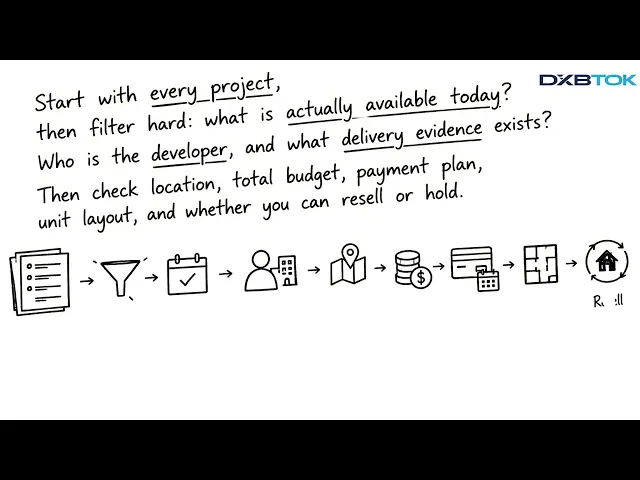
The best way to compare off-plan developments is to narrow the field before examining individual promotional offers.
A shortlist can start with four questions:
Purpose: Is the home for occupation, rental income, periodic use or a combination?
Capital: What is the maximum total purchase commitment, including fees and reserves?
Timing: When does the buyer need possession or potential rental income?
Risk: How much construction and market uncertainty can the buyer comfortably accept?
A buyer seeking a reasonably priced investment apartment should not automatically include luxury waterfront villas in the same final comparison.
Equally, a family looking for a substantial home should not prioritise a development simply because its entry-level apartments appear popular with investors.
Relevance is more useful than the number of projects on the list.
10. Compare the Developer's Experience With the Actual Project
Dubai developers differ in experience, property specialisation, construction scale and the types of communities they have previously delivered.
For an off-plan purchase, that matters because the buyer is committing capital before the final property exists.
Past projects may provide evidence about completed design quality, common-area execution and the developer's handling of delivery.
But past success is not a guarantee that a new project will meet every expectation or contractual date.
The comparison should also account for whether the developer's previous work is relevant to the project being considered. Experience with apartment towers is not identical to experience delivering an extensive low-rise villa community.
DXBTOK's guide to comparing Dubai developers before reserving off-plan property explains how buyers can assess delivery history, relevant experience, finished-project quality and current transaction terms on a consistent basis.
Developer confidence should support the project decision rather than replace it.
11. Why the Exact Unit Matters More Than the Project Brochure
Even after selecting a promising development, the buyer has not yet established whether the available unit is suitable.
Two apartments in the same tower may differ significantly in price because of floor level, orientation, balcony area, internal layout and views.
Similarly, two villas within one community may differ in plot size, privacy, position and proximity to communal amenities.
For a meaningful unit comparison, the property information should identify:
Exact unit number, building and project phase.
Property type and bedroom configuration.
Recorded saleable and relevant usable areas.
Floor or plot position and orientation.
Applicable parking allocation.
Specified finishes and included fixtures.
Current price and payment schedule.
Expected contractual delivery conditions.
A sample render does not establish the view or final arrangement of every property within a development.
A buyer should only compare an actual offer against alternative offers once the properties being compared are clearly identified.
12. Comparing Off-Plan Prices and Price Per Square Foot
Project marketing often uses starting prices to indicate the lowest advertised entry point.
However, the starting figure may apply to a property type, floor or inventory release that is no longer available or is not suitable for the buyer.
Price per square foot can provide an additional comparison measure, provided the area definitions are consistent.
For example, two apartments advertised at AED 1.8 million may have different sizes, layouts, outdoor spaces and usable room proportions.
The larger unit may appear cheaper per square foot, while the smaller one could have a more efficient floor plan or more desirable position.
Neither comparison proves the better purchase without examining the relevant building, property type and available alternatives.
Buyers should avoid comparing a villa's total plot area directly with an apartment's internal area as though those measurements represent equivalent usable property.

13. Compare New Developments Against Completed Alternatives
A new project should not be compared only with other promotional launches.
Completed homes in the surrounding market can offer useful evidence about current sale prices, physical standards, existing community facilities and observed demand.
In some cases, an off-plan apartment may carry a premium for newer design, a staged payment plan or anticipated future surroundings.
That premium may be commercially reasonable for a particular buyer, but it should be understood.
A ready property may offer more immediate use and direct inspection, while an off-plan home involves waiting for construction and comparing contractual promises with future delivery.
Buyers should evaluate these differences before deciding that newer automatically means better.
The strongest price comparison reflects what each property actually provides and the timing at which the buyer receives it.
14. How to Assess Location and Future Community Demand
The location of an off-plan development should be understood at both city and neighbourhood level.
Travel routes, nearby employment centres, schools, local services and the maturity of surrounding buildings can all influence the property's practical usefulness.
Established urban areas and emerging master communities offer different advantages.
An established district may already have substantial supporting infrastructure and visible patterns of resident activity.
An emerging area may offer newer homes and additional future amenities but create uncertainty around when the wider neighbourhood reaches its intended form.
Waterfront and branded developments can also command price premiums that depend partly on lifestyle positioning rather than rental fundamentals alone.
The better location is the one that matches the intended occupant or future buyer, not simply the project with the most striking masterplan.
15. Compare Developer Payment Plans as Financial Commitments
Off-plan payment plans affect how much money is required at each stage of the purchase.
A project with a relatively modest booking amount may still require substantial instalments before handover or a large final balance when construction is complete.
For example, consider two hypothetical properties priced at AED 2 million.
Under a 70/30 arrangement, AED 1.4 million of the purchase price would be due before or by the relevant pre-handover stages, with AED 600,000 allocated to the remaining contractual stage.
Under a 50/50 arrangement, the corresponding proportions would each represent AED 1 million.
Those calculations do not establish when each payment falls due; the detailed contractual schedule controls that.
Our Dubai off-plan payment-plan guide explains how booking payments, construction milestones, handover balances and extended instalment schedules can affect a buyer's liquidity throughout the purchase.
Payment flexibility is valuable only if the total price and every future obligation remain affordable.
16. Construction Progress, Handover Dates and Delivery Risk
The proposed completion date is a major factor when comparing unfinished developments.
A project nearing completion and a newly announced master community expose buyers to different remaining construction periods.
That does not mean a later-delivery project is inherently unsuitable. It means the buyer must understand the longer period before occupation or rental income becomes possible.
Dubai Land Department maintains official project information that can support independent verification of a development’s registration and reported construction progress, without guaranteeing its eventual completion date..
Published developer schedules, construction contract announcements and official status information should be assessed alongside the Sale and Purchase Agreement.
The relevant phase and project number matter; a broader masterplan may include buildings with different construction stages.
Our guide to delayed Dubai off-plan projects explains why a revised delivery date must be evaluated against the contract, recorded construction progress and official project status rather than treated as an automatic cancellation.
For each shortlisted development, buyers should understand what the completion estimate means and how a delay could affect their financial plans.
17. Newly Launched Projects Versus Later-Stage Developments
Early-phase launches and later-stage developments can create different buying conditions.
An early launch may provide more choice among initial layouts or positions, but relatively little completed-project evidence may exist.
A later-stage building may provide more observable construction progress or a clearer view of how the surrounding community is developing.
However, later releases can carry different prices and may have a narrower selection of available units.
Neither option automatically represents a superior investment.
Buyers also need to distinguish an officially announced project from an offer for a specific property that can presently be reserved.
DXBTOK's guide to Dubai project launches for remote buyers explains how to handle changing availability, current prices, exact-unit details and reservation pressure when a new development is released.
Being early is not a substitute for understanding the purchase terms, and being late does not automatically mean the best opportunities have disappeared.
18. Verify Project Registration and Escrow Arrangements
Before committing to an off-plan development, buyers should establish that they are dealing with the correct registered project and authorised transaction parties.
The official project identity, developer and escrow information should match the property and payment documents being presented.
Dubai's off-plan escrow framework is designed to regulate how qualifying buyer payments are held and used for the relevant development.
However, an escrow structure does not guarantee the completion date, future profitability or resale value of a property.
Project registration and payment verification are separate from assessing whether the property is commercially suitable.
The buyer should also understand the relevant provisional registration process and retain evidence of each transaction stage.
No development should win a shortlist solely because its marketing materials claim government approval without identifying what has actually been approved.
19. Which Off-Plan Projects May Suit Rental Investors?
Rental investors should begin with the likely future tenant, not a developer's projected return percentage.
An apartment close to established employment and transport links may serve a different rental audience from a large villa in a newer residential district.
The expected tenant profile affects the appropriate unit size, furnishing strategy, location and likely management requirements.
For an off-plan property, the buyer must also estimate when the unit could actually become available for occupation.
Expected rent should be evaluated against comparable properties and adjusted for potential vacancy, service charges, maintenance, management and other expenses.
Different buildings within the same development may command different rents after completion.
A famous project name or a large number of advertised amenities does not establish that future rental income will cover the purchase costs or financing obligations.
20. What Makes an Off-Plan Project Suitable for Long-Term Residence?
Owner-occupiers may place greater importance on everyday practicality than on projected investment performance.
Internal circulation, bedroom sizes, storage, noise exposure, parking and access to services can matter more than a dramatic exterior design.
For families, the future availability of schools, healthcare, public spaces and reliable transport may influence the suitability of a developing community.
Buyers should distinguish existing facilities from those planned within later masterplan stages.
They should also consider whether the property is large enough to remain comfortable as household requirements change.
A development can offer strong lifestyle appeal but still be unsuitable if the handover date does not fit the buyer's actual relocation plans.
Long-term residents should compare the quality and functionality of the home itself rather than judge the project primarily by its marketing prestige.
21. How Could Future Supply Affect Project Resale Potential?
Resale prospects depend partly on how an individual property will compete with other homes when the buyer eventually wants to sell.
A large master community may deliver several residential phases over an extended period.
That can help create an established destination, but it may also mean new units remain available while earlier buyers seek to resell.
Similarly, a premium waterfront project may attract a specialised buyer audience with different price expectations and holding periods from those of a mainstream apartment market.
Resale flexibility should therefore be assessed through the property's likely future competition, the price originally paid, the delivered specification and any contractual transfer conditions.
Buyers should not assume that being among the first purchasers automatically guarantees capital appreciation.
Future resale value is uncertain, even where the underlying masterplan is attractive.
22. Calculate the Full Cost of Each Development Opportunity
A property shortlist should reflect more than the agreed unit price.
Different developments can involve materially different transaction charges, instalment schedules and ongoing costs.
Relevant financial items may include:
Purchase price and any unit-specific premium.
Applicable Dubai Land Department registration charges.
Contractual administrative or other transaction fees.
Mortgage expenses where financing is used.
Final handover and property setup costs.
Furnishing and initial maintenance requirements.
Expected building service charges after completion.
Property-management expenses for rental or remote ownership.
Cash reserves for delays and unexpected expenditure.
For an off-plan property, some expenses may arise before the home is completed, while others begin when the buyer receives possession or the relevant ownership obligation starts.
The financial comparison should account for those differences in timing.
An apparently cheaper project can become a more expensive ownership proposition once all relevant costs are included.
23. How Can Buyers Score Several Projects Fairly?
A simple comparison scorecard can help buyers avoid selecting a project based on one impressive feature.
Consider applying the same categories to every shortlisted development:
Criterion | What to compare |
|---|---|
Property fit | Unit type, layout, space and intended use |
Location | Current amenities, accessibility and future surroundings |
Unit value | Exact price, usable area and relevant alternatives |
Developer evidence | Relevant past projects and delivered quality |
Project status | Official registration, construction and phase information |
Payment risk | Cash required at each stage and financing uncertainty |
Ownership costs | Service charges, management and future expenses |
Exit flexibility | Expected future competition and contractual resale conditions |
A buyer may assign more importance to some categories according to their own purpose.
For example, a household planning to occupy the property may prioritise usable space and local facilities, while an investor may place more weight on the entry price and future tenant market.
The scorecard does not generate a guaranteed return or identify a universally best project. Its purpose is to make the differences between offers visible and commercially meaningful.
24. What Should Be Confirmed Before Reserving an Off-Plan Unit?
After a project has been shortlisted, the decision moves from broad comparison to a particular property offer.
Before making a reservation payment, the buyer should receive clear information identifying the exact unit, agreed price, payment requirements and relevant conditions.
Additional attention should be given to whether the development information is current and whether the proposed payment recipient is appropriate for the actual transaction.
At this stage, important outstanding matters may include project registration, financing assumptions, contract provisions, completion commitments and the buyer's ability to fund later instalments.
The Dubai off-plan property buying checklist brings together the project, developer, escrow, contract, registration and handover issues that buyers should understand before moving from comparison to commitment.
A project may be highly attractive but still be unsuitable for immediate reservation when its current unit terms or transaction documents remain unclear.
25. Are the Most Popular Dubai Off-Plan Projects Always the Best Investment?
Popularity can signal market attention, but it is not the same as long-term investment value.
A widely promoted development may attract buyers because of its location, architecture, developer or launch campaign.
Those features can be commercially relevant, yet future performance will still depend on the purchase price, delivered quality, tenant or resident demand, competing supply and the cost of ownership.
A project receiving less publicity may be more suitable for a particular purchaser if it offers a better-fitting property at a more defensible price.
Investors should also distinguish promotional appreciation projections from realised market evidence.
No developer name, sales ranking or advertised return can remove the uncertainty attached to buying a property before completion.
The better investment candidate is the one supported by a stronger property-specific financial case, not necessarily the one receiving the most attention.
26. Best Off-Plan Projects in Dubai: Final Buyer Considerations
Dubai's off-plan market offers a wide range of development types, from urban apartments and design-led communities to family villas and new waterfront destinations.
The named developments in this guide demonstrate those differences, but they are not a universal ranking or a substitute for checking current project and unit information.
Buyers should define their purchase objective, narrow the shortlist to comparable homes and assess each offer through location, exact-unit value, developer evidence, construction stage, payment commitments and future ownership costs.
They should also reconfirm current availability, pricing and contractual conditions rather than relying on an older launch announcement.
DXBTOK helps international buyers compare selected Dubai property opportunities with clearer commercial information and structured support. Appropriately licensed developers, brokers and qualified professionals handle the relevant regulated transaction requirements.
The best off-plan project is not simply the newest or most expensive development. It is the project-and-unit combination that fits the buyer's intended use and remains commercially sensible under realistic financial and delivery assumptions.
Related DXBTOK Guides
Dubai Off-Plan vs Ready Property: Which Is Better for Buyers? →
Dubai Property Buyer Due Diligence Checklist →
Dubai Off-Plan Contract Terms: What Buyers Should Review →
Bank Transfer Safety for Dubai Property Buyers →
Dubai Property Service Charges: How Buyers Should Review Them →


