A projected Dubai handover date can affect final payments, relocation, rental plans and ownership setup, but buyers should not rely on one date from a brochure or sales conversation. Review what the stated timeline actually refers to, compare it with current project progress and the contractual completion framework, and allow practical flexibility before making financial or personal commitments around the expected handover.
Dubai Handover Timelines: What Off-Plan Buyers Should Check Before Buying
A projected handover date can materially affect an off-plan purchase.
It can influence when the buyer expects to make the final payment, move into the property, begin renting it, arrange finance, furnish the unit or start managing it from abroad.
But a handover timeline should not be treated as one fixed date taken from a brochure or sales message. Buyers should understand what the stated date actually refers to, how it compares with current project progress, how completion is addressed in the transaction documents and how much uncertainty remains before the property is genuinely ready for handover.
If the timing reference first appeared in marketing material, start by separating the delivery statement from the wider presentation using the Dubai off-plan project brochure guide.
The useful question is not simply “When is handover?” It is “What evidence supports the current timeline, what does that date actually mean, and how much flexibility should I allow around it?”
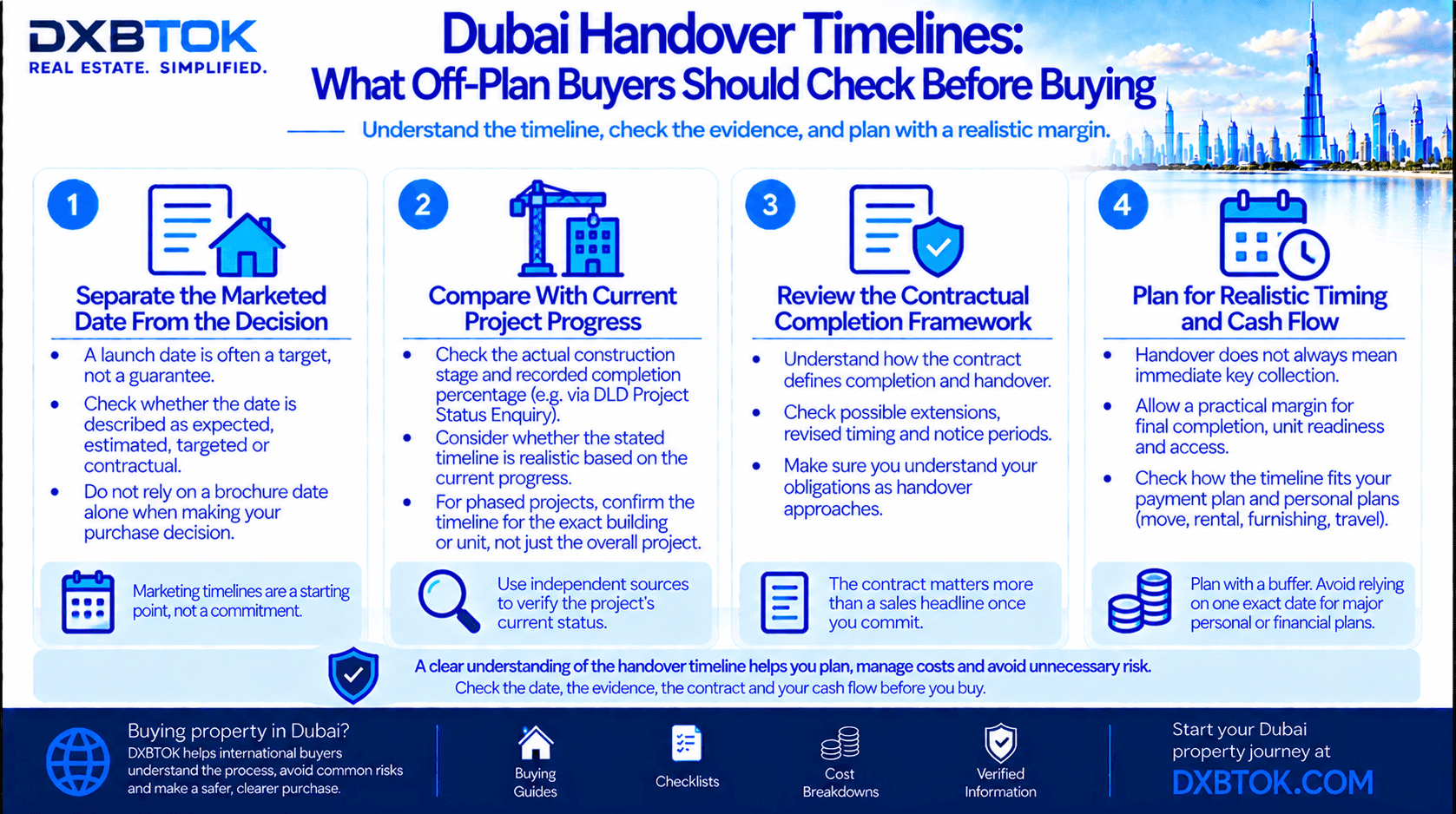
1. Separate the Marketed Date From the Buying Decision
A launch presentation may describe completion by a quarter, month or year. That gives the buyer an initial planning reference, but it should not carry the full weight of the purchase decision by itself.
Before relying on the timing, understand whether the statement is described as expected, estimated, targeted or contractually defined.
The wording matters because an indicative project timeline and the contractual framework governing completion are not the same thing.
2. Confirm Which Date Is Actually Being Discussed
“Completion” and “handover” are often used casually in sales conversations, but buyers should establish what the quoted date is intended to represent.
It may refer to a broad project completion target, completion of a particular phase or tower, an anticipated handover period, or the point when individual units are expected to begin becoming available to owners.
For a multi-building or phased development, a general project date may not describe the exact building or unit being considered.
3. Compare the Timeline With Current Project Progress
A future handover date is more useful when it is considered alongside the project's current stage.
Dubai Land Department records official project information that can provide an independent reference point when reviewing whether a stated handover timeline appears broadly consistent with the project’s reported progress.
The purpose is not to predict the exact handover day from a completion percentage. It is to give the buyer an independent reference point when assessing whether the stated timeline appears consistent with the current position of the project.
For the broader pre-reservation verification gate, use what to verify first when a Dubai project looks attractive.
4. Check the Contractual Completion Framework Before Relying on the Date
An off-plan purchase can run for years, so the signed transaction documents matter more than a sales headline once the buyer commits.
The buyer should understand how the contract addresses expected completion, extensions or revised timing, notices near completion and the obligations that arise as the property approaches handover.
This should remain a contract-review exercise rather than an assumption based on the launch date. The deeper off-plan obligation layer is covered in Dubai off-plan contract terms buyers should review.
5. Do Not Treat Construction Progress as the Same Thing as Immediate Key Handover
A project approaching physical completion does not automatically mean every owner will receive access at the same moment.
There can still be a transition between late-stage construction, project completion, unit-specific readiness, final buyer obligations and the actual handover of the property.
This is why a buyer planning a move, tenant start date or furnishing schedule should leave a practical margin rather than treating the earliest quoted date as guaranteed possession.
6. Check Whether the Timeline Fits the Payment Plan
Handover timing can affect cash flow because some payment structures place a material balance at or around completion.
Buyers should understand how the expected timeline connects with the final scheduled payments and whether any post-handover instalments form part of the structure.
The objective is not to merge handover timing with the full payment-plan analysis. It is to make sure the buyer is financially prepared if the project moves toward completion earlier or later than initially expected.
7. Be Careful With Personal Plans That Depend on One Exact Date
A buyer may intend to relocate, end another lease, begin short- or long-term rental activity, travel to Dubai for handover or arrange furniture and management around the projected date.
Those plans should be built with enough flexibility to absorb reasonable movement in the timeline.
The more expensive the consequence of a timing change, the more cautious the buyer should be about making irreversible commitments too early.
8. Recheck the Timeline as the Project Progresses
A timeline that looked reasonable at reservation should not be treated as permanently fixed information.
As construction progresses, buyers should compare the latest project position with formal developer communications, current project information and the relevant contractual framework.
The aim is simple: keep the ownership plan aligned with the most current evidence rather than with an old brochure or launch presentation.
9. Watch for Inconsistencies Before Reserving
A timeline deserves closer attention when different sources are giving materially different answers.
For example, the sales conversation may use one period, the brochure another, the latest project information may suggest a different stage, and the contract may describe completion through a wider framework rather than the same headline date.
That does not automatically mean the project is problematic. It means the buyer should resolve the inconsistency before making the timing an important part of the purchase decision.
10. Ask for the Current Position, Not Only the Original Launch Promise
Projects evolve after launch.
If a buyer is reviewing the project months or years later, the relevant question is the current expected position and the evidence supporting it.
An old launch date can remain visible online long after the developer has issued more recent information. Current written confirmation is more useful than an outdated sales graphic.
11. Keep Delay Management Separate From Timeline Verification
This article is about evaluating the handover timeline before or during a normal purchase decision.
If the project has already moved beyond its expected timeline, the issue changes. The buyer then needs to assess official project status, revised expectations, the contract, payment obligations and the seriousness of the delay.
That situation is covered separately in what happens if a Dubai off-plan project is delayed.
12. Keep the Actual Handover Process Separate as Well
Knowing when handover may happen is different from knowing what happens once the property is genuinely ready.
The completion stage can involve notice, inspection, snagging, outstanding payments, documents, access, utilities and the practical move into ownership.
When the property reaches that point, use the Dubai property handover process rather than turning a timeline check into a full handover procedure.
13. Use the Timeline as One Part of the Property Decision
A fast handover is not automatically better, and a later handover is not automatically worse.
The right timing depends on the buyer's purpose, cash flow, financing position, intended use and tolerance for construction-stage uncertainty.
The timeline should therefore be assessed alongside the exact unit, developer, project quality, payment structure, contract terms and the buyer's wider ownership plan.
Final Takeaway
A Dubai off-plan handover timeline should be treated as a decision input, not as a guaranteed calendar appointment.
Buyers should separate the marketed date from the contractual completion framework, compare the timeline with current project progress, understand which phase or building the timing refers to and leave enough flexibility around personal and financial commitments.
If the project is progressing normally, the timeline helps the buyer plan. If the evidence becomes inconsistent or the project moves into delay, the issue should be reviewed under the appropriate contract and project-status framework rather than through the original sales promise.
DXBTOK helps international buyers review selected Dubai property opportunities with clearer information around project status, payment timing, handover expectations and the wider purchase decision before moving forward.
Related DXBTOK Guides
Dubai Payment Plan Marketing: What Buyers Should Understand →
What International Buyers Should Ask a Dubai Developer Sales Team →
New-Build Dubai Property: What to Check →
Dubai Handover Costs: What Buyers Should Expect →
Dubai Off-Plan vs Ready Property: Which Is Better for Buyers? →