A Dubai property can reach handover while the buyer is still abroad. The challenge is not simply distance, but maintaining control over decisions, responsibilities, evidence and timing. Remote buyers should understand who is coordinating locally, who is authorised to act, whether the property condition is sufficiently evidenced, whether funds are accessible when required and who takes responsibility immediately after handover.
Dubai Property Inspection Before Handover: How Buyers Should Approach It
Inspecting a Dubai property before handover gives the buyer direct evidence of the exact unit’s condition at the point where construction is turning into ownership.
The inspection should help answer a few practical questions: does the unit broadly match what was agreed, does it appear complete, do the main elements function as expected, and are there material issues that need further attention before the buyer moves forward?
If the developer has already issued a handover notice, the notice and the physical condition of the property should still be considered separately. A completion-stage communication does not replace a condition review of the exact unit.
A useful pre-handover inspection is not measured by how many minor imperfections are found. It is measured by whether the buyer leaves with a reliable understanding of the property’s condition, the material issues that need attention and the evidence required for the next decision.
1. Inspect the Exact Unit, Not the Project in General
A project can be complete while an individual apartment, villa or townhouse still has unit-specific finishing or functional issues.
The buyer should therefore base the condition decision on the exact property being handed over rather than on the appearance of the lobby, show unit, marketing material or overall project completion status.
For the wider questions around first-occupancy readiness, access, utilities and immediate ownership use, see New-Build Dubai Property: What to Check.
2. Use the Agreed Specification as the Reference Point
The inspection is more meaningful when the buyer knows what the delivered property is supposed to include.
Layout, finishes, fixtures, appliances, materials and other agreed features should make sense against the relevant transaction documents and property specification. A difference matters more when it affects something the buyer was actually entitled to expect.
Where the concern is about a material difference between the delivered property and the agreed contractual position, the Dubai off-plan contract terms guide provides the wider context.
3. Start With the Overall Condition Before Focusing on Details
A first look at the unit can reveal whether it generally feels complete or whether obvious unfinished work remains.
Missing fittings, damaged finishes, incomplete sealant, poorly finished surfaces or visible signs that work is still ongoing can affect the buyer’s confidence that the property is genuinely ready.
The point is not to count every small mark immediately. It is to identify whether the overall condition appears consistent with a completed new property and where closer attention may be justified.
4. Look at Function as Well as Appearance
A property can look finished while still having problems that affect normal use.
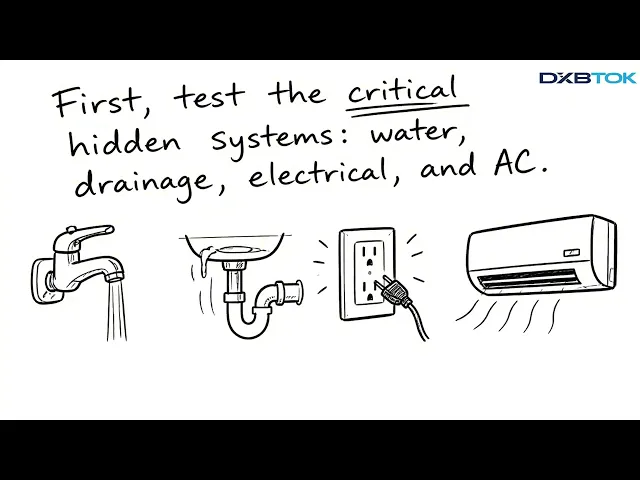
Doors and windows, plumbing, sanitary fittings, cooling, electrical points, built-in items and other fixed elements can reveal issues that are not obvious from appearance alone. Buyers should use these areas to judge whether the property is functioning normally and bring in technical support where a problem cannot be assessed confidently.
A functional issue can be more important than several cosmetic imperfections because it may affect comfort, access, durability or the buyer’s ability to use the property normally.
5. Pay Attention to Signs That May Need Specialist Assessment
Some observations are difficult to evaluate properly without technical knowledge.
Signs of moisture, repeated leakage, unusual cracking, significant cooling problems, electrical concerns or other potentially serious conditions may justify independent professional assessment rather than an assumption about the cause.
The buyer does not need to diagnose a technical problem personally. The important point is recognising when a finding may be significant enough to require specialist input.
6. Keep Evidence of Material Findings
A condition concern is easier to discuss when there is a clear record of what was actually observed.
Photographs, short descriptions and clear location references can help show where the issue is and what it looked like at the time of inspection.
That evidence becomes especially valuable if the buyer is overseas, if several parties are coordinating the handover or if the developer later needs to review the same finding.
7. Separate Observation From Diagnosis
Buyers can usually record what they see without needing to decide immediately why it happened or who is responsible.
A stain can be recorded as a stain. A door can be recorded as not closing correctly. A cooling issue can be recorded as a performance concern. The cause may require further review.
This helps prevent the inspection from becoming an argument over technical conclusions before the underlying condition has been properly assessed.
8. Know When Professional Inspection Support Adds Value
Some buyers are comfortable attending the inspection themselves. Others benefit from an independent inspector or suitably qualified technical professional.
Professional support can be particularly useful when the buyer is overseas, the property is high value, the unit is technically complex, there are signs of significant defects or the buyer does not feel confident assessing the property condition personally.
The value comes from stronger condition evidence and technical judgement where it is genuinely needed, not simply from producing a longer list of minor observations.
9. Move Identified Defects Into a Controlled Follow-Up Process
Once a material issue has been identified, the buyer needs more than the original observation.
The finding may need to be compared with the agreed specification, recorded clearly, communicated to the developer, tracked through the developer’s response and checked again after rectification.
The Dubai snagging process before handover explains that defect lifecycle from recorded finding to verified closure.
10. Keep Inspection Separate From Payment, Keys and Acceptance
Inspection often happens around the same time as final payments, documentation, key arrangements and other handover-stage actions.
Those issues can influence one another, but they are not the same question. A buyer should understand the property condition separately from whether a payment is due, whether keys are available or whether another completion-stage obligation is ready.
This separation is particularly useful when one part of the handover is progressing normally but a material condition issue still needs attention.
11. Reinspection Has a Different Purpose From the First Inspection
The first inspection helps identify the condition of the property and any material concerns.
A later reinspection is more targeted. It can help confirm whether significant items that were expected to be rectified have actually been resolved.
Buyers should avoid treating a status change on a defect list as equivalent to seeing evidence that an important problem has been corrected.
12. Remote Buyers Need Stronger Condition Evidence
A buyer who is outside Dubai may not be able to stand inside the unit and judge the condition personally.
That makes the quality of the inspection record more important. Clear photographs, useful reporting and a reliable person on the ground can help the buyer understand what matters without relying on vague reassurance.
Remote buyers should also be clear about who is coordinating locally, who has authority to act and which decisions still require the buyer personally.
13. Know When the Inspection Has Done Its Job
A pre-handover inspection cannot guarantee that no future issue will ever appear.
It has done its job when the buyer has a credible picture of the unit’s current condition, material concerns have been identified and evidenced, significant technical questions have been escalated where appropriate, and the buyer understands what still needs follow-up before proceeding.
The inspection should then sit alongside the wider Dubai property handover process, rather than being treated as the whole ownership transition.
Final Takeaway
Dubai property inspection before handover is primarily about verifying the condition of the exact unit before the buyer moves deeper into ownership.
Start with what was agreed, look at overall completion and normal function, record material findings clearly and bring in specialist support when a concern cannot be judged reliably from appearance alone.
If defects are identified, the next priority is not to keep expanding the inspection list. It is to make sure the important findings move into a controlled snagging and rectification process until the buyer has a clear outcome.
DXBTOK helps international buyers review selected Dubai property opportunities with clearer information around handover readiness, property condition, contracts, costs and remote ownership coordination before moving forward.
Related DXBTOK Guides
Dubai Property Handover From Abroad: What Remote Buyers Need in Place →
Dubai Handover Costs: What Buyers Should Expect →
Completed Dubai Property: What to Check Before Buying →