A delay in a Dubai off-plan project does not automatically mean the project has failed or that the buyer can stop paying or demand a refund. This guide explains how international buyers should verify the project’s official status, compare construction progress with the SPA, review payment obligations and developer notices, understand the difference between a delayed, under-cancellation and formally cancelled project, and organise the evidence needed if the situation becomes more serious.
What Happens if a Dubai Off-Plan Project Is Delayed?
A delay in a Dubai off-plan project can be frustrating, especially when a buyer has already paid several instalments and planned around an expected handover date.
But a delay does not automatically mean the project has failed, been cancelled or that the buyer can immediately stop paying or demand a refund.
The correct response is to establish the project’s official status, review the contract, understand what the developer is communicating and separate a normal construction delay from a more serious project problem.
The key is to react to verified information, not rumours, sales messages or assumptions.
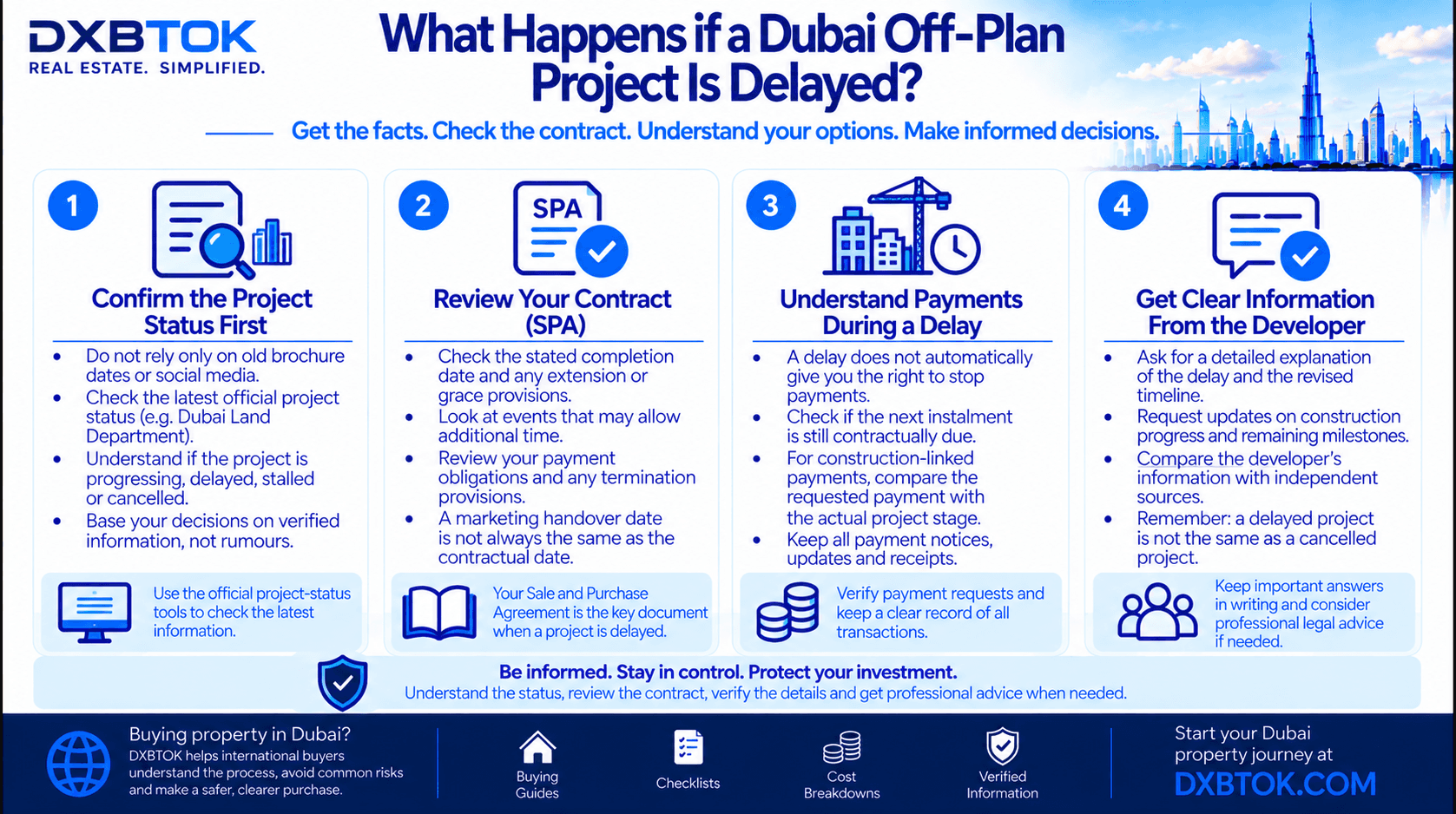
1. First Confirm That the Project Is Actually Delayed
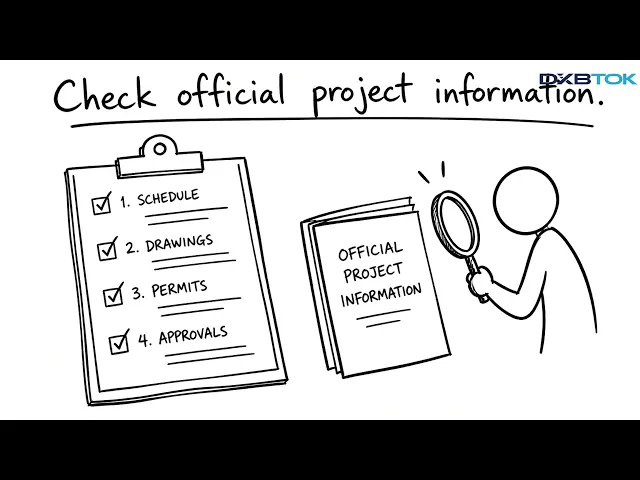
Do not rely only on an old brochure date, social-media discussion or an informal message.
Compare:
the contractual completion or handover position
the latest developer communication
the actual construction progress
the current official project information
Dubai Land Department provides a Project Status Enquiry service that allows buyers to check project details and completion percentage.
2. Check the Official Project Status
A buyer should know whether the project is:
active and progressing
progressing more slowly than expected
stalled
under cancellation procedures
formally cancelled
Those situations are not legally or commercially identical.
Before making a major decision, confirm the latest official status rather than treating every delay as a cancellation.
3. Compare the Delay With the Contract
Your Sale and Purchase Agreement is one of the most important documents when a project moves beyond its expected timeline.
Review:
the stated completion date
any extension or grace provisions
events that may allow additional time
notice requirements
buyer payment obligations
termination provisions
handover conditions
Use our Dubai off-plan contract terms guide to understand the wider long-term obligations that should be reviewed.
4. A Marketing Handover Date and a Contractual Date Are Not Always the Same
Buyers should separate promotional timelines from the dates and conditions that actually appear in the signed agreement.
A brochure, launch presentation or sales message may describe an expected handover period.
The legal effect of a delay depends on the signed contract and the applicable regulatory position, not only on the marketing material.
5. Do Not Stop Payments Automatically
A delayed project does not automatically give a buyer the right to stop making contractual payments.
Missing an instalment without understanding the contract can create a separate buyer-default problem.
Before withholding money, confirm:
whether the instalment is still contractually due
whether it is date-linked or construction-linked
what the SPA says about delay
whether the developer has issued a revised schedule
whether professional legal advice is needed
6. Construction-Linked Payments Need Extra Attention
If payments are tied to construction milestones, compare the requested payment with the actual stage of the project and the agreed payment structure.
Keep copies of:
payment notices
construction updates
receipts
developer correspondence
project-status information
For the wider off-plan payment structure, see our Dubai off-plan payment plans guide.
7. Review the Developer’s Explanation
A useful delay update should explain more than simply say that handover has moved.
Ask for clarity on:
current construction progress
reason for the delay
revised expected completion
remaining major milestones
whether the payment schedule changes
whether any formal notice has been issued
Keep important answers in writing.
8. Compare the Explanation With Independent Information
Developer updates are useful, but buyers should also check independent project information where available.
Dubai Land Department’s project-status tools can show project details and completion information.
This gives the buyer another reference point when evaluating whether the delay is temporary, prolonged or associated with limited construction progress.
9. Escrow Remains Relevant During a Delay
Dubai off-plan projects use regulated escrow structures for project funds.
A buyer should still keep clear records showing where payments were sent and which project they relate to.
For the payment-routing and project-account side, see our Dubai off-plan escrow account guide.
10. A Delayed Project Is Not the Same as a Cancelled Project
This distinction is critical.
A project can be late without being cancelled.
Dubai Land Department’s current guidance distinguishes projects that are under cancellation from projects that have already been formally cancelled.
If the project is merely delayed or still active, the buyer’s position remains tied to the project status, the SPA and the applicable legal process.
11. “Under Cancellation” Still Does Not Mean “Cancelled”
A project that is under cancellation procedures has not necessarily reached a final cancellation decision.
There may still be review, grievance or other regulatory steps before a formal cancellation is completed.
Buyers should therefore avoid making assumptions based only on rumours that a project is “being cancelled.”
12. Formal Cancellation Changes the Process
If a project is formally cancelled, the position changes from ordinary delay management to the applicable cancellation and liquidation process.
Dubai Land Department states that cancelled projects move into a liquidation process for dealing with available project funds and investor claims.
The exact recovery position can depend on the project, the available funds and the applicable legal process.
Do not assume that every delayed project will reach this stage.
13. RERA Monitors Stalled Projects
Dubai Land Department states that RERA periodically monitors construction progress.
Where a project is stalled or progress is very limited, the developer may be contacted and given an opportunity to correct the situation.
If progress does not improve and there is no accepted justification, cancellation procedures may be initiated under the applicable process.
14. Keep a Complete Evidence File
If a delay becomes serious, documentation matters.
Keep:
reservation form
SPA
Oqood or registration records where applicable
all payment receipts
payment schedule
developer notices
emails and formal correspondence
construction updates
official project-status screenshots or records
A complete file makes it easier to understand what has happened and what options may be available.
15. Check Whether the Developer Itself Remains Credible
A delay should also trigger a fresh look at the developer.
Check whether:
the developer remains active
other projects are progressing
communications remain consistent
the project is still officially recorded
construction activity is continuing
Use our Dubai property developer verification guide for the wider developer-check process.
16. Separate Delay Risk From Handover Preparation
If the project is still progressing toward completion, buyers should continue preparing for the eventual handover rather than treating the delay as the end of the transaction.
That can include planning for:
final payment
inspection and snagging
handover documentation
service charges
utilities
property management if the buyer is overseas
For the completion stage itself, see our Dubai property handover process guide.
17. Decide What You Actually Need From the Developer
When a project is delayed, vague questions usually produce vague answers.
Ask specific questions such as:
What is the current official completion percentage?
What caused the delay?
What is the revised completion or handover expectation?
Which construction milestones remain?
Does the payment schedule change?
Has any formal regulatory notice affected the project?
What documents support the revised timeline?
18. Know When the Situation Needs Legal Review
Some delays remain manageable through normal developer communication and revised construction timing.
Others become disputes.
Consider obtaining qualified legal advice if:
the project has stopped for a prolonged period
the developer is not responding
payment demands appear inconsistent with the contract
you want to terminate the agreement
the project is under cancellation or formally cancelled
you are considering court action or a refund claim
A buyer should not rely on general online information to make a contract-termination decision.
19. Use a Delayed-Project Checklist
Status: What is the project’s current official status?
Progress: What completion percentage is currently recorded?
Contract: What does the SPA say about completion, extensions and termination?
Payments: Are upcoming instalments still due under the agreed structure?
Developer: What explanation and revised timeline has been provided?
Evidence: Do I have all payment, registration and correspondence records?
Escrow: Are my project payments properly documented?
Cancellation: Is the project merely delayed, under cancellation or formally cancelled?
Handover: If construction continues, am I prepared for the eventual completion stage?
Advice: Do I need qualified legal advice before changing payments or seeking termination?
Final Takeaway
A Dubai off-plan delay should be treated as a fact-finding and contract-review issue first.
Confirm the official project status, compare actual progress with the SPA, keep the payment and communication record complete and distinguish a delayed project from one that is under cancellation or formally cancelled.
Do not stop payments, assume a refund or treat the project as cancelled until the contractual and official position is clear.
Need help organising the information around a Dubai off-plan purchase? DXBTOK can help international buyers structure the key property, project and transaction information before moving forward.
Start your Dubai property review at DXBTOK.com.
Related DXBTOK guides
Dubai Off-Plan Contract Terms: What Buyers Should Review →
Dubai Off-Plan Payment Plans Explained →
Dubai Escrow Accounts for Off-Plan Property Explained →