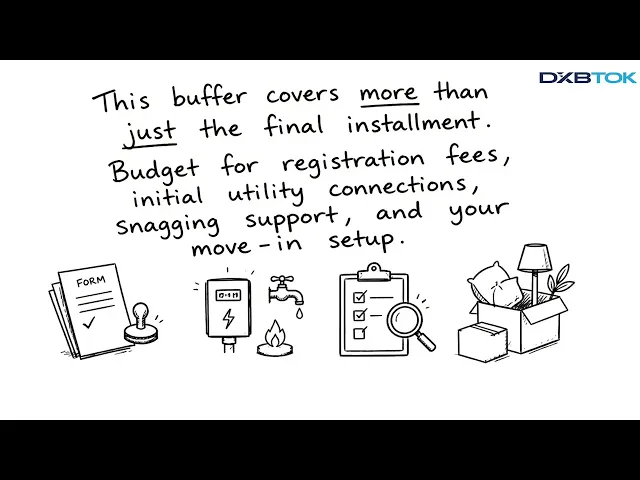
Dubai property handover can create a concentrated cash requirement, but there is no single standard handover fee. Buyers should separate the remaining purchase balance from transaction charges that are still outstanding, first ownership costs and optional setup expenses such as inspection, utilities, furnishing or management. The key is to understand what has already been paid, what becomes due around handover and what belongs to the ongoing ownership budget.
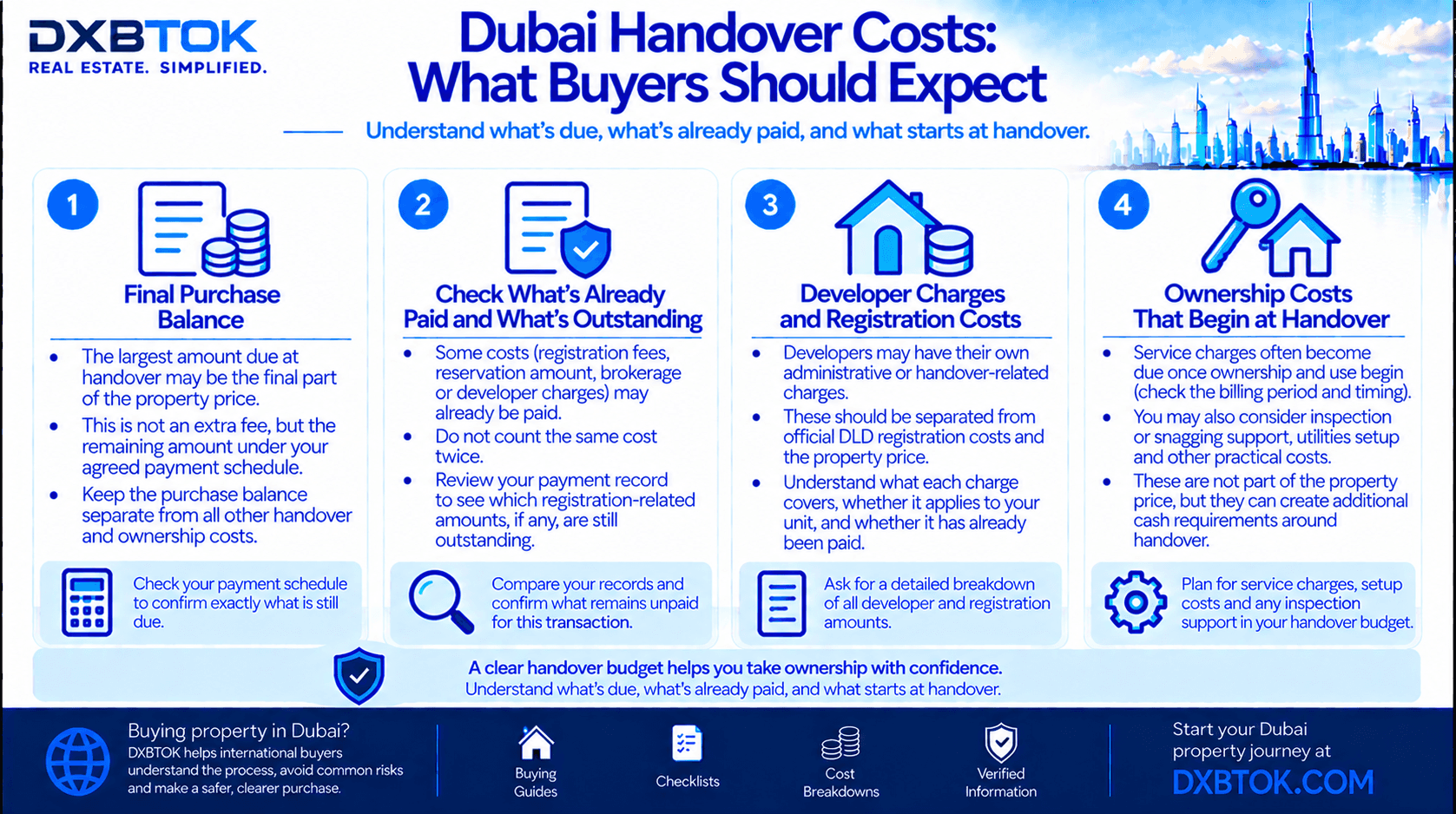
Dubai Handover Costs: What Buyers Should Expect
Handover can create one of the most concentrated cash requirements in a Dubai property purchase.
The important point is that there is no single standard “handover fee.” Some amounts may be part of the remaining purchase price, some may be transaction charges that were not settled earlier, and others begin only because the property is moving into active ownership.
Before treating a property as financially ready for handover, understand which amounts are still outstanding, which new costs begin at that stage, and which costs are optional setup choices rather than compulsory handover charges.
For the wider sequence around inspection, documents, final payment and release of the property, use the Dubai property handover process.
The safest way to think about handover costs is as a timing issue: what cash must be available around the ownership transition, rather than what percentage should automatically be added to every Dubai property.
1. Separate the Final Purchase Balance From Handover Costs
The largest amount due around handover may simply be the final scheduled part of the property price.
That amount is not an extra fee. It is part of the purchase obligation already agreed under the payment schedule.
This distinction matters because buyers can otherwise mix the remaining property balance with transaction fees, service charges, setup expenses and optional ownership costs, making the handover budget look less clear than it really is.
Start with the amount still due under the purchase terms, then keep every additional cost in a separate category.
2. Do Not Assume Every Purchase Cost Is Still Due at Handover
Some transaction costs may already have been paid earlier in the purchase.
Registration-related amounts, reservation payments, brokerage costs or developer charges should not automatically be counted again simply because handover is approaching.
The buyer should compare the original payment record with the current amount still outstanding and avoid budgeting the same cost twice.
For the full reservation-to-ownership cost structure, review the full cost of buying Dubai property for international buyers.
3. Check Whether Registration-Related Amounts Are Still Outstanding
Registration costs are an important part of a Dubai property purchase, but they are not automatically a new handover cost.
Depending on the transaction and when earlier payments were collected, some registration-related amounts may already have been settled while others may still need to be cleared before or around completion.
The useful question is therefore not “What is the DLD fee at handover?” but “Which registration-related amount, if any, remains unpaid for this exact transaction?”
The specialist breakdown is covered in Dubai Land Department fees for international buyers.
4. Separate Developer Charges From Official Registration Costs
A developer may have its own administrative, processing or handover-related charges depending on the project and transaction.
Those amounts should be separated from official registration costs and from the remaining purchase price.
Before relying on a handover statement, understand what each developer-side charge relates to, whether it applies to the exact unit and whether it has already been paid at an earlier stage.
Where a developer charge appears unclear, the dedicated Dubai developer admin fees page explains the distinction in more detail.
5. Service Charges Can Become Part of the Handover Cash Requirement
Handover is also the point where a buyer starts moving from acquisition costs into ownership costs.
For many jointly owned properties, service charges become relevant once ownership and use begin. The exact billing period, amount and timing depend on the property and the approved charge structure.
A buyer should therefore understand whether a service-charge payment is expected at or shortly after handover and what period that payment relates to.
Keep this separate from the property price and from private-unit maintenance. The detailed ownership-cost structure is explained in Dubai property service charges.
6. Inspection and Snagging Support Can Add a Practical Cost
A newly completed property may need to be inspected before the buyer treats it as ready for use.
Some owners inspect personally, while others use professional snagging or technical inspection support. Where professional support is used, that cost should be included in the handover-stage budget rather than discovered after the final payment is due.
The purpose is not to create another fixed fee assumption. It is to recognise that checking the delivered unit can require time, professional support or both, particularly for an overseas buyer.
7. Utilities, Cooling, Access and Building Setup May Create Smaller Costs
A property can be handed over physically while still requiring accounts, deposits or service setup before it is fully usable.
Depending on the building and property type, this can involve electricity and water, district cooling, internet, access cards or other building-related arrangements.
The amounts and payment structure are not identical across every property. Buyers should obtain the current position for the exact unit rather than copying a setup estimate from another building.
These amounts may be much smaller than the final property balance, but several smaller setup costs arriving together can still affect the cash needed around handover.
8. Furnishing Is Not a Handover Fee, but It Can Be a Major Handover-Stage Expense
An unfurnished or partly furnished property may require a substantial setup budget before it can be occupied or rented.
Furniture, curtains, appliances, lighting, household equipment, delivery and installation can all arrive soon after handover.
These are not developer handover charges, but they matter because they can fall in the same cash-flow period.
Keep furnishing as a separate setup budget so the buyer can distinguish compulsory transaction costs from choices about how the property will be used.
9. Overseas Owners May Need Management Setup From the Start
An international buyer who will not be in Dubai after handover may also need local support.
That can include key holding, inspection coordination, maintenance access, tenant preparation or wider property-management services.
Management setup is not automatically part of the handover charge from the developer, but it can become necessary immediately once the property moves into active ownership.
Buyers should therefore separate the cost of receiving the property from the cost of operating it afterwards.
10. Mortgage Buyers Can Have a Different Completion Cash Position
A financed purchase can create additional timing considerations around completion.
The bank, valuation position, mortgage documentation and final buyer contribution can affect how much cash the buyer needs to have available before the property can be completed.
Those amounts are specific to the financing arrangement and should not be copied from a cash-buyer handover example.
If financing is involved, the handover budget should reflect the lender's current requirements and the buyer's remaining contribution rather than a generic estimate.
11. Keep a Clear Boundary Between Handover Costs and Future Maintenance
Handover is the start of ownership, not the end of property costs.
Future repairs, appliance replacement, air-conditioning issues, interior wear and other private-unit maintenance belong to the ongoing ownership budget rather than the handover budget unless a specific issue already exists at delivery.
This distinction matters because a buyer can otherwise overstate handover costs while understating the money needed to own the property over the following months and years.
12. Build the Budget Around the Handover Date, Not Around One Percentage
A practical handover budget should answer a small number of high-level questions:
How much of the purchase price remains unpaid?
Which transaction or developer charges are genuinely still outstanding?
What ownership costs begin at or shortly after handover?
What setup costs are required before the property can be used?
Which optional costs depend on the owner's own use and management plan?
The objective is not to create a universal Dubai handover formula. It is to identify the cash requirement for the exact property and exact transaction.
13. Leave Room for Timing Changes and Final Quotations
A handover budget prepared months in advance can change before the actual handover date.
The final purchase statement may change as payments are reconciled, current service-charge information becomes available, setup quotations are confirmed or the owner's use plan becomes clearer.
For that reason, buyers should avoid using every available dirham for the final property payment while leaving no room for the ownership transition.
A reasonable contingency should reflect the exact property, the number of unresolved cost items and the buyer's wider financial position.
Final Takeaway
Dubai handover costs are not one standard percentage and should not be treated as one universal fee.
The handover-stage cash requirement can combine the remaining purchase balance, any transaction or developer amounts still outstanding, first ownership charges, inspection support, utilities, furnishing and management setup.
The key is to separate what has already been paid from what remains due, and to separate compulsory transaction costs from optional setup choices.
Once those categories are clear, the buyer can see the real amount needed to move from purchase into practical ownership without double-counting costs or discovering major setup expenses too late.
DXBTOK helps international buyers review selected Dubai property opportunities with clearer information around purchase costs, handover readiness and the wider ownership transition before moving forward.
Related DXBTOK Guides
New-Build Dubai Property: What to Check →
Dubai Property Maintenance Costs: What Buyers Should Expect →
Dubai Property Budget Checklist for Remote Buyers →