A Dubai property can reach handover while the buyer is still abroad. The challenge is not simply distance, but maintaining control over decisions, responsibilities, evidence and timing. Remote buyers should understand who is coordinating locally, who is authorised to act, whether the property condition is sufficiently evidenced, whether funds are accessible when required and who takes responsibility immediately after handover.
Dubai Property Handover From Abroad: What Remote Buyers Need in Place
A Dubai property can reach handover while the buyer is in Europe, North America, Australia or another country. Distance does not automatically make the handover unmanageable, but it does make unclear responsibility much more expensive.
The remote buyer needs to know who is handling each important part of the ownership transition, what still requires the buyer’s own decision, what evidence will be provided and where a local representative or professional may be needed.
For the full sequence around completion, inspection, payments, documents and access, see the Dubai property handover process. Remote buyers should then look at that same stage through one extra question: can the transition remain controlled even when the owner is not physically in Dubai?
Remote handover works best when the buyer retains control of the decisions while local people handle only the responsibilities they are clearly authorised and qualified to perform.
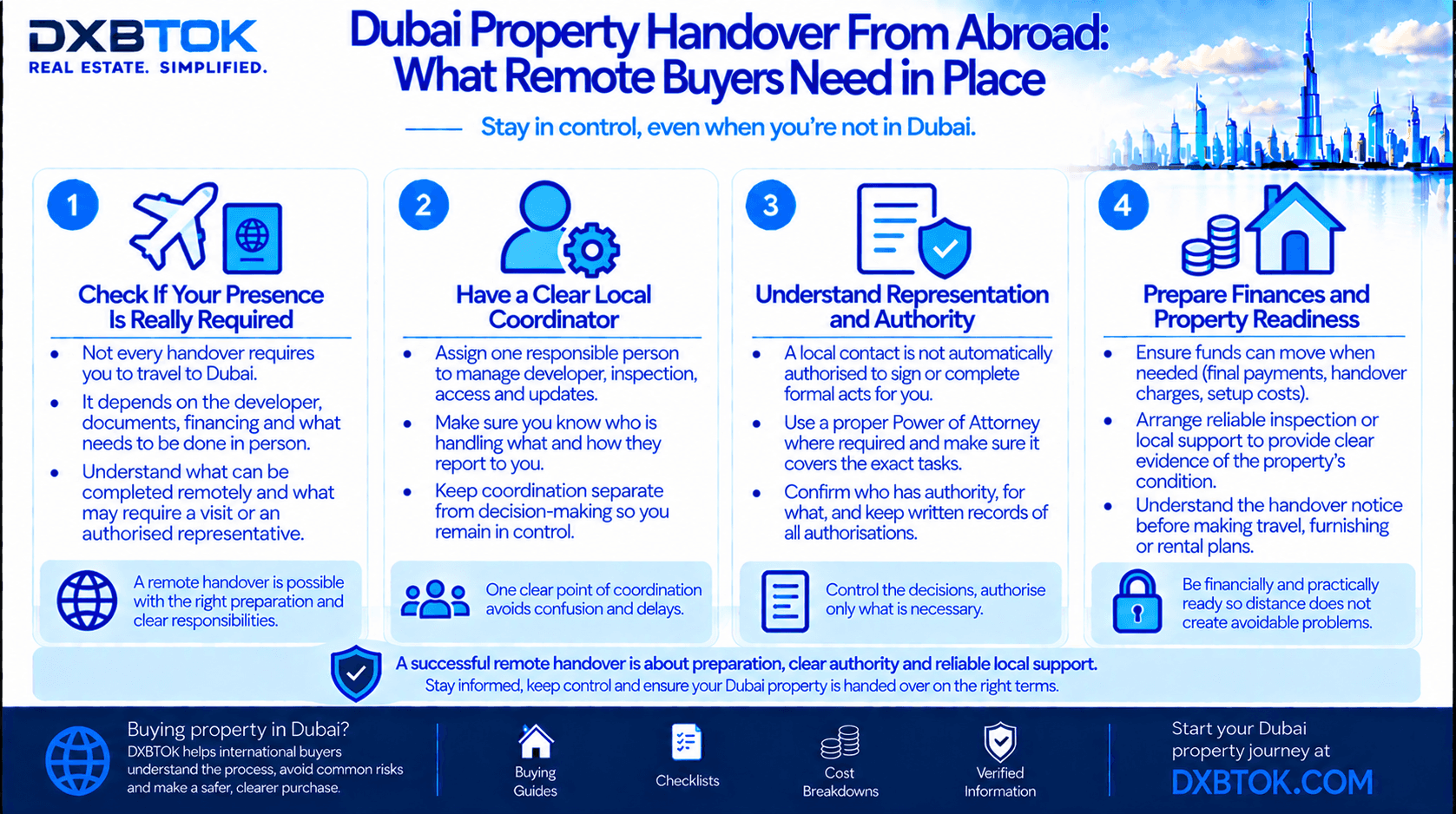
1. Decide Whether Your Physical Presence Is Actually Necessary
Not every handover requires the owner to travel to Dubai for every activity, but buyers should not assume that the entire process can automatically be completed from abroad either.
The practical answer depends on the developer, the property, the documents involved, any financing requirements and whether a formal act needs to be completed personally or through an authorised representative.
Buyers who expect to remain outside the UAE should understand the wider limits of remote completion through buying Dubai property without visiting before the handover date creates time pressure.
2. Make One Person Responsible for Local Coordination
A remote handover becomes difficult when the developer, inspector, broker, property manager and buyer are all communicating separately without one clear coordination point.
The buyer should know who is collecting updates locally, who is allowed to speak to the developer, who is arranging property access and who is expected to report unresolved issues back to the owner.
That person does not need unlimited authority. In fact, separating coordination from decision-making can help the buyer remain in control while still having reliable support on the ground.
3. Be Clear About Representation and Authority
A local contact, broker or property manager is not automatically authorised to sign documents, accept obligations or complete formal acts on the buyer’s behalf.
Dubai Land Department recognises authorised representation through official powers of attorney for relevant real-estate transactions. The important question for the buyer is whether the person acting locally has the right authority for the exact task rather than simply being available in Dubai.
Where delegated authority may be needed, the Dubai property power of attorney guide explains the wider considerations.
4. Understand the Handover Notice Before Building Plans Around It
A remote buyer may receive a completion or handover communication while already planning travel, furnishing, rental activity or management.
The notice should make sense for the exact property and should be understood before expensive commitments are made around it. A remote buyer has less room for last-minute correction if a date, unit reference, payment position or readiness assumption later turns out to be unclear.
Keep written developer communication, the SPA and any important clarification together so the buyer’s decisions are based on the current position rather than on an old sales expectation.
5. Make Sure the Money Can Move When It Is Needed
Remote buyers can have enough money overall and still face a handover problem if the required funds are not accessible, transferable or available within the required timing.
Final purchase balances, legitimate handover-stage charges and ownership setup costs can arrive within the same period. Banking limits, foreign-exchange timing or financing delays can create avoidable pressure if they are discovered too late.
The financial side should therefore be prepared independently from the property-condition side. The Dubai property budget checklist for remote buyers covers funding readiness in more detail.
6. Do Not Let Distance Weaken the Property-Condition Evidence
An owner who is not present still needs a reliable picture of the exact unit being handed over.
That may come through professional inspection, a trusted representative or another suitable local arrangement. What matters is that the buyer receives enough evidence to understand the condition of the property and any material unresolved issues rather than relying on a general message that everything looks acceptable.
Remote buyers should be particularly cautious about approving important property-condition decisions from low-quality photographs, incomplete reports or verbal reassurance alone.
7. Give Snagging Issues a Clear Owner Until They Are Resolved
If defects or incomplete items are identified, the remote buyer needs to know who will follow them through with the developer and how the buyer will know when significant items are actually resolved.
The issue is not simply whether a snag list exists. Material findings may need evidence, developer response, rectification and a follow-up check before they can reasonably be treated as closed.
The Dubai snagging process before handover explains that defect lifecycle from recorded finding to verified rectification.
8. Keep Keys, Access and Acceptance as Separate Questions
Receiving keys or access can feel like the final moment of handover, but remote buyers should avoid treating every handover-stage action as the same decision.
Property access, physical condition, outstanding defects, payment status and the buyer’s acceptance position can involve different responsibilities. The buyer should understand what each action means before a local representative collects keys or confirms something on the owner’s behalf.
This becomes especially important when the buyer will not see the property personally until weeks or months later.
9. Plan the First Days of Ownership Before the Handover Date
Handover can create immediate practical responsibilities even when the buyer is still abroad.
Access control, utility or building arrangements, insurance, furnishing, maintenance access and management can all become relevant soon after the property changes into active ownership.
The remote buyer does not need every long-term operating decision completed in advance, but there should be a clear plan for who can protect and manage the property immediately after handover if the owner is not present.
10. Keep a Single Evidence Trail
Remote handover often creates information across email, WhatsApp, inspection reports, payment confirmations, developer statements and messages from local representatives.
Important decisions become harder to control when those records are scattered between different people and devices.
The buyer should retain the material evidence showing what was requested, what was confirmed, what was paid, what condition issues remained and what responsibilities were handed to someone locally.
11. Watch for the Remote-Buyer Failure Points
The biggest risks are often coordination failures rather than one dramatic problem.
Examples include assuming someone has authority when they do not, paying because a deadline feels urgent while property-condition questions remain unresolved, allowing several people to give conflicting instructions, or reaching key handover without a clear plan for access and immediate ownership responsibilities.
These situations are easier to prevent when the buyer knows which decisions remain personal, which responsibilities are delegated and what evidence is expected before each major commitment.
12. Know When Travel or Specialist Support Becomes Worthwhile
Remote handover should not become a principle that the buyer must follow at any cost.
If the property condition is disputed, authority is unclear, a major payment question remains unresolved or the buyer is uncomfortable relying on the available evidence, travelling to Dubai or appointing appropriate professional support may be the more sensible choice.
The more important the unresolved issue, the less value there is in forcing the handover to remain fully remote.
13. Use a Simple Remote-Handover Readiness Test
Before the ownership transition moves forward, the buyer should be able to answer a few core questions with confidence.
Who is coordinating locally? Who has authority to act? What important decisions still require the buyer personally? Is the property condition sufficiently evidenced? Are the required funds available? Are significant snagging issues being tracked? Who takes responsibility for the property immediately after handover?
If those answers are clear, distance becomes much easier to manage. If they are not, the problem is not that the buyer is overseas. The problem is that control of the handover is still incomplete.
Final Takeaway
Dubai property handover from abroad is primarily a control and coordination challenge.
The remote buyer should retain control over the important decisions while making sure local responsibilities, delegated authority, property-condition evidence, funds, defect follow-up and immediate ownership arrangements are clearly understood.
A well-prepared remote handover should leave the buyer knowing who is responsible, what has been confirmed, what remains unresolved and what evidence supports the next decision.
DXBTOK helps international buyers review selected Dubai property opportunities with clearer information around remote buying, handover readiness, property condition, costs and ownership coordination before moving forward.
Related DXBTOK Guides
Dubai Handover Notice: What Off-Plan Buyers Should Check Before Acting →
Dubai Property Management for Overseas Owners →
Dubai Property for Remote Ownership →