


Dubai off-plan payment plans are often marketed through simple headline structures such as 20/80, 1% monthly or post-handover plans. This guide explains how buyers should translate those headlines into actual financial obligations, including booking amounts, early instalments, payment triggers, handover balances, post-handover commitments, costs outside the advertised plan and the final payment terms stated in the purchase documents.
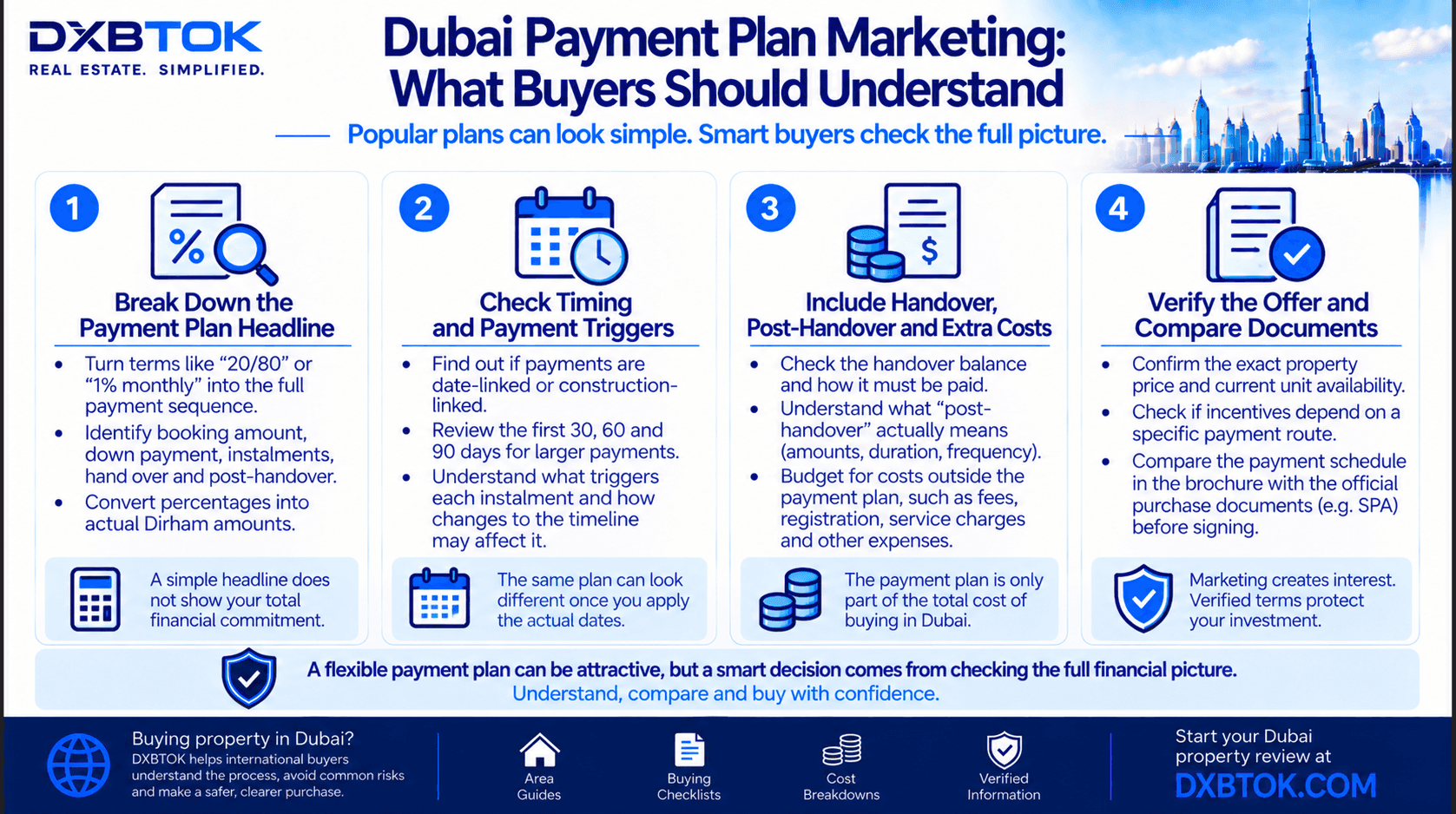
Dubai Payment Plan Marketing: What Buyers Should Understand
Dubai off-plan payment plans are often presented in a simple and attractive way.
You may see phrases such as “20/80,” “1% monthly,” “low down payment,” “post-handover plan” or “pay over several years.”
Those descriptions can be useful as a starting point, but they do not tell you the full financial obligation by themselves.
The buyer’s job is to translate the marketing headline into a real schedule of amounts, dates, milestones, handover obligations and costs outside the plan.
1. Start With the Headline — Then Break It Apart
A payment-plan headline is usually designed to make the structure easy to understand quickly.
But the headline may compress several different obligations into one short phrase.
For example, a plan described as “20/80” may suggest that 20% is paid before handover and 80% later. That does not tell you when the first 20% is due, whether there is a separate booking amount, what fees are payable at reservation, the exact handover date, or how the final balance must be funded.
Always convert the headline into the actual payment sequence.
2. Identify the Reservation or Booking Amount
The first payment is often the point at which the buyer becomes financially committed.
Check the amount or percentage required, when it must be paid, what document is issued at that stage, whether any administrative charges are collected separately, and what happens if the buyer does not proceed.
Do not assume that a small booking amount means the overall purchase commitment is small.
3. Separate the Down Payment From Later Instalments
A plan may advertise a low initial payment while requiring a much larger amount shortly afterwards.
Map the first 30, 60 and 90 days separately. This is where a plan that looks easy in a headline can become much more demanding in practice.
If you need the underlying mechanics of off-plan schedules, review our Dubai off-plan payment plans guide.
4. Check Whether Instalments Are Date-Linked or Construction-Linked
Not all instalments are triggered in the same way. Some may be tied to calendar dates, while others may be connected to construction milestones.
Ask what triggers each payment, how the trigger will be communicated, what evidence accompanies construction-linked payments where relevant, and whether the schedule can shift if the project timeline changes.
5. Turn Percentages Into Actual Currency Amounts
Percentages can feel abstract. Convert every instalment into an actual amount for the exact property price.
This immediately shows whether the schedule is comfortable or concentrated around a few large payments.
6. Pay Attention to the Handover Balance
The handover payment can be the largest single obligation in the plan.
A buyer may spend months or years making smaller instalments and then face a much larger balance at completion.
Confirm what percentage is due at handover, whether it must be paid before possession, whether mortgage finance is expected, and what other costs become payable around handover.
7. Understand What “Post-Handover” Actually Means
Post-handover plans can reduce the amount needed at completion, but the phrase itself is not enough.
Check how much remains after handover, how long the period lasts, how frequently payments are due, whether any conditions apply, and whether possession, title or other transaction steps depend on outstanding payments.
8. Do Not Treat “1% Monthly” as the Whole Plan
Monthly-payment marketing is easy to understand and can make a property appear highly affordable.
But buyers should ask what sits around the monthly instalments. There may also be an initial booking amount, a larger down payment, milestone payments, a handover balance and fees outside the advertised monthly amount.
9. Check the Exact Property Price Before Judging the Plan
A flexible payment plan does not make an overpriced unit attractive.
Always evaluate the payment structure together with the exact purchase price. The financing structure and the property value are separate questions.
10. Separate Payment-Plan Marketing From the Brochure Presentation
A brochure may show the payment plan in a clean chart or graphic.
Use that as an extraction point, not as the final authority on the transaction.
Our guide to reading a Dubai off-plan project brochure explains how to pull out the payment schedule, specification and other decision-critical information from marketing material.
11. Identify Costs That Sit Outside the Payment Plan
The advertised payment plan normally focuses on the property price. It may not represent the buyer’s full cash requirement.
Depending on the transaction, buyers may also need to budget for registration-related charges, administrative fees, mortgage-related costs where applicable, service-charge payments, furnishing or fit-out, and other transaction expenses.
Use our guide to the full cost of buying Dubai property to assess the payment plan inside the wider purchase budget.
12. Ask Whether Incentives Depend on a Particular Payment Route
Some pricing or incentives may be linked to the way the buyer pays.
If a discount or incentive is being offered, ask for the exact conditions in writing and compare the final purchase price, not only the headline discount.
13. Do Not Assume a Longer Plan Is Automatically Better
A longer schedule can reduce short-term cash pressure, but it can also extend the period during which the buyer remains financially committed.
Compare total purchase price, payment timing, size of the handover balance, post-handover obligations and other fees.
14. Stress-Test the Plan Against Your Own Cash Flow
Do not test the payment plan only against today’s bank balance. Look at the full schedule.
Ask whether you can fund every instalment on time, whether another expense could collide with a payment date, whether you can still meet the handover balance, and whether you are depending on a future sale, bonus or refinancing event.
A payment plan should work under a realistic scenario, not only an optimistic one.
15. Confirm the Project and Offer Before the Plan Creates Urgency
An attractive payment structure can make buyers feel they need to reserve quickly.
But the plan should not replace basic project and unit verification.
Before committing, use our first-check guide for attractive Dubai projects to confirm the project, developer, current availability and exact unit being offered.
16. Compare Marketing Terms With the Purchase Documents
Before signing, compare the payment schedule shown during the sales process with the payment obligations stated in the relevant transaction documents.
Check that you understand payment amounts, due dates or milestones, late-payment consequences, handover-related obligations and any conditions connected to outstanding balances.
For the contract stage, review our Dubai SPA guide.
17. Use a Payment-Plan Reality Check Before Reserving
Exact price: What is the current price of the exact unit?
Booking amount: What is payable first?
Early payments: What is due in the first 30, 60 and 90 days?
Instalment triggers: Are payments date-linked or construction-linked?
Actual amounts: What does each percentage equal in dirhams?
Handover balance: How much must be available at completion?
Post-handover: What remains payable after possession?
Extra costs: What sits outside the advertised plan?
Affordability: Can your cash flow support the entire schedule?
Documents: Does the final documentation match the terms you were shown?
Final Takeaway
Dubai payment-plan marketing can make a property easier to understand, but the headline should never be the end of the analysis.
Translate the plan into exact amounts, dates, milestones, handover obligations and additional costs. Then compare those obligations with your own finances and the final transaction documents.
Do not ask only whether the payment plan looks flexible. Ask whether you can meet every obligation it creates from reservation through handover and beyond.
Need help comparing Dubai property payment structures? DXBTOK can help international buyers review selected property opportunities and organise the key commercial information before moving forward.
Start your Dubai property review at DXBTOK.com.
Related DXBTOK guides
Dubai Off-Plan Payment Plans Explained for Remote Buyers →
How to Read a Dubai Off-Plan Project Brochure →
Full Cost of Buying Dubai Property: What International Buyers Should Budget →
When a Dubai Project Looks Attractive: What to Verify First →
Dubai SPA Explained: What Buyers Should Review Before Signing →


