

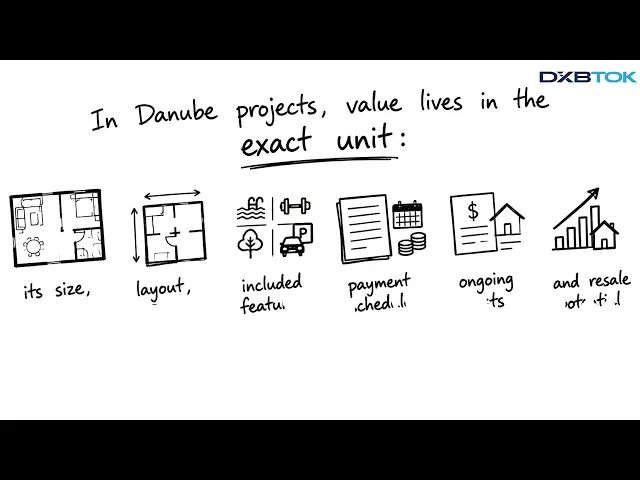
Danube Properties offers residential opportunities across different Dubai locations, property types, project stages and payment structures, so the developer name alone should not determine the purchase. International buyers should compare the exact project and unit, verify current availability and project evidence, understand the full payment commitment, review the relevance of the developer’s track record, and test the property against credible alternatives before moving forward.
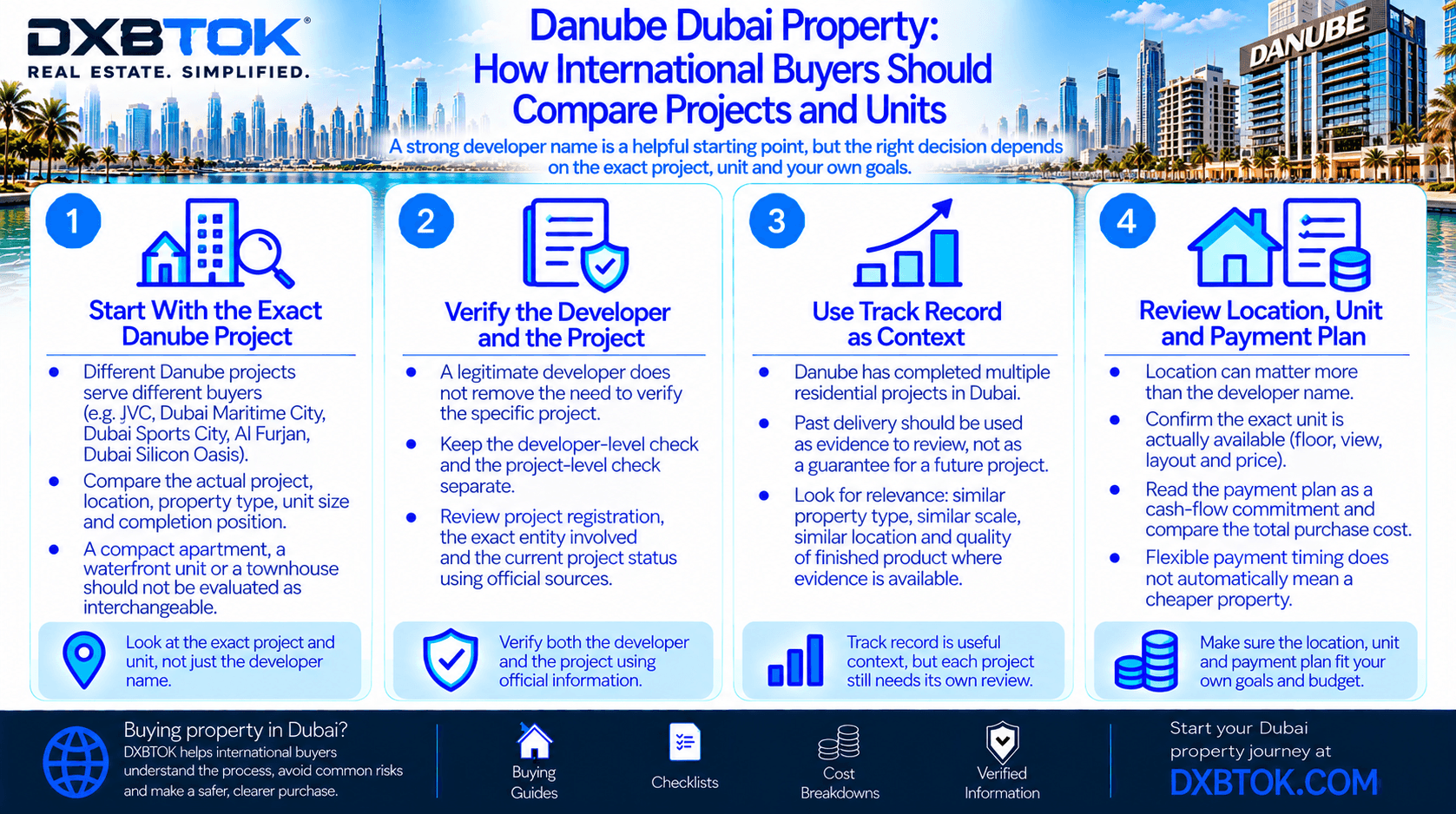
Danube Dubai Property: How International Buyers Should Compare Projects and Units
Danube Properties is a familiar name in Dubai’s off-plan market, but buying “a Danube property” is not one single decision. The developer’s portfolio spans different locations, property types, project stages, layouts, price points and payment structures.
For an international buyer, the useful question is not whether the Danube name is attractive in general. It is whether the exact Danube project and exact unit fit the buyer’s location needs, budget, payment capacity, property-use plan and long-term ownership requirements.
Danube’s current project marketing includes residential opportunities across areas such as JVC, Dubai Maritime City, Dubai Sports City, Al Furjan and Dubai Silicon Oasis, as well as newer townhouse and villa development. That makes project-level comparison more important than relying on the developer name alone.
A developer brand can help create a shortlist. The purchase decision still needs to be made at project and unit level.
1. Start With the Exact Danube Project
Different Danube projects can serve very different buyers.
A compact apartment in JVC, a waterfront residence in Dubai Maritime City, a unit in Dubai Sports City and a townhouse or villa in a newer community should not be evaluated as if they were interchangeable.
Start with the actual project, location, property type, unit size, completion position and intended use. Only then does the wider developer brand become useful context.
2. Verify the Developer and the Project Separately
A legitimate developer does not remove the need to verify the specific project being considered.
Developer identity, project registration, the exact entity involved and the status of the project are separate questions. The Dubai Property Developer Verification guide explains the wider developer-verification layer.
International buyers should keep the developer-level check and the project-level check separate rather than assuming one automatically proves the other.
3. Use Track Record as Context, Not as a Shortcut
Danube has developed and completed multiple residential projects in Dubai, but historical delivery should be used as evidence to review rather than as a guarantee about a future project.
Look at the relevance of previous projects: similar property type, similar scale, similar location context and the quality of the finished product where evidence is available.
The Dubai Developer Track Record guide sets out the broader questions buyers should use when interpreting delivery history.
4. Location Can Matter More Than the Developer Name
A strong developer name cannot compensate for a location that does not fit the buyer.
Compare road access, nearby employment or lifestyle destinations, public transport where relevant, surrounding development, noise, density and the maturity of the wider community.
A Danube project that works well for one buyer may be the wrong fit for another simply because their daily use and long-term ownership plans are different.
5. Treat the Project as Its Own Buying Decision
Marketing material can make a project look compelling before the important buyer questions are clear.
Project stage, registration, expected handover position, specification, unit mix, building configuration, surrounding construction and the evidence supporting the offer all matter.
The Dubai Project Verification guide is useful when a specific Danube project has moved from general interest to a serious shortlist.
6. Confirm That the Exact Unit Is Actually Available
Brochures and project pages describe the development. They do not prove that a particular unit, floor, view, layout or price is still available.
For a serious purchase decision, the buyer needs current information about the exact unit being offered.
The Dubai Project Availability guide explains why availability should be confirmed before a buyer bases a decision on a marketed option.
7. Read the Payment Plan as a Cash-Flow Commitment
Danube is well known for marketing monthly payment structures. Its current promotional material continues to feature 1% monthly payment plans while also stating that actual plans vary by project.
The headline monthly percentage is therefore only the starting point.
Compare the down payment, construction-stage payments, handover amount, any post-handover portion, the total time commitment and the buyer’s ability to fund the full schedule.
8. Do Not Confuse Flexible Timing With a Lower Purchase Cost
A payment plan can make the timing of payments easier without making the property cheaper.
Compare the actual purchase price, unit specification, usable space and ownership costs with realistic alternatives at the same total budget.
If a payment structure is the main reason the project looks attractive, test whether the property itself would still make the shortlist without that financing-style marketing advantage.
9. Compare the Exact Layout, Not Just the Bedroom Count
Two units with the same bedroom count can have very different practical value.
Review usable room dimensions, storage, balcony allocation, circulation space, kitchen arrangement, privacy, natural light and whether any flexible or furnished layout genuinely suits the intended use.
For remote buyers, the floor plan should be treated as a decision document rather than a decorative brochure page.
10. Amenities Need to Be Judged Against Ongoing Ownership
Large amenity packages can strengthen lifestyle appeal, but they also need to be considered alongside the building’s operating model and recurring ownership costs.
More facilities do not automatically mean a better purchase.
The relevant question is whether the amenities are useful to the buyer or future occupants and whether the overall building remains practical to own over time.
11. Ready, Near-Completion and Off-Plan Opportunities Need Different Evidence
A completed or near-completed property can be judged with more physical evidence than an early-stage off-plan purchase.
For an off-plan unit, buyers rely more heavily on project documents, specifications, construction progress, payment obligations and the developer’s delivery process.
The evidence available should match the stage of the exact Danube property being considered.
12. Compare Danube With Real Alternatives
A Danube project should not be evaluated only against other Danube projects.
Once the buyer has defined the budget, area, property type and intended use, compare the shortlisted Danube option with credible alternatives from other developers.
The Compare Dubai Developers guide provides the wider cross-developer decision framework without replacing the project-level comparison.
13. Separate Developer Reputation From the Exact Unit Premium
Brand familiarity can influence buyer confidence, but the exact price still needs to be justified by the property being purchased.
Floor, orientation, view, layout, size, furnishing, building position and current supply can all affect the value of one unit relative to another.
A buyer should be able to explain why the specific unit is preferable at its asking price, not merely why the developer is recognizable.
14. Be Careful With Return and Appreciation Claims
Projected returns, future rental demand and expected appreciation are assumptions, not substitutes for property analysis.
Review current evidence and understand the assumptions behind any commercial claim. Avoid treating promotional yield or appreciation language as a guaranteed outcome.
The property still needs to make sense under more conservative assumptions.
15. International Buyers Should Test Remote Ownership Practicality
If the property will be bought or owned from abroad, consider how practical the exact building and unit will be to manage remotely.
Access, handover coordination, furnishing, maintenance, property management and document control can matter more to an overseas owner than they do to a resident buyer.
A property that looks attractive on a sales presentation can become less attractive if the ownership process is unnecessarily difficult from overseas.
16. Know What Would Make You Reject the Project
A disciplined shortlist needs rejection criteria.
Examples may include a location that does not fit the intended use, an unsuitable unit layout, unclear availability, a payment commitment that strains future liquidity, weak project-level evidence, pricing that is difficult to justify against alternatives or an ownership model that does not work remotely.
Rejecting a property that does not fit is part of a strong buying process.
Final Takeaway
Danube Properties can be a relevant developer for international buyers, but the developer name should begin the analysis rather than end it.
Compare the exact project, exact unit, location, project stage, payment structure, current availability, ownership costs and realistic alternatives. Use Danube’s wider track record as context, then make the decision on the specific property in front of you.
DXBTOK helps international buyers compare selected Dubai property opportunities with clearer information around developers, projects, exact units, buyer costs and remote purchase practicalities before moving forward.
Related DXBTOK Guides
Buying Direct from Developer vs Through a Licensed Broker →
Dubai Off-Plan Payment Plans Explained for Remote Buyers →
Dubai Payment Plan Marketing: What Buyers Should Understand →
Full Cost of Buying Dubai Property: What International Buyers Should Budget →


