A Dubai developer’s track record can give international buyers useful evidence about past execution, but reputation or project count alone is not enough. This guide explains how to review completed developments, delivery history, comparable project experience, finished-product consistency, branded-residence experience and the developer’s current project pipeline before assessing a new property purchase.
Dubai Developer Track Record: What Buyers Should Review
A developer’s track record can help a buyer understand how the company has performed across previous projects.
But the number of developments shown in a brochure is not enough.
A useful review looks at what was actually delivered, how completed projects compare with the original proposition, how consistently the developer has executed, and whether that history is relevant to the project being considered now.
The practical question is:
“What evidence from this developer’s past work helps me assess the current project?”
Track record is evidence. It is not a guarantee.
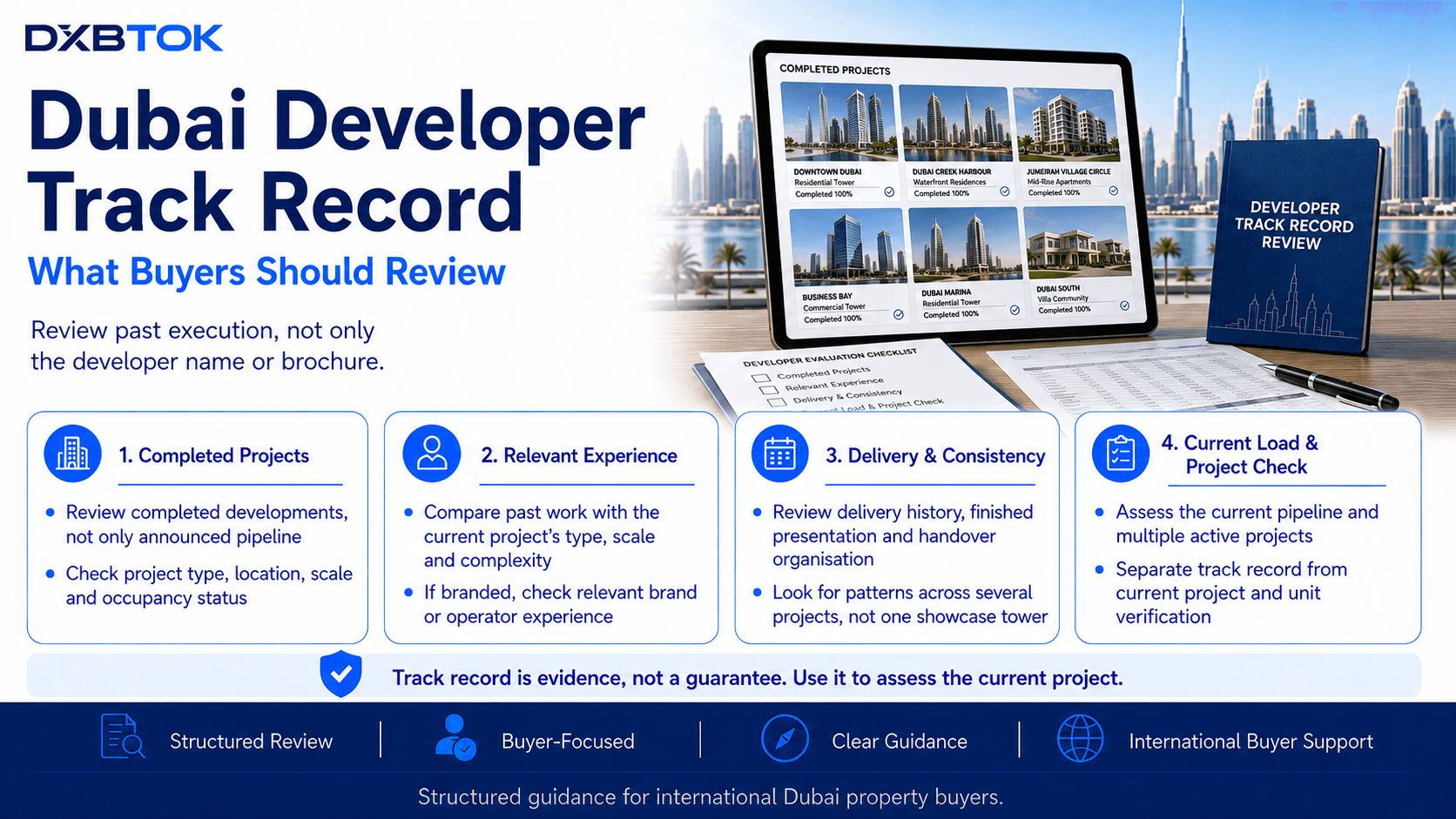
1. Start with completed projects
A developer may advertise a large project pipeline, but completed developments usually provide more useful evidence than future announcements.
Review examples of projects that have already reached completion.
Look at:
project name and location
property type
approximate scale
completion status
whether buyers or residents are already occupying the development
Buyers should also verify the Dubai property developer before relying on its project history.
The goal is to understand what the developer has actually delivered, not only what it plans to build.
2. Compare past projects with the developer’s current positioning
A developer can change over time.
A company that previously focused on mid-market apartments may later launch luxury towers, villas or branded residences.
That does not automatically make the new project weak.
But buyers should ask whether the developer’s earlier experience is relevant to the type and complexity of the new project.
Compare:
property type
project scale
design complexity
amenity level
location profile
target buyer segment
A strong record in one category does not automatically prove equal experience in every category.
3. Review delivery history, not only project count
Ten announced projects and ten completed projects are not the same thing.
Buyers should distinguish between:
announced projects
projects under construction
completed developments
projects already handed over
This creates a clearer view of the developer’s actual execution history.
The important metric is not simply how active the developer appears. It is how much of that activity has reached completion.
4. Look for consistency across several developments
One successful project can be encouraging.
A pattern across several projects is more informative.
Review whether the developer shows reasonable consistency in areas such as:
delivery
finished presentation
common-area quality
building management setup
communication
handover organisation
Buyers should look for patterns rather than relying on one showcase development.
5. Compare the finished product with the original proposition
Marketing materials show what a project is intended to become.
Completed projects show what the developer ultimately delivered.
Where possible, compare previous marketing or project positioning with the finished development.
Ask:
Does the completed property broadly match the intended positioning?
Do the common areas support the promised level of the project?
Is the building maintained in a way consistent with its market segment?
Does the finished product feel aligned with the developer’s original proposition?
The objective is not to expect a perfect match between a rendering and reality.
Buyers should also understand how to read Dubai property marketing claims before treating promotional statements as evidence.
It is to understand how effectively the developer turns a sales proposition into a completed property.
6. Check whether the developer has experience in the relevant location
Location experience can matter.
A developer that has already completed projects in the same area may have more direct experience with that market, infrastructure and buyer segment.
Review whether the developer has:
completed projects nearby
multiple developments in the same master community
experience with similar land or building formats
an established presence in the area
This should not be used as a standalone quality score.
It is another piece of evidence in the wider review.
7. Review the scale of past projects
A developer’s experience with small residential buildings may not be directly comparable with a large mixed-use development or multi-tower masterplan.
Look at whether previous projects are similar in scale to the current one.
Consider:
number of units
number of buildings
height or construction complexity
amenity requirements
retail or hospitality components
phased delivery where applicable
The larger and more complex the current development, the more relevant comparable execution experience becomes.
8. For branded residences, review relevant branded experience
If the current project is a branded residence, general development experience is useful but may not answer every question.
Buyers can also review whether the developer has previously worked with:
international brands
hotel operators
luxury management structures
branded-service models
higher-specification residential projects
A branded project can add operational and contractual complexity beyond the construction of the property itself.
For branded projects, buyers can separately verify branded residence claims in Dubai.
Relevant experience can therefore be useful evidence, while still requiring project-specific verification.
9. Do not confuse brand recognition with developer track record
A famous developer name may create confidence quickly.
A less familiar developer may require more research.
But recognition and track record are not exactly the same thing.
Track record should be reviewed through evidence such as:
completed developments
delivery history
relevant project experience
finished product
consistency across projects
A buyer should be able to explain why the developer’s history supports confidence in the current project beyond simply recognising the name.
10. Review handover experience where evidence is available
The final construction stage is important because this is when buyers move from an off-plan commitment toward an actual property.
Where reliable information is available, review how previous projects moved through:
completion communication
handover scheduling
final payment stages
buyer documentation
access and possession
Do not rely on isolated anecdotes as if they represent every buyer experience.
To understand the buyer-side completion stage itself, review the Dubai property handover process.
Look for broader patterns and confirmed information.
11. Review the developer’s current project load
Historical delivery is only one side of the picture.
Buyers should also understand what the developer is building now.
A rapidly expanding pipeline can indicate growth, but it can also mean the developer is managing more projects simultaneously than in the past.
Review:
number of active projects
approximate scale of the current pipeline
whether several major projects are progressing at the same time
whether the current project is materially larger than previous work
This does not produce a simple good-or-bad answer.
It helps put the historical track record into the context of the developer’s current commitments.
12. Separate developer track record from project verification
A strong developer history does not remove the need to verify the specific project.
Buyers still need to review:
the exact development
the unit
current commercial terms
payment structure
relevant documents
project-specific completion information
The developer’s history can support the decision.
Use the Dubai property buyer due diligence checklist to review the wider transaction beyond developer history.
It should not replace due diligence on the current purchase.
13. Use official and project-specific information where possible
Developer track-record research can easily become a collection of marketing claims, old articles and online opinions.
Buyers should distinguish between:
developer marketing
official project information
completed-project evidence
independent observations
unverified online claims
The strongest review is built from information that can be connected to identifiable projects and actual delivery.
14. Be careful with online reviews
Online reviews can provide useful signals, but they should not be treated as definitive proof.
A developer may have thousands of customers across different projects, years and transaction types.
Individual reviews can reflect:
a specific sales interaction
a particular building
a handover issue
property-management experience
a service complaint unrelated to construction quality
Look for repeated themes rather than making a major buying decision from one positive or negative comment.
15. Compare developers using the same criteria
Track-record research becomes more useful when buyers compare developers consistently.
For each developer under consideration, review the same categories:
Completed projects
Relevant project experience
Delivery history
Finished-product consistency
Experience in the location or property category
Current project pipeline
Evidence relevant to the specific project being considered
This prevents the comparison from being driven by whichever developer has the strongest marketing presentation.
16. Past performance should inform the decision, not decide it
A strong historical record can improve buyer confidence.
But no developer’s past performance can guarantee:
future completion dates
future construction quality
future property values
future rental performance
future service standards
Every new project has its own circumstances.
Track record should therefore be treated as one part of a wider property and transaction review.
17. Use a simple developer track-record checklist
Before reserving, ask:
What has this developer already completed?
Are those projects relevant to the one I am considering?
How consistent is the developer’s delivery history?
How do completed projects compare with their original positioning?
Does the developer have experience with this property type or project scale?
If branded, does it have relevant branded or operator experience?
What is the developer currently building?
Have I separately verified the specific project and unit?
If the buyer can answer these questions with evidence, the developer review becomes substantially more useful than simply asking whether the company is “good.”
Final takeaway
A Dubai developer’s track record should be reviewed through evidence, not reputation alone.
Look at completed projects, delivery history, comparable development experience, finished-product consistency, current project load and how relevant that history is to the property being considered.
Then keep the developer review separate from the verification of the specific project, unit, commercial terms and transaction documents.
Past execution can help you assess a developer. It cannot guarantee the outcome of the next project.
Comparing a Dubai developer before buying?
DXBTOK helps international buyers review selected Dubai property opportunities with clearer information around developers, projects, verification, commercial terms and the wider purchase process.
Start your Dubai property review at DXBTOK.com.
Related DXBTOK guides
How to Verify a Dubai Property Developer →
Dubai Property Buyer Due Diligence Checklist →
How to Read Dubai Property Marketing Claims →
Dubai Property Handover Process Explained →
How to Verify Branded Residence Claims in Dubai Before Buying →