Comparing Dubai developers before reserving an off-plan property requires more than looking at brand recognition or headline prices. This guide explains how international buyers can compare projects, completed-development evidence, relevant developer experience, delivery history, payment structures, current units, commercial terms and transaction processes using the same criteria before deciding which opportunity is stronger.
How to Compare Dubai Developers Before Reserving Off-Plan Property
Two Dubai off-plan projects can look equally attractive while the developers behind them are very different.
One may have a longer delivery history. Another may offer a stronger payment plan. One may have more relevant experience in the property type or location. Another may have a clearer reservation and buyer-support process.
That is why comparing developers should not begin with a question such as:
“Which developer is the best?”
A more useful question is:
“Which developer and project combination is stronger for this specific purchase?”
The comparison should use the same criteria for every developer so the decision is not driven only by brand recognition, launch presentation or headline price.
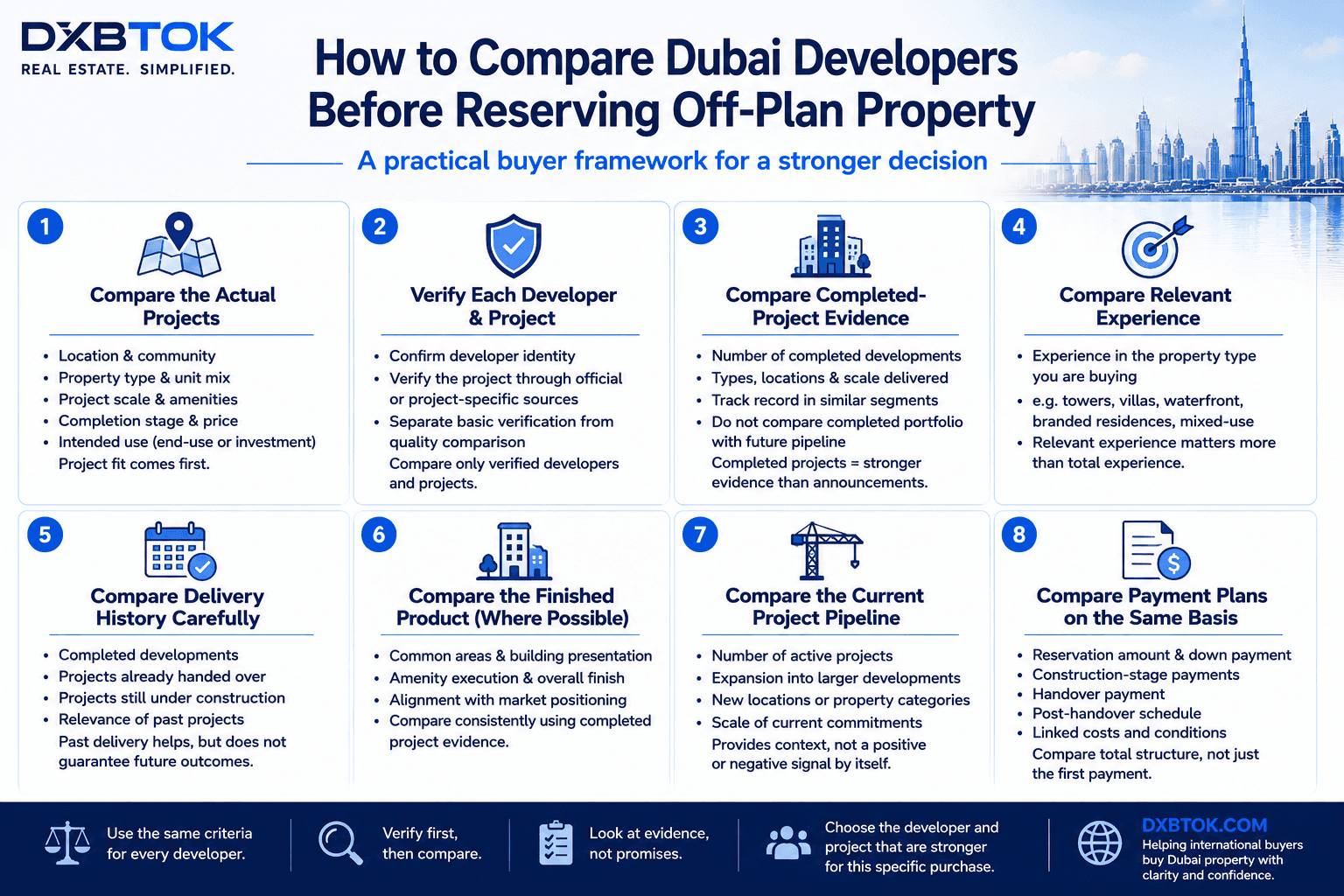
1. Compare the actual projects, not only the developer names
A developer comparison is useful only when it is connected to the projects the buyer is actually considering.
Start by placing the projects side by side.
Compare:
location
property type
unit configuration
project scale
expected completion stage
amenities
intended use
current price
A highly recognised developer with the wrong property for the buyer is not automatically the stronger choice.
Project fit comes first.
2. Verify each developer before comparing quality
Before trying to decide which developer appears stronger, confirm that the buyer is reviewing the correct developer and project information.
Check the developer identity and the project through appropriate official or project-specific sources.
This separates basic verification from the later comparison of experience, execution and commercial terms.
Before comparing execution or commercial strength, buyers should verify the Dubai property developer.
A buyer should not compare two developers using information that has not first been connected to the actual entities and projects involved.
3. Compare completed-project evidence
Once the developers and projects are identified, review what each developer has actually completed.
Useful evidence can include:
number of completed developments
types of properties delivered
project locations
scale of previous developments
completed buildings in a similar market segment
Do not compare one developer’s completed portfolio with another developer’s future pipeline as if they were equivalent.
For a deeper review, use the guide to Dubai developer track record evidence.
Completed projects provide stronger execution evidence than announcements alone.
4. Compare relevant experience, not just total experience
A developer may have many completed projects but limited experience with the type of development the buyer is considering.
For example, compare whether each developer has experience with:
large residential towers
villa or townhouse communities
waterfront developments
branded residences
mixed-use projects
projects of a similar scale
Relevant experience often matters more than simply counting how many developments carry the developer’s name.
5. Compare delivery history carefully
Delivery history is one of the most obvious comparison points, but it should be used carefully.
Review whether previous developments reached completion and whether there is a broader pattern across several projects.
Consider:
completed developments
projects already handed over
projects still under construction
whether previous projects are relevant to the current one
Past delivery can provide useful evidence.
It cannot guarantee the completion date or outcome of a new development.
6. Compare the finished product where possible
Developer comparison should not stop at delivery dates.
Completed developments can also provide evidence about what the finished product looks and feels like.
Where possible, compare:
common areas
building presentation
amenity execution
overall finish
how the completed project aligns with its market positioning
The objective is not to perform a technical construction inspection from photographs.
It is to compare the developer’s finished-project evidence consistently.
7. Compare the current project pipeline
A developer’s past track record should be viewed together with what the company is building now.
Review whether each developer is:
managing several active projects
expanding into larger developments
entering new locations or property categories
handling a materially larger pipeline than before
A large pipeline is not automatically positive or negative.
It gives the buyer context about the scale of the developer’s current commitments.
8. Compare the payment plans on the same basis
Off-plan payment plans can make two similarly priced properties feel very different financially.
Do not compare only the monthly or initial payment.
Compare:
reservation amount
down payment
construction-stage instalments
amount due at completion or handover
post-handover payments where applicable
payment timing
A lower initial payment does not necessarily mean the overall structure is better for the buyer.
Buyers can also review how Dubai off-plan payment plans are structured before comparing offers.
The payment plan should fit the buyer’s full cash-flow position.
9. Compare the total commercial proposition
Headline price is only one part of an off-plan comparison.
Two developers may offer similar unit prices but different overall commercial structures.
Review:
purchase price
payment plan
included furniture or packages
incentives
applicable transaction costs
expected ongoing ownership costs
The stronger offer is not automatically the one with the biggest discount.
It is the one whose full commercial structure better fits the buyer’s objectives and budget.
10. Compare the exact unit, not just the project
A buyer may prefer Developer A at project level but find that Developer B currently offers the more suitable unit.
Compare the actual properties available.
Check:
unit size
floor
layout
orientation
view
balcony or terrace
parking where relevant
current availability
The final purchase is an exact property, not an abstract developer ranking.
11. Compare how clearly each developer presents the transaction
The buyer experience before reservation can also reveal useful differences.
Compare whether the developer-side process provides clear answers about:
current unit availability
current price
reservation requirements
payment schedule
documents
next steps
payment instructions
A structured transaction process helps the buyer understand what they are agreeing to and what happens next.
12. Compare documentation, not only sales conversations
Verbal explanations and sales messages are useful during the comparison stage.
But important commercial information should eventually connect to written documents.
Before reservation, compare whether the current information is consistent across:
unit details
price information
payment plan
reservation terms
developer-issued or project-specific documentation
The buyer should be able to move from marketing information toward documented transaction information without unexplained contradictions.
13. Compare how transparent the important limitations are
Strong comparison does not look only for advantages.
It also looks at what each project requires the buyer to accept.
This can include:
payment deadlines
completion uncertainty
use restrictions
management arrangements
service charges
project-specific conditions
A project can still be attractive while having limitations.
The buyer simply needs to understand them before committing.
14. Do not let one marketing feature decide the comparison
A large discount, branded partnership, long payment plan, spectacular view or launch incentive can dominate the sales conversation.
But no single feature should replace the wider comparison.
Ask how the feature fits with:
project quality
developer evidence
price
payment structure
buyer objective
transaction terms
Use the guide on how to read Dubai property marketing claims when comparing promotional messages.
The stronger decision comes from the whole proposition, not the loudest marketing point.
15. Use the same scorecard for every developer
A simple comparison table can reduce emotional decision-making.
For each developer and project, review the same categories:
Project fit
Developer verification
Completed-project evidence
Relevant experience
Delivery history
Finished-project evidence
Current project pipeline
Payment plan
Total commercial proposition
Exact unit
Transaction clarity
Documentation
The purpose is not to create a mathematically perfect ranking.
It is to make sure every developer is being judged by the same standard.
16. There is no universal “best Dubai developer”
Different developers can be stronger for different buyers.
One buyer may prioritise a completed-project record and conservative payment structure.
Another may prioritise a particular location, property type or newer project concept.
A third may value post-handover payment flexibility.
The correct comparison depends on:
buyer objective
budget
risk tolerance
property type
location
payment capacity
intended holding or use
The goal is not to identify the best developer in Dubai.
It is to identify the stronger purchase for the specific buyer.
17. Reconfirm the winning option before reservation
After comparing the developers and choosing a preferred property, reconfirm the transaction before committing.
Check:
exact unit
current availability
current price
payment plan
reservation amount
reservation terms
legitimate payment destination
next document or transaction step
The comparison phase identifies the preferred opportunity.
Before sending money, buyers should also verify the Dubai property offer against the current unit and terms.
The final confirmation ensures that the opportunity being reserved is still the one the buyer actually compared.
Final takeaway
Comparing Dubai developers before reserving an off-plan property should be a structured exercise, not a popularity contest.
Compare the actual projects, developer verification, completed-project evidence, relevant experience, delivery history, payment structures, exact units, transaction clarity and documentation.
Use the same criteria for every developer.
The strongest choice is not necessarily the most famous developer or the lowest headline price. It is the developer-and-project combination that best fits the buyer’s objectives and is supported by the clearest evidence and transaction terms.
Comparing Dubai off-plan projects?
DXBTOK helps international buyers review selected Dubai property opportunities with clearer information around developers, projects, payment structures, verification and the wider purchase process.
Start your Dubai property review at DXBTOK.com.
Related DXBTOK guides
Dubai Developer Track Record: What Buyers Should Review →
How to Verify a Dubai Property Developer →
Dubai Off-Plan Payment Plans Explained →