

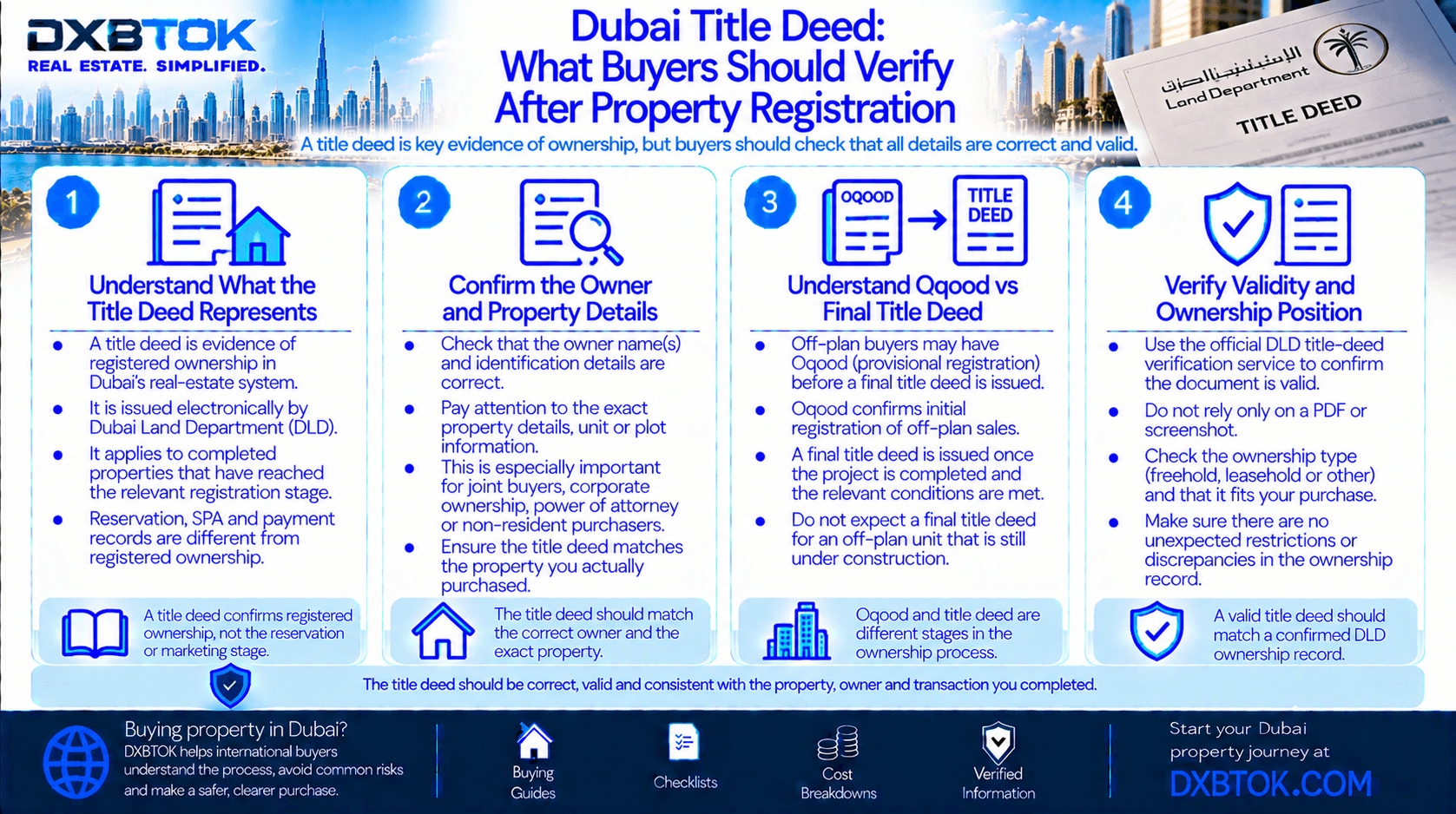
A Dubai title deed is important registered ownership evidence, but receiving the document should not be the end of the buyer’s review. International buyers should confirm that the electronic title deed is valid, reflects the correct owner and exact property, matches the expected ownership structure and remains consistent with the wider transaction record. Off-plan buyers should also understand the difference between provisional Oqood registration and the final title-deed stage once the property reaches the relevant completion and registration position.
Dubai Title Deed: What Buyers Should Verify After Property Registration
A Dubai title deed is an important ownership document, but international buyers should not treat receiving the document as the end of the ownership check.
Dubai Land Department issues title deeds electronically, and DLD also provides an official title-deed verification service. That creates a clear distinction between simply holding a copy of a document and confirming that the ownership record is valid and consistent with the property that was bought.
For a buyer, the practical question is whether the issued title deed correctly reflects the owner, property and registered ownership position after the transaction has been completed.
The title deed should match the transaction you completed: correct owner, correct property, correct ownership position and a valid DLD record. Any inconsistency deserves attention before the document is treated as settled.
1. Understand What the Title Deed Represents
A title deed is evidence of registered ownership in Dubai’s real-estate system for property that has reached the relevant registration stage.
For completed property, the deed sits at the ownership end of the transaction rather than the reservation or marketing stage.
The Dubai Property Reservation vs Full Purchase guide explains why reserving a property and holding registered ownership are not the same transaction position.
2. Keep the Transfer Process Separate From the Ownership Record
The property-transfer process and the title deed are closely connected, but they answer different buyer questions.
The transfer process concerns how ownership moves from one party to another. The title deed is the ownership evidence that follows successful registration.
The Dubai Property Transfer Process Explained covers the broader completed-property transfer mechanics, including pre-transfer readiness, NOC requirements where applicable, payment readiness and registration.
3. Confirm the Owner Details Are Correct
The buyer should check that the ownership details shown on the title deed reflect the person or people who were meant to acquire the property.
This becomes especially important where there are joint buyers, corporate ownership, a power of attorney or a non-resident purchaser.
Minor-looking differences in names or identification details can create practical problems later if the ownership record does not align cleanly with the buyer’s official identity documents.
4. Confirm the Exact Property Details
The title deed should correspond to the property that was actually purchased.
Buyers should pay attention to the property description, unit or plot information and other identifying details shown on the ownership record.
This matters because the transaction may have involved brochures, reservation forms, an SPA, floor plans and payment records before the final ownership document was issued.
The Dubai Property Documents Checklist helps keep those documents connected to the same property and buyer.
5. Understand the Difference Between a Title Deed and Oqood
Off-plan buyers may encounter Oqood or provisional registration before a final title deed is issued.
DLD describes initial registration as the registration of off-plan sales and other legal actions before they move into the full Real Estate Registry. DLD also states that completed units can move from the initial register to the Real Estate Registry and receive a title deed once the relevant conditions are met.
The Dubai Oqood Explained for Off-Plan Buyers covers the off-plan registration position separately.
6. Do Not Assume an Off-Plan Purchase Should Already Have a Final Title Deed
A buyer who has reserved or substantially paid for an off-plan unit may still be in the provisional-registration stage rather than the final title-deed stage.
The property’s completion and registration status matter.
That distinction is important because asking for the wrong document at the wrong stage can create unnecessary confusion about whether ownership has been properly recorded.
7. Verify That the Title Deed Is Valid
DLD provides an official service specifically for validating title deeds issued by the department.
For an international buyer, this matters because a PDF, screenshot or forwarded document should not be treated as sufficient evidence merely because it looks official.
The key point is simple: the document should correspond with a valid DLD ownership record.
8. Check the Ownership Type and Property Position
International buyers should understand the type of ownership attached to the property and whether it is consistent with the purchase they intended to make.
For foreign buyers, freehold eligibility and the exact property location remain relevant before purchase and when reviewing the final ownership position.
The Freehold Property in Dubai guide explains the wider international-buyer ownership context.
9. Joint Ownership Deserves Extra Attention
Where more than one person owns the property, buyers should make sure the ownership record reflects the intended co-ownership arrangement.
This matters for future sale, financing, succession planning and any later transaction requiring owner consent.
If the title deed does not reflect the ownership structure the buyers expected, the issue should be clarified rather than left until a future sale or mortgage application.
10. Mortgage Status Should Not Be Assumed From the Purchase Conversation
A buyer who used mortgage finance should make sure the registered property position matches the financing structure actually completed.
DLD’s detailed property statement can include information such as ownership, mortgage, seizure, suspension and project details.
That means buyers should distinguish between what was discussed during financing and what is actually recorded against the property.
11. Restrictions or Property Issues May Require a Wider Record Check
A title deed is important, but some ownership questions go beyond the face of the document.
DLD provides property-status and detailed-property information that can reflect matters such as mortgages or restrictions associated with the property.
Where a buyer has concerns about an unusual transaction history, legal restriction or inconsistency, the broader registered property position may matter more than the deed copy alone.
12. Keep the Title Deed With the Rest of the Transaction Evidence
The title deed should sit inside the buyer’s wider ownership file together with the main purchase agreement, payment evidence, transfer documents, identification records and any relevant NOC or financing documents.
This gives the owner a cleaner documentary trail if the property is later refinanced, sold, inherited, managed remotely or reviewed by a professional adviser.
International owners should avoid relying on a single screenshot or an isolated document without the supporting transaction record.
13. Understand When a New or Updated Title Deed May Be Relevant
Ownership information can change over time because of transactions such as sale, transfer, ownership-data correction or other approved amendments.
DLD has services for title-deed issuance and ownership-data modification, and the resulting document is electronic.
The buyer does not need to master those administrative procedures, but should understand that the ownership document should remain consistent with the registered position after a material approved change.
14. Remote Buyers Need a Clean Digital Record
An owner living outside the UAE may rarely handle the property documents in person.
For that reason, a clean electronic record becomes especially important: the title deed, identity records, payment evidence and relevant transaction documents should be easy to locate and consistent with one another.
Remote ownership works better when the documentary record remains organised and internally consistent from purchase onward.
15. Title Deed Fees Are Separate From Ownership Verification
DLD charges fees for title-deed issuance and related registration services, but the existence of a fee does not change the verification question.
Buyers should separate the transaction cost from the ownership evidence itself.
The amount paid for registration or document issuance does not prove that every ownership detail is correct; the final registered record still needs to match the transaction.
16. A Title Deed Does Not Replace the Need to Preserve Earlier Documents
Once the title deed has been issued, buyers sometimes assume earlier documents no longer matter.
That can be a mistake. Reservation records, SPA terms, payment evidence, NOCs and transfer documentation can still be relevant when explaining how the ownership position was reached.
The title deed is a key final ownership document, but it is strongest when the full transaction file remains coherent.
17. Think Ahead to Future Ownership Changes
A clean ownership record makes future transactions easier to understand.
When a property is later sold, refinanced, transferred or inherited, the current owner information and registered property position become part of the next transaction.
That is another reason to resolve discrepancies when they are first noticed rather than carrying them into a later ownership event.
Final Takeaway
A Dubai title deed is not just another document in the purchase file. It is important registered ownership evidence.
International buyers should make sure the deed is valid, matches the correct owner and property, reflects the expected ownership position and fits consistently with the wider transaction record.
If something does not match, it is better to identify the issue immediately than to discover it later during a mortgage, resale, inheritance or ownership change.
DXBTOK helps international buyers review selected Dubai property opportunities with clearer information around ownership documents, transaction stages, buyer costs and remote purchase practicalities before moving forward.
Related DXBTOK Guides
Dubai Land Department Fees for International Buyers →
What Is a No Objection Certificate in Dubai Property? →
Power of Attorney for Dubai Property: What Buyers Should Know →


