Dubai property buyers can often access new developments either through the developer’s internal sales team or through a licensed broker or authorised channel partner. The best route depends on whether the buyer already knows the exact project, needs broader market comparison, wants additional coordination or is purchasing remotely. This guide explains the practical differences between the two routes without assuming that either one is automatically cheaper or better.
Buying Direct from Developer vs Through a Licensed Broker
Dubai property buyers often face an early decision: should they deal directly with the developer, or work through a licensed real estate broker?
Both routes can be legitimate.
But they are not identical.
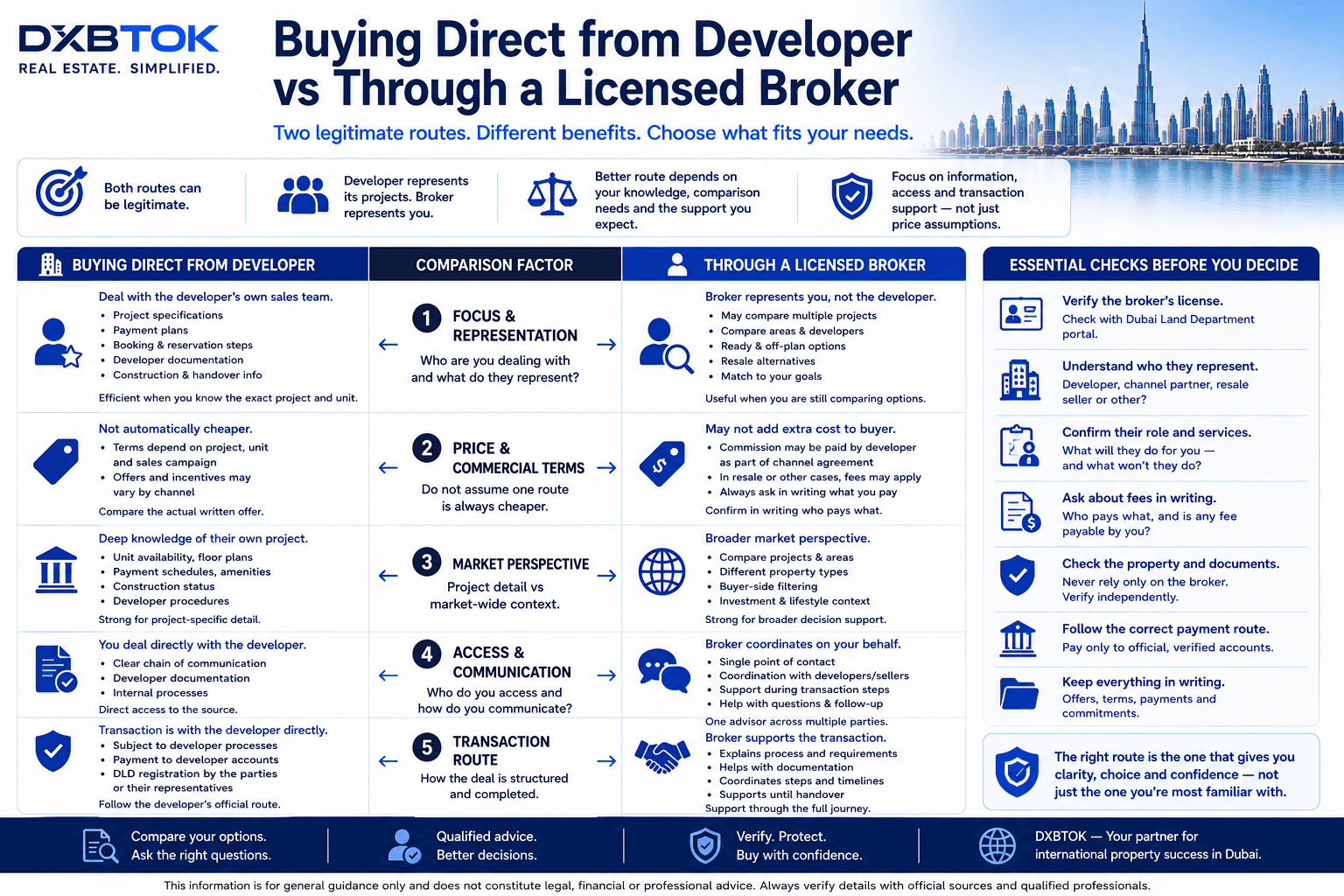
The developer’s sales team represents the developer and its inventory. A licensed broker may help the buyer compare options, explain the market, coordinate with different developers or sellers and guide the buyer through parts of the transaction.
The better route depends on what the buyer already knows, how much comparison is still needed and what kind of support the buyer expects.
The key question is not:
“Which route is always cheaper or better?”
It is:
“Which route gives me the information, access and transaction support I need for this specific purchase?”
1. Buying direct means dealing with the developer’s own sales channel
When you buy directly from a developer, you are dealing with the company selling its own project or inventory.
The developer’s sales team can usually explain:
available units
project specifications
payment plans
booking or reservation steps
developer documentation
construction or handover information provided by the developer
This can make the process efficient when the buyer already knows the exact project and unit they want.
But the developer’s team is naturally focused on the developer’s own inventory.
It is not an independent comparison service across the wider Dubai market.
2. A licensed broker can widen the comparison
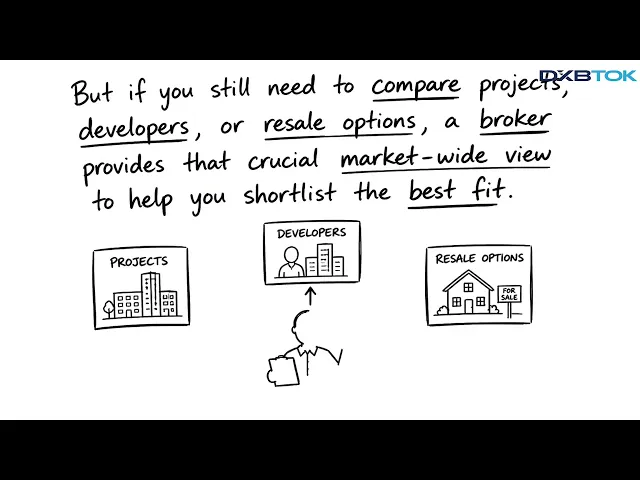
A broker can potentially help the buyer compare multiple projects, developers, locations or resale properties.
That can be useful when the buyer has not yet made a final decision.
Instead of asking only:
“Which unit should I buy in this project?”
a broker may help the buyer ask:
“Is this project actually the best fit among the options available to me?”
This broader comparison can be valuable for international buyers who are not deeply familiar with Dubai’s communities, developers and transaction structures.
3. Direct access does not automatically mean a better deal
Some buyers assume that buying directly from a developer must automatically produce a lower price.
That should not be assumed.
The actual commercial terms depend on the project, unit, sales campaign, developer pricing structure and any authorised channel arrangement.
A developer may offer the same inventory through its internal team and licensed external brokers.
In other cases, unit access, incentives or availability may differ by channel.
The buyer should compare the actual written offer rather than assuming that one route is inherently cheaper.
4. A broker does not automatically mean an extra buyer cost
Another common assumption is that using a broker always means the buyer must pay a separate broker fee.
That is not universally true.
In some developer sales, broker compensation may be arranged between the developer and the broker rather than being added as a separate buyer charge.
In other transactions, especially resale or specific service arrangements, different fee structures may apply.
The correct approach is simple:
Ask in writing what the buyer pays, what the developer pays, and whether any brokerage or service fee applies to the transaction.
Do not rely on assumptions about commission.
5. The developer knows its project; the broker may know the alternatives
A developer sales representative can often provide detailed information about the developer’s own project.
That can include:
unit availability
floor plans
payment schedules
amenities
construction status
developer-specific procedures
A good broker may add a different layer:
comparison with competing projects
comparison between areas
ready versus off-plan alternatives
different property types
resale alternatives
buyer-side filtering
The buyer may therefore receive deeper project detail from the developer and broader market context from the broker.
Those are different forms of value.
6. Ask who the broker actually represents in the transaction
Do not assume that every broker relationship works in exactly the same way.
A broker may be introducing a buyer to a developer, working as an authorised channel partner, handling a resale listing or supporting another transaction structure.
Before relying on the broker, understand:
which brokerage they belong to
whether they are licensed
which property or developer they are representing
whether they are authorised to market the property
who pays their commission or fee
what services they are actually providing to you
Before relying on an intermediary, buyers should understand how to verify a Dubai real estate broker.
Role clarity is more important than the word “broker.”
7. Verify the broker before relying on the relationship
For a more specific credential check, review how a Dubai broker BRN number can be used as part of broker verification.
A buyer should not rely only on a WhatsApp profile, business card or social-media account.
If a broker is involved, verify the individual and brokerage through the appropriate Dubai real estate channels.
The buyer should be able to identify the broker’s credentials and the brokerage they operate under.
This matters even when the property itself is being sold by a major developer.
A legitimate project does not automatically verify every person claiming to sell it.
8. Verify the developer separately
Buying direct does not remove the need for due diligence.
International buyers can use the dedicated guide to verify a Dubai property developer before committing.
The developer itself should still be checked.
Depending on the property, buyers may need to confirm matters such as:
developer identity
project identity
current unit availability
payment instructions
contracting entity
relevant registration or project information
“Direct from developer” describes the sales route.
It does not mean the buyer should skip verification.
9. Compare the information you receive, not only the person delivering it
Whether the information comes from a developer or broker, the buyer should separate sales information from transaction information.
Sales information can include:
brochures
renders
estimated rental positioning
lifestyle claims
project marketing
Transaction information includes:
exact unit
current price
payment schedule
reservation terms
contract documents
payment recipient
registration steps
The second category should drive the final purchase decision.
10. Direct purchase can work well when the buyer already knows exactly what they want
There are situations where going directly to the developer is practical.
For example, the buyer may already have:
selected the area
selected the developer
selected the project
compared competing alternatives
understood the payment plan
decided that the specific unit fits the objective
At that stage, the buyer may mainly need current availability, final commercial terms and a clear transaction route.
Direct developer contact can be efficient in that situation.
11. A broker can add more value when the buyer is still deciding
A broker can be more useful when the buyer still needs help narrowing the market.
This may apply when the buyer is unsure about:
which area fits the objective
which developer to consider
ready versus off-plan
apartment versus villa or townhouse
which payment structure is suitable
which projects should be excluded
The value is not simply access to listings.
The value is reducing the number of unsuitable options before the buyer commits time and capital.
12. International buyers should pay attention to coordination
For a buyer living outside Dubai, the transaction is not only about finding the property.
It may also involve:
remote calls and viewings
document collection
KYC or compliance steps
reservation coordination
payment instructions
contract follow-up
registration or handover communication
A developer may handle these steps through its internal team for its own project.
A licensed broker may help coordinate between the buyer and the relevant developer, seller or transaction party.
The broader sequence is explained in the Dubai property buying process guide.
What matters is that the buyer knows who is responsible for each stage.
13. More intermediaries do not automatically mean more protection
A long chain of people can make a transaction less clear rather than safer.
International buyers should know exactly who they are dealing with.
A cleaner structure is usually easier to control:
buyer → verified broker or developer channel → official transaction party
If multiple intermediaries are involved, ask why they are needed and what each one is responsible for.
The buyer should not lose visibility simply because more people are included in the conversation.
14. The best broker relationship should make verification easier
A broker should not discourage the buyer from checking credentials, developer details, documents or payment instructions.
Buyers can also review buyer safety and transparency before moving from property selection into payment and documentation.
A strong professional relationship should make the transaction easier to verify.
The buyer should be able to ask:
Who is the developer or seller?
What is the exact unit?
What is the current written price?
What is the payment plan?
Which document confirms the next step?
Where will the money be sent?
Who handles the regulated transaction step?
Clear answers are more important than sales pressure.
15. The best route can change during the search
A buyer may begin directly with one developer and later decide that another project is better.
Another buyer may begin with a broker, compare several options and then work closely with the chosen developer’s internal team once a project is selected.
These routes are not mutually exclusive.
A buyer can use broader comparison during the decision stage and direct developer coordination during the transaction stage where appropriate.
The important point is to understand who is doing what.
16. Compare the route using five practical questions
Before deciding whether to buy direct or through a licensed broker, ask:
Do I already know the exact property or project I want?
Do I still need broader comparison across multiple options?
Who is responsible for verifying availability, documents and payment instructions?
What does the buyer pay under each route?
Who will coordinate the transaction if I am outside Dubai?
The answers usually make the appropriate route much clearer.
Final takeaway
Buying directly from a developer and buying through a licensed broker are both normal routes into Dubai property.
The developer route can be efficient when the buyer already knows the exact project and mainly needs access to current inventory and the developer’s transaction process.
A licensed broker can add value when the buyer still needs broader comparison, market filtering or coordination across different options.
Do not choose based on assumptions that “direct is always cheaper” or “a broker is always better.”
Compare the actual property, the written commercial terms, the role of each party and the support you need.
The strongest route is the one that gives you clear information, verified parties and a transaction structure you understand.
Need help comparing Dubai property options?
DXBTOK helps international buyers review selected Dubai property opportunities, compare suitable routes and coordinate the next steps with licensed broker or developer channels where appropriate.
Start your Dubai property review at DXBTOK.com.
Related DXBTOK guides
How to Verify a Dubai Real Estate Broker →
Dubai Broker BRN Number Explained: How Buyers Can Check Credentials →
How to Verify a Dubai Property Developer →