
Dubai Property for Holiday-Home Use: What Buyers Should Verify Before Buying


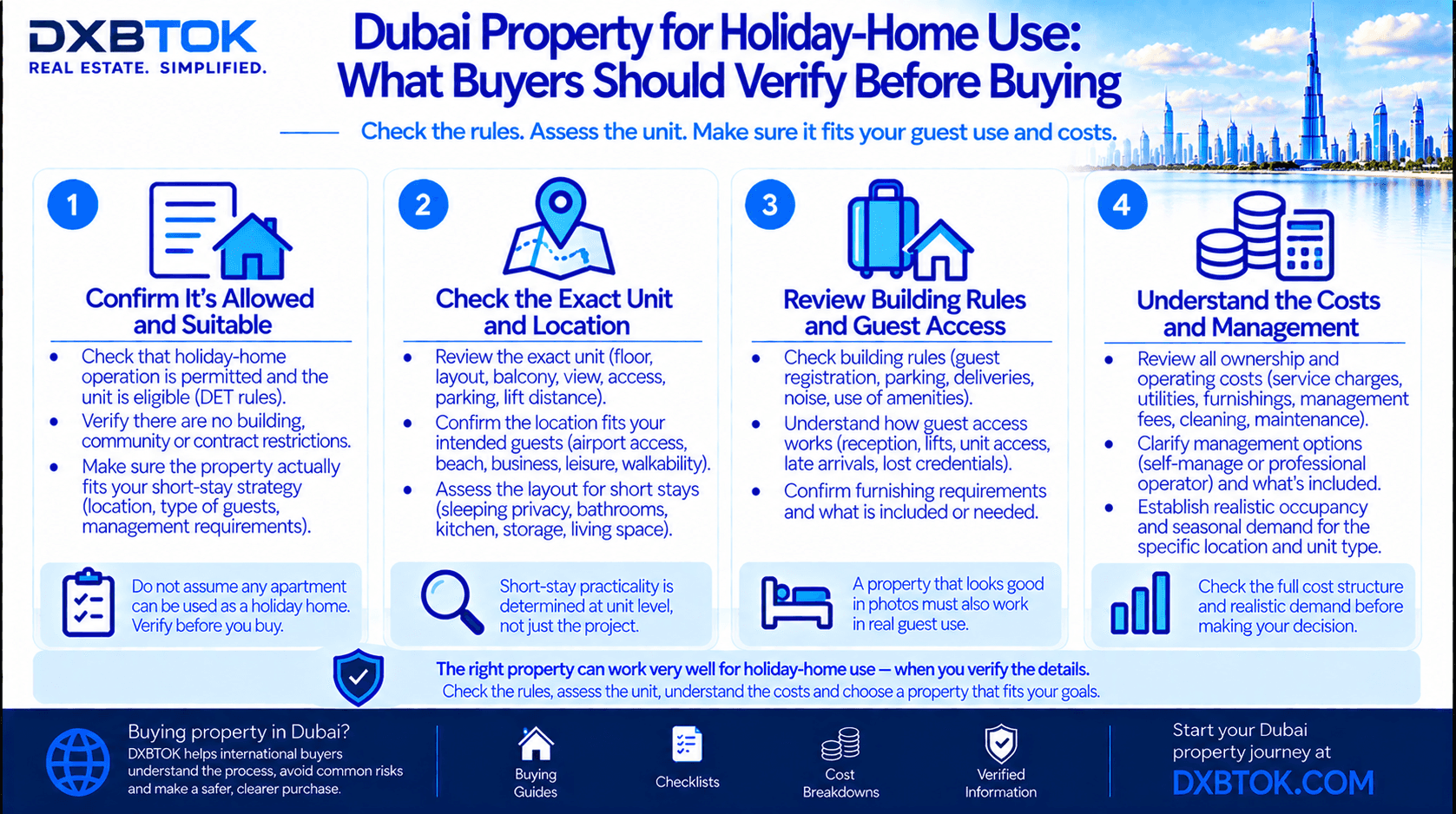
A Dubai property can look suitable for short stays without being practical to operate as a holiday home. Buyers should confirm the exact unit’s regulatory and property-level suitability, guest access, building environment, layout, furnishing requirements, cleaning and turnover logistics, management intensity, recurring ownership costs and personal-use flexibility before purchasing for holiday-home use.
Dubai Property for Holiday-Home Use: What Buyers Should Verify Before Buying
A Dubai property can look attractive for short stays without necessarily being a practical holiday-home property.
Location, building access, unit layout, furnishing, guest turnover, management intensity, operating restrictions and recurring ownership costs can all affect whether the exact property works for this use.
Before buying with holiday-home use in mind, verify the exact property's operational suitability rather than assuming that any well-located apartment can be used successfully for short stays.
1. Separate the Property Decision From the Rental-Strategy Decision
The first question is whether you actually want a holiday-home rental model rather than a conventional long-term tenancy.
That broader decision involves personal-use flexibility, occupancy patterns, management intensity, furnishing, operating costs and vacancy exposure.
For that comparison, use our Dubai holiday home vs long-term rental guide.
Once the strategy is clear, evaluate whether the exact property is suitable for the holiday-home use you intend.
2. Confirm That Holiday-Home Operation Is Actually Possible
Do not assume that ownership alone means the property can automatically be operated as a holiday home.
Holiday-home activity in Dubai is regulated by the Department of Economy and Tourism, and the relevant unit must meet current requirements before it is operated for this purpose.
Before purchase, confirm the current regulatory position, unit eligibility and any building, community or contractual restrictions that could affect the intended use. The official Dubai DET Holiday Homes permit service provides the relevant authority reference for current holiday-home permit requirements.
3. Verify the Exact Unit, Not Only the Project
A project may appear suitable for short stays while individual units behave very differently.
Check the exact:
unit number
floor
layout
balcony
view
access route
parking position
distance from lifts and shared facilities
Short-stay practicality is often determined at unit level.
4. Check Whether the Location Fits the Intended Guest Use
A holiday-home property should be assessed against the type of visitor you expect to use it.
Consider:
airport and major-road access
beach, business, leisure or event proximity
walkability
public transport
restaurants and daily services
the surrounding environment at night and on weekends
Use our Dubai property area-selection guide to keep the wider location decision separate from the holiday-home operating question.
5. Match the Layout to the Likely Guest
The number of bedrooms alone does not determine short-stay usability.
Check whether the layout supports the intended guest profile.
For example:
Is there enough sleeping privacy?
Are bathrooms practical for the likely number of guests?
Is luggage storage realistic?
Does the living area work when the property is fully occupied?
Is the kitchen appropriate for the intended stay pattern?
Is there usable dining or work space?
A compact unit can work well if the layout is efficient. A larger unit can still be awkward if circulation and storage are weak.
6. Check Arrival and Access Practicality
Guest arrival should be assessed as an operating process, not only a building-security feature.
Ask how access would work for:
the building entrance
reception or security
lifts
the unit itself
parking
late arrivals
replacement or lost access credentials
If frequent guest access is difficult to coordinate, the property's operating burden can increase significantly.
7. Understand Building Rules Before Buying
Building and community rules can affect how smoothly a short-stay property operates.
Ask about practical rules concerning:
guest access
registration procedures
parking
deliveries
use of shared amenities
noise
move-in or luggage handling
The important point is whether the intended use works with the building's real operating environment.
8. Check Furnishing Requirements at Property Level
Holiday-home use normally creates a different furnishing requirement from an unfurnished long-term rental or occasional personal-use property.
Assess:
bed configuration
durability of furniture
storage
window coverings
lighting
kitchen equipment
laundry practicality
replacement ease
A property that photographs well but is difficult to maintain can create unnecessary operating work.
9. Consider Cleaning and Turnover Logistics
Short stays can require repeated cleaning, linen changes, inspections and preparation between guests.
Ask whether the property is easy to reset.
Look at:
cleaning access
linen and supply storage
waste disposal
laundry arrangements
maintenance access
time needed to inspect the unit between stays
Operational friction becomes more important when the owner lives abroad.
10. Check Remote-Ownership Practicality
If you will not be in Dubai full-time, the property has to remain manageable when you are absent.
Review who can coordinate access, inspect the property, respond to maintenance issues and handle practical problems locally.
Our Dubai property for remote ownership guide covers the broader pre-purchase question of whether an exact property is practical to own from abroad.
11. Separate Personal Use From Holiday-Home Operation
A property bought partly for your own stays needs a clear personal-use plan.
Ask:
How often do you expect to use it yourself?
Which periods do you want to keep available?
How much flexibility do you need?
Will personal possessions remain in the unit?
Who prepares the property before you arrive?
For the personal-use ownership decision itself, see our Dubai property for second-home buyers guide.
12. Check Storage for Owner Belongings
If you intend to use the property personally, you may want belongings to remain there between visits.
Check whether the unit has:
lockable owner storage
enough wardrobe capacity
space for luggage
a practical way to separate personal items from guest-use items
A property with almost no storage may be inconvenient for mixed personal and holiday-home use.
13. Review Wear-and-Tear Exposure
Frequent turnover can create a different pattern of wear from one long-term occupant.
Pay attention to:
flooring
paint finishes
doors and handles
kitchen surfaces
bathrooms
soft furnishings
air-conditioning use
Durability can matter as much as appearance when the unit is used repeatedly by different guests.
14. Understand the Management Intensity
Holiday-home use can require more active coordination than a conventional long-term tenancy.
Depending on the setup, someone may need to handle:
guest communication
access
cleaning
inspections
maintenance
supplies
owner reporting
urgent problems
For the broader post-purchase operating framework, use our Dubai property management for overseas owners guide.
15. Check the Full Recurring Cost Base
Do not evaluate the property only by purchase price.
Recurring ownership and operating costs may include:
building service charges
maintenance
management
cleaning
furnishing replacement
utilities
insurance where applicable
other operating charges
Separate fixed annual ownership costs from costs that rise with guest activity.
16. Do Not Assume Short-Stay Revenue Will Automatically Cover the Costs
A property can be operationally suitable for holiday-home use and still be a weak financial purchase at the price being asked.
Avoid relying on headline nightly rates or simple occupancy assumptions.
Consider the full ownership and operating cost, realistic periods of vacancy, management deductions, furnishing replacement and your own personal-use periods before forming a view of the economics.
17. Compare Similar Units on the Same Use Case
When comparing two properties, do not compare only purchase price or view.
Compare them on the same holiday-home use case:
same likely guest profile
similar access practicality
similar furnishing requirement
similar management intensity
similar recurring-cost structure
similar personal-use expectations
This helps reveal whether a more expensive property actually offers a better operating setup.
18. Check Whether the Property Still Works if Your Strategy Changes
Your intended use may change later.
Ask whether the property would still be practical if you decided to:
use it more personally
move to a long-term tenancy
leave it vacant for periods
sell it
A property with only one narrow use case can create more future friction than a flexible unit.
19. Keep Hotel-Suite Products Separate
A hotel-suite investment, serviced unit or operator-controlled product can have a different ownership and operating structure from a normal residential property used as a holiday home.
Do not assume the economics, personal-use rights, management structure or resale conditions are interchangeable.
Confirm what you are actually buying before applying a conventional holiday-home analysis.
20. Use a Holiday-Home Property Suitability Checklist
Strategy: Have I already decided that holiday-home use fits my ownership objective?
Eligibility: Have I confirmed current regulatory and property-level suitability?
Exact unit: Does this specific unit work for short stays?
Location: Does the location fit the intended guest profile?
Layout: Is the internal arrangement practical for the likely occupancy?
Access: Can arrivals, keys, parking and building entry be handled efficiently?
Building: Are the operating rules compatible with the intended use?
Furnishing: Can the property be furnished and maintained practically?
Turnover: Are cleaning, linen, waste and reset logistics manageable?
Remote ownership: Can the property be operated while I am abroad?
Personal use: Can my own stays coexist with the operating model?
Storage: Is there enough space for owner and operating items?
Wear: Can the finishes tolerate repeated guest turnover?
Management: Do I understand the operational intensity?
Costs: Have I separated fixed ownership costs from operating costs?
Economics: Have I avoided relying only on headline nightly rates?
Flexibility: Would the property still work if my strategy changes?
Final Takeaway
A Dubai holiday-home property should be selected as an operating asset, not simply as an attractive apartment in a tourist-friendly area.
Verify the exact unit, current eligibility, building environment, guest access, layout, furnishing, turnover logistics, management requirements, recurring costs and personal-use flexibility before buying.
The key question is not whether the property looks suitable for short stays. It is whether the exact property can be operated practically, compliantly and flexibly for the use you intend.
Related DXBTOK guides
Dubai Holiday Home vs Long-Term Rental: What Owners Should Compare →
Dubai Property Area Selection: How Buyers Should Compare Locations →
Dubai Property for Second-Home Buyers →


