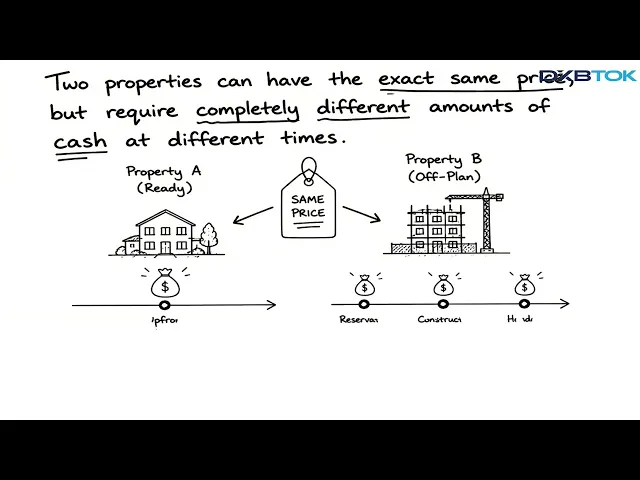
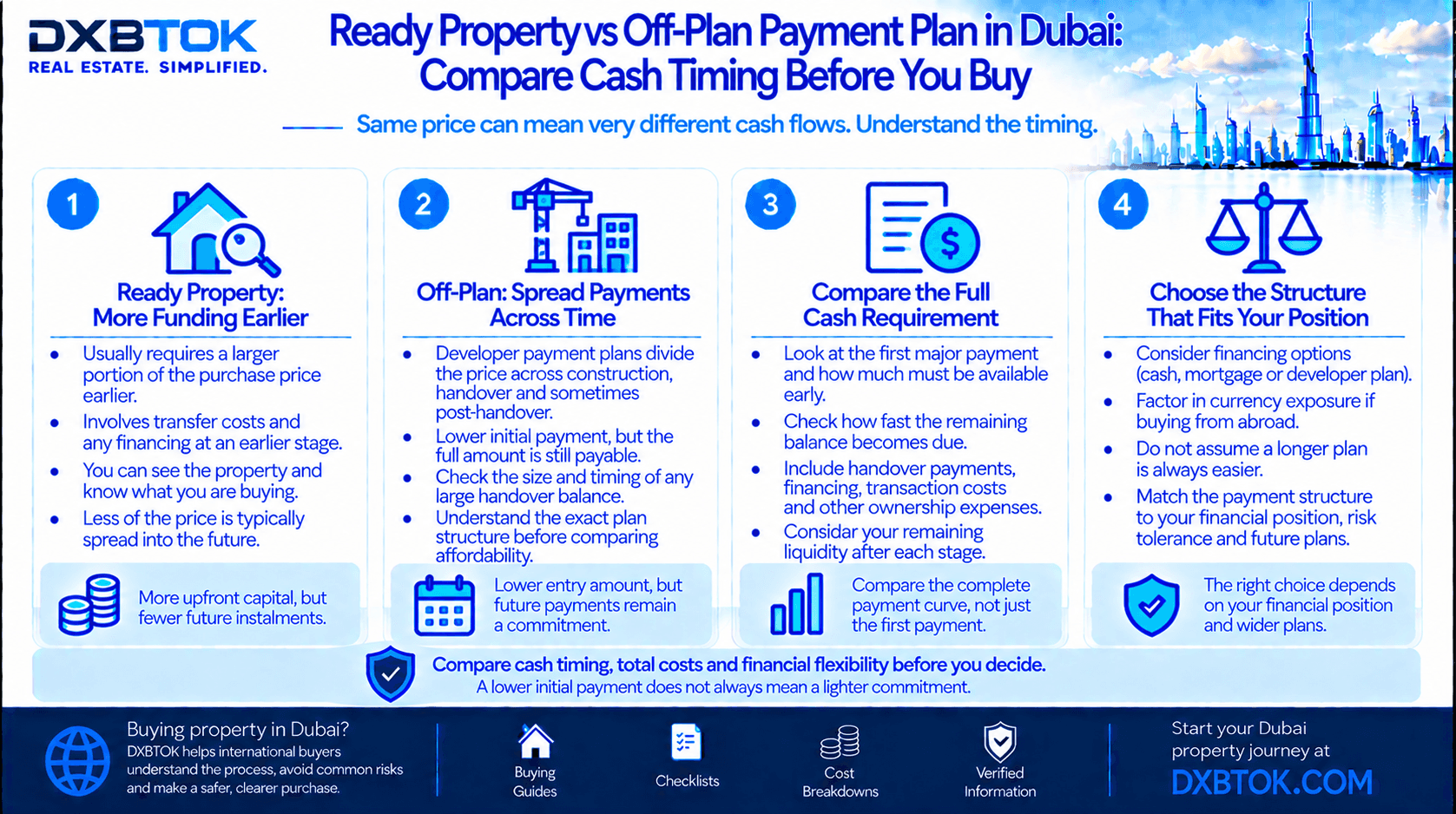
Ready property and off-plan payment plans can create very different funding demands even when the headline purchase prices are similar. Buyers should compare how much capital is needed early, how quickly the remaining balance becomes due, whether a large handover payment appears later, how financing changes the structure and how much liquidity remains after each major payment stage.
Ready Property vs Off-Plan Payment Plan in Dubai: Compare Cash Timing Before You Buy
A ready Dubai property and an off-plan property with staged developer payments can create very different cash-flow demands even when the headline purchase prices look similar.
The useful question is not simply which property costs less. Buyers need to understand how much capital is required early, how long the remaining commitment lasts, whether a large balance appears later and how much liquidity remains after each major payment stage.
Buyers comparing the property routes themselves can review the wider trade-offs in Dubai Off-Plan vs Ready Property. When the decision comes down mainly to funding structure, the timing of the money deserves its own comparison.
A lower initial payment does not necessarily mean a lighter financial commitment. Compare the full timing of the cash requirement, not only the amount needed on day one.
1. Ready Property Usually Concentrates More of the Funding Earlier
A ready-property purchase normally moves toward transfer on a much shorter timeline than an off-plan purchase.
That can mean the buyer needs a larger portion of the purchase funding available earlier, together with the transaction costs and any financing requirements that apply.
The practical advantage is clarity: the buyer can usually see the asset that the money is buying. The financial challenge is that less of the purchase price may remain spread into the future.
2. Off-Plan Can Spread Payments Without Reducing the Total Obligation
Developer payment plans can divide the purchase price across booking, construction, handover and sometimes post-handover stages.
That may reduce the amount of capital required immediately, but the unpaid balance remains a commitment that the buyer needs to fund later.
Before treating staged payments as an affordability advantage, buyers should understand the underlying structure through the Dubai off-plan payment plans guide.
3. Compare the First Major Cash Requirement
The first useful comparison is how much money must be available before the transaction can move forward meaningfully.
With a ready purchase, that may involve a larger near-term capital requirement. With off-plan, the initial commitment may be lower but followed by scheduled instalments.
The buyer should judge whether the early cash requirement fits comfortably with the rest of the purchase budget rather than choosing the structure only because one entry payment looks smaller.
4. Then Compare How Fast the Remaining Balance Becomes Due
Two off-plan plans can look similar at reservation and still create very different pressure later.
One may spread obligations gradually. Another may place a substantial amount into a short pre-handover period or concentrate a large balance at completion.
Likewise, a ready-property purchase may demand more money now but leave fewer future purchase-price instalments hanging over the buyer.
The comparison becomes more useful when buyers look at the full commitment curve rather than the first payment alone.
5. A Handover Balance Can Change the Apparent Advantage
An off-plan plan can feel comfortable while the instalments are relatively small, then become much more demanding when a larger balance is due around handover.
That future amount matters because it may arrive alongside other ownership costs, furnishing decisions, financing needs or personal financial commitments.
A staged plan is therefore only as practical as the buyer’s ability to meet the later concentration of payments without relying on an uncertain future event.
6. Financing Changes the Comparison Again
A ready-property buyer may use cash, mortgage finance or a combination of both. An off-plan buyer may be relying primarily on developer instalments before completion and financing later.
Those are different funding decisions.
If the buyer is deciding specifically between using cash and taking a mortgage, see Cash Buyer vs Mortgage Buyer in Dubai. If the comparison is between bank finance and a developer plan, the Dubai Property Mortgage vs Developer Payment Plan guide covers that funding choice directly.
7. Retained Liquidity Has Real Value
The payment structure affects how much cash remains available after the purchase commitment is made.
A ready purchase funded heavily upfront can reduce the buyer’s remaining liquidity quickly. A staged off-plan plan may preserve more cash in the short term but create future obligations that need to be protected against other spending.
The important question is not whether one route leaves more cash today. It is whether the buyer still has enough flexibility after accounting for the obligations that have not yet been paid.
8. Do Not Confuse Deferred Payment With a Discount
Paying later and paying less are not the same thing.
A payment plan can improve timing without improving the underlying purchase price. Likewise, a ready property requiring more cash upfront may still be commercially stronger if the total price, condition and ownership costs are better.
Buyers should compare the financial structure separately from the value of the property itself.
9. Costs Outside the Purchase Price Still Matter
Neither a ready purchase nor an off-plan payment plan should be assessed using the purchase price alone.
Registration-related costs, financing costs where relevant, handover or transfer-stage expenses, service charges, furnishing, maintenance and management can all affect the amount of cash the buyer ultimately needs.
The full cost of buying Dubai property should therefore sit beside the payment-timing comparison.
10. Currency Exposure Can Affect International Buyers
For a buyer earning or holding funds outside the UAE, the payment date can also influence how much home-currency capital is eventually required.
A ready purchase may concentrate currency conversion into a shorter period. A staged off-plan plan can spread conversion across several future dates.
That does not make one route automatically better. It means the buyer should recognise that later instalments can carry future exchange-rate uncertainty when the money is held in another currency.
11. The Longest Payment Plan Is Not Automatically the Easiest
A longer schedule can reduce short-term pressure, but it also extends the period during which the buyer remains committed to future payments.
That can matter if income changes, another major expense appears, financing assumptions shift or the buyer wants to preserve flexibility for other investments or personal plans.
The strongest structure is the one the buyer can comfortably support across the whole schedule, not the one with the smallest advertised monthly or initial amount.
12. Compare Funding Certainty, Not Only Funding Timing
Buyers should distinguish between money they already control and money they expect to become available later.
A future bonus, property sale, refinancing event or expected investment return may never arrive exactly when the payment schedule requires it.
The more a purchase depends on uncertain future liquidity, the more fragile the funding plan becomes.
13. The Better Structure Depends on the Buyer’s Financial Position
A buyer with substantial available liquidity may prefer the simplicity of funding a ready property sooner and reducing future purchase-price obligations.
Another buyer may value the ability to stage payments because keeping liquidity available for longer is important.
Neither choice is automatically stronger. The relevant comparison is whether the cash timing fits the buyer’s real financial position without creating pressure later in the transaction.
Final Takeaway
Ready property and off-plan payment plans create different funding patterns.
Ready property can require more capital earlier. Off-plan can spread the obligation across time but may create later instalments, a concentrated handover balance and a longer period of financial commitment.
Compare the first cash requirement, the remaining schedule, the size of any completion balance, financing assumptions, retained liquidity, currency exposure and costs outside the purchase price before deciding which structure fits your position.
DXBTOK helps international buyers compare selected Dubai property opportunities with clearer information around purchase price, payment timing, buyer costs and funding structure before moving forward.
Related DXBTOK Guides
Dubai Payment Plan Marketing: What Buyers Should Understand →
Currency Exchange When Buying Dubai Property from Europe →
Dubai Property Budget Checklist for Remote Buyers →