
A Dubai property payment should leave the buyer with more than proof that money left a bank account. Buyers should retain enough evidence to connect each important payment to the correct property, obligation, authorised recipient and updated transaction position. A clear record becomes particularly valuable when purchases involve several instalments, remote coordination, currency conversion or later reconciliation questions.
Dubai Property Payment Receipts: What Buyers Should Keep After Paying
Every meaningful Dubai property payment should leave the buyer with evidence that connects the money to the correct transaction.
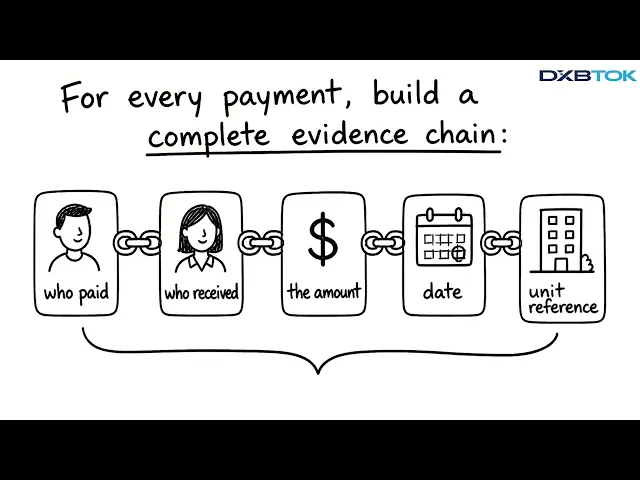
A bank transfer confirmation can show that funds left an account, but the buyer may also need evidence showing why the payment was due, who received it, which property or unit it relates to and whether it was correctly recognised against the purchase.
For the controls that should happen before and during payment, see the Dubai Property Payment Safety Checklist. After money has moved, the priority becomes keeping a clear evidence trail.
A useful payment record does more than prove that money was sent. It helps show the payment purpose, amount, recipient, property reference and whether the transaction record was updated correctly.
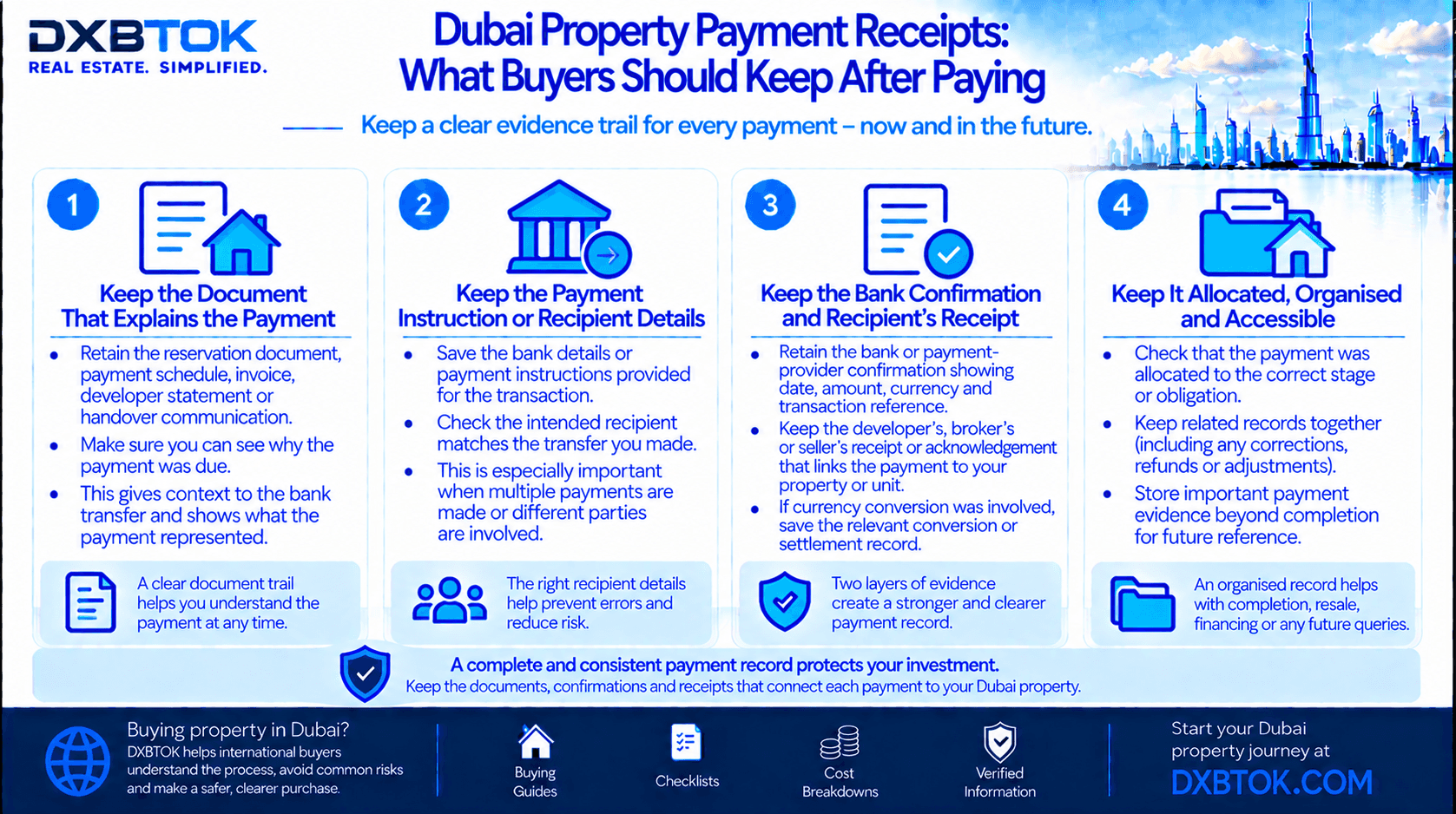
1. Keep the Document That Explains Why the Payment Was Due
A payment makes more sense when it can be connected to the document or obligation that triggered it.
Depending on the stage of the purchase, that may be a reservation document, payment schedule, invoice, developer statement, handover communication or another transaction record.
The buyer should be able to look back later and understand what the payment represented rather than seeing an isolated bank transaction with no clear commercial context.
2. Keep the Payment Instruction or Recipient Details
The evidence file should preserve the payment destination that was supplied for the transaction.
This can help the buyer later compare the intended recipient with the transfer that was actually made, particularly when several payments are made over time or when different parties are involved in the transaction.
The separate Bank Transfer Safety for Dubai Property Buyers guide covers the actual transfer and reconciliation controls in more detail.
3. Keep the Bank or Payment-Provider Confirmation
A bank or payment-provider confirmation is an important part of the evidence because it can show the date, amount, currency, payer, beneficiary and transaction reference.
That does not automatically prove that the payment was allocated to the correct property obligation, but it establishes what the buyer instructed and what the payment system recorded.
If currency conversion was involved, the buyer may also want to retain the relevant conversion or settlement record so the home-currency amount can later be understood alongside the AED obligation.
4. Keep the Recipient’s Receipt or Acknowledgement
Where the developer, broker, seller or other authorised recipient issues a receipt or formal acknowledgement, that record can provide a second layer of evidence.
The strongest acknowledgement is one that can be matched back to the buyer, the amount, the property or unit and the payment purpose.
A generic message saying “payment received” is less useful than a record that clearly connects the money to the transaction.
5. Keep Evidence That the Payment Was Allocated Correctly
Sending money and having it credited to the correct obligation are not always the same thing.
For staged purchases, buyers should be able to see whether a payment was applied to the expected instalment, reservation amount, outstanding balance or other legitimate charge.
An updated account statement, payment schedule or other transaction record can be useful when it confirms that the buyer’s balance changed in the expected way.
6. Reservation Payments Need Their Own Clear Evidence
A reservation payment can happen before the main purchase contract is fully in place, which makes the supporting record especially important.
The buyer should understand the amount paid, what it was intended to reserve and how that payment is treated if the purchase proceeds.
The Dubai Property Reservation Fee Explained guide covers the commercial mechanics of that payment separately.
7. Match the Receipt Back to the Reservation or Purchase Document
A payment record is stronger when it agrees with the underlying transaction document.
Buyer name, property or unit reference, price, reservation amount, payment schedule and payment destination should not create unexplained contradictions across the file.
For the document-consistency side of the early transaction, see Dubai Property Reservation Form: What Buyers Should Check.
8. Do Not Rely on Screenshots as the Only Evidence
Screenshots can be useful for quick communication, but they are a weak substitute for the underlying payment record.
A buyer should prefer records that can later be identified clearly, such as the bank confirmation, issued receipt, payment statement or formal correspondence that connects the payment to the purchase.
This matters particularly when a transaction spans several months and old messages become difficult to retrieve or interpret.
9. Handover Payments Should Stay Connected to the Handover File
Near handover, several amounts can become relevant within a short period.
A final purchase balance, legitimate developer charges, first ownership costs or other completion-stage amounts should remain distinguishable from one another in the buyer’s records.
The wider cash requirements at this stage are explained in Dubai Handover Costs: What Buyers Should Expect.
10. Remote Buyers Need a Stronger Record Trail
A buyer managing the purchase from abroad may be working across a bank, currency provider, developer, broker, mortgage lender or representative.
That creates more opportunities for payment evidence to become scattered across emails, apps and different people.
A clear record helps the buyer remain in control even when the transaction is being coordinated from another country.
11. Keep Corrections and Refunds With the Original Payment
If an amount is corrected, refunded, reallocated or replaced by another payment, the later record should not be separated from the original transaction history.
Keeping both sides together makes it easier to understand what happened and prevents a later refund or adjustment from appearing as an unexplained standalone transaction.
The same principle applies when a payment is rejected or returned and a replacement transfer is made.
12. Preserve Important Records Beyond the Day of Payment
Payment evidence can remain useful after the immediate transaction stage has passed.
It may help with later reconciliation, completion questions, accounting, financing, resale preparation, professional review or a disagreement about what was paid and when.
The appropriate retention period can depend on the buyer’s circumstances and any legal, tax, accounting or professional requirements that apply, so buyers should avoid discarding important payment records simply because the property purchase has completed.
13. The Evidence Should Tell One Consistent Story
The strongest payment file is not necessarily the one with the most documents.
It is the one where the obligation, payment instruction, transfer confirmation, recipient acknowledgement and updated transaction balance all point to the same property, amount and purpose.
If those records conflict, the buyer should clarify the discrepancy rather than assuming one document automatically overrides the others.
Final Takeaway
Dubai property payment receipts are valuable because they help preserve the financial history of the purchase.
Buyers should be able to connect each important payment to the reason it was due, the authorised recipient, the transfer evidence, the acknowledgement received and the updated transaction position.
That record does not replace payment safety checks before sending money. It gives the buyer a clearer evidence trail after the payment has been made.
DXBTOK helps international buyers review selected Dubai property opportunities with clearer information around payment safety, transaction costs, documents and remote purchase coordination before moving forward.
Related DXBTOK Guides
Full Cost of Buying Dubai Property: What International Buyers Should Budget →
Currency Exchange When Buying Dubai Property from Europe →
Dubai Property Compliance Checks for International Buyers →


