

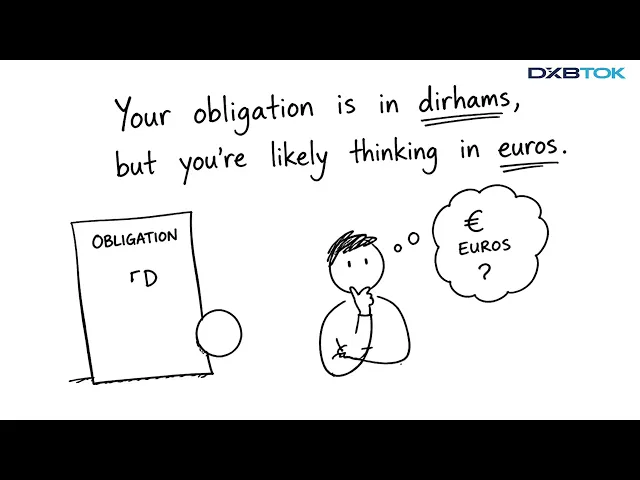
Learn how European Dubai property buyers can compare exchange rates, spreads, transfer fees, payment timing and home-currency requirements without relying on currency forecasts.
Currency Exchange When Buying Dubai Property from Europe
Buying Dubai property from Europe creates a cost that is easy to underestimate:
the property may be priced in AED, while your money is held in EUR, GBP, CHF or another currency.
That means the buyer is not dealing with only one price.
There are really two:
the AED amount required for the property
the amount of home currency needed to obtain and transfer that AED
A useful framework is:
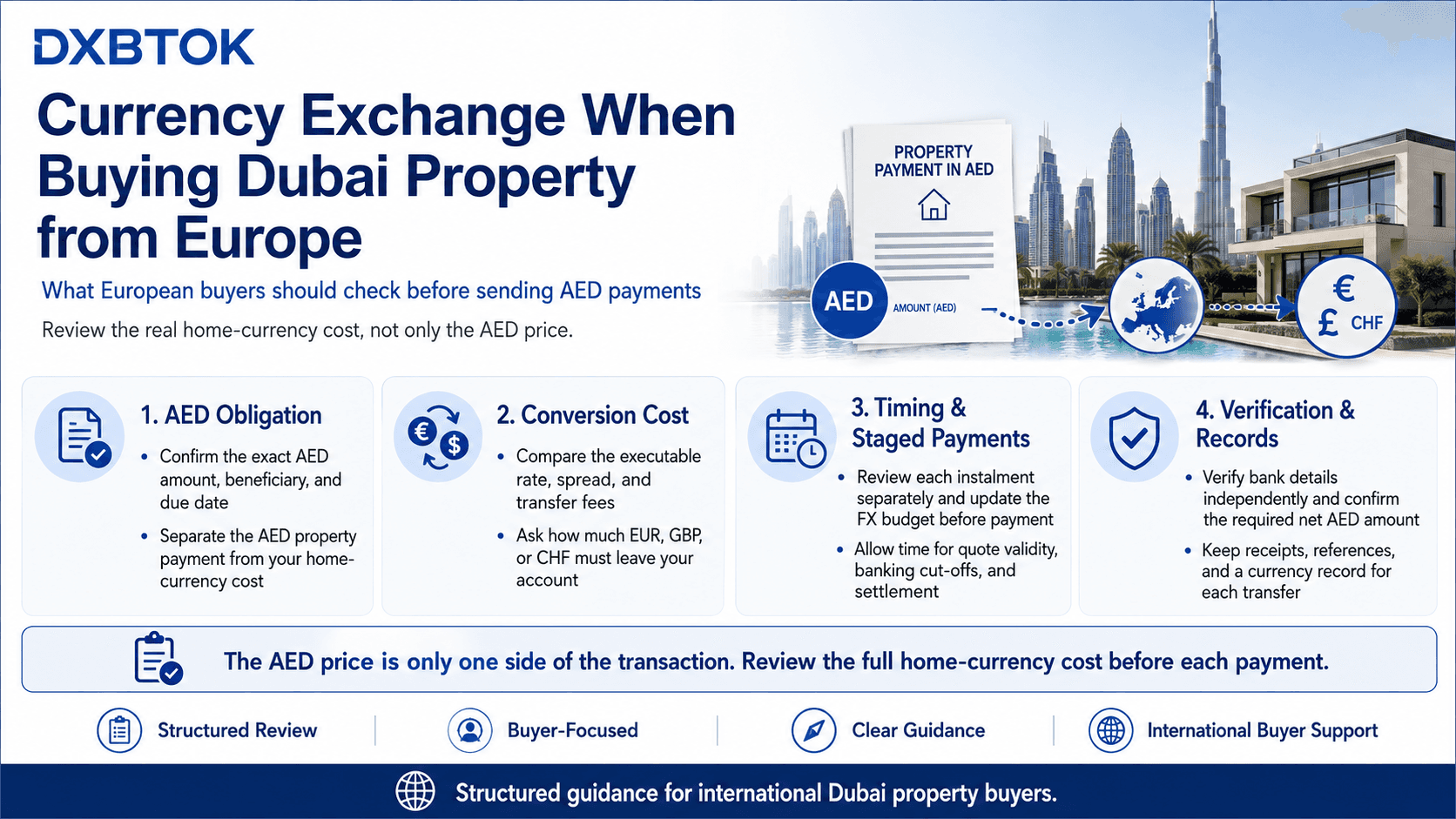
AED obligation → home-currency conversion → provider rate/spread → transfer cost → payment timing
The objective is not to predict exchange rates.
It is to make sure the buyer understands the real conversion cost before sending money.
Start with the currency of the obligation
European buyers should also review the wider process for buying Dubai property from Europe when coordinating the property, documents and payments remotely.
The first question is:
What currency must the seller or developer actually receive?
For Dubai property transactions, that will commonly be AED.
The UAE dirham operates under a fixed exchange-rate policy against the US dollar. The Central Bank of the UAE states that maintaining the AED/USD peg is its monetary-policy objective.
For a European buyer, this means the main currency exposure often comes from the relationship between the buyer's home currency and the US dollar/AED system.
A euro-based buyer may therefore see the EUR amount required for the same AED payment change over time even though the property price in AED has not changed.
1. Separate the property price from the conversion cost
Suppose a property payment is fixed at a certain AED amount.
That AED amount may stay unchanged.
But the home-currency amount needed to fund it can change depending on:
exchange rate
provider spread
bank fees
transfer fees
timing
So the correct question is not only:
“How much is the property?”
It is also:
“How much of my own currency will I need for each AED payment?”
2. Do not confuse the published exchange rate with the rate you receive
A public exchange-rate screen may show one number.
Your bank or currency provider may give you another.
The difference can come from:
provider spread
transaction fee
transfer charge
payment method
account type
transaction size
The buyer should compare the actual executable rate, not only the headline market rate.
3. The exchange-rate spread can matter more than the transfer fee
A bank may advertise a low transfer fee.
But that does not necessarily mean the conversion is inexpensive.
The larger cost may be embedded in the exchange-rate spread.
For example, two providers may charge:
different visible fees
different conversion rates
The provider with the lower transfer fee may still produce the more expensive conversion overall.
Always compare the final home-currency amount required.
4. Ask for the all-in conversion figure
Before sending a material payment, ask:
“How much of my home currency will leave my account for the full AED amount to arrive?”
That figure should incorporate:
exchange rate
spread
sending fee
intermediary fees where relevant
receiving fees where relevant
This is more useful than comparing one rate in isolation.
5. Check the required net AED amount
The seller, developer or other approved recipient may require a precise AED amount.
Confirm:
beneficiary
exact AED amount
payment reference
deadline
whether bank charges must be borne by the sender
A payment that arrives slightly short may create unnecessary transaction delays.
6. Exchange timing matters more with staged payments
Off-plan property may involve multiple payments over time.
That means the buyer is not making one currency decision.
They may be making several.
For example:
reservation
first instalment
construction payments
handover payment
post-handover instalments where applicable
For off-plan purchases, review the exact off-plan payment plan so every future AED obligation is mapped before the currency transfer is required.
Each payment may occur at a different exchange rate.
That makes the payment schedule part of the currency plan.
7. Do not assume today's conversion rate will apply later
If the next payment is months away, the home-currency amount required may be different.
Do not build the entire purchase budget using one exchange rate and assume it will remain unchanged.
Instead, record:
AED payment amount
due date
current indicative conversion
liquidity available
buffer
The future rate is unknown.
8. Separate exchange-rate risk from property-price risk
These are two different things.
The property price may remain fixed in AED.
But your home-currency cost can still change.
For example, a European buyer can face:
same AED property price + different EUR cost
That is not the property becoming more expensive in AED.
It is a currency effect.
9. Euro buyers should understand the AED/USD relationship
Because the AED is pegged to the US dollar, a euro-based buyer's effective EUR/AED exposure is strongly connected to EUR/USD movements.
The Central Bank's current exchange-rate data continues to show the US dollar at approximately AED 3.6725.
The practical lesson is simple:
A buyer holding euros should monitor the EUR amount required to fund the AED payment, not only the AED/USD relationship.
10. UK buyers have a different currency exposure
A UK buyer may be funding the purchase in GBP.
The AED amount may remain fixed, while the GBP amount required changes with the GBP/USD/AED relationship.
Again, the useful buyer number is:
GBP required for the exact AED payment
not a generic exchange-rate headline.
11. Swiss buyers face the same principle
A buyer holding CHF should apply the same process.
Check:
exact AED obligation
CHF conversion quote
spread
transfer charges
settlement timing
The home currency changes.
The method does not.
12. Compare providers using the same AED payment
If comparing different banks or FX providers, give each one the same instruction:
“How much EUR/GBP/CHF do I need to deliver AED X to this recipient?”
Then compare:
total home currency required
transfer time
fees
execution certainty
payment traceability
That creates a fair comparison.
13. Do not compare rates quoted at different times
Foreign-exchange markets move.
A quote received at 09:00 and another received hours later may not be directly comparable.
When comparing providers:
request quotes close together
confirm how long each quote is valid
identify whether the rate is indicative or executable
Otherwise you may attribute a market move to the provider.
14. Understand indicative versus locked rates
Some quotes are only indicative.
That means the final executed rate may differ.
Ask:
Is this rate executable?
How long is it valid?
When is the rate fixed?
When must funds arrive?
Can the quote expire?
This becomes more important with large property payments.
15. Transfer speed can matter near a deadline
The cheapest-looking provider may not always be the most practical choice if funds must arrive by a specific date.
Check:
conversion time
transfer time
cut-off times
weekends
UAE banking days
European banking days
compliance review
Allow enough time for the funds to arrive.
16. Large transfers may require compliance checks
Property transactions can involve large international payments.
Banks or currency providers may request:
source-of-funds evidence
SPA or reservation documents
developer invoice
beneficiary details
proof of identity
bank statements
This is normal compliance activity.
Prepare supporting documents before the payment deadline.
17. Do not split payments simply to avoid bank scrutiny
If a payment is legitimate and properly documented, the safer approach is to provide the required documentation.
Artificially splitting transfers to avoid checks can create more problems.
Use the correct payment route and keep a complete record.
18. Beneficiary verification remains separate from currency conversion
A competitive exchange rate does not make a bank account legitimate.
Before transferring, independently verify:
beneficiary name
account details
payment purpose
developer or transaction instructions
Use the dedicated payment safety checklist before sending material funds.
Currency cost and payment safety are two separate controls.
19. Never change bank details based only on a message
If new bank details arrive by:
email
WhatsApp
messaging app
do not rely on the message alone.
Verify the account independently through a known official channel.
Use the dedicated bank-detail verification process where relevant.
Exchange-rate savings are irrelevant if the payment goes to the wrong account.
20. Build FX into the total buyer budget
Currency conversion should appear inside the broader full buyer budget.
The buyer should know:
AED purchase obligation
home-currency funding requirement
transfer fees
conversion costs
payment dates
buffer
That keeps FX from becoming an afterthought.
21. Avoid converting the entire purchase amount too early without a reason
Some buyers may consider converting a large amount well before it is due.
That changes the risk rather than removing it.
You may reduce future currency uncertainty, but you also:
tie up liquidity
hold AED earlier
create banking or account considerations
lose flexibility
This is a financial decision.
DXBTOK does not provide advice on when buyers should exchange currency.
For personal currency strategy, use qualified financial or FX advice where appropriate.
22. Avoid waiting until the final day
The opposite extreme can also create problems.
Waiting until the payment deadline may leave little time for:
compliance checks
bank transfer delays
quote changes
beneficiary verification
missing documents
Build enough operational time into the payment process.
23. Keep a currency record for every payment
For each property payment, record:
payment date
AED amount
home currency used
exchange rate
provider
fees
amount sent
amount received
payment reference
receipt
This creates a clean transaction record.
24. Store the transfer receipt
After payment, retain:
bank confirmation
SWIFT or transfer reference where available
beneficiary confirmation
developer or seller receipt
This supports later reconciliation.
The payment is not fully documented merely because money left your bank.
25. Compare home-currency cost across the full payment plan
For off-plan property, do not judge the currency impact based only on the booking amount.
Map the full schedule.
For each instalment:
record AED amount
record due date
estimate current home-currency equivalent
update before payment
record actual executed amount
This gives the buyer a complete view.
26. Do not mix currency planning with exchange-rate forecasting
A buyer can manage currency exposure without trying to predict the market.
Good planning means:
knowing payment dates
knowing AED amounts
comparing providers
maintaining liquidity
retaining a buffer
documenting payments
It does not require forecasting EUR/USD or GBP/USD.
27. Ask the provider the right questions
Before a large conversion, ask:
What rate will I actually receive?
What spread applies?
What fees apply?
How much of my currency is required?
How long is the rate valid?
How long will settlement take?
Will intermediary charges apply?
What documents may be required?
That produces a clearer comparison.
28. Use a currency buffer
If future payments are significant, a buyer should avoid budgeting to the exact cent based on today's conversion.
A reasonable buffer can help absorb:
currency movement
transfer fees
small payment changes
The appropriate buffer depends on the buyer's finances and transaction.
Buyers should use qualified financial or FX advice where appropriate.
29. Review the currency position before each major payment
A practical workflow is:
30–14 days before payment
confirm AED amount
confirm beneficiary
prepare source-of-funds documents
Several days before payment
compare actual conversion quotes
confirm settlement time
Before sending
verify bank details
confirm final AED amount
After sending
retain receipt
confirm funds arrived
This reduces avoidable last-minute problems.
30. Use the currency-conversion test
Before every major payment, answer five questions:
1. AED obligation
How much must arrive?
2. Home-currency cost
How much EUR, GBP, CHF or other currency is required?
3. Provider cost
What spread and fees apply?
4. Payment timing
When must the funds arrive?
5. Payment verification
Have the beneficiary details been independently confirmed?
If any answer is unclear, resolve it before sending.
European Buyer Currency Checklist
Payment obligation
Exact AED amount confirmed
Due date confirmed
Beneficiary confirmed
Conversion
Home currency identified
Executable rate requested
Spread reviewed
Transfer fees reviewed
All-in cost compared
Timing
Quote validity confirmed
Transfer duration checked
Banking cut-off considered
Compliance time allowed
Safety
Beneficiary independently verified
Payment reference confirmed
Bank-detail changes rechecked
Receipt retained
Budgeting
Full payment schedule mapped
Home-currency requirement updated
FX buffer considered
Currency records stored
How DXBTOK Approaches Currency Planning
DXBTOK does not attempt to predict exchange rates.
The practical process is:
confirm AED obligation → calculate home-currency requirement → compare all-in conversion cost → verify beneficiary → transfer → retain evidence
This keeps currency planning connected to the actual property transaction.
Final Takeaway
For a European buyer, the Dubai property price is only one side of the transaction.
The other is:
how much of your home currency is required to fund each AED payment.
Before sending money, compare:
actual exchange rate
spread
provider fees
settlement time
bank charges
required net AED amount
beneficiary details
The key question is not:
“Where will the exchange rate go next?”
It is:
“What will this exact AED payment cost me today, and will the full amount arrive correctly and on time?”
Need Help Structuring a Dubai Property Purchase from Europe?
DXBTOK helps international buyers review suitable Dubai properties, understand the payment stages and organize the practical checks required before transferring funds.
Contact DXBTOK and let us help you move through the Dubai property buying process more clearly.
Related DXBTOK guides
Full Cost of Buying Dubai Property →


