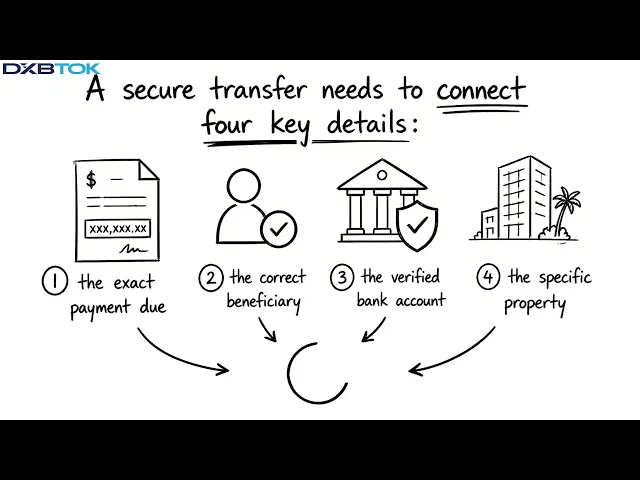
Learn how to check a Dubai property bank transfer before sending money, including the payment obligation, beneficiary, IBAN or account details, off-plan escrow information, currency, transfer reference, proof of payment and final allocation.
Bank Transfer Safety for Dubai Property Buyers
A Dubai property purchase can involve large bank transfers, often made from another country and sometimes across several payment stages.
That creates a simple but important risk:
a payment can be correctly intended but still be sent to the wrong beneficiary, wrong account, wrong project or wrong transaction reference.
Bank-transfer safety is therefore not only about fraud prevention.
It is about making sure that every transfer matches the property transaction before the money leaves your account.
A useful transfer-control sequence is:
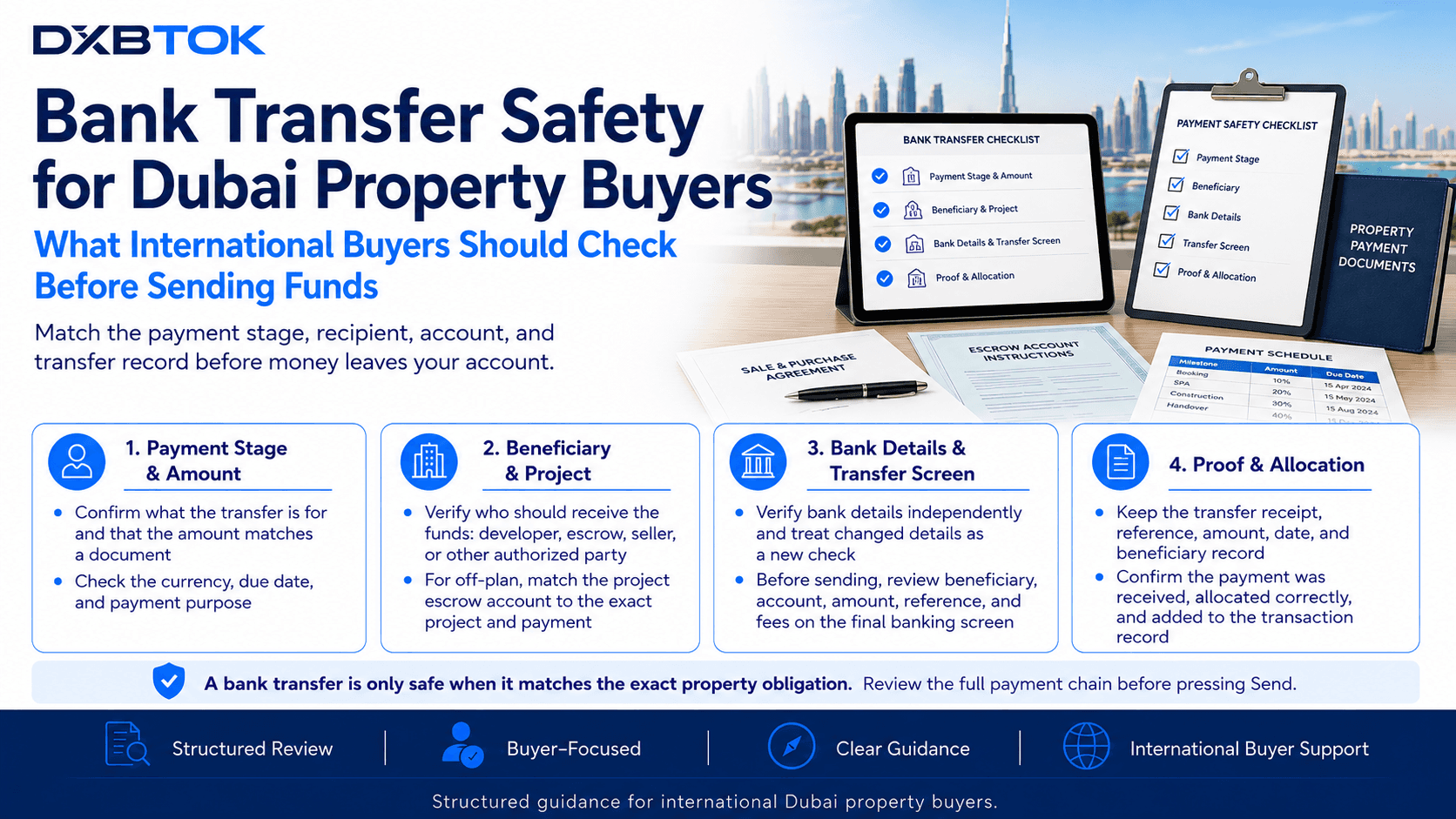
payment stage → amount → beneficiary → bank account → project/property → transfer reference → proof → confirmation
The goal is to create a payment trail that can be checked before and after every transfer.
1. Start with the payment stage
Before sending money, identify exactly what the transfer is for.
For example:
reservation payment
booking amount
SPA-related installment
off-plan construction installment
balance payment
transfer-related payment
service or transaction fee
other property-related amount
Do not start with the bank details.
Start with the transaction obligation that creates the payment.
For an initial booking payment, use the Dubai property reservation process guide to understand where that payment sits in the wider transaction.
2. Match the amount to a document
The amount should be supported by something you can identify.
That could be:
reservation form
payment schedule
SPA
official payment request
invoice
statement
transfer instructions
Check:
amount
currency
due date
purpose
unit or project reference
A verbal request or chat message should not be the only evidence for a significant property transfer.
3. Verify who should legally or contractually receive the money
The recipient can depend on the transaction.
It may involve:
developer
project escrow account
seller
registration-related party
service provider
other authorized recipient
Do not assume that the person communicating with you is also the person or entity that should receive the funds.
The sender of the payment instruction and the beneficiary of the payment are separate questions.
4. For off-plan property, identify the project escrow account
Dubai Land Department states that amounts collected from purchasers of off-plan units are deposited into the project's real-estate escrow account.
DLD's Project Status service can also display project information including developer details and escrow-account information.
For an off-plan buyer, the project itself and the payment destination should therefore be connected.
Do not treat a generic developer bank account as automatically interchangeable with the project's escrow structure.
5. Match the escrow account to the exact project
A developer may operate more than one project.
That means the buyer should confirm:
project name
developer
bank
escrow account information
unit or purchaser reference
payment stage
The important question is not only:
“Is this the developer's bank?”
It is:
“Does this account match this exact project and this exact payment?”
6. Verify bank details through an independent route
If bank details arrive through:
WhatsApp
email
PDF attachment
invoice
salesperson message
do not rely on that same communication alone for verification.
Use the bank-details verification guide when confirming a payment destination independently.
For material payments, the safest process is to compare the payment instruction with a separately verified source or official transaction record where available.
7. Treat changed bank details as a new verification event
One of the most important rules is simple:
new bank details = new verification
Even if you have already paid the same developer or seller before, do not assume a later account change is legitimate.
Recheck:
beneficiary
bank
account number or IBAN
project
payment purpose
reason for the change
Do not let transaction familiarity replace verification.
8. Check the beneficiary name carefully
The beneficiary shown in your banking app should make sense for the payment you are making.
If the name is different from what you expected, stop and clarify.
Do not explain away a mismatch yourself.
Ask why the beneficiary differs and verify the explanation independently before proceeding.
9. Do not rely on the beneficiary name alone
A familiar beneficiary name is useful, but it is not the complete check.
You still need to match:
account details
payment purpose
project or property
amount
transfer reference
supporting document
Bank-transfer safety works through several matching controls, not one familiar-looking field.
10. Understand the currency you are sending
Dubai property obligations are commonly expressed in AED, but an international buyer may be funding the transfer from another currency.
Before sending, confirm:
currency required by the recipient
currency your bank will send
whether conversion occurs before or during transfer
expected banking or intermediary fees
whether the recipient must receive an exact net amount
Use the currency exchange guide for Dubai property buyers from Europe if your home currency must be converted into AED.
11. Separate exchange-rate decisions from transfer safety
A good exchange rate does not make a payment destination safe.
Likewise, a verified beneficiary does not guarantee a good conversion rate.
Treat these as two separate questions:
What will the currency conversion cost me?
and
Am I sending the resulting funds to the correct recipient?
Keeping them separate makes the transaction easier to control.
12. Allow for bank and intermediary charges
International transfers can involve charges from:
sending bank
intermediary bank
receiving bank
foreign-exchange provider
If the recipient expects an exact amount, clarify whether fees must be paid separately or whether they can reduce the amount received.
Do not assume that sending the stated figure means the recipient will receive that exact figure.
13. Use the correct payment reference
A transfer reference can help the recipient identify your payment.
Depending on the transaction, this may include:
buyer name
project
unit
customer number
invoice
installment reference
Use the reference requested in the verified payment instructions.
Avoid vague references when a specific transaction reference has been provided.
14. Double-check the transfer screen before authorizing
Before pressing the final confirmation button, compare the banking screen with the verified instruction.
Check:
beneficiary name
bank
IBAN or account number
currency
amount
reference
fees where shown
Do this from the final banking screen, not only from memory.
15. Large transfers deserve a deliberate second check
Property transfers are not routine household payments.
For a material payment, consider a deliberate second review before authorization.
That can mean:
re-reading the payment request
comparing the IBAN again
checking the beneficiary
checking the unit or project
confirming the amount
confirming the payment stage
The purpose is to reduce avoidable human error.
16. Be cautious with copy-and-paste
Copying an IBAN or account number is convenient.
But convenience should not eliminate checking.
After pasting, compare enough of the account details with the verified source to confirm that the destination has not changed.
The final banking screen should be treated as the last control point.
17. Keep proof of transfer
After sending, retain:
bank confirmation
transfer receipt
transaction reference
date
amount
currency
beneficiary
payment instruction used
This creates evidence of what was sent and where it was sent.
Do not rely only on the transaction disappearing from your bank balance.
18. Obtain confirmation from the receiving side
Sending the transfer is not the final step.
Confirm that the payment has been:
received
allocated to your transaction
matched to the correct project or unit
recorded against the correct installment or obligation
If possible, retain written confirmation.
19. Distinguish bank receipt from transaction allocation
A recipient can receive money without the payment necessarily being allocated correctly.
For example, a missing or incorrect reference may delay matching.
That is why the process should be:
transfer sent → funds received → payment allocated → transaction record updated
Do not stop at “the bank transfer went through.”
20. Keep a payment ledger for staged purchases
Off-plan purchases may involve several installments over time.
Create a simple record containing:
due date
amount
currency
amount sent
transfer date
bank reference
beneficiary
confirmation received
outstanding balance
This makes later payments easier to reconcile.
21. Re-verify each major installment
Do not assume that checks completed for the first installment automatically cover every later payment.
Before each major transfer, confirm that:
the payment is actually due
the amount matches the schedule
the beneficiary remains correct
the account details remain correct
the reference is current
This is particularly important when installments are months apart.
22. If instructions conflict, stop the transfer
Examples of conflicts include:
different account details in two messages
different beneficiary names
amount not matching the payment schedule
payment requested earlier than expected
project name not matching
unexplained currency change
request to send funds to an individual when you expected a company or project account
Do not choose the version that seems most convenient.
Resolve the discrepancy first.
23. Urgency should not override verification
A request may be time-sensitive.
That still does not justify skipping a payment check.
Statements such as:
“pay immediately”
“the unit will be lost”
“the account has just changed”
“send now and we will update the paperwork later”
should not replace documented verification.
A genuine deadline and a verified payment route can exist together.
24. Use stronger controls when buying remotely
An international buyer may never meet the salesperson, developer representative or seller in person.
That makes the written and digital transaction trail more important.
Remote buyers should be able to connect:
property → payment obligation → recipient → bank details → proof → confirmation
without relying on personal familiarity.
25. Bank-transfer safety is only one part of payment safety
This article focuses narrowly on the transfer itself.
The wider payment process also includes:
verifying the property
verifying the offer
confirming the transaction stage
checking documentation
understanding reservation conditions
retaining payment evidence
Use the Dubai property payment safety checklist for the broader payment-control workflow.
26. Build transfer costs into the buyer budget
Bank fees and currency conversion can affect the total amount needed to complete the transaction.
They should be planned alongside:
purchase price
registration-related costs
service charges
financing costs where applicable
maintenance
other transaction expenses
Use the full cost of buying Dubai property guide when planning the broader buyer budget.
27. Use a pre-transfer checklist
Before authorizing a Dubai property bank transfer, confirm:
Payment
Payment is actually due
Amount matches the supporting document
Currency is correct
Recipient
Beneficiary is expected
Bank details are independently verified
Project or property connection is clear
Transfer
IBAN/account number checked
Reference entered correctly
Fees understood
Final banking screen reviewed
After Transfer
Receipt saved
Recipient confirms receipt
Payment is allocated correctly
Updated transaction record retained
How DXBTOK Approaches Bank Transfer Safety
The process should not be:
receive bank details → copy IBAN → send money
A stronger process is:
identify the payment obligation → verify the recipient → verify the account → match the project/property → check the final transfer screen → retain proof → confirm allocation
The objective is not to make the transaction unnecessarily slow.
It is to make each transfer traceable.
Final Takeaway
A safe Dubai property bank transfer is not defined only by whether the bank accepts the payment.
The transfer should match:
the correct payment stage
the correct amount
the correct recipient
the correct bank account
the correct project or property
the correct reference
the correct transaction record
For off-plan property, project escrow information is an especially important part of that chain.
The key question before pressing Send is:
“Can I independently connect this exact bank transfer to this exact property obligation?”
Need Help Reviewing a Dubai Property Payment?
DXBTOK helps international buyers structure the checks around Dubai property payments, including the transaction stage, beneficiary, bank details, project or property reference and supporting documentation.
Contact DXBTOK and let us help you review the payment route more clearly before moving forward.
Related DXBTOK guides
Dubai Property Payment Safety Checklist →
Currency Exchange When Buying Dubai Property From Europe →
Full Cost of Buying Dubai Property for International Buyers →