

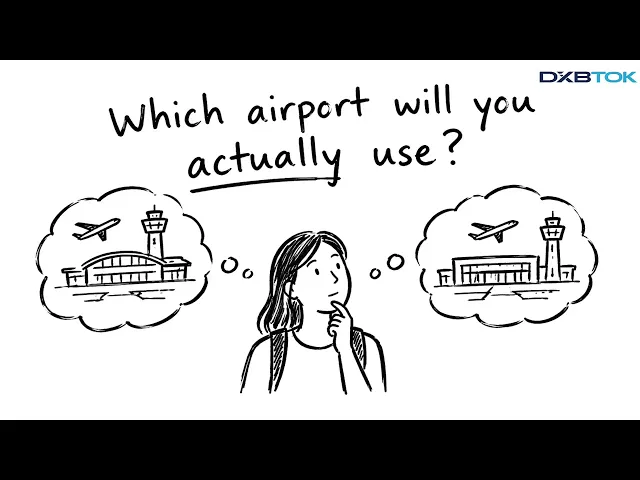
Buying Dubai property near airport access requires comparing real travel convenience with the wider ownership decision. International buyers should assess DXB and DWC, terminal journeys, aircraft noise, future infrastructure, annual travel savings, exact-unit quality and any additional purchase premium.
Dubai Property Near Airport Access: How Buyers Should Judge Real Travel Convenience
“Close to the airport” can sound like a major advantage when buying Dubai property, especially for frequent travellers, second-home owners, airline or aviation-sector professionals and buyers who expect regular international travel.
But airport convenience is not one simple distance measurement. Dubai has two airports with very different current roles: Dubai International (DXB) is the city’s main passenger gateway, while Dubai World Central – Al Maktoum International (DWC) is operating today and is also the focus of Dubai’s major long-term aviation expansion.
For an international buyer, the stronger question is whether the exact property provides genuinely useful access to the airport the owner is most likely to use — without weakening the wider location, building and ownership decision.
Airport access should be treated as a use-case advantage, not as a substitute for choosing the right area and property. The value depends on which airport matters, the real road journey, travel frequency and whether the property still works when airport proximity is removed from the sales pitch.
Buyers comparing properties for sale near Dubai airports should shortlist exact available homes by their usual terminal, actual journey time, purchase price and daily lifestyle. Verify ownership eligibility and compare travel convenience with the total cost of the property before reserving.
1. Start With Which Airport Actually Matters
Dubai Airports manages both DXB and DWC, but they do not currently serve the same role.
DXB remains Dubai’s primary international passenger hub. DWC handles passenger, cargo and general-aviation activity and is being expanded as Dubai’s future major aviation hub.
A property advertised as having “airport access” should therefore be judged against the airport the buyer is realistically likely to use, not against the word “airport” in general.
If the wider location decision is still open, the Dubai Property Area Selection guide provides the broader framework.
Which Areas Should Airport-Focused Buyers Compare?
Airport priority | Example areas to investigate | Main checks |
|---|---|---|
DXB | Dubai Festival City, Dubai Creek Harbour | Actual terminal route, building condition and everyday access |
DWC | Dubai South, Expo City Dubai | Current roads, operational facilities and future development dependencies |
These are geographic starting points, not rankings, journey-time guarantees or availability claims. Confirm foreign-ownership eligibility for the exact property and test the relevant terminal route.
2. DXB Convenience Is Mainly About Current Travel Patterns
For buyers who regularly fly through Dubai International, practical road access to DXB can be a meaningful lifestyle advantage.
That is especially relevant for frequent business travellers, owners who arrive for short stays and households with regular international travel.
The benefit should still be measured against the exact property. A shorter airport journey is useful only if the surrounding area, building and unit also fit the buyer’s everyday needs.
3. DWC Requires a Different Buyer Mindset
DWC is already an operating airport, but its longer-term importance is tied to the much larger expansion now under development.
That means buyers considering Dubai South or nearby locations should separate two things: the access available to DWC today and the future aviation ecosystem being built around it.
Future airport growth can strengthen the surrounding economy and infrastructure, but it should not be treated as if the final long-term airport environment already exists.
4. Do Not Turn DWC Expansion Into a Property Guarantee
Dubai Airports has confirmed a major expansion programme for DWC, with substantially higher future passenger capacity and new aviation infrastructure planned over the coming years.
That is relevant context for nearby property, but it does not guarantee a particular resale price, rental return, completion timetable for surrounding projects or the exact future travel pattern of every owner.
The property still needs to make sense on its current merits.
Dubai Airports states that the AED 128 billion Phase Two expansion was approved in April 2024, with an ultimate planned capacity of 260 million passengers annually. This is a long-term capacity objective, not current passenger traffic or a guaranteed completion date. Verify current airline schedules and development progress before relying on future accessibility. Source: Dubai Airports, DWC fact file, reviewed 26 November 2026.
5. Real Drive Time Matters More Than Straight-Line Distance
A property can look close to an airport on a map while producing a less convenient journey in practice.
Road layout, peak traffic, community exits, airport approach roads, terminal access and the exact building position can all affect travel time.
The useful comparison is the normal journey from the property to the terminal the owner expects to use most often.
Measure Annual Airport Travel Savings
Hypothetical journey | Property A | Property B |
|---|---|---|
One-way terminal journey | 40 minutes | 20 minutes |
One-way transport cost | AED 100 | AED 60 |
Annual cost for 24 round trips | AED 4,800 | AED 2,880 |
Annual journey time | 32 hours | 16 hours |
Property B saves AED 1,920 and 16 hours annually under these assumptions. A round trip means two airport journeys. These are illustrative figures, not taxi quotations or route estimates. Include parking, tolls, waiting and alternative transport where relevant.
6. DXB Terminal Access Is Not Completely Interchangeable
DXB operates across Terminals 1, 2 and 3, and airlines use different terminals.
The airport remains one destination, but road approach and drop-off patterns can differ. A buyer who flies frequently with a particular airline may therefore care about the practical route to the relevant terminal rather than only the distance to the airport perimeter.
This matters more for frequent travellers than for an owner who flies only a few times each year.
7. Airport Proximity Can Create Noise and Activity Trade-Offs
Being closer to airport infrastructure can improve travel convenience while also increasing exposure to aircraft movements, major roads or logistics activity in some locations.
The effect is highly property-specific. Orientation, floor, glazing, surrounding buildings and the exact flight or road environment can change the experience materially.
Buyers should therefore judge the exact unit rather than assuming that all properties at a similar map distance experience the same trade-offs.
Visit the exact unit at different times, including evening hours where practical. Listen inside bedrooms with windows open and closed, and assess balcony noise, glazing, road traffic and nearby logistics activity. Request available noise or planning information where relevant. A quiet inspection at one time does not guarantee quiet conditions throughout the day or after future infrastructure changes.

8. Frequent-Traveller Convenience Should Be Valued Against Daily Life
A buyer may save time on airport journeys but spend more time reaching work, schools, beaches, business districts or the places used every day.
For most owners, airport trips are less frequent than ordinary weekly travel.
The stronger location is usually the one that balances airport convenience with the rest of the buyer’s normal routine.
9. The Building and Exact Unit Still Matter
A convenient airport location cannot compensate for a weak building or unsuitable property.
Apartment buyers should still assess layout, condition, lifts, parking, service charges, privacy, noise, natural light and building management.
The Dubai Apartments for International Buyers guide covers the wider building-and-unit decision.
10. Airport Access Can Matter Differently for Families
A household that travels frequently may value airport convenience, but families usually have additional location priorities such as schools, parks, bedrooms, storage, commute patterns and everyday community access.
Living significantly closer to an airport may not improve the overall family proposition if it weakens those more frequent needs.
The Family Property in Dubai guide provides the wider family-use framework.
11. Second-Home and Remote Owners May Value Airport Access More
A second-home owner who arrives for short stays may place a higher value on a simpler airport-to-property journey.
Remote owners may also care about ease of arrival when visiting the property, meeting managers or handling occasional maintenance and ownership matters.
The benefit is strongest when the property also works as a low-friction home while the owner is outside Dubai.
For occasional personal stays, compare airport journey savings with annual ownership costs and the number of nights you expect to use the property. The Dubai second-home buyer guide explains how to assess that wider personal-use decision.
12. Ready and Off-Plan Property Need Different Airport-Access Evidence
With a ready property, the buyer can assess the existing road journey, current traffic patterns, surrounding activity and the actual building environment.
With an off-plan property, future roads, community entrances and wider infrastructure may still affect the final travel experience.
The Dubai Off-Plan vs Ready Property guide explains the broader evidence difference between completed and future property.
13. Airport Access Should Not Be Confused With Airport-Driven Investment Claims
Large infrastructure can influence how areas develop, but buyers should be cautious when airport expansion is used to support guaranteed appreciation, rental-demand or resale claims.
Property outcomes still depend on entry price, exact location, building quality, supply, ownership costs and future buyer demand.
Airport proximity is one factor inside a larger property decision, not an investment result by itself.
Does Airport Access Justify Additional Rental Investment?
Assume two comparable apartments with purchase prices of AED 1,200,000 and AED 1,320,000, plus acquisition expenses of 6%.
Hypothetical annual rental budget | Property A | Property B |
|---|---|---|
Initial investment | AED 1,272,000 | AED 1,399,200 |
Potential annual rent | AED 85,000 | AED 91,000 |
Vacancy allowance | AED 5,000 | AED 5,000 |
Service charges | AED 9,600 | AED 9,600 |
Maintenance reserve | AED 4,000 | AED 4,000 |
Management allowance | AED 4,500 | AED 4,500 |
Net income after modelled expenses | AED 61,900 | AED 67,900 |
Net yield on initial investment | 4.87% | 4.85% |
The additional AED 6,000 annual net income represents a 4.72% incremental return on AED 127,200 additional capital. A 5% incremental return requires AED 6,360 in additional annual net income. These are hypothetical figures, not forecasts. Financing, tax, insurance and other property-specific expenses are excluded. Verify comparable registered rents and costs without assuming that airport proximity causes higher rent.
14. Compare Total Ownership Cost, Not Travel Convenience Alone
A more expensive property with better airport access may still be the stronger choice for a frequent traveller, but the premium should be visible and explainable.
Purchase price, financing, service charges, maintenance, furnishing, transport habits and property management all contribute to the real ownership cost.
The Full Cost of Buying Dubai Property guide provides the wider budget framework.
Is the Airport-Access Premium Worth Paying?
Hypothetical purchase | Property A | Property B |
|---|---|---|
Purchase price | AED 1,200,000 | AED 1,320,000 |
Acquisition expenses (assumed 6%) | AED 72,000 | AED 79,200 |
Total initial investment | AED 1,272,000 | AED 1,399,200 |
At an assumed 4% annual opportunity cost, the extra AED 127,200 capital represents AED 5,088 in annual foregone returns. The AED 1,920 annual airport travel saving in Section 5 falls short by AED 3,168 before other ownership-cost differences. At AED 80 saved per round trip, approximately 64 round trips annually would cover the modelled capital cost. Personal time savings may still justify a premium. These are hypothetical assumptions, not market premiums. Purchase capital is not an annual expense; financing, resale value and other ownership costs must be considered separately.
15. Think About Future Buyer Appeal Without Assuming It
Airport convenience may appeal to aviation professionals, frequent travellers, business owners or certain tenants, but not every future buyer will value it equally.
Some buyers may prefer stronger school access, a more central business location, beach proximity or a quieter residential environment.
The property should therefore have enough strengths beyond airport access to remain attractive to a broader buyer pool.
16. Remote Ownership Practicality Still Matters
International owners should also consider how easily the property can be managed while they are abroad.
Building communication, access control, maintenance response, inspections and property-management support may matter more over time than saving a few minutes on the drive from the airport.
Airport convenience should sit inside the wider ownership plan rather than replace it.
17. Know When Airport Proximity Should Not Drive the Purchase
Airport access should carry less weight when the buyer flies infrequently, works elsewhere in the city, prioritises schools or leisure, expects to drive everywhere anyway or finds a materially stronger property in another location.
It can also be the wrong reason to pay more if the exact building, unit, service-charge level or long-term resale proposition is weaker than nearby alternatives.
The property should remain a sound purchase even if airport convenience becomes less important later.
Airport-Access Property Checklist Before Reserving
Usual airport, airline and terminal identified.
Actual routes tested at relevant travel times.
Current access distinguished from future infrastructure.
Exact-unit noise, glazing and privacy assessed.
Daily work, school and leisure journeys compared.
Ownership eligibility, property condition and costs verified.
Additional purchase capital compared with realistic travel savings or rental income.
Long-term suitability confirmed if travel patterns change.
Final Takeaway
Buying Dubai property near airport access starts with identifying the airport and terminal you actually use. Test the real journey, noise exposure, daily lifestyle and exact-unit quality. Compare additional purchase capital with realistic travel savings or rental income, without relying on future airport expansion to justify the price.
Considering Buying Dubai Property With Convenient Airport Access?
DXBTOK helps international buyers compare selected Dubai properties, assess location practicality and ownership costs, and coordinate the buying process with appropriately licensed transaction partners.
Related DXBTOK Guides
Buying Dubai Property Without Visiting: What Is Possible? →
Dubai Property Resale: What Buyers Should Think About Before Buying →
Dubai Property Service Charges Explained for Buyers →
Dubai Property for Remote Ownership →
Dubai Property Management for Overseas Owners →
Dubai Property for Second-Home Buyers: What to Check Before Buying →
Dubai Property Area Selection: How Buyers Should Compare Locations →
Full Cost of Buying Dubai Property: What International Buyers Should Budget →


