

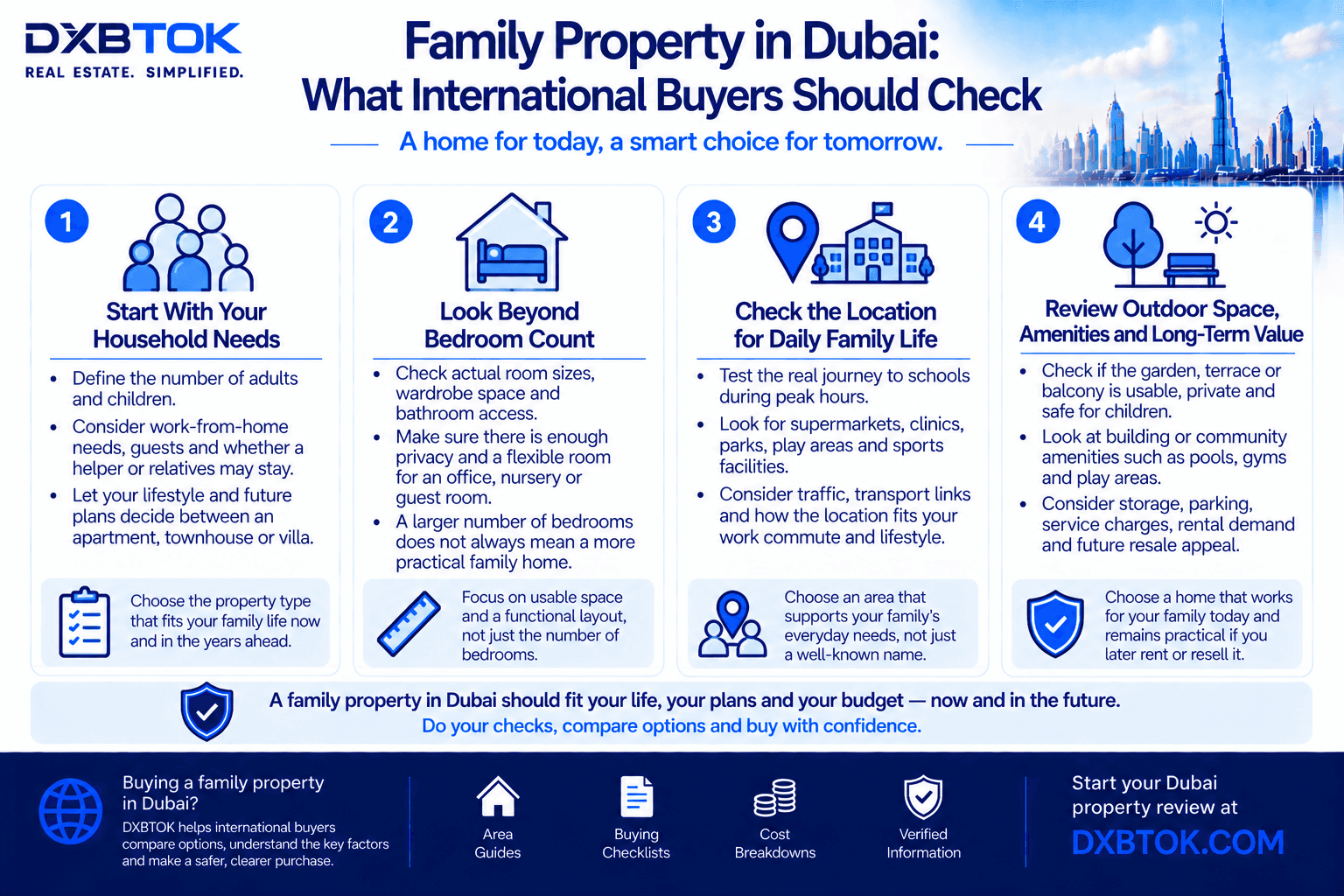
A good family property in Dubai is about more than bedroom count or total size. This guide explains how international buyers should assess household needs, room flexibility, school and commute practicality, shared living space, storage, outdoor areas, privacy, parking, community amenities, ownership workload and future resale appeal before choosing the right home.
Family Property in Dubai: What International Buyers Should Check
Buying a family property in Dubai is not simply a question of choosing a larger home.
A property can have enough bedrooms on paper and still be a poor fit for daily family life because the layout, school access, storage, parking, outdoor space or community setup does not work well.
For international buyers, the better approach is to start with how the household will actually live in the property, how those needs may change over time, and whether the home remains practical if the buyer later rents or resells it.
1. Start With the Household, Not the Property Type
Before deciding between an apartment, townhouse or villa, define what the household needs.
Consider:
number of adults
number and ages of children
whether grandparents or relatives stay regularly
whether anyone works from home
whether a live-in helper or nanny needs accommodation
how often guests stay
The correct property type should follow those needs.
If you are still deciding between the main residential formats, use our Dubai apartment vs villa vs townhouse buyer guide.
2. Bedroom Count Is Only the Starting Point
A family should not judge a property only by the number of bedrooms.
Check whether the rooms are large enough for the people who will actually use them.
Review:
bedroom dimensions
wardrobe space
bathroom access
privacy between rooms
whether a bedroom can later become an office, nursery or guest room
A flexible room can be more valuable than a nominal extra bedroom that is too small to use properly.
For buyers considering a smaller family setup, our 2-bedroom apartments in Dubai buyer guide explains how to assess bedroom and bathroom configuration in more detail.
3. Think About How the Household May Change
A property that works today may feel restrictive in three or five years.
Ask whether the home can adapt if:
a child is born
children need separate rooms
someone begins working from home
parents or relatives stay more often
the family needs more storage
You do not need to overbuy space, but a family property should have enough flexibility to avoid becoming obsolete too quickly.
4. School Access Should Be Tested With the Real Journey
A school may look close on a map and still create a difficult daily commute.
Check:
actual driving time during school hours
morning and afternoon traffic
school-bus availability
alternative schools nearby
how the route affects the work commute
For families with school-age children, daily access can matter more than being in a famous area.
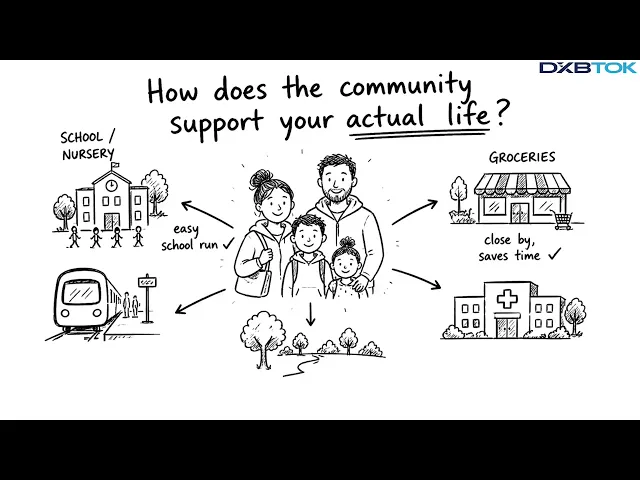
5. Compare the Area Around Daily Family Needs
A family-friendly location should support normal everyday life.
Look at access to:
supermarkets
pharmacies and clinics
parks and play areas
schools and nurseries
restaurants and cafés
sports and recreation
main roads and transport links
Use our Dubai property area selection guide to compare locations based on actual household requirements rather than name recognition alone.
6. Check the Living Area for More Than One Person
A family uses shared space differently from a single occupant or couple.
Check whether the living and dining areas can realistically support:
family seating
a proper dining table
children moving through the space
guest seating
television and storage
A property with several bedrooms but an undersized living area may not function well as a family home.
7. Storage Should Be Treated as Essential
Family homes accumulate more clothing, toys, luggage, equipment and household items.
Check for:
built-in wardrobes
linen cupboards
kitchen storage
laundry space
entrance storage
store rooms
space for suitcases, sports equipment or pushchairs
A larger property with weak storage can still feel overcrowded.
8. Review the Kitchen for the Way the Family Eats
A decorative kitchen is not automatically a practical family kitchen.
Look at:
counter space
refrigerator size
cabinet capacity
ventilation
dishwasher provision
proximity to the dining area
whether the layout works when several people are using the space
If the family cooks regularly, this can materially affect day-to-day comfort.
9. Outdoor Space Should Match Real Use
A large garden, terrace or balcony can be attractive, but only if the family will use it.
Ask:
Is the area shaded?
Is it private?
Is it safe for children?
How much maintenance does it require?
Does it face a road, neighbouring property or construction area?
Do not pay a large premium for outdoor space that looks impressive but is inconvenient in practice.
10. Privacy Changes With Property Design
Families often need both shared and private areas.
Consider:
distance between bedrooms
guest access
whether bedrooms open directly onto the living room
bathroom sharing
staff or helper accommodation
whether parents can separate work and family areas
A good family layout should support both interaction and privacy.
11. Parking Can Become a Bigger Issue Over Time
A household may begin with one car and later need two.
Confirm:
number of allocated spaces
visitor parking
whether additional spaces can be rented or purchased
distance from parking to the property
electric-vehicle charging availability where relevant
Parking is easy to ignore during a remote review but difficult to change after purchase.
12. Community Amenities Should Be Judged by Daily Use
A large list of amenities does not automatically make a development family-friendly.
Ask which facilities the household will actually use.
That may include:
children’s play areas
swimming pools
parks
sports areas
walking paths
community retail
Then compare those benefits against the service charges or community fees that support them.
13. Check Noise and Traffic at Family-Relevant Times
A property can feel quiet during a midday viewing and very different in the morning or evening.
Check:
school-hour traffic
road noise
construction nearby
amenity noise
delivery and service access
weekend activity
Remote buyers should ask for current video or local confirmation where possible rather than relying only on marketing material.
14. Calculate the Full Family Ownership Budget
The purchase price is only one part of the decision.
Family buyers may also need to budget for:
transaction and registration costs
service charges or community fees
financing costs where applicable
furnishing
maintenance
garden or pool upkeep where relevant
property management if the family is not in Dubai full-time
Use our full cost of buying Dubai property guide before deciding how much of your budget should go into the property price itself.
15. Larger Homes Can Mean More Ownership Work
A larger family property can provide more space but also create more maintenance responsibility.
This is especially relevant for villas, townhouses and homes with private outdoor areas.
International buyers should consider:
air-conditioning maintenance
plumbing and electrical repairs
garden upkeep
pool maintenance where applicable
pest control
periodic inspections
If the property will sometimes be vacant or managed from overseas, review our Dubai property management guide for overseas owners.
16. Think About the Family’s Exit Before Buying
A family home should also make sense to a future buyer or tenant.
Consider whether the property has broad appeal based on:
bedroom configuration
school and community access
parking
storage
outdoor space
building or community condition
recurring ownership costs
Highly personalised or unusually large homes can work well for one family but appeal to a narrower market later.
17. Use a Family-Property Checklist Before Reserving
Before moving forward, confirm:
Household: Who will live in the property now and later?
Bedrooms: Are the rooms genuinely usable and flexible?
Bathrooms: Does the configuration work for the household?
School access: Is the real daily journey practical?
Community: Are everyday services easy to reach?
Shared space: Is the living area large enough for family use?
Storage: Is there enough for normal family life?
Outdoor space: Will it actually be used?
Parking: Does it work for current and future needs?
Budget: What is the full annual ownership cost?
Management: How will the property be maintained if you are abroad?
Exit: Will the property remain attractive to another family later?
Final Takeaway
A good family property in Dubai is not simply the home with the most bedrooms or the largest floor area.
It is the property that works across daily routines, school access, shared and private space, storage, parking, outdoor use, maintenance and future household needs.
Choose the family use case first. Then choose the property type, exact unit and community that support it.
Need help comparing family properties in Dubai? DXBTOK can help international buyers review selected options, compare practical household fit and check the information needed before moving forward.
Start your Dubai property review at DXBTOK.com.
Related DXBTOK guides
Dubai Apartment vs Villa vs Townhouse: Buyer Guide →
2-Bedroom Apartments in Dubai: Buyer Guide →
Dubai Property Area Selection: How Buyers Should Compare Locations →
Full Cost of Buying Dubai Property: What International Buyers Should Budget →


