

A property in Dubai can sit inside a master-planned community controlled by one company while the individual building or residential project is developed by another. This guide explains how buyers should separate community-level responsibilities from project-level responsibilities, understand who may control infrastructure, public areas, construction, specification, amenities, management and handover, and assess each developer based on the responsibilities it actually holds.
Dubai Master Developer vs Private Developer: What Buyers Should Know
In Dubai, buyers may come across two different development layers inside the same area.
One company may be responsible for the wider master-planned community, while another develops an individual building, plot or residential project within that community.
This distinction matters because the two parties may influence different parts of the ownership experience.
The useful question is not simply whether a property is being sold by a master developer or a private developer. It is who controls the community, who controls the project, and which responsibilities belong to each.
1. What Is a Master Developer?
A master developer is generally associated with planning and developing a larger district or community rather than only one individual building.
Depending on the development, its role may include elements such as:
overall master planning
community roads and access
public realm and landscaping
shared infrastructure
parks and open spaces
community retail or amenities
plot allocation to other developers
The exact scope varies between developments, so buyers should not assume that every master developer performs the same functions.
2. What Does “Private Developer” Usually Mean?
In everyday Dubai property discussions, buyers may use “private developer” to describe a developer delivering an individual project rather than controlling the wider master community.
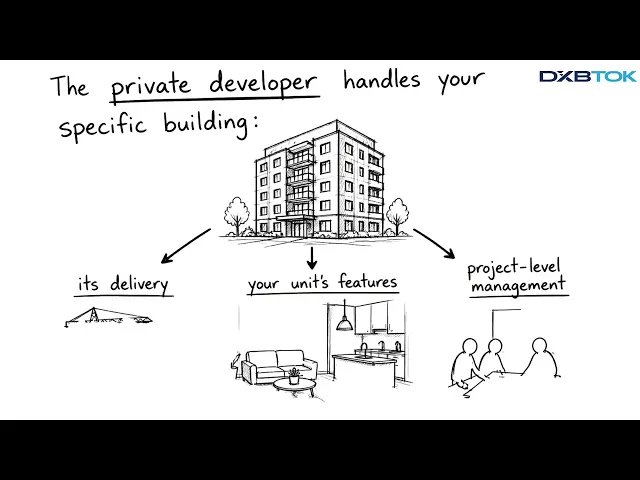
That developer may be responsible for areas such as:
the individual building or residential project
unit layouts
construction delivery
finishes and specification
project-level amenities
handover
defect procedures
building-level management arrangements
The term itself should not be treated as a formal quality rating. The buyer still needs to assess the exact company and project.
These labels are not strict opposites. A privately owned company may also serve as a master developer, while an individual project can be delivered by a separate company. For a buyer, the important distinction is the role each legal entity holds in the specific community and project—not whether the company is described as private.
3. One Property Can Depend on Both Layers
A buyer can purchase an apartment from one developer while the surrounding community is shaped by another.
That means the ownership experience may depend on two separate layers:
community layer: roads, landscaping, public realm, wider infrastructure and neighbourhood planning
project layer: the building, unit, specification, delivery and project-level services
Understanding this split helps buyers ask the right questions instead of judging everything under one developer name.
4. Do Not Assume the Community Brand Is the Building Developer
A well-known community name can be prominent in marketing even when another company is developing the specific property.
Before reserving, confirm:
who is the master developer of the community
who is developing the exact project
which company appears in the relevant sales and purchase documents
For the separate identity and legitimacy checks, use our Dubai property developer verification guide.
5. Community Infrastructure Belongs to a Different Decision Layer
When buyers evaluate a master-planned area, they should look beyond the individual building.
Consider:
road access
pedestrian connections
parks and public spaces
retail and daily services
school or nursery access where relevant
future phases
surrounding construction
These factors can affect daily use even if the individual apartment or villa is excellent.
6. The Project Developer Controls the Property You Actually Buy
The individual project requires its own review.
A strong wider community does not automatically tell you whether a specific building has a good layout, specification, delivery process or ownership cost.
Check the exact project on its own merits.
Our Dubai developer track-record guide explains how buyers can review completed projects, delivery history and relevant development experience.
7. Compare Responsibilities, Not Labels
A common mistake is to assume that one type of developer is automatically safer or higher quality.
That is too simple.
Instead, ask:
What does this company actually control?
What is it responsible for delivering?
What evidence exists for that responsibility?
Which obligations belong to another party?
This keeps the comparison practical.
8. Review the Masterplan Separately From the Building
The masterplan can show how the project sits inside the larger area.
Check:
the project’s position
nearby roads
open plots
parks
retail areas
waterfront or open-space relationships
future development phases
The building brochure may focus heavily on the project itself, while the masterplan provides the wider context.

9. Check the Exact Project Brochure for Project-Level Promises
The individual developer’s brochure can help you identify what is being presented specifically for the building or project.
Look at unit plans, finishes, amenities, payment terms and delivery references.
Use our guide to reading a Dubai off-plan project brochure to separate useful project information from illustrative marketing.
10. Ask Who Controls the Shared Amenities
Not every amenity visible around a project necessarily belongs exclusively to that building.
Some facilities may be:
building-specific
shared across several buildings
part of the wider community
operated by a separate management entity
Ask who owns, operates and maintains the facilities that matter to you.
11. Understand the Different Service-Charge Layers
Properties inside large communities can involve more than one level of shared cost or management structure.
Depending on the property, buyers may need to understand building-level charges, community-level charges or other shared operating costs.
Do not assume that the developer label alone tells you what the annual ownership cost will be.
Ask for the applicable charges for the exact property and understand what each charge supports.
12. Handover Responsibility Usually Sits at Project Level
For an individual off-plan property, the project developer is normally the party the buyer focuses on for the specific unit delivery process.
That can include:
completion communication
handover scheduling
unit condition
snagging or defect procedures
access and key collection
project-specific documentation
The fact that the project sits inside a large master community does not remove the need to assess the project-level handover process.
13. Future Community Development Can Affect the Property
A buyer should also consider what may happen around the project after purchase.
Open plots, later phases, roads, retail areas or future buildings can change:
views
traffic
noise
access
community maturity
Ask what is already delivered, what is under construction and what remains planned.
14. Compare Developers on the Same Responsibilities
If you are choosing between projects from different developers, compare like with like.
For example, assess project developers against project-delivery factors rather than giving one company extra credit simply because it also controls a larger master community.
Our guide to comparing Dubai developers before reserving off-plan property provides a broader framework for side-by-side comparison.
15. Do Not Let a Famous Community Name Replace Project Due Diligence
A strong master community can be a positive factor, but buyers still need to review the exact property.
Check:
the project developer
the exact unit
current availability
price
payment terms
specification
relevant purchase documents
The community and the property should both work.
16. Do Not Treat a Private Developer as a Warning Sign
Likewise, a project being developed by a company that does not control the wider community is not automatically a negative.
The proper question is whether that developer can support the specific project it is delivering.
Review its track record, relevant experience, project details, commercial terms and contractual responsibilities.
17. Verify the Exact Opportunity Before Reserving
Once you understand the two development layers, move back to the actual buying opportunity.
Confirm the exact project, developer, unit, current availability and documented commercial terms.
Our first-verification guide for Dubai projects explains the checks to make before an attractive project becomes a reservation decision.
18. Use a Who-Controls-What Checklist
Before buying in a master-planned Dubai community, ask:
Master community: Who controls the wider development?
Exact project: Who is developing the building or residential project?
Infrastructure: Who is responsible for roads, public realm and wider community facilities?
Building: Who is responsible for construction, specification and project delivery?
Amenities: Which are building-specific and which are community-wide?
Management: Who manages the building and the wider community?
Charges: What building and community costs apply?
Future phases: What is still planned around the property?
Handover: Who handles delivery of the exact unit?
Documents: Which company is legally responsible for the obligations you are relying on?
Final Takeaway
A master developer and an individual project developer can influence different parts of the same property purchase.
The master-community layer may shape the wider roads, infrastructure, public realm and neighbourhood. The project-level developer may control the building, unit specification, delivery and handover.
Do not choose a property simply because one label sounds stronger. Identify who controls each part of the ownership experience, then judge each party on the responsibilities it actually has.
Need help comparing Dubai projects and developers? DXBTOK can help international buyers organise the key project information, compare selected opportunities and identify what still needs to be confirmed before moving forward.
Start your Dubai property review at DXBTOK.com.
Related DXBTOK guides
How to Verify a Dubai Property Developer →
Dubai Developer Track Record: What Buyers Should Review →
How to Read a Dubai Off-Plan Project Brochure →
How to Compare Dubai Developers Before Reserving Off-Plan Property →
When a Dubai Project Looks Attractive: What to Verify First →


