Dubai Property Rental Yield: What Buyers Should Compare About Gross vs Net Returns


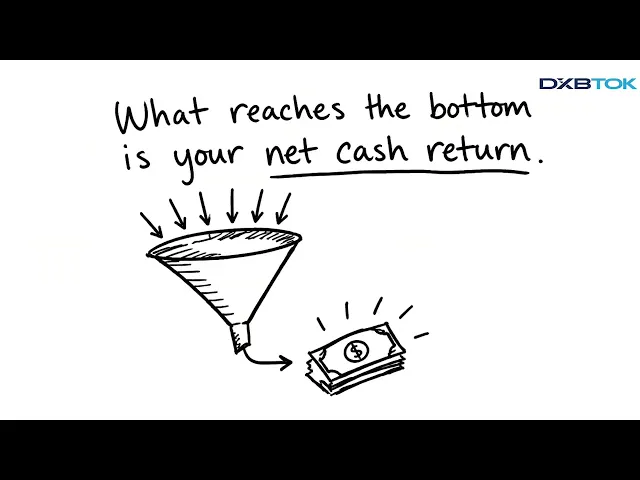
A Dubai property advertised with a 7% or 8% rental yield can appear attractive, particularly to an international buyer comparing different investment opportunities. But the advertised percentage may be based on expected annual rent divided by the purchase price, before any allowance for service charges, vacancy, management or maintenance. Gross rental yield and net rental yield answer different questions. Gross yield offers a quick comparison of rent against price. Net yield helps a buyer understand how much income may remain after the costs of operating and owning the property are considered. Even then, mortgage repayments, acquisition costs and personal tax circumstances can change the investor's actual return. Before comparing two Dubai properties on rental income, buyers should understand which figures are evidenced, which are projections, what costs have been deducted and what investment amount is being used. This guide explains those differences through clear examples so buyers can evaluate rental-yield claims before committing to a property.
Dubai Property Rental Yield: What Buyers Should Compare About Gross vs Net Returns
A Dubai property advertised with a 7% or 8% rental yield can appear attractive, particularly to an international buyer comparing different investment opportunities. But the advertised percentage may be based on expected annual rent divided by the purchase price, before any allowance for service charges, vacancy, management or maintenance.
Gross rental yield and net rental yield answer different questions. Gross yield offers a quick comparison of rent against price. Net yield helps a buyer understand how much income may remain after the costs of operating and owning the property are considered. Even then, mortgage repayments, acquisition costs and personal tax circumstances can change the investor's actual return.
Before comparing two Dubai properties on rental income, buyers should understand which figures are evidenced, which are projections, what costs have been deducted and what investment amount is being used. Buyers should compare these figures using clear, consistent calculations before relying on a rental-yield claim or committing to a property.
1. What Is Rental Yield in Dubai Property?
Rental yield expresses a property's annual rental income as a percentage of its value or purchase cost. It helps buyers compare income potential across properties that have different prices.
A property producing AED 80,000 in annual rent may look more attractive than one producing AED 60,000. But if the first costs significantly more to purchase, its yield may actually be lower.
The percentage therefore matters alongside the rent and the investment amount used in the calculation.
However, rental yield is not the same as total investment return. It does not necessarily capture future changes in the property's market value, financing costs, taxation or sale proceeds.
Buyers should identify exactly what a quoted yield represents before relying on it to compare properties.
2. Gross Rental Yield vs Net Rental Yield: What Is the Difference?
The basic distinction is straightforward.
Gross rental yield measures annual rent before deducting property-related expenses.
Net rental yield measures rental income remaining after specified ongoing expenses, expressed as a percentage of a clearly stated investment base.
Two simple calculation methods are:
Gross rental yield: annual gross rent divided by purchase price, multiplied by 100.
Net operating rental yield: annual rent after vacancy and property operating costs divided by purchase price, multiplied by 100.
Some investors calculate net yield using the purchase price plus acquisition costs in the denominator. This is a different calculation basis and should be labelled accordingly.
Neither definition should be used without explaining which expenses have been deducted and whether the property is financed.
The difference is important because two investments can advertise similar gross yields while producing meaningfully different net income.
3. How Is Gross Rental Yield Calculated?
Consider a hypothetical apartment in Dubai with the following figures:
Purchase price: AED 1,500,000.
Expected annual rent: AED 105,000.
The calculation is:
AED 105,000 ÷ AED 1,500,000 × 100 = 7% gross rental yield.
This means the projected annual rent represents 7% of the purchase price before deducting expenses.
The figure can be helpful when initially screening properties, but it tells you nothing about what remains after ownership and rental costs.
It also assumes the estimated annual rent is achievable. If the property's actual income differs from the projection, the realised gross yield will differ as well.
A gross yield should therefore be understood as an initial measurement rather than proof of investment profitability.
4. Advertised Rent Is Not Always Achievable Rent
One of the largest sources of error in Dubai rental-yield projections is using an optimistic rent estimate as though it were confirmed income.
A listing may be advertised at AED 120,000 annually, but that does not establish that a tenant will agree to pay that amount or that the property will remain occupied throughout the year.
Buyers should distinguish:
Asking rent: the amount currently advertised by a landlord or agent.
Contracted rent: the amount agreed in an existing tenancy.
Achievable market rent: a reasoned estimate supported by relevant comparable leasing evidence.
Collected rent: the money actually received during the period.
Dubai Land Department provides rental-market and rental-index information, but an index figure should not be treated as a guaranteed rent for an individual investment unit.
The building, floor, layout, condition, furnishing, tenancy status and rental restrictions can materially affect achievable income.
An income projection based solely on one ambitious advertisement is a weak basis for a purchase decision.
5. Why Vacancy Must Be Included in Rental-Yield Comparisons
A property does not automatically generate a full year's rent simply because its advertised annual rent is attractive.
There may be periods without a tenant, delays between contracts, repairs that temporarily prevent occupation or an initial marketing period after handover.
For example, a unit with an annual rental potential of AED 105,000 may generate less if it remains empty during part of the year.
The relevant allowance depends on the property and proposed rental arrangement. A buyer should not assume that a fixed vacancy percentage is universally appropriate for Dubai.
A stronger comparison includes a realistic vacancy scenario based on the property type, tenant market and available evidence.
Vacancy assumptions should also be kept separate from management and maintenance expenses, rather than hidden inside an unexplained deduction.
6. How Do Dubai Service Charges Affect Net Rental Yield?
Service charges are among the most important recurring expenses affecting the net yield of apartments in jointly owned developments.
These charges can contribute toward managing, operating, maintaining and repairing shared parts of a building or community under the applicable approved budget.
Dubai Land Department provides an official Service Charge Index through which the relevant approved charges may be checked for a project, usage category and year.
The actual financial burden depends on the exact property, the approved charging basis and applicable ownership obligations.
Two apartments in different developments may generate similar rents but have materially different annual service charges.
For example, if two AED 1.5 million properties each receive AED 105,000 in gross annual rent, but one has AED 12,000 in annual service charges and the other AED 24,000, the latter has AED 12,000 less annual income before considering any other expense.
That difference alone equals 0.8 percentage points of yield against the same AED 1.5 million purchase price.
Our Dubai property service-charge review guide explains the separate building-level checks. For rental-yield analysis, the key point is that approved service charges must be reflected in the net-income calculation.
7. Maintenance Costs Are Different From Building Service Charges
Buyers should avoid assuming that paying building service charges means there will be no further maintenance expenses.
Service charges normally relate to the applicable shared-building and community responsibilities. Repairs and replacement costs inside the individual property may fall separately on the owner, depending on the tenancy and relevant agreements.
Potential expenses can include:
Air-conditioning repairs and servicing obligations.
Appliance replacements.
Plumbing and electrical repairs.
Furniture or furnishing replacement.
Periodic refurbishment.
Unexpected property damage or equipment failures.
Even a newly delivered apartment may eventually require repairs that affect the owner's annual return.
For comparison purposes, a sensible allowance should be based on the property condition and expected obligations, rather than assuming maintenance will always be zero.
Actual expenses may vary substantially from one year to another.
8. Property-Management Fees Can Change the Return
International buyers frequently consider professional rental or property management because they do not intend to supervise the unit personally.
The management cost may be quoted as a percentage of rent, a fixed fee or a combination of core and additional charges.
A percentage alone does not tell the buyer the full cost. The agreement may distinguish regular management from tenant placement, renewal administration, inspections, emergency coordination and other services.
It is also important to identify whether a percentage is applied to contracted rent, collected rent or another defined amount.
For rental-yield calculations, include the actual applicable fees without deducting the same expense twice.
Our Dubai property-management fee comparison guide explains how owner-level charges can differ between providers.
A gross yield that looks attractive before management costs may become less compelling when those fees are included.
9. Long-Term Rentals and Holiday Homes Need Different Assumptions
Rental-yield comparisons are less reliable when they mix figures from different rental operating models.
A conventional long-term tenancy may involve an agreed annual rent and a relatively predictable contractual period, although vacancy, collection and maintenance risks remain.
Holiday-home operations may generate bookings at varying nightly rates and occupancy levels. They can also involve additional management, cleaning, utilities, furnishing, marketing, platform and regulatory costs.
Annual booking revenue is not equivalent to annual net rental income.
A short-term rental projection based on an attractive peak-season nightly rate can materially overstate the income actually achievable throughout the year.
For the separate decision about rental formats, see our Dubai holiday home versus long-term rental guide.
When calculating yield, the underlying revenue and expense assumptions must match the proposed operating model.

10. Example: A 7% Gross Yield That Becomes 4.53% Net
Consider a hypothetical Dubai apartment purchased for AED 1.5 million with potential annual rental income of AED 105,000.
The following figures are illustrative assumptions, not current market averages or estimates for any identified property.
Annual income and expenses | AED |
|---|---|
Potential annual rent | 105,000 |
Less: vacancy allowance | −7,000 |
Less: building service charges | −18,000 |
Less: property-management fees | −5,000 |
Less: maintenance allowance | −5,000 |
Less: other owner operating costs | −2,000 |
Estimated annual net operating income | 68,000 |
Gross rental yield: AED 105,000 ÷ AED 1,500,000 × 100 = 7.00%.
Net operating rental yield: AED 68,000 ÷ AED 1,500,000 × 100 = approximately 4.53%.
The difference is substantial. The headline figure remains 7%, but the modelled income after specified expenses is considerably lower.
This example excludes mortgage costs, acquisition costs, tax obligations and changes in capital value. Those items need separate treatment before calculating an investor's complete financial return.
11. Should Purchase Costs Be Included in the Yield Calculation?
Yes, purchase costs should be considered when evaluating how efficiently the buyer's invested capital may generate income. However, they must be incorporated consistently.
A basic gross yield usually uses the property's purchase price as the denominator.
A more complete acquisition-cost-adjusted net yield can use the purchase price plus relevant one-time buying and setup costs.
For example, assume the hypothetical AED 1.5 million apartment has AED 90,000 of additional initial acquisition and setup costs. The total investment base becomes AED 1.59 million.
Using the same estimated annual net operating income of AED 68,000:
AED 68,000 ÷ AED 1,590,000 × 100 = approximately 4.28%.
This lower figure reflects the higher capital committed at acquisition. It is not a second deduction of purchase costs from the same year's rental income.
Real transaction expenses vary according to the purchase structure and property. The AED 90,000 used here is illustrative only.
Our guide to comparing total costs between Dubai properties explains the wider acquisition-cost categories.
The important requirement is to state the calculation base clearly and compare properties using the same method.
12. Why Two Properties With the Same Gross Yield May Perform Differently
Imagine two Dubai apartments with the same purchase price and the same achievable annual rent.
On a gross-yield calculation, they appear equivalent.
But Property A has lower recurring building charges, limited expected maintenance and straightforward management requirements.
Property B has higher service charges, more expensive owner obligations and greater expected periods between tenants.
Property A may generate materially higher net rental income even though both advertise the same gross yield.
That does not automatically make Property A the better purchase. Building condition, future tenant demand, liquidity and capital risk still matter.
However, it demonstrates why a buyer should not use a gross percentage as a substitute for evaluating the underlying property economics.
13. Net Rental Yield Is Not the Same as Monthly Cash Flow
An investment property can show a positive net operating yield while producing limited cash flow for a financed owner.
Net operating rental yield commonly measures income after property operating expenses but before financing payments.
Monthly cash flow takes the timing of income and outgoings into account, including applicable mortgage payments.
For a financed property, interest or profit costs and principal repayments affect the money available to the investor. Principal repayment also reduces outstanding debt, so it should not automatically be treated as the same type of economic expense as interest or maintenance.
The distinction matters because a mortgage repayment can exceed the cash received after operating costs even where the property's underlying rental yield appears reasonable.
Investors should therefore consider operating yield and financing cash flow as related but separate measurements.
14. How Does a Mortgage Affect the Investor's Actual Return?
Borrowing changes the amount of personal capital deployed and introduces repayment obligations.
A mortgage does not change the property's unleveraged operating income by itself. It does change the investor's financing costs, cash-flow exposure and potential return on contributed equity.
For example, two buyers may purchase similar rental properties, but one pays entirely in cash while the other uses substantial mortgage financing.
The properties could have similar gross and net operating yields while the buyers experience very different cash flows and financial risks.
The financed investor may retain more capital outside the property but must sustain mortgage payments even if the property becomes vacant.
When evaluating a financed purchase, buyers should distinguish property-level yield from cash-on-cash return, debt repayment and potential changes in equity value.
No leverage structure should be assumed to improve returns automatically.
15. Rental Yield Does Not Include Future Property Appreciation
Rental yield primarily measures income in relation to the property's price or investment base. It does not establish whether the property will appreciate or depreciate.
A property may produce an attractive rental yield while its resale price weakens. Another may deliver lower annual income but later increase in market value.
Total investment return can be influenced by both income and capital-value changes, together with transaction, financing, ownership and exit costs.
Neither future appreciation nor the timing of a profitable resale is guaranteed.
Consequently, a buyer should avoid comparing a rental-yield percentage against a projected capital-growth percentage as though they measure the same thing.
They describe different sources of return and involve different uncertainties.
16. Be Careful With Guaranteed Rental-Yield Claims
Some Dubai property offers advertise a guaranteed return or fixed rental-income arrangement.
A contractual income commitment is different from an ordinary forecast of what the property could earn in the open rental market.
Even where an arrangement contains a contractual payment promise, the buyer must understand who makes that promise, how long it applies, which conditions are attached and what happens when the arrangement ends.
A guaranteed percentage may be calculated on a specific price or payment base and may not represent the net yield after all owner expenses.
A higher property price can also change the economic value of an attractive-looking income commitment.
Our guide to guaranteed returns in Dubai property covers the separate contractual and promotional risks.
For ordinary yield comparison, avoid treating an advertised guarantee as evidence of the property's independently achievable rental income.
17. Why Building, Unit and Tenant Evidence Matter More Than Area Averages
Dubai rental-yield discussions often focus on broad averages for particular communities or types of apartment.
These figures can offer market context, but they do not establish the expected performance of a specific property.
Actual rent and ongoing expenses can vary by building age, floor, condition, layout, furnishing, facilities and the demand for the particular unit.
An area may appear attractive on average while a particular building has unusually high service charges or weaker demand.
Similarly, a prestigious address may have strong tenant appeal but a purchase price that produces a lower rental yield.
Buyers should use area-level figures as context, then examine comparable unit-level income and costs before relying on a projection.
18. How Should Buyers Compare Rental-Yield Projections?
The comparison should use consistent assumptions rather than accepting each seller's preferred calculation.
For two competing properties, the useful information includes:
Purchase price and the total capital commitment.
Supported annual rental assumptions.
Existing tenancy terms where relevant.
Expected vacancy or income interruption.
Actual or properly supported service-charge obligations.
Management and leasing expenses.
Maintenance and other owner-paid operating costs.
Financing arrangements, considered separately.
Whether the calculation uses purchase price or an all-in investment base.
Each figure should be clearly classified as documented, estimated or dependent on a future event.
A comparison becomes less meaningful when one property is modelled using actual costs and the other is modelled using only optimistic advertising assumptions.
19. What Happens to Yield When Rent Falls or Costs Increase?
A buyer should not evaluate only the most attractive possible rental scenario.
Using the earlier hypothetical property, suppose potential annual rent falls from AED 105,000 to AED 95,000 while annual service charges increase from AED 18,000 to AED 25,000.
If the other illustrative deductions remain unchanged at AED 19,000 in total, estimated annual net operating income falls to AED 51,000.
Against the same AED 1.5 million purchase price, that represents a net operating yield of approximately 3.40%.
The example is not a forecast. It shows how sensitive the result can be to changes in rental income and recurring expenses.
A property that appears compelling only under an optimistic rent and cost scenario may provide insufficient financial resilience for the intended buyer.
Testing more than one reasonable outcome can reveal the level of uncertainty before the purchase becomes binding.
20. When Is an Advertised Rental Yield a Warning Sign?
A rental-yield estimate deserves additional scrutiny when its assumptions are unsupported, important costs are omitted or the calculation method remains unclear.
Warning signs include:
A percentage quoted without identifying the purchase price or rental assumption.
Projected annual rent presented as confirmed income without sufficient evidence.
No allowance for vacancy or periods without income.
Service charges and maintenance costs excluded without explanation.
Short-term rental revenue treated as net income before operating expenses.
Mortgage costs mixed into the calculation inconsistently.
Claims that one property's yield is guaranteed by general Dubai market performance.
Different calculation bases being used to make one property appear stronger than another.
These warning signs do not automatically mean the property is unsuitable. They mean the yield claim is not yet supported well enough to drive an investment decision.
21. Which Rental-Yield Figure Should Buyers Prioritise?
Gross yield is useful for an initial comparison because it quickly relates income to price.
Net operating yield is more informative when assessing the income that could remain after the property's ongoing operating expenses.
Acquisition-cost-adjusted yield adds the effect of the buyer's initial transaction and setup expenditure.
For financed buyers, cash flow and equity-return measures add another layer that reflects personal borrowing and capital commitments.
These calculations should support one another rather than be used interchangeably.
The most useful figure depends on the decision being made, but a buyer considering a real purchase should not stop at gross yield alone.
22. Compare Dubai Property Rental Yield Before You Buy
Dubai property rental yield can be useful when evaluating an income-focused purchase, but the difference between gross and net returns is central to understanding the actual investment case.
A headline yield may appear attractive until service charges, vacancy, management and maintenance are included. Even a carefully calculated net operating yield does not, by itself, establish the investor's ultimate return after financing, acquisition costs and personal tax circumstances.
The stronger approach is to compare properties using supported rental evidence, clearly identified cost assumptions and the same calculation methodology.
DXBTOK helps international buyers compare selected Dubai property opportunities with clearer commercial information and structured support before moving forward with the appropriate licensed professionals.
Buyers should focus on what the property could realistically produce rather than choosing based on the highest advertised percentage.
Related DXBTOK Guides
Dubai Property Costs Explained: Fees, Service Charges and Setup →
Dubai Property Management for Overseas Owners →
Dubai Property Area Selection: How Buyers Should Compare Locations →
Hidden Fees and Ownership Costs in Dubai Branded Residences →


