Buying Distressed Property in Dubai: How Buyers Should Verify Discounts, Ownership and Risk


A steep discount is only valuable if the property can be acquired, used and eventually sold on workable terms. In Dubai, an urgent resale may involve unresolved debt, restricted possession or expensive repairs. This guide helps buyers weigh the apparent saving against the legal, financial and practical obligations that could follow the purchase.
Buying Distressed Property in Dubai: How Buyers Should Verify Discounts, Ownership and Risk
Buying distressed property in Dubai can appear attractive when an owner needs a quick sale, a property carries financial obligations or an auction offers a different route to acquisition. But a lower advertised price does not automatically mean a buyer is securing a genuine bargain.
The term distressed is used broadly in property marketing. It can describe an ordinary owner who wants to sell urgently, a mortgage-related sale, a court-supervised auction or a property whose condition or contractual position creates uncertainty. Each situation involves different evidence, risks and requirements before ownership can be transferred.
For international buyers, the key decision is whether the proposed discount remains meaningful after comparable market prices, outstanding obligations, property condition, occupancy, transaction costs and the ability to complete the purchase are properly assessed. This guide explains how to distinguish a credible distressed opportunity from a low headline price supported by insufficient evidence.
1. What Is a Distressed Property in Dubai?
A distressed property is generally understood as a property being offered for sale under circumstances that may place financial or timing pressure on the seller.
However, the word distressed is not a single legal classification that automatically establishes the property's condition, ownership status or market value.
Buyers searching for distressed property for sale in Dubai may encounter very different opportunities:
Urgent owner sales: an owner wants to complete a transaction quickly because of relocation, financial commitments or changing personal circumstances.
Mortgage-related sales: a property is being sold while an existing lender has an outstanding registered financial interest.
Court-related auctions: a property is offered through an authorised process connected to a legal judgment or other permitted sale arrangement.
Off-plan resales: an existing purchaser wants to transfer their contractual interest before completion, subject to the applicable developer and registration requirements.
Properties requiring substantial expenditure: a lower asking price may reflect repairs, occupancy difficulties or other property-specific disadvantages.
These categories should not be treated as interchangeable. An urgent private resale may be relatively straightforward, while a court-related or heavily encumbered property could involve materially different conditions.
The first commercial question is not how much the property has supposedly been discounted. It is why the opportunity exists and what obligations accompany it.
2. Does Distressed Always Mean Below Market Value?
No. A property described as distressed may still be priced at or above its realistic market value.
A seller might genuinely need a quick transaction but choose an asking price that reflects a premium location, a desirable unit or their own financial requirements.
Alternatively, a broker may advertise a significant discount by comparing the current asking price with an older listing, a developer's original price or an unusually expensive property nearby.
None of those references automatically establishes a genuine market discount.
Buyers should distinguish three figures:
Advertised reference price: the amount used in the sales presentation to illustrate the supposed saving.
Current asking price: what the seller is presently seeking.
Evidence-supported market value: a defensible estimate derived from relevant comparable transactions, property characteristics and current conditions.
A property offered below its former asking price can still be a poor purchase if comparable units are available for less.
The meaningful discount is measured against a realistic current alternative, not against an arbitrary marketing reference.
3. Where Do Genuine Distressed Opportunities Come From?
Real seller motivation can arise for several reasons.
Some owners need liquidity to meet other obligations. Others are relocating, restructuring investments or reducing exposure to property. A seller may also face a financing deadline or prefer certainty of completion over negotiating for the highest possible price.
In some cases, financial pressure may be associated with a mortgage or a legal enforcement process.
These circumstances can influence the seller's willingness to negotiate, but they do not automatically establish a valid discount or an uncomplicated transfer.
Buyers should distinguish a privately negotiated motivated-seller transaction from an actual bank-related or court-authorised sale.
A listing described as a bank repossession or foreclosure should not be accepted at face value without credible documentation identifying the seller's authority and the applicable sale process.
Genuine urgency can create an opportunity. Unsupported urgency can simply create pressure on the buyer.
4. How Can Buyers Recognise a Real Discount?
A meaningful comparison starts with the exact property rather than a broad statement that Dubai prices have increased or that one neighbourhood offers bargains.
Relevant factors include:
The building, community and exact unit type.
Property size, layout, floor, view and parking allocation.
Physical condition and recent maintenance.
Whether the property is vacant or tenanted.
Recent comparable completed sales rather than asking prices alone.
Ownership restrictions or outstanding obligations.
Differences in payment and completion terms.
Dubai Land Department publishes official real-estate transaction data that can provide useful evidence of completed sales. Professional valuation may also be appropriate when comparable information is limited or the property has unusual characteristics.
A headline discount of 15% is not persuasive if the reference property is larger, better maintained, vacant or materially more desirable.
Buyers should also consider the date of the comparable transaction. A historic price is not necessarily an accurate representation of today's achievable value.
The stronger investment case is supported by both an attractive purchase price and a credible explanation for why that price is below relevant alternatives.
5. Verify Who Owns the Property and Who Can Sell It
Seller authority is a central concern in any property transaction, but it becomes particularly important when a sale is presented as urgent, bank-controlled or legally distressed.
The buyer should be confident that the person or entity arranging the sale has the appropriate authority to complete the specific transaction.
Dubai Land Department provides official title-deed verification services and property-status information. These can form part of the ownership review, but a title-deed check alone should not be assumed to resolve every mortgage, restriction or contractual issue.
Depending on the property and proposed seller, the transaction may require examination of registered ownership, company authority, legal representation, mortgage interests or the basis for an auction sale.
A broker's advertisement, a forwarded title-deed image or a verbal assurance that the seller is genuine does not provide equivalent certainty.
For broader property and seller verification, our Dubai property buyer due-diligence guide
Where ownership authority is disputed or unclear, the issue requires qualified professional attention before funds are committed.
6. Can Foreign Buyers Purchase Distressed Property in Dubai?
Foreign buyers may be eligible to purchase distressed properties in Dubai, provided the exact property and ownership right are available to them under the applicable legal framework.
Distressed status does not create an exception to foreign-ownership restrictions.
For example, a property offered at a substantial discount outside an area or ownership category available to the buyer does not become eligible simply because the seller urgently needs to complete a sale.
It is also important to distinguish completed freehold property from off-plan contractual interests and other recognised property rights.
Those interests may involve different documentation and registration conditions.
Our freehold property guide for international buyers
A buyer should establish legal eligibility for the specific property before treating a discounted price as a serious purchase opportunity.
7. What Happens if the Distressed Property Has an Existing Mortgage?
An existing mortgage does not necessarily prevent a Dubai property from being sold.
However, it can change the transaction structure because the lender's secured interest must be properly addressed.
Dubai Land Department has an established service for registering sales of mortgaged property, including arrangements involving an outstanding bank liability and subsequent mortgage release.
The specific transaction may therefore involve the lender, seller, purchaser and relevant registration professionals, rather than an ordinary payment directly to the seller.
Important commercial questions include:
Whether there is an existing registered mortgage.
Whether the outstanding liability is established by reliable documentation.
Whether the lender is participating in or has approved the required arrangements.
How the mortgage will be released in connection with completion.
Whether the agreed completion timetable is realistic.
What happens if the amount owed differs from the amount previously represented.
The fact that a seller owes money does not automatically make the property unsafe to purchase. The risk arises when the financial obligation, release arrangements or transfer conditions cannot be reliably established.
A buyer should not assume responsibility for an unexplained seller debt or transfer funds under informal settlement instructions.
8. Are Dubai Property Auctions a Reliable Way to Find Bargains?
Dubai permits property sales through authorised auction arrangements, including circumstances where an auction follows a court decision.
Dubai Land Department also provides a process for registering properties sold through authorised auction companies.
However, an auction is a method of selling property, not a guarantee that the final purchase price will be below market value.
Competitive bidding can push a price higher than the buyer originally expected. Auction-specific fees, deposit requirements, payment deadlines and property conditions can also affect the economics.
A buyer should understand whether the auction is voluntary, connected to court enforcement or structured under another lawful arrangement.
The relevant auction documents should establish the property being offered, the authority governing the sale, applicable conditions and the consequences of a successful bid.
Access to inspect the property, occupation status and the certainty of obtaining possession can be particularly important.
Buyers should not assume that standard private-sale protections, timelines or financing arrangements will apply unchanged to every auction transaction.
A low opening bid is not the same as a low final acquisition cost.
9. Check Unpaid Service Charges and Other Owner Obligations
A property with an attractive asking price may carry unpaid service charges or other financial matters that need resolution before the transaction can be completed.
For apartments and properties within jointly owned developments, service charges are especially relevant because they form part of ongoing ownership costs.
The buyer should understand the applicable approved charges, whether arrears exist and how any outstanding amounts will be addressed under the agreed transaction arrangements.
A developer or relevant management entity may need to issue a no-objection certificate for an ordinary resale, depending on the property and registration route.
The cost of resolving outstanding obligations should not be left to assumption or an informal understanding between buyer and seller.
Our Dubai property service-charge review guide
A distressed purchase is not attractive merely because the initial payment is smaller. The buyer needs confidence that no material ownership cost or unresolved obligation has been overlooked.
10. Does Buying a Distressed Property Mean It Will Be Vacant?
No. A distressed property can be occupied by a tenant, the seller or another party whose rights or circumstances affect possession.
In Dubai, the sale of a leased property does not automatically terminate an existing fixed-term tenancy. Applicable tenancy law and contractual arrangements must be respected.
A buyer who intends to occupy the property immediately should therefore distinguish ownership transfer from the practical ability to obtain vacant possession.
Even where a seller promises that the property will be empty at completion, the promise should be supported by appropriate transaction documentation and reliable evidence.
Tenancy-related concerns can affect:
When the buyer can personally occupy the unit.
Whether the property can be refurbished immediately.
Which rental terms remain in force.
Whether a different rental strategy is realistically available.
The amount of time and money needed before the property fits its intended use.
An occupied unit can still be an appropriate investment for a buyer who understands and accepts the existing tenancy.
It may be unsuitable for someone whose purchase objective depends on immediate possession.

11. Physical Condition Can Explain an Apparently Attractive Price
Some discounted properties require substantial work before they are suitable for occupation, rental or resale.
Buyers should distinguish cosmetic improvements from more significant condition risks.
Examples include outdated interiors, damaged appliances, water intrusion, poorly maintained mechanical equipment or alterations that require further professional assessment.
The most important issues are not always visible in marketing photographs.
Where condition or access is uncertain, the purchase price should reflect the additional risk as well as the expected cost of making the property suitable for its intended use.
A professional inspection may be appropriate, particularly where the asking price appears unusually low or the property has been vacant or neglected for an extended period.
Buyers should also consider whether major works are permitted under building rules and what practical constraints could affect their timing.
A distressed apartment that needs extensive renovation may be more expensive to own than a better-maintained alternative offered at a higher price.
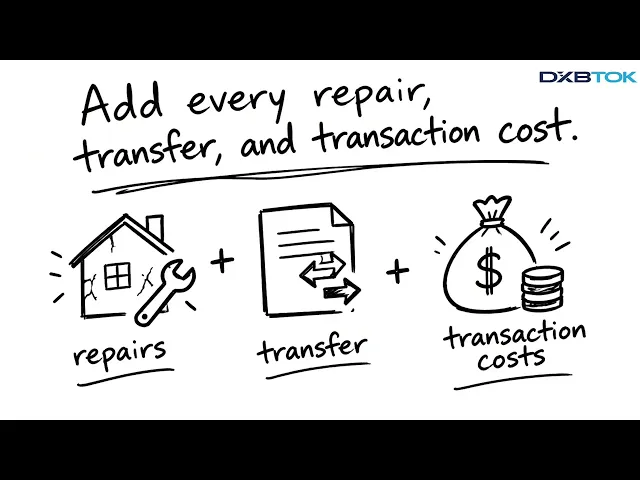
12. Compare the Discount Against the Total Financial Commitment
A genuine saving can disappear when acquisition expenses, repairs, delayed possession and other property-specific costs are added.
Consider two hypothetical Dubai apartments offering broadly comparable size, location and intended use.
Ordinary comparable property:
Purchase price: AED 2,000,000.
Assumed transaction and initial setup costs: AED 100,000.
Illustrative total commitment: AED 2,100,000.
Distressed property:
Purchase price: AED 1,750,000.
Assumed transaction expenses: AED 82,000.
Estimated renovation and repair costs: AED 155,000.
Estimated additional holding and preparation costs: AED 60,000.
Illustrative total commitment: AED 2,047,000.
The distressed property is advertised at 12.5% below the ordinary comparable property's purchase price.
But once the different estimated expenditures are included, the illustrative total-commitment difference is only AED 53,000, or approximately 2.5% of the ordinary property's total commitment.
These figures are hypothetical and are not quotations for a particular property or forecasts of Dubai transaction costs. The difference could change further if renovations, completion delays or other assumptions prove inaccurate.
Our guide to comparing total costs between Dubai properties
The correct investment question is how much economic value remains after the full purchase commitment—not how impressive the advertised percentage looks.
13. Can You Finance a Distressed Dubai Property With a Mortgage?
Mortgage financing may be available for some distressed properties, but it should not be assumed merely because the purchaser meets a lender's personal eligibility criteria.
The selected property must also satisfy the lender's requirements.
Financing could be affected by the property's legal status, physical condition, valuation, ownership documentation or the specific sale process.
A lender may value a property below the agreed purchase price, require further information or decline the proposed transaction.
Auctions and time-sensitive sales can create additional challenges if the buyer cannot obtain finance within the relevant contractual deadline.
There is also a distinction between the seller's existing mortgage and a new loan requested by the purchaser. Both may need to be accommodated in the completion arrangements.
Buyers should therefore avoid assuming that an attractive purchase price automatically produces a larger financing margin or easier mortgage approval.
A distressed opportunity becomes financially credible only when the required funds can realistically be provided under the actual transaction conditions.
14. Distressed Off-Plan Resales Carry Different Risks
Some buyers encounter discounted offers from existing purchasers who want to exit an off-plan development before completion.
These opportunities should be distinguished from purchases of completed properties with ordinary title-deed ownership.
An off-plan purchaser may hold registered contractual rights associated with an unfinished unit, while additional instalments remain payable to the developer.
The proposed transfer may depend on the relevant contract, developer consent, outstanding payments and applicable registration requirements.
Key commercial issues can include:
How much of the original purchase price has actually been paid.
Which future developer instalments remain outstanding.
Whether transfer or assignment is currently permitted.
Whether a developer no-objection certificate is required.
What contractual rights the proposed purchaser would receive.
Whether construction and handover assumptions remain realistic.
A discounted assignment price should not be confused with the total price ultimately payable for the unit.
The buyer may still assume significant future obligations.
An attractive off-plan resale needs an independently supported contractual and project position, not simply evidence that the original purchaser is willing to accept less money.
15. Understand the Legal and Registration Conditions of the Sale
Different distressed-property categories can require different documents and completion arrangements.
An ordinary motivated-seller transaction, a mortgaged resale, an off-plan transfer and a court-related auction should not be treated as identical processes.
The buyer should know what type of transaction is being proposed, who has authority to complete it and what conditions must be satisfied for lawful registration.
Depending on the case, matters requiring professional confirmation may include:
Seller identity and authority.
The relevant registered property interest.
Existing mortgage or other registered restrictions.
Applicable developer or bank approvals.
Court or auction documents where relevant.
The purchaser's ability to obtain ownership registration.
Completion and possession obligations.
Documented allocation of financial liabilities.
No general description of a property as distressed replaces these transaction-specific requirements.
The more unusual the sale structure, the more important it becomes to understand the applicable registration conditions before assuming the deal is ready to complete.
16. Urgent Payment Requests Should Not Replace Transaction Evidence
Distressed-property advertising frequently emphasises speed.
There may be a legitimate commercial reason why the seller needs a quick decision. However, urgency does not independently verify the seller, property, transaction documents or payment destination.
A buyer should distinguish a documented contractual deadline from pressure created through marketing messages.
Particular caution is warranted when payment instructions are introduced at the last minute, funds are requested for an unexplained purpose or a broker promises that documentation can be resolved after payment.
The correct recipient depends on the transaction type and stage. A private resale, bank-related completion and authorised auction may involve different payment arrangements.
Our Dubai property payment safety checklist
A genuine opportunity should be capable of supporting clear explanations about who receives the buyer's money and what contractual obligation that payment satisfies.
17. What Happens When the Seller's Problems Affect Completion?
The reason for the seller's financial pressure can sometimes create obstacles to completing a transaction.
An outstanding mortgage may require coordinated settlement. Unpaid obligations can complicate transfer preparations. A disputed ownership interest or court restriction may require legal resolution before an ordinary sale can proceed.
Where the property is tenanted, immediate possession may not be available even after ownership changes.
Buyers should therefore separate three questions:
Can the price be agreed? The seller and purchaser may be willing to transact at an attractive amount.
Can the transaction be lawfully completed? Required legal, financial and registration conditions must be satisfied.
Can the buyer use or control the property as expected? Occupancy, possession and condition can affect practical value.
A favourable negotiated price does not automatically answer the second or third question.
This is particularly important when a buyer intends to rent the property immediately, undertake renovations or refinance shortly after acquisition.
18. Are Distressed Properties Automatically Better Investments?
No. A lower purchase price can improve the economics of a property, but it does not eliminate market risk or make the underlying asset suitable.
A discounted apartment may face weak rental demand, high service charges, expensive repairs or limited resale appeal.
Another property purchased at an ordinary market price may offer better physical condition, a stronger tenant market and a more predictable ownership experience.
Distressed status is therefore only one factor within the wider investment decision.
Potential investors should consider:
The property's realistic current market value.
The total capital required.
Timing before the property can generate income.
Outstanding financial and legal matters.
Future ownership costs.
Likely tenant or end-user demand.
Resale flexibility.
The possibility that expected repairs or delays will cost more than estimated.
A property can be cheap relative to the seller's original investment and still be expensive relative to its current market potential.
19. What About Buying Distressed Property to Renovate and Resell?
Some buyers are attracted to distressed property because they expect to acquire it at a discount, improve it and sell it for a profit.
That strategy depends on several uncertain outcomes.
The purchase price must leave sufficient financial room for transaction expenses, repairs, ownership costs, possible delays and eventual selling costs.
Renovation may also reveal conditions that were not apparent at the initial inspection. Building requirements or contractor availability may affect what can be completed and when.
Future resale prices depend on market conditions at the time of sale, not merely on what the buyer has spent improving the property.
The fact that an apartment looks undervalued before renovation does not establish a profitable resale after renovation.
Buyers considering this strategy should base the decision on supported cost estimates, realistic resale comparisons and sufficient financial capacity to manage an unfavourable outcome.
20. Why International Buyers Face Additional Considerations
Overseas buyers may find distressed-property opportunities attractive because the advertised savings appear substantial when compared with prices in their home markets.
However, completing a property transaction from abroad can introduce additional practical risks.
A buyer may be relying on remote communication, photographs, inspection reports, representatives and transaction documents without having personally examined the asset.
Time-sensitive situations can magnify this disadvantage if the buyer feels compelled to reserve before important details are confirmed.
International buyers should consider whether appropriate professional support is available to assess the property's condition, ownership status, legal obligations, payment arrangements and future management requirements.
Cross-border currency conversion, funding documentation, financing eligibility and personal tax circumstances may also affect the real financial commitment.
A property marketed as a rare opportunity should not require the buyer to accept an ownership or payment risk they do not understand.
21. When Should Buyers Reject a Distressed Property Opportunity?
Some distressed opportunities can be commercially reasonable. Others should be rejected because the apparent saving does not compensate for the uncertainty.
Important warning signs include:
No credible basis for the claimed discount.
Unclear seller identity or authority.
Refusal to provide information needed for ownership verification.
Undisclosed or unexplained mortgage obligations.
Unclear bank, auction or court-related sale conditions.
Promises of vacant possession that conflict with available tenancy information.
Significant condition concerns without sufficient inspection evidence.
Unresolved service-charge or other ownership liabilities.
Financing assumptions inconsistent with the proposed completion deadline.
Pressure to send money before the relevant documents and payment recipient are verified.
A supposed discount that disappears once total purchase and remediation costs are included.
A discounted price is not enough to justify proceeding when the transaction's fundamental legal, financial or practical conditions remain unresolved.
Rejecting an unsuitable opportunity can be a better investment decision than attempting to capture every advertised bargain.
22. How Should Buyers Compare Two Distressed Properties?
Consider two hypothetical properties with similar headline discounts.
Property A is being sold by an identifiable owner with a clear ownership record, supported pricing evidence, known condition and a documented completion arrangement.
Property B is advertised at a slightly lower price but has uncertain possession, unresolved financial obligations and limited evidence supporting the stated discount.
Property B might look more attractive on the first page of a listing. It may also present materially higher completion and ownership risks.
A stronger comparison considers whether the opportunity is genuinely available and whether the buyer can establish:
What makes the seller willing or required to sell.
Whether the stated discount is supported by current comparable values.
Who legally controls the sale.
Which financial obligations must be resolved.
Whether the buyer can obtain the intended property rights.
When possession and practical use are possible.
The all-in financial commitment.
The uncertainty remaining before the transaction can complete.
Two distressed listings with the same advertised discount can represent entirely different levels of financial and legal exposure.
Price is important, but the quality of the underlying transaction can be equally decisive.
23. Buying Distressed Property in Dubai: Final Considerations
Buying distressed property in Dubai can offer an opportunity to acquire a suitable asset at an attractive price. However, the commercial value depends on the reason for the sale, the credibility of the discount and the buyer's ability to complete the transaction with an understood ownership position.
The term distressed should never replace analysis of current market value, seller authority, mortgage obligations, auction conditions, tenancy, physical condition and total financial exposure.
A genuine discount is valuable only when it survives those considerations.
DXBTOK helps international buyers compare selected Dubai property opportunities with clearer commercial information and structured buyer support. Where a distressed opportunity is considered, current availability and material property-specific claims should be independently confirmed, with appropriately licensed brokers and qualified legal or financial professionals handling the relevant transaction requirements.
The strongest purchase is not necessarily the property advertised with the largest discount. It is the property where the price, ownership position, completion arrangements and remaining risks form a credible, supportable buyer decision.
Related DXBTOK Guides
How to Verify a Dubai Property Offer Before Sending Money →
Dubai Property Documents Checklist for International Buyers →
Dubai Secondary Market vs Off-Plan Market: What Buyers Should Compare →
Dubai Property Area Selection: How Buyers Should Compare Locations →
Dubai Property for Remote Ownership: What Buyers Should Check →


