Buying Dubai property for relocation requires a different decision from purchasing a second home or remotely managed asset. International buyers should align the exact property with the expected move date, work and family routine, property type, actual move-in readiness, transition costs and first-year ownership needs while keeping enough flexibility for changes in employment, residence or family timing.
Dubai Property for Relocation Planning: What Buyers Should Check Before Moving
Buying a Dubai property for relocation is different from buying a property that will remain a second home or remotely managed asset.
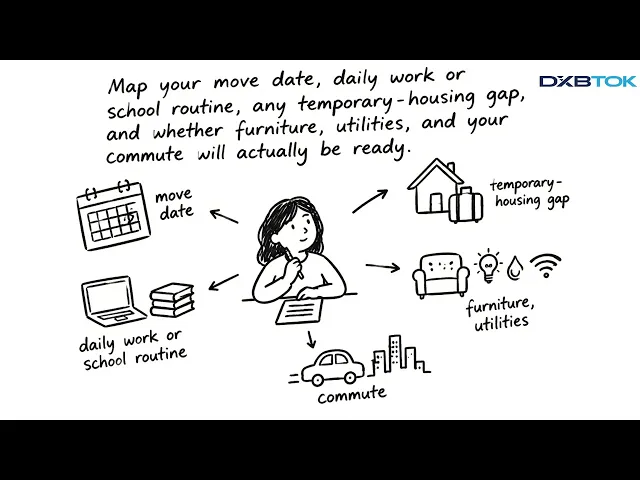
The property has to work with a real move: when the buyer expects to arrive, where daily life will be centred, whether the property is actually ready to occupy, what type of home is practical and how much uncertainty the household can accept during the transition.
For an international buyer, the useful question is which exact Dubai property best supports the relocation date, first-year routine, household needs and longer-term ownership plan without making the move depend on assumptions that may not happen on time.
Choose the property around the move. Do not force the move around a property that is in the wrong area, wrong stage or wrong format for daily life.
1. Start With the Expected Relocation Date
The first property question is timing.
A buyer moving in three months has a different decision from someone planning to relocate in two years. The closer the move date, the more important actual occupancy readiness becomes.
If the buyer needs a home immediately after arrival, a property that depends on uncertain construction, handover or setup timing can create avoidable pressure.
2. Keep Property Ownership and Residence Status Separate
Property ownership and relocation status should not be treated as the same decision.
Dubai Land Department provides separate property-linked investor residence services with their own eligibility criteria and application requirements. A buyer should therefore avoid assuming that buying a property automatically resolves the wider residence-planning question.
The property should still make sense as a home even if the buyer’s employment, residence or family timing changes.
3. Choose the Area Around Daily Life, Not Reputation
A relocation property should reduce daily friction.
Work location, school routes, regular social destinations, airport use, healthcare, groceries and preferred lifestyle can all matter more than choosing a famous district.
The Dubai Property Area Selection guide provides the wider framework for comparing locations by buyer purpose, access, maturity and property fit.
4. Test the Commute Before You Fall in Love With the Property
A strong apartment or villa can become a weak relocation choice if the household spends too much time reaching the places that matter every day.
Test the actual route from the shortlisted property to work, school, family destinations and other regular locations at realistic travel times.
A map distance that looks small can still produce an inconvenient routine if internal roads, traffic patterns or access routes work against the buyer.
5. Property Type Should Fit the First Year of Life in Dubai
An apartment, townhouse and villa can create very different relocation experiences.
Apartments may reduce private maintenance and can make early ownership more manageable. Townhouses can add family space without the full maintenance burden of a larger villa. Villas can provide privacy and outdoor space but usually create more property-level responsibility.
The Dubai Apartment vs Villa vs Townhouse guide provides the broader property-type comparison.
6. Family Relocation Needs More Than Extra Bedrooms
A larger property is not automatically a stronger family relocation choice.
School route, outdoor space, road safety, children's activities, groceries, medical access, parking, storage and how the family uses the property every day can matter more than bedroom count alone.
The Family Property in Dubai guide provides the broader family-property framework.
7. Ready and Off-Plan Property Create Different Relocation Risk
A ready property gives the buyer more certainty around move-in timing, physical condition, surrounding environment and current operating costs.
An off-plan property may suit a buyer with a longer relocation horizon, but it creates more dependence on construction progress, handover timing, specification and future surroundings.
The Dubai Off-Plan vs Ready Property guide explains the wider differences between completed and off-plan property.

8. Do Not Let the Handover Date Become the Entire Relocation Plan
A projected handover date is not the same as a guaranteed move-in date.
Final property readiness, condition, keys, furnishing, utilities and the buyer’s own travel or residence timing can still affect when the home becomes practically usable.
A relocation plan is stronger when the household has enough flexibility to absorb timing changes without turning the property purchase into an emergency.
9. Furnishing and Setup Can Matter More Than Buyers Expect
A completed property may still need furniture, appliances, window treatments, internet, minor repairs or other setup before it works as a normal home.
For buyers relocating with children, pets or significant household belongings, that transition can be more demanding than the purchase itself.
The property should therefore be judged not only by whether it is legally complete, but by how easily it can become usable for the household.
10. Budget for the Transition, Not Only the Purchase
A relocation can create overlapping costs.
The buyer may still have accommodation, travel, storage, school, furnishing, transport or setup expenses while also funding the property transaction.
The Dubai Property Budget Checklist for Remote Buyers helps separate headline affordability from actual funding readiness and payment timing.
11. Avoid Using the Maximum Property Budget Too Early
A household moving countries often needs more liquidity than expected.
Unexpected travel, temporary accommodation, furnishing, deposits, vehicle costs, school expenses and other transition costs can reduce the amount of cash comfortably available for the property.
A relocation property should leave enough flexibility that normal move-related expenses do not create pressure immediately after purchase.
12. Decide Whether a Pre-Purchase Visit Materially Improves the Decision
Some buyers already know Dubai well and can evaluate a property remotely with strong local support. Others are making a location decision and a relocation decision at the same time.
For the second group, visiting can materially improve confidence around commute, neighbourhood feel, school routes, building quality and the exact property.
The decision should depend on what information is still missing rather than on a rule that every buyer must visit or that every purchase can be completed remotely.
13. Plan for the Period Before the Household Is Fully Settled
The buyer may own the property before moving permanently, or may relocate before the final home is ready.
That can create a temporary period in which the property needs to be inspected, furnished, maintained or managed while the owner is still abroad or moving between countries.
A strong relocation property should remain manageable during that transition rather than requiring constant local attention.
14. Test the Property Against a Change in Relocation Plans
Jobs change, school decisions change, family timing changes and moves can be delayed.
A property bought specifically for relocation should therefore remain understandable if the household arrives later than expected, spends more time abroad or changes its preferred part of Dubai.
This does not mean choosing a generic property. It means avoiding a purchase that only works under one narrow scenario.
15. Separate First-Year Fit From Long-Term Ownership Fit
The best property for the first six months is not always the best property to own for several years.
Short-term convenience may favour a central apartment close to work, while long-term plans may favour more space, different schools or a quieter community.
Buyers should decide whether they are purchasing a transition home or a property they genuinely expect to keep after the relocation phase is over.
16. Think About Remote Ownership Even If You Plan to Live in Dubai
Relocation plans can change after purchase.
If the buyer later spends extended periods abroad, the property may need to function with less hands-on involvement.
Building management, private maintenance responsibility, access, document control and local support can therefore matter even for a property originally purchased as a primary home.
17. Know What Would Make You Reject the Property
A disciplined relocation shortlist needs rejection criteria.
Examples may include a commute that does not work, dependence on an uncertain handover date, the wrong property type for the household, weak school or family fit, too much setup work, insufficient liquidity after purchase or a location that only makes sense under one employment or lifestyle assumption.
The right relocation property should reduce uncertainty around the move rather than add another fragile dependency.
Final Takeaway
Dubai property for relocation should be selected around the buyer’s real move, not around a generic idea of the best area or best investment.
Start with the expected relocation date, daily routine, property type, family needs and actual occupancy timing. Then test the budget, setup burden, temporary ownership period and long-term usefulness of the exact property before committing.
DXBTOK helps international buyers compare selected Dubai property opportunities with clearer information around locations, property types, move-in practicality, buyer costs and remote purchase considerations before moving forward.
Related DXBTOK Guides
Dubai Property for Remote Ownership →
Buying Dubai Property Remotely vs Visiting Dubai First →
Dubai Property for Long-Term Ownership: What Buyers Should Check Before Buying →
Full Cost of Buying Dubai Property: What International Buyers Should Budget →