

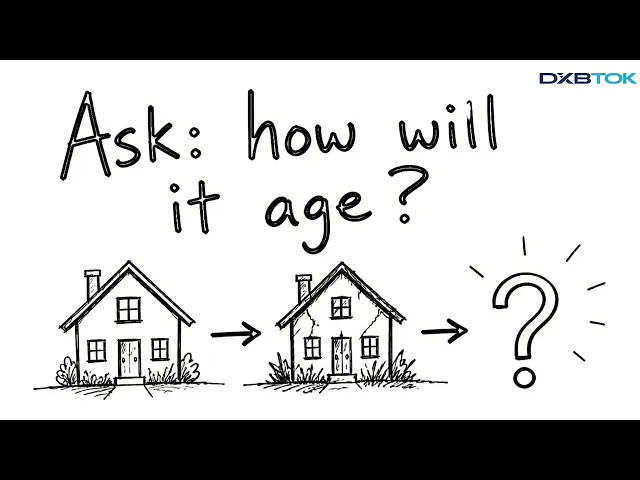
Long-term ownership requires a different buying lens from a short-term market decision. International buyers should consider whether the exact property remains practical as ownership costs, personal use, building condition and market conditions change over time. The strongest long-term purchase is not simply the property with the best story today, but one with durable location fundamentals, manageable recurring costs, practical ownership requirements and enough flexibility for future use or resale.
Dubai Property for Long-Term Ownership: What Buyers Should Check Before Buying
A property can look attractive at the point of purchase and still become difficult to own over a long period.
For buyers expecting to hold a Dubai property for many years, the decision should not be based only on today's price, current rental demand or a short-term market story. The property also needs to remain practical as costs, personal plans, building condition and market conditions change.
The useful question is not simply whether the property looks good today. It is whether the ownership decision remains sensible if you still own the same property several years from now.
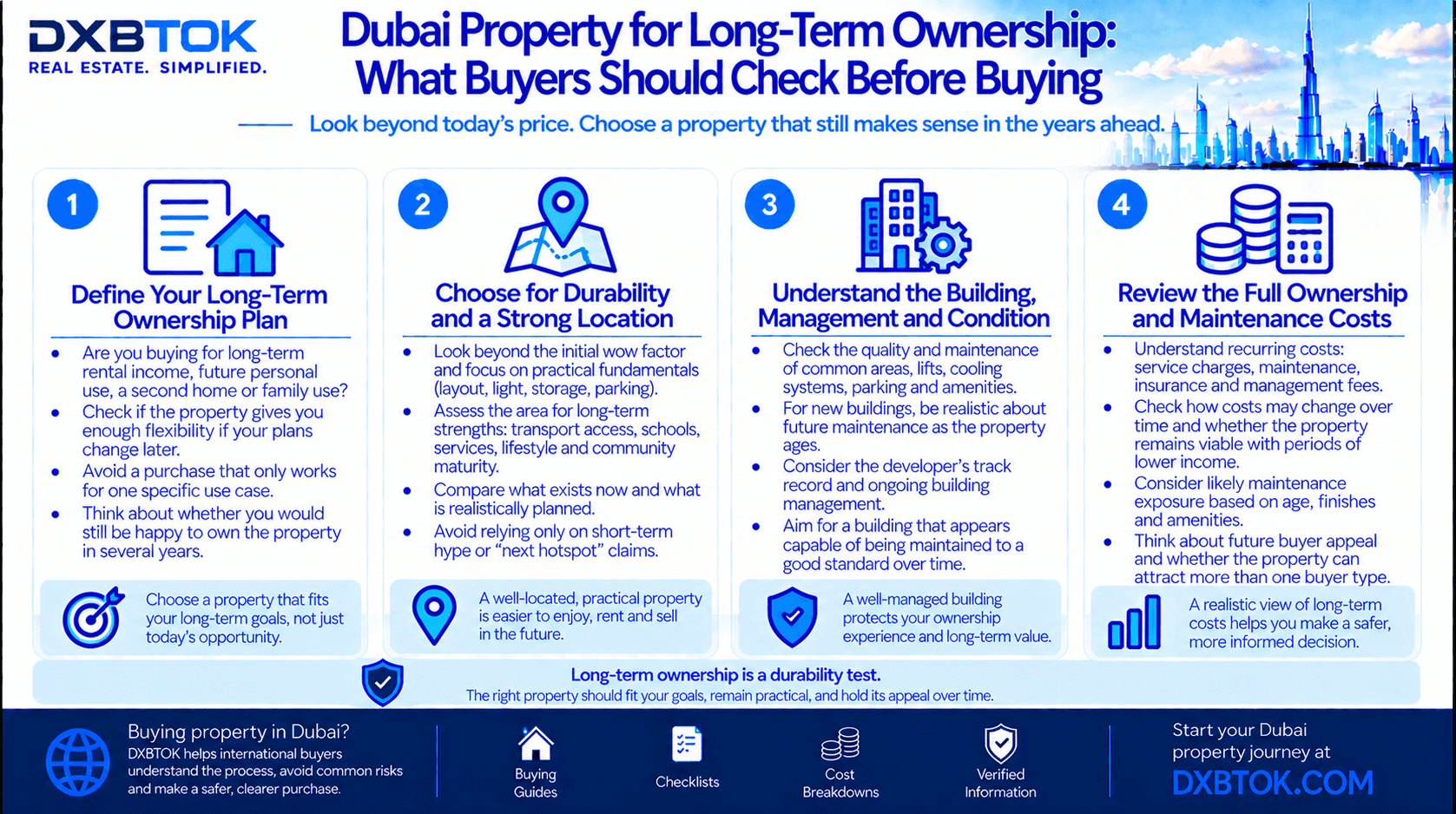
Long-term ownership is mainly a durability test: property fit, recurring cost, building quality, management practicality, use flexibility and future buyer appeal all need to hold together over time.
1. Start With the Reason You Expect to Hold the Property
Long-term ownership can mean different things to different buyers.
You may be buying primarily for:
long-term rental income;
future personal use;
a second home;
relocation later;
family use;
a combination of rental and personal use.
The property should be judged against the ownership plan you actually expect to follow. A unit that works well for one use may be less practical if your plans change later.
Before buying, ask whether the property gives you enough flexibility to adapt without forcing an early sale simply because your original use case changed.
2. Choose for Durability, Not Only for Today’s Appeal
A feature that creates excitement during a viewing does not automatically make the property stronger to own for many years.
Long-term buyers should look beyond presentation and consider fundamentals such as:
layout practicality;
natural light and ventilation;
storage;
parking where relevant;
access to everyday services;
building quality;
community usability;
whether the property can serve more than one reasonable buyer or tenant profile.
The aim is not to find a property that suits everybody. It is to avoid paying heavily for a feature that matters today but leaves the property unnecessarily narrow later.
3. Judge the Area With a Multi-Year Ownership Lens
Area selection matters because the surrounding location changes the ownership experience every day and can influence who may want the property later.
Review the area for practical strengths that can remain useful over time: transport access, everyday services, schools where relevant, employment access, lifestyle infrastructure, community maturity and the amount of competing supply.
Do not rely on a general statement that an area is “the next hotspot.” A stronger approach is to compare what exists now, what is reasonably planned, and whether the location still makes sense if market conditions are less exciting than expected.
For a deeper location comparison, use the Dubai property area selection framework.
4. Understand the Building You May Still Own Years From Now
Long-term ownership means the condition and management of the building can become more important with time.
A buyer should look beyond the apartment itself and consider how the common areas, lifts, cooling systems, access controls, parking, amenities and shared facilities are maintained.
For an established building, current condition can provide useful evidence. For a newer property, the buyer has less operating history and should be careful not to assume that new automatically means low-maintenance forever.
The relevant question is whether the building appears capable of being maintained to an acceptable standard as it ages, not whether it looks perfect on the day you buy.
5. Recurring Ownership Costs Matter More Over a Long Holding Period
A small annual cost difference becomes more important when repeated over many years.
Long-term owners should therefore understand the recurring cost base before committing to the property. That can include service charges, maintenance, insurance where applicable, management costs and periods when the property is not producing income.
Do not judge the property only by its purchase price. Review the ongoing ownership burden as well.
The specialist breakdown belongs in the dedicated Dubai property service charges and Dubai property maintenance costs pages.
6. Think About Maintenance Exposure Before It Becomes Your Problem
Every property requires maintenance eventually. The more useful question is what type of maintenance exposure you are accepting and how manageable it is likely to be.
Consider the age of the property, quality of finishes, complexity of amenities, condition of the common areas and whether the exact unit has features that may create additional upkeep.
A highly complex property can still be a good purchase, but the buyer should understand that additional features can create additional ownership responsibilities.
7. International Buyers Should Test Remote-Ownership Practicality
A long holding period can become frustrating if every maintenance issue, access request or tenant question is difficult to manage from abroad.
If you expect to spend significant time outside Dubai, check whether the property can be supervised without constant personal presence.
That means understanding who can access the property, how maintenance is handled, how building communication works and whether you need local management support.
The deeper ownership-operability questions are covered in Dubai property for remote ownership.
8. Avoid Building the Decision Around One Rental or Appreciation Assumption
A long-term purchase should not depend on one optimistic forecast.
Rental demand, selling prices, financing conditions and buyer preferences can change. A property that only makes sense if rents rise quickly or resale prices increase on schedule leaves the owner with very little room for error.
A stronger ownership decision is one you can remain comfortable with under less exciting conditions.
Stress-test the decision conceptually:
Would you still want to own the property if prices were flat for a period?
Would the recurring costs still feel acceptable?
Could you continue owning it if rental income temporarily weakened?
Would the property still serve a useful personal or rental purpose?
This is not about predicting the market. It is about reducing dependence on one forecast.
9. Keep Future Use Flexibility
Your reason for owning the property may change during a long holding period.
A rental property may later become a second home. A second home may later be rented. A property bought before relocation may need to remain rentable for several years before you move.
That is why long-term buyers should think about reasonable future uses before purchase rather than assuming the original plan will never change.
The exact property, building rules, ownership structure and management practicality should support the uses that genuinely matter to you.
10. Separate Long-Term Ownership From the Off-Plan vs Ready Decision
Both off-plan and ready property can be held long term. The holding period alone does not determine which route is better.
The real difference is the evidence available at the time of purchase.
With ready property, buyers can usually inspect more of the exact unit, building and surrounding area. With off-plan property, more of the decision depends on future delivery, the developer, the payment structure and what the area may look like when the property is completed.
Choose the purchase route based on your timing, evidence requirements, cash-flow position and risk tolerance rather than assuming that one route is automatically better for long-term ownership.
11. Think About the Future Buyer Without Turning the Purchase Into a Short-Term Trade
Planning to hold a property for many years does not remove the need to think about resale.
You do not need to buy for a quick exit. But it is sensible to ask whether another reasonable buyer could understand the property's value later.
Future buyer appeal can be affected by the location, layout, property type, building condition, ownership costs, parking, view, surrounding supply and how easy the property is to use.
Keep the detailed exit analysis on the dedicated Dubai property resale considerations page. For long-term ownership, the principle is simpler: avoid creating an unnecessary exit problem at the moment you buy.
12. Compare the Full Ownership Commitment, Not Only the Entry Price
A lower purchase price does not automatically mean a lower long-term ownership burden.
Compare the property using the full commitment:
purchase price;
transaction costs;
recurring ownership costs;
maintenance exposure;
management needs;
furnishing or setup requirements;
the amount of cash you may need to keep available after purchase.
The objective is not to predict every future expense. It is to avoid entering a long ownership period with a budget that only works under ideal conditions.
13. Use a Long-Term Ownership Test Before Buying
Before committing, the buyer should be able to answer a few basic questions clearly:
Does the property fit the way I expect to use it?
Would it still work if my use changes later?
Is the area practical beyond today's marketing story?
Am I comfortable with the building and its likely ownership demands?
Do the recurring costs fit my long-term budget?
Can I manage the property effectively if I am abroad?
Am I relying too heavily on one rental or appreciation assumption?
Would another reasonable buyer understand the property's appeal later?
Can I continue owning the property if market conditions become less favourable for a period?
If the property only works when every assumption is optimistic, the ownership case is weak.
Final Takeaway
Buying Dubai property for long-term ownership is not about finding the property with the strongest short-term story.
The better test is whether the property remains practical to own as time passes: the location still works, the building remains manageable, recurring costs stay understandable, the property can adapt to reasonable changes in use, and the buyer is not depending on one market forecast to justify the purchase.
Buy for the ownership period you actually expect. Review the property, building, area, cost base, management needs and future flexibility before committing.
DXBTOK helps international buyers review Dubai property with a structured focus on the exact unit, ownership costs, practical use and long-term fit before moving forward.
Related DXBTOK Guides
Dubai Off-Plan vs Ready Property →
Completed Dubai Property: What to Check Before Buying →
New-Build Dubai Property: What to Check →
Full Cost of Buying Dubai Property: What International Buyers Should Budget →
Freehold Property in Dubai: What International Buyers Should Know →


