

Investing in Dubai property begins with a purchase decision, not a promise about future returns. Two properties at similar asking prices may require different amounts of capital, become usable at different times, carry very different ongoing costs and attract different future buyers. For international investors, the most useful comparison is not which listing looks most impressive. It is which property fits the buyer’s objective, available funds, holding period, risk tolerance and realistic route to income or eventual resale. A compelling brochure or projected return is not evidence that the underlying investment will work. This guide brings those decisions together before you shortlist a property. It focuses on the investment case as a whole. More specialised questions—such as choosing an individual neighbourhood, calculating rental yield or structuring a mortgage—deserve their own detailed comparisons.
Dubai Property Investment: What Buyers Should Compare Before Buying
Investing in Dubai property begins with a purchase decision, not a promise about future returns. Two properties at similar asking prices may require different amounts of capital, become usable at different times, carry very different ongoing costs and attract different future buyers.
For international investors, the most useful comparison is not which listing looks most impressive. It is which property fits the buyer’s objective, available funds, holding period, risk tolerance and realistic route to income or eventual resale. A compelling brochure or projected return is not evidence that the underlying investment will work.
Before shortlisting a property, compare the investment case as a whole: buyer objective, capital required, holding period, income potential, ownership costs, financing and eventual resale.
1. Decide What the Investment Must Achieve
“Dubai property investment” can mean several different things. One investor wants regular rental income. Another is willing to wait for possible long-term value growth. A third wants a second home that may produce some income when unused. Those objectives do not always lead to the same purchase.
Before comparing properties, decide which outcome matters most:
Income: the property needs to support recurring cash flow after realistic operating expenses.
Long-term capital growth: the buyer accepts an extended holding period and uncertain resale conditions.
Capital preservation: financial resilience, ownership clarity and future liquidity matter more than ambitious projections.
Mixed personal and investment use: flexibility of occupation may be valuable even if it reduces rental income.
These are competing priorities, not labels for a marketing brochure. A property that suits one investor may be unsuitable for another.
2. Match the Property to Your Actual Holding Period
A planned two- or three-year ownership period creates different constraints from a longer commitment. Buyers with shorter horizons may be more exposed to transaction costs, temporary market weakness and a narrow resale window. Longer-term owners have more time, but must sustain expenses and maintenance through changing conditions.
Ask whether you could continue owning the property if a sale took longer than expected or if rental income temporarily disappointed. If the investment only works when the property can be resold quickly at a higher price, the strategy depends heavily on conditions you cannot control.
3. Compare Total Capital Required, Not the Advertised Price
The asking price is only the beginning of the investment commitment. Buyers may also face registration and transaction charges, financing expenses, initial fit-out or furnishing, recurring service charges, insurance and maintenance, as applicable to the exact property.
Two properties at the same asking price can have meaningfully different all-in capital requirements. A more affordable unit might also need larger immediate spending before it is suitable for occupation or rental use.
Keep a separate reserve for unexpected costs rather than allocating every available amount to the purchase. Our guide to comparing total costs between Dubai properties addresses the detailed purchase-cost calculation.
4. Understand When the Property Can Deliver Value
A completed property and a property purchased before completion do not offer the same evidence or timing. A ready unit can generally be assessed in its physical condition and may become usable sooner, subject to tenancy, transfer and preparation. An off-plan purchase depends more on plans, contractual terms, future construction and actual handover.
Off-plan instalments may spread payments across time, but a smaller amount due today is not necessarily a lower total investment. A buyer expecting near-term rental income should pay particular attention to the period before the property can be used.
For the full purchase-route comparison, see Dubai off-plan versus ready property. Here, the essential question is whether the timing fits your investment objective and cash commitments.
5. Judge Rental Income as a Range, Not a Promise
A projected rent can be a useful starting assumption, but it is not a guarantee of actual receipts. Lease terms, tenant demand, vacancy periods, incentives, furnishing, property condition and management choices can all change the result.
When assessing an income-led opportunity, separate three things: the rent being advertised, evidence from genuinely comparable properties and the amount likely to remain after the costs of operating and holding the unit.
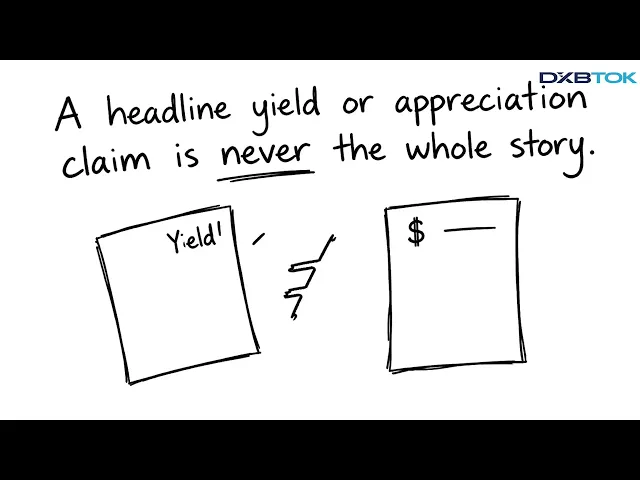
A high headline yield can look less attractive once recurring expenses, an empty period or a substantial repair are included. Buyers should compare gross and net yield separately and decide whether realistic income is sufficient for the risk and capital involved.
6. Consider Who Would Actually Want to Rent It
Investment value depends partly on a property being useful to its intended occupants. A practical residence for long-term tenants is not necessarily the same product as a holiday-use apartment or a home bought for personal enjoyment.
Consider whether the likely tenant needs predictable transport, sufficient storage, suitable building management, parking or a particular community environment. The most visually impressive property may not be the most practical rental product for its likely market.
Do not turn an attractive lifestyle narrative into a demand forecast. Claims about occupancy, rent or tenant preference should be supported by evidence relevant to the exact building and comparable homes.
7. Evaluate Financing as Part of the Investment Risk
Borrowing can reduce the amount of your own money deployed at purchase, but creates ongoing repayment obligations and exposure to financing terms. Paying cash removes lender approval and repayment risk, but concentrates more capital in the asset and can reduce liquidity elsewhere.
For international buyers, financing availability may depend on residency, income, lender criteria and the property being purchased. No mortgage should be treated as assured until the lender has reviewed the circumstances and issued the relevant approval.
Our cash buyer versus mortgage buyer comparison covers the funding choice in depth. From an investment standpoint, the property must remain manageable after the financing method is taken into account.
8. Treat Location as a Source of Both Demand and Risk
Location matters, but a famous district name is not an investment thesis. A location can be attractive for residents while offering a very different price-to-rent relationship or future supply environment from a nearby development.
What matters is how access, community maturity, the surrounding development pipeline and everyday usability affect likely occupancy, future competition and resale appeal. Even within one district, two buildings can face very different conditions.
Use the Dubai property area-selection guide for the full location analysis. Location should be judged by how it strengthens—or weakens—the property’s wider financial case, rather than by treating particular districts as universal winners.

9. Assess the Costs That Continue After Purchase
Once the initial transaction is finished, ownership continues to require money and attention. Depending on the property and intended use, costs may include service charges, repairs, cooling and utilities during vacancy, insurance, management, furnishing replacement and other owner obligations.
Those amounts are not identical across buildings. A development with extensive shared facilities can offer a premium experience while also involving substantial operating commitments. A seemingly simple investment can become less attractive if maintenance or management needs are difficult to coordinate from abroad.
The right question is not only “Can I buy it?” but also “Can I comfortably keep it?”
10. Separate Market Price From Investment Value
Paying the current asking price does not establish that a property offers value. Sellers and developers can price different units according to layout, view, floor, payment terms, delivery status and demand for the specific product.
An investor should ask what justifies a premium over genuinely comparable homes. A better view, stronger usable layout or more established building might justify extra cost for some buyers. A marketing incentive, attractive payment headline or vague forecast of appreciation is a weaker basis for paying more.
The investment case should still be understandable if the market does not rise immediately after purchase.
11. Build a Downside Case Before Imagining the Upside
Any investment projection is more useful when it can withstand a less favourable outcome. Consider what happens if the unit remains vacant longer than expected, achievable rent is lower than the sales presentation suggests, a major repair is necessary or resale takes longer than planned.
A resilient purchase is not one without risk. It is one where the buyer understands how much financial pressure those risks could create and has sufficient resources to manage them.
If one modest adverse change makes ownership unaffordable, the proposition may be too dependent on an optimistic scenario.
12. Think About the Future Buyer Before You Become the Owner
Exit flexibility is often overlooked because the purchase feels more immediate than a future sale. Yet a property’s eventual audience matters. A highly specialised layout, unusually high recurring costs or restricted practical use may narrow the group of potential purchasers.
A sale may also depend on the wider market, outstanding financing, contractual rights and property-specific documentation. For an off-plan purchase, the conditions affecting resale before completion may differ from the process for a completed unit.
Investment quality therefore includes not just a plausible reason to buy, but a realistic understanding of who may want to buy from you later.
13. Account for the Reality of Investing From Overseas
International investors face additional questions around currency conversion, availability of local support, property oversight, cross-border payments and their own tax residence. These can influence the effective cost and convenience of holding Dubai property even when the purchase itself appears straightforward.
Ownership rights and permissible property interests must be confirmed for the relevant location and buyer structure. Tax treatment depends on the investor’s circumstances and jurisdiction; it should not be assumed from a simple statement about Dubai property taxes.
A property that requires frequent on-site decisions or extensive ongoing coordination may be less suitable for an investor living thousands of kilometres away.
14. Distinguish Evidence From Sales Assumptions
Strong marketing can make very different investments appear equally attractive. Before drawing conclusions, distinguish:
Observed facts: the current property specification, completed works, documented charges and reliably comparable transactions.
Commercial assumptions: expected rent, future operating costs, likely completion timing and resale demand.
Promotional claims: statements such as “guaranteed upside,” “risk-free income” or a supposed opportunity that must be accepted immediately.
The greater the role of assumptions in the return story, the more cautious the comparison should be. Our guide to guaranteed-return claims in Dubai property explains why income promises require careful scrutiny.
15. Compare Two Properties on the Same Investment Terms
Imagine two properties with similar purchase prices. One is completed, has an operating history and could become rentable sooner, but carries higher visible ownership charges. The other offers staged payments and a future delivery date, but lacks completed-building evidence and cannot yet generate rent.
Neither is automatically the better investment. Compare them using the same questions:
Which better serves your primary objective—income, growth, flexibility or personal use?
How much cash must be committed, and at what stages?
What return assumptions are supported by current evidence?
Which recurring costs and downside exposures remain after purchase?
How practical is management from your country of residence?
Who is the likely future purchaser, and how flexible might the exit be?
Only then does a lower price, stronger specification or more attractive payment plan have useful meaning.
16. Know When an Attractive Property Is Not a Suitable Investment
A buyer should be prepared to reject a property even if it is well presented. Warning signs include a purchase that exhausts available reserves, rent projections unsupported by appropriate comparables, unclear ongoing obligations, financing assumptions that have not been validated or a return case that depends on a rapid resale at a higher price.
Another warning sign is pressure to decide before the material property, contract or payment questions have been resolved. An attractive opportunity should remain capable of reasoned comparison.
17. Make the Final Decision About Fit, Not Hype
Dubai property investment can serve different financial and personal purposes. The strongest candidate is not automatically the newest property, the most prominent address, the lowest entry price or the highest advertised yield. It is the property whose purchase cost, ownership commitments, plausible income or resale case and risks align with your actual circumstances.
DXBTOK helps international buyers compare selected Dubai property opportunities with clearer commercial information and structured support before moving forward with the appropriate licensed professionals. The goal is a better-informed purchase decision—not a promise about market performance.
Related DXBTOK Guides
Dubai Property for Remote Ownership: What Buyers Should Check →
Dubai Property Currency Risk for International Buyers →
Freehold Property in Dubai: What International Buyers Should Know →
Dubai Property Buyer Due Diligence Checklist →
Dubai Secondary Market vs Off-Plan Market: What Buyers Should Compare →


