Can You Buy Dubai Property With Zero Down Payment? What Buyers Should Verify


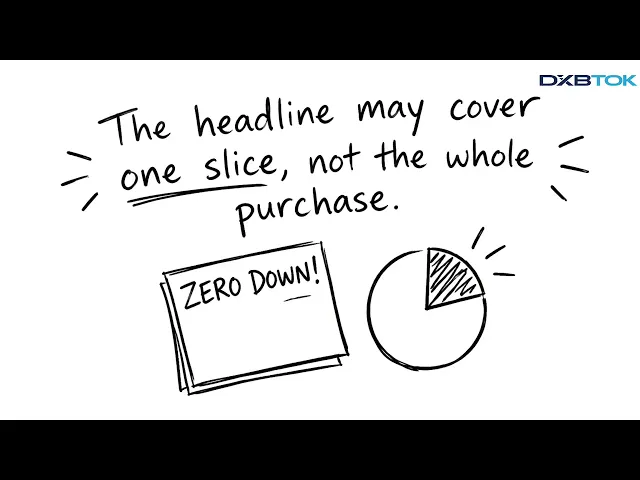
A Dubai property advertised with zero down payment can sound like an opportunity to become an owner without committing substantial capital. But the phrase does not always mean the same thing. One offer may delay the first property instalment, another may reduce the booking amount, and a third may advertise a fee incentive while leaving the purchase deposit unchanged. For buyers using a UAE mortgage, regulated lending limits generally require a contribution from the buyer's own resources. Developer payment arrangements are different: they can change when purchase instalments are due, but they do not automatically remove the purchase price, registration charges or future payment obligations. Before comparing any zero-down-payment property in Dubai, buyers need to understand what is actually due at reservation, during construction, at handover and after completion. Buyers should focus on the commercial terms behind these offers and the risks they create, rather than treating them as a way around lending rules.
Can You Buy Dubai Property With Zero Down Payment? What Buyers Should Verify
A Dubai property advertised with zero down payment can sound like an opportunity to become an owner without committing substantial capital. But the phrase does not always mean the same thing. One offer may delay the first property instalment, another may reduce the booking amount, and a third may advertise a fee incentive while leaving the purchase deposit unchanged.
For buyers using a UAE mortgage, regulated lending limits generally require a contribution from the buyer's own resources. Developer payment arrangements are different: they can change when purchase instalments are due, but they do not automatically remove the purchase price, registration charges or future payment obligations.
Before comparing any zero-down-payment property in Dubai, buyers need to understand what is actually due at reservation, during construction, at handover and after completion. This guide focuses on those commercial claims and the risks behind them—not on promising a way around lending rules.
1. Can You Really Buy Property in Dubai With Zero Down Payment?
For a conventional UAE bank mortgage, genuinely buying with no buyer equity is generally not an available route. Mortgage loan-to-value limits mean an eligible borrower must contribute part of the property value from their own resources.
Developer offers can work differently. A particular off-plan promotion might advertise no initial property instalment or a reduced booking payment. That does not necessarily mean the buyer can acquire ownership without committing money, paying transaction fees or accepting future obligations.
The essential distinction is between paying nothing initially and buying without an economic contribution. Those are not the same.
Before considering any advertised zero-down-payment deal, buyers should establish which meaning applies and whether the offer is available for the exact property, buyer and transaction date.
2. What Does a Zero-Down-Payment Property Offer Actually Mean?
The phrase can describe several different commercial arrangements:
Zero booking payment: no initial reservation amount, although an instalment or fee may become payable shortly afterwards.
Deferred first instalment: the first property payment is delayed, rather than removed.
Low initial payment: a small booking percentage is advertised as an affordable entry point.
Developer incentive: part of a registration charge or another cost is absorbed by the developer.
Alternative contractual arrangement: occupancy or payments begin under terms that differ from a standard immediate purchase.
These arrangements have different consequences for ownership, cash flow and contractual risk.
An advertisement using the word “zero” should not be treated as a statement that no money will be needed until the buyer receives the property.
3. Why Traditional Dubai Mortgages Require Buyer Equity
The Central Bank of the UAE sets maximum loan-to-value ratios for residential mortgage financing. These limits determine the highest permitted proportion of an eligible property's value that can be financed under the relevant borrower and property category.
For example, under the applicable first-home, owner-occupier category, an expatriate purchaser of a qualifying property valued at AED 5 million or less may be eligible for financing of up to 80% of the property value. That means at least 20% must come from the buyer's own contribution, before separate transaction costs.
Different limits apply to higher-value homes, subsequent or investment properties, UAE nationals and off-plan purchases. Off-plan mortgage financing is subject to a maximum 50% loan-to-value ratio under the relevant regulation, although actual lending availability and timing may be more restrictive.
These are regulatory ceilings, not mortgage entitlements. A lender can approve less, decline the application or impose additional requirements.
For a qualifying AED 1 million purchase financed at 80%, the basic illustration is AED 800,000 of borrowing and AED 200,000 of buyer equity, excluding fees. The actual approved amount depends on lender assessment, valuation and eligibility.
The key point is straightforward: standard mortgage financing should not be presented as a guaranteed zero-deposit purchase.
4. A Bank Deposit Is Not the Same as a Developer Booking Payment
Property marketing can use the words deposit, booking payment, reservation fee and down payment loosely. Buyers should not assume they all refer to the same contractual obligation.
With a bank mortgage, the buyer's equity contribution represents the part of the purchase value not financed by the lender.
With an off-plan developer purchase, an initial booking payment may reserve the unit or be credited toward the agreed property price. Further contractual instalments may then follow during construction or at handover.
A booking amount of 5%, for example, does not establish that 95% of the price is being provided as bank finance. It may simply mean that the remaining purchase price is payable under the developer's contract.
This distinction matters because buyers can underestimate their funding obligations when they compare a mortgage deposit with a developer's initial booking percentage.
5. How Zero-Down-Payment Developer Offers Can Work
Selected off-plan developments may advertise unusually low initial payments or promotional arrangements under which the first purchase instalment is deferred.
The specific contract determines the real financial commitment. A buyer may still face registration charges, administration costs or scheduled instalments shortly after reservation.
Some structures postpone a large percentage of the price until a later construction milestone or handover. Others divide the balance into monthly or quarterly payments.
Neither arrangement automatically reduces the total amount payable. Moving the due date can make an offer appear more accessible without making the property less expensive.
A buyer comparing such offers should focus on the full contractual purchase price, payment dates and obligations if the buyer cannot complete the schedule.
For a fuller comparison of these different funding structures, see our Dubai mortgage versus developer payment plan guide.
6. Are Post-Handover Payment Plans the Same as Zero Down Payment?
No. A post-handover plan normally means that some contractual purchase payments remain due after the property is delivered or handed over, subject to the exact agreement.
That can spread the buyer's financial commitment over a longer period. However, it does not establish that there is no initial payment or that the buyer has already paid the full purchase price.
A plan extending beyond handover may look attractive to someone expecting rental income. But future rent is uncertain, and the buyer remains responsible for contractual payments even if the property is vacant or earns less than anticipated.
Buyers also need to understand what ownership, possession, default and resale rights exist while instalments remain outstanding.
A post-handover plan can be commercially useful, but it should be judged against the total price and the buyer's ability to meet every future obligation—not only the amount due today.
7. What Costs Can Still Be Payable With a Zero-Deposit Offer?
A zero-deposit promotion does not automatically eliminate Dubai property transaction costs.
Dubai Land Department's standard sale-registration fee is 4% of the relevant sale value, with the allocation between seller and buyer governed by the applicable rules and agreement. In many residential transactions, the commercial arrangements place this cost on the buyer, but the actual allocation must be checked.
Other potential expenses can include:
Registration and transaction-service charges.
Developer or administrative fees, where applicable.
Bank valuation, arrangement and mortgage-registration costs.
Brokerage or professional fees where applicable.
International bank-transfer and currency-conversion costs.
Property preparation, furnishing and handover expenses.
Initial service charges and ongoing ownership commitments.
A promotion might cover one of these costs while leaving the others payable. Buyers should therefore calculate their actual cash commitment rather than accept the general description of an offer.
Our full cost of buying Dubai property guide explains the main transaction and ownership costs buyers should include in the total budget.
8. Does a DLD Fee Waiver Mean the Purchase Is Free of Registration Costs?
A developer may advertise a DLD fee waiver or an offer to cover some or all of the buyer's registration expense.
That should not be interpreted as a universal exemption from Dubai's official registration framework.
The commercial benefit may be that the developer agrees to absorb a defined cost. Its actual value depends on the written offer, the applicable registration obligation and any conditions attached to the promotion.
Buyers should consider whether the same unit is available at a different price without the incentive. A fee-saving offer is less attractive if its value is offset by a materially higher purchase price.
A genuine comparison needs both the property price and the treatment of the advertised incentive.
9. A Zero-Down-Payment Offer Can Still Be More Expensive Overall
A convenient payment schedule is not necessarily the lowest-cost way to buy.
Imagine two otherwise comparable apartments. One requires a meaningful initial payment but is offered at a lower total purchase price. Another requires little or nothing at reservation but has a higher agreed price or larger future instalments.
The second property may be easier to enter financially, yet cost more over the full contractual period.
Other differences may include:
Whether the purchase price changes under the promotional plan.
Whether important incentives are already reflected in the price.
How much is payable at handover.
Whether resale or assignment is restricted before certain payments.
What financial consequences follow a missed instalment.
The best offer is not automatically the one demanding the least money today. Buyers should understand the complete financial and contractual commitment before deciding.

10. Can Non-Residents Buy Dubai Property With No Deposit?
International buyers may be eligible to purchase qualifying Dubai property without holding UAE residency, but ownership eligibility does not create an entitlement to zero-deposit financing.
Some UAE banks consider mortgage applications from qualifying non-residents. Their policies may be more restrictive than the general regulatory maximums, depending on the applicant's income, country of residence, documentation and the property being financed.
A non-resident might also consider an eligible developer payment plan. In that case, the payment schedule must be evaluated independently of any assumed future mortgage availability.
For overseas buyers, the practical funding questions also include currency conversion, cross-border transfers, source-of-funds documentation and the ability to meet payments from abroad.
See our non-resident Dubai mortgage guide or the main eligibility, funding and lender considerations affecting overseas buyers.
11. What About Rent-to-Own or Other Alternative Arrangements?
Rent-to-own arrangements, instalment-based ownership structures or agreements involving another funding party may sometimes be marketed as alternatives to a conventional deposit.
These should not automatically be equated with acquiring ordinary registered property ownership without an initial contribution.
Depending on the contractual structure, the buyer may be occupying the property while paying toward a possible future acquisition, rather than receiving the same ownership rights as someone who has completed a standard purchase.
Financial obligations, treatment of prior payments, registration and termination rights may differ significantly.
Any arrangement that combines occupation, future purchase rights or third-party funding requires independent review of its legal and financial terms. A buyer should not rely on the word “ownership” in advertising to establish precisely what rights have been acquired.
12. Should Buyers Borrow Separately to Cover a Mortgage Deposit?
Buyers occasionally encounter suggestions that a personal loan, credit card or separate borrowing arrangement could eliminate the need to use their own savings for the property deposit.
That approach can create significant regulatory, affordability and disclosure problems.
The UAE Central Bank's mortgage regulations state that the borrower's down payment should come from their own resources rather than other borrowing, including personal loans or credit cards.
Additional debt can also reduce a buyer's ability to qualify for mortgage finance and increase the risk of financial distress after purchase.
Buyers should not treat separate borrowing as a simple workaround for a required equity contribution. Any funding proposal should be fully disclosed to the relevant lender and reviewed with an appropriately qualified adviser.
13. Check the Deposit Against the Contract, Not the Sales Pitch
One of the most important distinctions is whether a promotion appears only in marketing or is reflected in the actual transaction documentation.
A brochure might advertise “zero down payment,” while a reservation form specifies an immediate administration charge or another payment obligation.
The relevant sale and purchase agreement, payment schedule and associated documents should clarify what the buyer is agreeing to pay, when it becomes due and what happens if the buyer does not proceed.
Buyers should also distinguish refundable sums from non-refundable commitments. A payment described informally as a reservation amount should not be assumed refundable merely because it is made before the final purchase documents are signed.
Written contractual terms carry more weight than general promotional language. Material inconsistencies deserve clarification before the buyer accepts the offer.
14. Confirm Where the Money Goes
Even when an offer requires a small initial payment, the buyer needs confidence that the requested transfer belongs to the actual transaction.
For off-plan property, Dubai's real-estate project escrow framework is relevant to payments collected from purchasers. The appropriate project account and documented payment instructions should be consistent with the property and payment stage.
Not every fee necessarily has the same recipient. Buyers should understand why a particular party is receiving each payment and how it is documented.
Pressure to transfer funds urgently, unexplained changes in bank details or informal assurances about where money will be credited should not substitute for proper verification.
Our Dubai property payment safety checklist
15. Understand What Happens if You Cannot Make a Later Payment
Small initial payments can create a false sense of affordability when much larger obligations are deferred.
A buyer might comfortably meet the amount due today but struggle with construction-linked instalments, a handover payment or continuing monthly commitments.
Before entering the contract, consider the financial impact of:
A major payment becoming due earlier than expected under the agreed schedule.
A change in personal income or available savings.
Exchange-rate movements affecting overseas funding.
A mortgage application being declined or approved for less than expected.
A delayed completion or a property that cannot yet produce rental income.
Contractual default, cancellation and refund consequences can be material and depend on the applicable legal framework and agreement.
An attractive entry arrangement is not suitable if the buyer cannot reasonably sustain the later obligations.
16. Do Not Treat Future Mortgage Approval as Guaranteed
Some buyers consider a developer payment plan with the expectation that a bank mortgage will finance a substantial later payment.
That may be a possible funding objective for a qualifying buyer and property, but it must not be treated as an assured outcome.
Lender policies, the property's eligibility, its construction or completion status, valuation and the buyer's circumstances can all affect mortgage availability when the financing is actually needed.
A buyer who commits to a future payment without confirmed funding assumes the risk that bank finance may not be available on the expected terms.
The funding plan should therefore be assessed realistically, including what happens if less finance is offered or no suitable lender approves the property.
Our cash buyer versus mortgage buyer comparison
17. Compare the Real Cash Requirement Across Different Offers
The most useful comparison is how much money the buyer must commit over the entire transaction, rather than the percentage advertised on the first page of the sales presentation.
Consider a hypothetical AED 1 million property. Three offers could present very different upfront figures:
Mortgage-financed ready property: the buyer may need a substantial equity contribution plus applicable fees, depending on eligibility and lender approval.
Off-plan property with a low booking percentage: the initial property payment could be smaller, but later instalments remain payable under the agreed schedule.
Promotional zero-initial-instalment offer: the first property instalment may be deferred, while registration costs, other fees and future contractual obligations still need to be assessed.
None of those structures is automatically better. They involve different cash timing, ownership and completion risks, financing assumptions and total commitments.
The relevant comparison is the money the buyer must actually provide, the contractual dates on which it is due and what rights or obligations exist at each stage.
18. When Should a Buyer Reject a Zero-Down-Payment Offer?
A buyer should be prepared to walk away from an advertised offer when the essential terms remain unclear or the purchase depends on unrealistic financial assumptions.
Warning signs include:
Advertising that promises ordinary bank mortgage finance with no borrower contribution.
A claimed zero-deposit offer contradicted by the reservation or payment documents.
Important registration fees or purchase obligations being omitted from the initial presentation.
A higher purchase price justified only by the convenience of paying less upfront.
Unverified claims that a future mortgage will cover outstanding payments.
Unclear developer, project, unit or payment-recipient information.
Pressure to commit before material costs and cancellation terms are understood.
A payment schedule that is unaffordable without speculative future income or resale proceeds.
These warning signs do not mean every promotional payment plan is unsuitable. They mean the buyer should judge the evidence and financial commitment independently of the advertising.
19. Can a Low-Deposit Offer Still Be Worth Considering?
Yes. A reduced initial payment or carefully structured instalment plan can be commercially useful for some buyers, provided the terms are genuine, the total price is competitive and the future commitments are affordable.
A buyer may reasonably value the flexibility of spreading payments over construction or retaining more cash in reserve during the early stages of a purchase.
But convenience should not override the property comparison. A well-structured offer on an unsuitable property is still an unsuitable investment or home purchase.
Property quality, the developer's track record, contractual clarity, delivery expectations, ownership expenses and eventual resale flexibility all remain important.
A low initial payment should improve the fit of a sound purchase decision—not become the sole reason for buying.
20. Make the Final Decision Based on What You Will Actually Pay
Buying Dubai property with genuinely zero down payment is not a normal route through conventional mortgage financing. Selected developer promotions may reduce or defer initial payments, but the exact offer must be supported by written terms and a realistic financial assessment.
For buyers, the most important comparison is the difference between what the advertisement suggests and what the contract requires.
A credible offer should make the full price, payment schedule, relevant registration obligations, eligibility conditions and consequences of missed payments understandable before the buyer commits.
DXBTOK helps international buyers compare selected Dubai property opportunities with clearer commercial information, while the appropriate licensed developers, brokers, banks and professional advisers handle the regulated elements of a transaction.
Buyers should choose a property and payment structure that remain financially realistic from reservation through ownership, rather than relying on a supposed way to avoid a necessary deposit.
Related DXBTOK Guides
Dubai Escrow Accounts for Off-Plan Property Explained →
Bank Transfer Safety for Dubai Property Buyers →
Dubai Property Buyer Due Diligence Checklist →
What International Buyers Should Ask a Dubai Developer Sales Team →


