

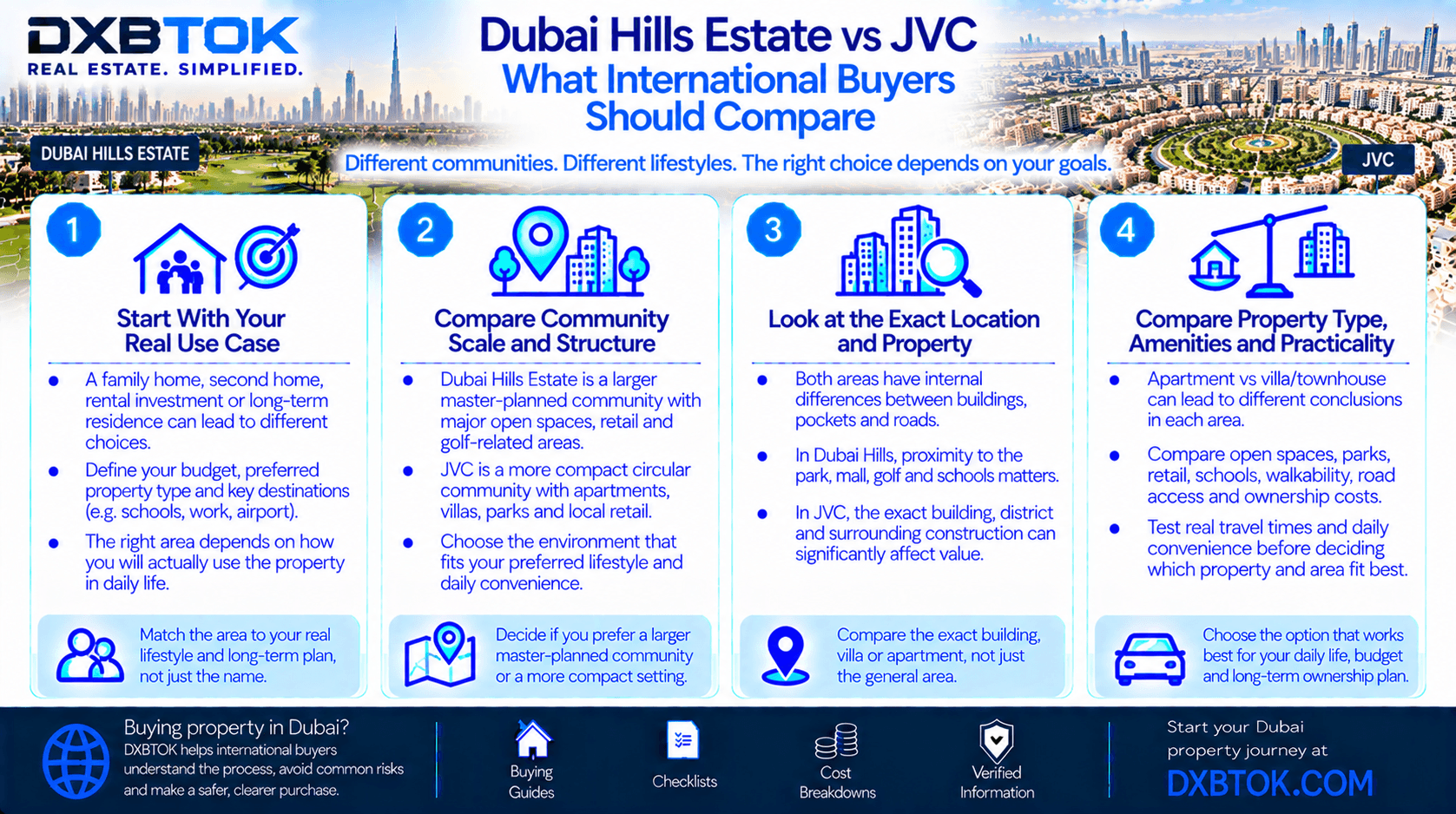
Dubai Hills Estate and Jumeirah Village Circle can both suit international buyers, but they provide different residential environments. Dubai Hills Estate offers a more cohesive master-planned setting with major green spaces, community amenities and a broad apartment-and-villa mix, while JVC offers a more varied residential market across many buildings and property options. Buyers should compare the exact properties available in each area—including neighbourhood or building quality, layout, access, family needs, recurring ownership costs and total budget—rather than declaring one community universally better.
Dubai Hills Estate vs JVC: What International Buyers Should Compare
Dubai Hills Estate and Jumeirah Village Circle can both suit international buyers, but they organise daily life and property choice in different ways.
Dubai Hills Estate is a large master-planned community with apartments, villas, townhouses, major open spaces, retail and golf-led amenities. JVC is a more compact circular community with a broad mix of apartment buildings, villas, townhouses, neighbourhood parks and community retail.
For a buyer, the useful question is not which area is better in general. It is which exact property in Dubai Hills Estate or JVC better fits the buyer's budget, property type, commute, family needs, ownership costs and long-term plan.
Compare the community structure first. Then compare the exact building, villa, townhouse or apartment.
1. Start With the Buyer’s Real Use Case
A buyer relocating with family, buying a second home, purchasing an apartment for occasional use or planning long-term ownership may reach a different conclusion.
Before comparing the two areas, define the property type, realistic total budget, destinations that matter most and how often the property will be used.
The Dubai Property Area Selection guide provides the wider framework. This comparison should stay focused on the specific Dubai Hills Estate-versus-JVC decision.
2. Compare Community Scale and Structure
Dubai Hills Estate is planned on a larger master-community scale, with distinct residential neighbourhoods, major open spaces, Dubai Hills Park, Dubai Hills Mall and golf-related areas.
JVC has a more compact circular structure with residential districts, internal roads, parks, local retail and Circle Mall.
Neither structure is automatically stronger. The important question is whether the buyer prefers a larger master-planned environment or a more compact community where the exact building and internal road position can heavily influence daily convenience.
3. Do Not Let the Area Name Replace the Exact Location
Both areas contain meaningful internal differences.
In Dubai Hills Estate, proximity to the park, mall, golf course, schools, main roads and the exact residential pocket can change the ownership experience.
In JVC, the building's district, internal road position, nearby construction, access route and relationship to parks, schools or Circle Mall can matter just as much.
The Dubai Hills Estate Property Guide covers the Dubai Hills-specific decision in more depth.
4. JVC Requires Building-Level Discipline
JVC has a wide variety of apartment buildings alongside villas and townhouses, and the operating quality of individual buildings can differ materially.
For an apartment buyer, the tower's age, lobby and common areas, lifts, parking, access control, maintenance standard, amenity condition, service-charge position and management quality can all affect value.
The Jumeirah Village Circle Property Guide should be used for the deeper JVC-specific review once a buyer has shortlisted that area.
5. Property Type Can Change the Result
The comparison can look completely different for an apartment buyer than for a villa or townhouse buyer.
An apartment buyer may care more about tower quality, parking, lift performance, service charges, views and walkability to community amenities. A villa or townhouse buyer may care more about plot position, privacy, garden or outdoor space, road access and private maintenance responsibility.
The Dubai Apartment vs Villa vs Townhouse guide provides the broader property-type framework.
6. Compare Open Space and Amenity Pattern, Not Marketing Language
Dubai Hills Estate's master plan gives open space a prominent role through large parks, landscaped areas and golf-related surroundings.
JVC also includes parks, sports facilities, walking routes and local community amenities, but the pattern is more neighbourhood-based.
A buyer should ask which amenity pattern is genuinely useful for daily life rather than simply counting facilities.
A park-facing apartment that is difficult to access or expensive to own can still be a weaker fit than a less visually impressive property with better daily practicality.
7. Walkability and Driving Dependence Need a Real-World Test
Neither area should be judged from a map alone.
Test the actual route from the shortlisted property to work, schools, shops, restaurants, the airport, Downtown, Dubai Marina or other destinations that matter to the buyer.
Internal road position can materially change driving time. Pedestrian comfort can also vary by building, season and destination.
The better area is the one whose exact property works with the buyer's real movement pattern.
8. Family Buyers Should Compare the Daily Routine
Both communities can appeal to family buyers, but family suitability should not be reduced to the presence of parks or schools.
Compare the practical school run, children's activities, road crossings, access to daily shopping, medical needs, outdoor space and the property layout itself.
A family may prefer the larger open-space structure of Dubai Hills Estate, while another may prefer a specific JVC property because its school, budget and commute fit better.
The decision should remain property-specific.
9. Compare the Exact Apartment or House, Not the Bedroom Count
Two one-bedroom apartments or two three-bedroom townhouses can offer very different usable value.
Compare internal layout, actual room dimensions, balcony or outdoor space, storage, floor, orientation, privacy, parking and the quality of the immediate surroundings.
A stronger exact property can outweigh a general preference for one community over the other.
10. Building and Community Costs Can Change the Comparison
The purchase price is only one part of the ownership decision.
For apartments, compare service charges with the quality of the building, amenities and operating standard. For villas and townhouses, consider private maintenance responsibility, outdoor areas and any community-related charges.
Do not assume that the higher-priced area automatically has higher total ownership cost, or that the lower-priced property is automatically cheaper to own.
11. Ready and Off-Plan Properties Need Different Evidence
A ready property gives the buyer more direct evidence about the building, exact unit, access, surrounding environment and current operating costs.
An off-plan property depends more heavily on project documentation, specification, construction progress, payment obligations and what the surrounding environment is expected to become.
If one shortlisted property is ready and the other is off-plan, adjust the evidence standard before comparing them.
This section should support the comparison, not replace the broader ready-versus-off-plan decision.
12. Compare Current Surroundings With Future Surroundings
Open plots, new projects and road changes can alter privacy, views, access and competing supply.
That matters in both communities, although the type and concentration of future development may differ by exact location.
A buyer should distinguish what exists today from what is planned or still being built around the shortlisted property.
Do not pay a permanent premium for a temporary open view without checking the wider development context.
13. Compare Similar Properties at a Similar Total Budget
A fair comparison requires similar buying conditions.
Compare apartment with apartment, villa with villa or townhouse with townhouse where possible. Keep the total budget, usable size, condition, project stage and ownership costs reasonably comparable.
If the same budget buys a larger but weaker building in JVC and a smaller but stronger property in Dubai Hills Estate, the trade-off should be explicit.
The reverse can also be true. The correct decision depends on what the buyer values and what the exact property delivers.
14. Remote Buyers Should Test How Easy the Property Is to Own
An overseas owner may depend more heavily on building management, property management, local representatives and clear digital documentation.
For an apartment, test building access, maintenance coordination, furnishing practicality and recurring-payment visibility. For a villa or townhouse, consider the greater private-maintenance burden that can come with outdoor space and larger systems.
The community name does not solve remote ownership. The exact property and management setup do.
15. Test the Decision for Multi-Year Ownership
A property should still make sense after the first year.
Consider whether the location, commute, property type, building or community condition, recurring costs, maintenance exposure and surrounding development remain acceptable over several years.
The Dubai Property for Long-Term Ownership guide provides the broader durability framework.
Do not use expected appreciation or rental growth to justify a property that is already weak on practical ownership fundamentals.
16. Know What Would Make You Reject Either Property
A disciplined comparison needs rejection criteria.
For Dubai Hills Estate, that might include an unjustified community premium, a weak exact unit, inconvenient internal position, high recurring cost or a property type that does not fit the buyer's use.
For JVC, it might include weak building condition, poor parking, difficult internal access, excessive nearby construction, unsuitable layout, heavy recurring costs or a price that is not competitive with stronger alternatives.
The purpose is not to declare one area the winner. It is to reject the weaker exact property.
Final Takeaway
Dubai Hills Estate and JVC can both work for international buyers, but they should not be compared as simple labels.
Dubai Hills Estate generally offers a larger master-planned community structure with substantial open space and a broad apartment, villa and townhouse mix. JVC offers a more compact community where exact building quality, internal location, road access and property-level value can play an especially important role.
Compare the buyer's use case, community structure, property type, exact location, exact property, daily movement, ownership costs, future surroundings and long-term practicality before deciding which opportunity deserves a place on the shortlist.
DXBTOK helps international buyers compare selected Dubai property opportunities with clearer information around locations, buildings, exact units, buyer costs and remote purchase practicalities before moving forward.
Related DXBTOK Guides
Dubai Property Service Charges Explained for Buyers →
Dubai Property Near Schools: How Buyers Should Judge School Access →
Dubai Off-Plan vs Ready Property: Which Is Better for Buyers? →
Dubai Property for Remote Ownership →
Full Cost of Buying Dubai Property: What International Buyers Should Budget →


