

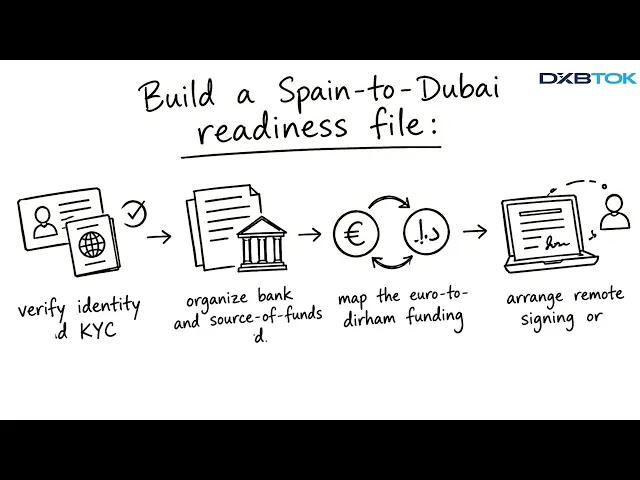
Spanish buyers can purchase Dubai property in areas open to foreign ownership, including while remaining based in Spain. The cross-border decision nevertheless needs to account for Spanish tax residence, potential foreign-asset reporting, euro funding and currency conversion, source-of-funds documentation, the practicalities of buying from abroad and the long-term management of the property. These Spain-specific considerations should be reviewed alongside the exact Dubai property, rather than treating the purchase as only a standard European remote-buying transaction.
Buying Dubai Property from Spain: What Spanish Buyers Should Know
Buying Dubai property from Spain combines two separate sets of questions: whether the Dubai property itself is suitable, and how ownership fits the buyer’s Spanish tax, banking and reporting position.
The Dubai transaction does not become “Spanish” because the buyer lives in Spain, and the buyer does not stop being subject to Spanish rules simply because the property is in the UAE.
For a Spain-based buyer, the practical question is whether the exact Dubai property works commercially and operationally while the funding, tax-residency, foreign-asset and documentation consequences are understood before money is committed.
The strongest Spain-to-Dubai purchase separates three decisions: the property decision, the Dubai transaction, and the buyer’s Spanish tax and financial position.
1. Start With the Wider Europe-to-Dubai Buying Framework
Spanish buyers share several issues with other Europe-based buyers: buying from abroad, transferring funds, understanding Dubai property documents and deciding how much of the process can be handled remotely.
The Buying Dubai Property from Europe guide provides that wider framework.
The Spain-specific layer begins where Spanish tax residence, foreign-asset reporting, euro funding and Spanish banking evidence can materially affect the buyer’s planning.
2. Buying Property in Dubai Does Not by Itself Change Spanish Tax Residence
Owning a Dubai property and being tax resident in the UAE are different questions.
Spain’s tax authority determines individual tax residence using factors that include time spent in Spain, the location of the main base of economic activities or interests and, in some circumstances, family residence.
A UAE residence permit or a Dubai property purchase should therefore not be treated as automatic evidence that Spanish tax residence has ended.
Buyers who are considering a wider relocation or change of tax residence should obtain advice on that question separately from the property transaction.
3. Spanish Tax Residents Should Consider Foreign-Asset Reporting
A Dubai property is an overseas asset for a buyer who remains tax resident in Spain.
The Spanish Tax Agency currently includes foreign real estate within the categories that can fall within Modelo 720 foreign-asset reporting. The reporting obligation depends on the applicable thresholds, ownership position and circumstances.
For foreign real estate, the current general threshold used by the Tax Agency is €50,000 for the relevant reporting category, with separate rules governing later filings and changes.
This is a reporting issue rather than a reason to accept or reject a Dubai property. It does mean that a Spain-based buyer should understand the Spanish reporting position before assuming that the asset sits entirely outside the Spanish tax system.
4. Ownership, Rental Use and a Future Sale Can Have Different Spanish Tax Consequences
A property held for personal use, a rented property and a property that is later sold can create different tax questions for a Spanish resident.
Spanish income-tax rules can take foreign property into account, and the Spain–UAE double-tax treaty also contains rules dealing with income, gains and wealth connected with real estate.
The relevant treatment depends on the buyer’s tax residence, how the property is used, whether it produces income and the buyer’s personal circumstances.
That analysis belongs with a Spanish tax adviser rather than being reduced to a simple “Dubai has no personal income tax” statement.
5. Foreign Buyers Can Own Dubai Property in Freehold Areas
Spanish nationality does not prevent an individual from owning Dubai property in areas where foreign ownership is permitted.
Dubai Land Department distinguishes freehold areas, where purchase is available to all nationalities, from non-freehold areas with different ownership restrictions.
The Dubai Property for Foreigners guide explains the broader ownership position for international buyers.
6. You Do Not Need to Treat UAE Residency as a Precondition to Buy
Dubai property ownership and UAE residency should be evaluated separately.
Dubai Land Department services recognise non-resident foreign buyers using valid passport identification in relevant transactions.
If residency or a future visa is part of the buyer’s wider plan, the eligibility criteria should be reviewed independently. The property should still make sense even if the residency objective changes.
7. EUR-to-AED Exposure Matters Before the First Transfer
Most Spain-based buyers think in euros while Dubai property obligations are normally denominated in UAE dirhams.
That creates a currency-conversion issue even where the underlying property price does not change.
The Currency Exchange When Buying Dubai Property from Europe guide explains how conversion rates, spreads and timing can affect the euro amount required to meet an AED obligation.
This becomes more important for off-plan property when payments are spread across a longer schedule.

8. A Long Payment Plan Creates Repeated EUR Funding Decisions
An off-plan buyer may make several payments over construction rather than one single transfer.
Each future instalment can expose the buyer to a different EUR/AED conversion point and a different liquidity position.
That means the buyer should test the full schedule in euros, not only the reservation amount or first instalment.
A payment plan should be affordable under less favourable exchange-rate and liquidity assumptions, not only under today’s conditions.
9. Make Sure the Funds Are Operationally Ready in Spain
Having enough net worth is not the same as having funds ready for a property transaction.
Spanish banks or payment providers may require supporting information for significant international transfers, and the Dubai side may also require buyer identification and source-of-funds evidence.
The Dubai Property Budget Checklist for Remote Buyers helps separate the headline budget from actual funding readiness, transfer timing and payment evidence.
10. Keep a Clean Source-of-Funds Record
For a cross-border purchase, the buyer should be able to explain where the money comes from and how it moved from the source account to the correct transaction destination.
Salary savings, business income, sale proceeds, investment proceeds or other sources may require different evidence depending on the buyer and financial institutions involved.
The objective is not to create an unnecessarily complicated file. It is to avoid a situation where a payment deadline arrives but the bank or transaction party cannot comfortably reconcile the source and purpose of the funds.
11. Decide Early Whether You Need to Visit Dubai
Some Spain-based buyers prefer to visit before reserving, while others are comfortable making part of the decision remotely.
The right choice depends on how much can be verified without travel, the type of property, whether the unit is ready or off-plan and the buyer’s confidence in the available evidence.
The Buying Dubai Property Remotely vs Visiting Dubai First guide helps separate situations where travel materially improves the property decision from those where remote review may be sufficient.
12. Do Not Let Distance Reduce Property-Level Due Diligence
A Spain-based buyer should still understand the exact developer, project, unit, price, payment schedule, ownership position and transaction documents.
Remote buying should increase the importance of clear evidence rather than lower the standard of review.
If information is inconsistent, incomplete or overly dependent on verbal reassurance, the buyer should resolve the gap before progressing.
13. Compare the Full Dubai Ownership Cost, Not Only the Purchase Price
The asking price is only one part of the budget.
Registration and transaction costs, service charges, maintenance, financing where relevant, currency conversion, furnishing and property-management costs can all affect the real ownership position.
A Spain-based buyer should compare the full AED cost and the expected euro funding requirement rather than treating the advertised property price as the complete budget.
14. Keep Spain and Dubai Documentation Consistent
The buyer’s name, passport details, purchase documents, payment evidence and ownership records should tell one consistent story.
That is useful not only for the Dubai transaction but also for Spanish banking, tax reporting and later professional review.
Retain the core transaction and ownership evidence rather than relying on screenshots or scattered messages.
15. Remote Ownership Is a Separate Long-Term Decision
Buying remotely and owning remotely are different issues.
A Spain-based owner may later need local help with handover, furnishing, maintenance, tenant coordination, building access or ongoing property management.
The exact building and property should therefore be tested for remote ownership practicality before purchase, especially if the buyer expects to remain primarily based in Spain.
16. Do Not Treat “No UAE Personal Income Tax” as the Whole Tax Analysis
The local UAE tax environment can be attractive, but a Spain-based buyer should not use one UAE tax fact to answer the separate question of Spanish taxation.
If the buyer remains Spanish tax resident, Spanish rules and the Spain–UAE treaty can still matter to foreign property, income, gains and reporting.
The safe planning assumption is that the Dubai property needs to be reviewed in both jurisdictions until a qualified adviser confirms the buyer’s actual position.
17. Know What Would Make You Pause the Purchase
Examples include an unclear Spanish tax position, uncertainty over the source or timing of funds, a payment schedule that becomes uncomfortable after EUR/AED conversion, inconsistent buyer documents, weak property evidence or a remote-ownership model that depends too heavily on assumptions.
The property itself should be strong enough that the buyer does not need a tax, residency or payment-plan narrative to justify a weak purchase.
Final Takeaway
Buying Dubai property from Spain is not simply a European remote-purchase process with a Spanish address added to it.
Spanish buyers should separate the Dubai property decision from Spanish tax residence, foreign-asset reporting, euro funding and banking documentation. The exact property should still be assessed on its own merits, while the Spain-side consequences are understood before the transaction becomes difficult to reverse.
Spanish tax treatment depends on individual circumstances, tax residence and the applicable rules at the time. Buyers should obtain current Spanish tax or legal advice where required before relying on a particular tax or reporting position.
DXBTOK helps international buyers compare selected Dubai property opportunities with clearer information around ownership, funding, transaction stages, buyer costs and remote purchase practicalities before moving forward.
Related DXBTOK Guides
Buying Dubai Property Without Visiting: What Is Possible? →
Full Cost of Buying Dubai Property: What International Buyers Should Budget →
Bank Transfer Safety for Dubai Property Buyers →


