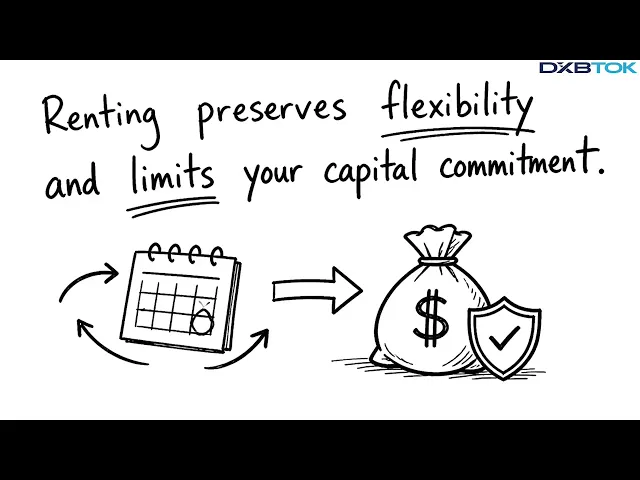
Buying a branded residence in Dubai can offer long-term control and ownership of a premium property, while renting provides greater flexibility and requires far less upfront capital. This guide compares the two routes across holding period, liquidity, recurring costs, lifestyle control, market risk and future resale so buyers can decide which option better fits their plans.
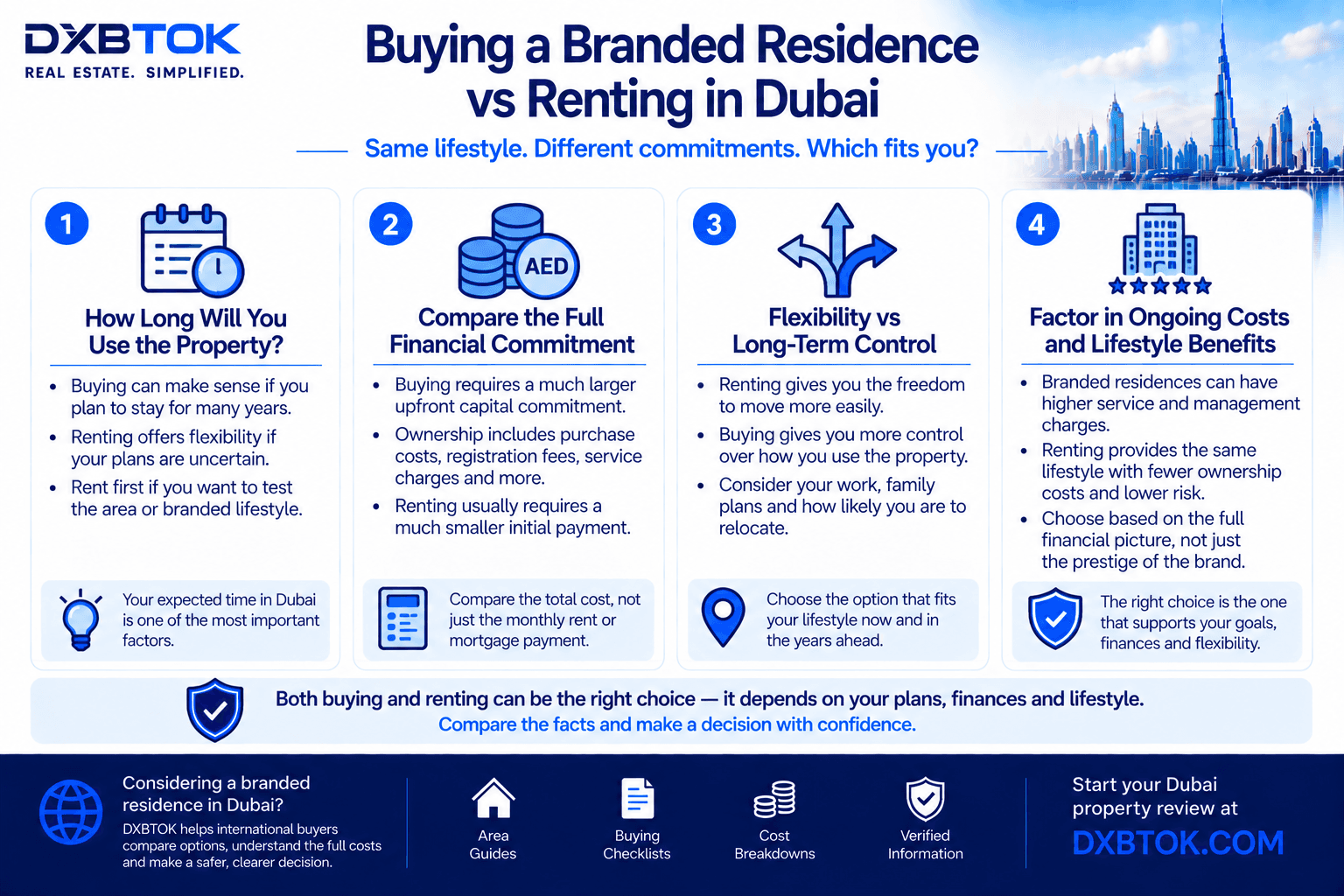
Buying a Branded Residence vs Renting in Dubai
A branded residence can offer a premium Dubai lifestyle with hotel-style services, recognised branding and high-end amenities.
But that does not automatically mean buying is better than renting.
For some buyers, ownership makes sense because they expect to stay for years, want control over the property and are comfortable committing significant capital. For others, renting can provide access to the same lifestyle with far more flexibility and much less exposure to ownership costs and resale risk.
The right comparison is not simply monthly rent versus mortgage payment. It is the full cost and flexibility of each route.
1. Start With How Long You Expect to Use the Property
Your expected holding period is one of the most important variables.
Buying usually makes more sense when you expect to keep the property long enough for the upfront purchase costs and future resale process to become reasonable within your wider financial plan.
Renting can be stronger when:
your Dubai plans are uncertain
you may relocate within a few years
you want to test an area or building first
you do not want capital tied up in one property
If you are still deciding whether the branded category itself suits you, start with our Branded Residences in Dubai buyer guide.
2. Buying Requires a Much Larger Upfront Capital Commitment
A buyer needs to prepare more than the advertised property price.
The purchase can involve registration charges, financing costs where applicable, developer or transaction-related fees, furnishing or fit-out costs, and other amounts depending on the property.
Renting normally requires a much smaller initial commitment.
That difference matters because the capital used to buy the property is no longer available for other investments, business needs or liquidity reserves.
Before deciding that ownership is financially stronger, compare the full cost of buying Dubai property against the realistic cost of renting the same or a comparable residence.
3. Renting Buys Flexibility
One of the strongest advantages of renting is the ability to change course more easily.
A tenant can usually move at the end of the lease without needing to sell a property.
That can be valuable if:
your work location changes
your family needs change
you want to move to another Dubai area
you decide the branded lifestyle is not worth the premium
you plan to leave the UAE
An owner has more commitment.
If the property no longer suits you, the practical exit is usually to rent it out, keep it vacant or sell it.
4. Buying Gives You More Control Over the Home
Ownership can give you a stronger sense of control over the property.
Depending on the development rules and agreements, an owner may have more freedom around how long they stay, how they furnish the residence and whether they keep it for personal use or place it into a rental programme.
A tenant is subject to the lease and the landlord’s decisions.
The property may also be sold or withdrawn from the rental market later, subject to the applicable tenancy rules and notice requirements.
For someone who wants a long-term Dubai base, ownership can therefore offer more continuity.
5. Branded Ownership Can Carry Higher Recurring Costs
Premium services and amenities are not free.
Owners may face recurring charges connected with the building, brand, management structure and services.
These can be materially higher than in a more conventional residential building.
Before buying, review the fees and ownership costs attached to Dubai branded residences rather than assuming the purchase price tells you the full annual cost.
A tenant usually pays rent and the costs assigned to the tenant under the lease, while the property owner remains responsible for ownership-level obligations.
6. Compare the Real Annual Cost, Not the Headline Numbers
A useful comparison should put both routes on the same annual basis.
For ownership, include:
capital committed to the purchase
purchase and registration costs
financing costs if applicable
service charges
brand or management-related charges where applicable
maintenance and replacement costs
insurance where relevant
future selling costs
For renting, include:
annual rent
deposit
brokerage where applicable
utilities and other tenant costs
moving costs if you change properties
The better route is the one that fits your real use case and finances, not the one with the smaller-looking monthly number.
7. Renting Can Be a Useful Way to Test the Product
Branded residences can look very attractive in marketing material.
Living in one can reveal whether the services and amenities actually matter to you.
Renting first can help you judge:
service quality
privacy
resident experience
noise and guest activity
amenity usage
location convenience
whether the brand premium feels justified
For buyers who are new to Dubai or to branded residential living, this can be a rational way to reduce uncertainty before committing capital.
8. Buying Exposes You to Property-Market Risk
Ownership creates the possibility of capital appreciation, but it also creates exposure to price movements.
The property may rise in value, remain flat or fall.
Your result will depend on factors such as:
entry price
location
developer and brand
building quality
future supply
service-charge levels
market conditions when you sell
A renter does not participate in future appreciation, but also does not carry the same resale-price exposure.
9. Consider the Resale Exit Before You Buy
If you buy, you should think about how you may eventually exit.
A branded residence can attract buyers who value the brand, services and location, but resale demand is not guaranteed.
The future buyer will also examine the recurring costs, condition of the property, operator relationship and competing supply.
Before purchasing, review the practical issues involved in reselling a branded residence in Dubai.
Renting avoids this exit process entirely.
10. Compare the Value of the Brand Premium
Both renters and buyers may pay more to live in a branded residence than in a comparable non-branded property.
The difference is that the buyer may pay that premium through the purchase price and recurring ownership charges, while the tenant pays it through rent.
Ask whether the brand genuinely improves:
service
amenities
location experience
property management
resale appeal
rental demand
If the brand does not materially improve your experience or investment case, the premium may not be worth paying under either route.
11. Ownership Agreements Matter More Than Tenants Often Realise
A tenant mainly needs to understand the lease and building rules.
An owner can be exposed to a wider set of agreements.
These may include:
sale and purchase documents
building-management terms
brand-related agreements
service agreements
rental-management agreements where applicable
That makes ownership more complex.
Our guide to branded residence contracts in Dubai explains why buyers should understand the agreements that continue after the purchase itself.
12. Renting Avoids Concentrating Capital in One Property
Buying a premium branded residence can require a substantial amount of capital.
That may be perfectly reasonable for a buyer with sufficient liquidity.
But it can be inefficient if the purchase leaves too little cash for:
business needs
other investments
emergency reserves
future property opportunities
personal flexibility
Renting can preserve that capital.
The trade-off is that rent does not create property ownership.
13. Buying Can Make More Sense for a Long-Term Dubai Base
Ownership becomes more compelling when the buyer has a clear long-term reason to hold the property.
That may include:
using Dubai as a permanent or regular base
wanting control over the same residence for many years
being comfortable with the ownership costs
having sufficient liquidity after the purchase
accepting market and resale risk
The decision should still be based on the exact property and price, not simply on the idea that “buying is always better than renting.”
14. Renting Can Make More Sense When Your Plans Are Still Moving
Renting can be the stronger route when flexibility is more valuable than ownership.
That may apply if:
you are new to Dubai
you are unsure which area suits you
your work or residency plans may change
you want to preserve capital
you want to experience the branded residence before buying
There is nothing inefficient about renting a premium property when the flexibility itself has value.
15. Compare Like With Like
Do not compare the purchase price of one branded residence with the rent of a completely different property.
Use the same building or a genuinely comparable alternative where possible.
Compare:
unit size
view
floor
furnishing
service level
amenities
parking
location
This makes the buy-versus-rent decision much more meaningful.
16. Use a Simple Buy-vs-Rent Test
Before deciding, answer these seven questions:
Time: How many years do I realistically expect to use or hold the property?
Capital: How much money will ownership tie up?
Flexibility: How important is the ability to move easily?
Annual cost: What does ownership really cost each year?
Control: How much do I value having my own permanent Dubai base?
Risk: Am I comfortable with property-market and resale exposure?
Premium: Is the branded lifestyle worth the extra cost to me?
If those answers are clear, the decision becomes much easier.
Final Takeaway
Buying a branded residence in Dubai can make sense for someone who wants a long-term base, values control over the property and is comfortable committing capital and carrying ownership costs.
Renting can be the better choice for someone who values flexibility, wants to preserve capital or is still testing where and how they want to live in Dubai.
The better route is not automatically ownership. It is the route that best matches your time horizon, liquidity, lifestyle and willingness to take property-market risk.
DXBTOK helps international buyers review selected Dubai property opportunities with clearer information around ownership, costs, contracts, verification and the wider buying process.
Start your Dubai property review at DXBTOK.com.
Related DXBTOK guides
Branded Residences in Dubai: Buyer Guide →
Hidden Fees and Ownership Costs in Dubai Branded Residences →
Branded Residence Contracts in Dubai: What Buyers Should Review →
Reselling a Branded Residence in Dubai: What Buyers and Owners Should Know →
Full Cost of Buying Dubai Property: What International Buyers Should Budget →