
Learn how to review Dubai branded residence ownership costs, including service charges, branded and management fees, maintenance, utilities, furnishing obligations, rental-management costs and future resale considerations.
Hidden Fees and Ownership Costs in Dubai Branded Residences
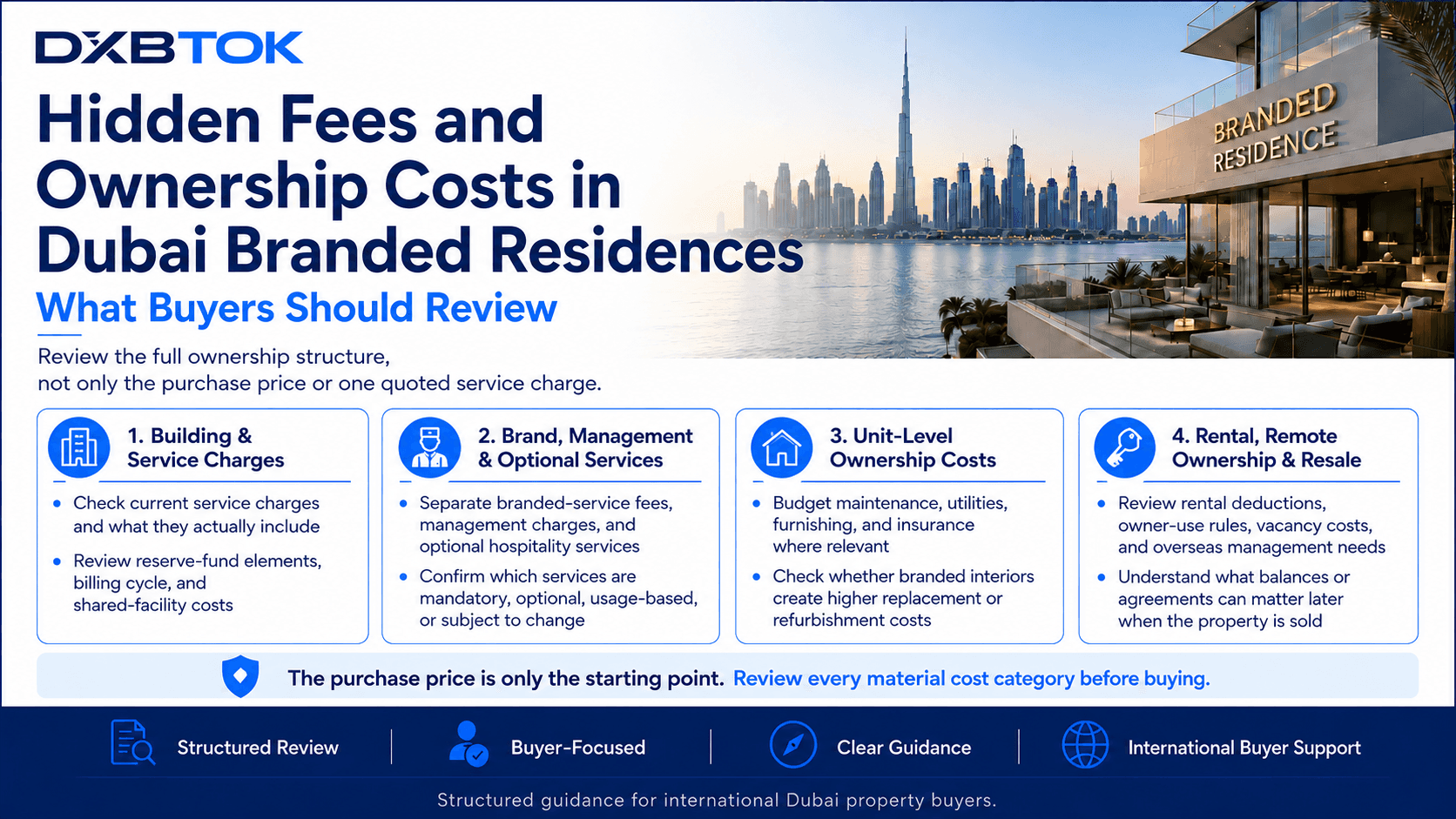
Buying a branded residence in Dubai involves more than the advertised purchase price.
The property may also carry a combination of:
service charges
management fees
branded-service costs
maintenance expenses
utilities
insurance where relevant
furnishing or replacement costs
rental-management charges
optional hospitality services
transaction and resale-related costs
Not every branded residence uses the same fee structure.
That is why the useful question is not:
“What is the service charge?”
It is:
“What will this exact branded residence cost me to own, operate and eventually resell?”
A useful framework is:
mandatory building costs → branded-service costs → management → maintenance → utilities → optional services → rental costs → future resale costs
1. Separate the purchase price from the ownership cost
The purchase price tells you what you are paying to acquire the property.
It does not tell you what ownership will cost afterward.
Before buying, separate:
acquisition cost
recurring annual costs
variable operating costs
optional services
future exit costs
This makes comparisons between properties more meaningful.
2. Start with the official service-charge structure
Dubai properties can carry service charges for the operation and maintenance of common areas and shared facilities.
These may contribute toward items such as:
common-area maintenance
building cleaning
security
facilities
lifts
common utilities
building management
reserve-fund contributions where applicable
Use the dedicated service charges guide to understand general Dubai service-charge mechanics before reviewing branded-specific costs.
3. A branded residence may have more than one fee layer
One of the most important checks is whether the quoted service charge represents the full recurring cost.
A branded residence may potentially involve:
standard building service charges
management charges
branded-service charges
hospitality-related charges
separate optional services
The exact structure depends on the project.
Do not assume one quoted figure covers everything.
4. Ask for the fee schedule in writing
Before committing, ask for a written breakdown showing:
fee category
basis of calculation
whether it is mandatory
how often it is charged
who receives the payment
what service it covers
whether the amount can change
A verbal estimate is not enough for a serious ownership-cost comparison.
5. Understand what the service charge actually includes
Two properties can quote different service charges because they provide different facilities and services.
Ask whether the charge includes:
pool operation
gym
concierge
security
valet areas
landscaping
common-area air conditioning
shared utilities
beach facilities
residential lounges
The amount matters, but so does what the owner receives for it.
6. Separate branded services from normal building services
A branded residence may provide services beyond normal residential building management.
These could include:
concierge
hospitality support
housekeeping coordination
owner-relations services
valet
hotel-access privileges
reservation assistance
Determine whether these services are:
included
separately charged
optional
usage-based
subject to change
7. Do not assume every branded service is included forever
A service may be advertised strongly at launch.
That does not necessarily mean it is:
permanently included
free
transferable
available without conditions
Review the actual property and management documents.
Use the broader Branded Residences in Dubai buyer guide to understand the relationship between the property, brand, operator and owner services.
8. Management fees can be separate from service charges
A management fee may relate to:
property management
hotel-style operation
rental management
owner administration
unit-level services
Ask specifically whether management fees sit:
inside the service charge
outside the service charge
only within an optional rental program
within a separate management agreement
Do not combine these categories without checking.
9. Check whether management participation is mandatory
Some management arrangements may be optional.
Others may be tied more closely to the ownership or operating structure.
Before buying, understand:
whether participation is compulsory
whether the agreement can be terminated
how long it runs
whether it renews automatically
what it costs
what happens when the property is sold
10. Rental-management costs deserve a separate calculation
If you plan to rent the branded residence, do not assume the property's normal ownership costs cover rental operations.
A rental-management arrangement may involve:
management commission
booking costs
housekeeping
linen
guest services
maintenance
platform or distribution costs
marketing
administration
The precise structure depends on the operator and agreement.
11. Gross rental income is not the same as owner income
If a rental program is presented to you, identify what is deducted before money reaches the owner.
Ask:
What is gross revenue?
What fees are deducted?
Who pays housekeeping?
Who pays utilities?
Who pays repairs?
Who pays furnishing replacement?
Are there reserve deductions?
Are there management fees?
The relevant number is not only what guests pay.
It is what remains after the applicable costs.
12. Owner-use periods can affect the economics
Some owners buy a branded residence partly for personal use.
If the property also participates in a rental program, check whether personal use affects:
rental availability
housekeeping costs
booking rules
minimum-stay requirements
owner-use charges
revenue allocation
Lifestyle use and rental operation need to be reviewed together.
13. Maintenance is different from service charges
Service charges generally relate to shared property operation.
Maintenance can include costs inside the individual residence.
Examples may include:
air-conditioning issues
appliances
plumbing
electrical repairs
furniture
flooring
joinery
bathroom fittings
repainting
Use the dedicated maintenance costs guide to separate unit-level upkeep from building-wide service charges.
14. Branded interiors can increase replacement costs
Some branded residences include premium:
furniture
appliances
fixtures
finishes
lighting
decorative elements
If these items need repair or replacement later, the cost may differ from that of a standard apartment.
Ask whether replacements must meet:
brand standards
operator standards
approved specifications
rental-program requirements
15. Furnishing packages can create future obligations
If the property participates in a managed rental or hospitality program, the owner may need to maintain the unit at a certain standard.
Check:
whether furnishing is mandatory
who replaces damaged items
whether refurbishment is periodically required
whether the operator chooses replacements
who pays
This can become a meaningful ownership cost over time.
16. Utilities should be calculated separately
Do not assume all utilities are included in service charges.
Depending on the property and operating model, owners may need to budget separately for:
electricity
water
cooling
internet
television
other unit-level services
Confirm the exact billing structure for the property.
17. Vacant properties still have costs
A branded residence can remain expensive to own even when it is not occupied.
Possible continuing costs include:
service charges
management costs
utilities
maintenance
insurance where applicable
periodic cleaning
property-management support
This matters particularly for international owners who use the residence only part of the year.
18. Overseas ownership may create another operational layer
If you live outside Dubai, you may need someone to coordinate:
inspections
repairs
access
contractors
utilities
tenant issues
handover from guests
emergencies
Use the property management for overseas owners guide if the property will be managed remotely.
19. Optional hospitality services should stay optional in your budget
A branded residence may offer services such as:
housekeeping
laundry
room service
spa
valet
food and beverage
concierge arrangements
These can add convenience.
But they should not be confused with unavoidable ownership costs unless they are contractually mandatory.
20. Ask whether owner benefits have conditions
A project may advertise:
discounts
hotel access
loyalty benefits
dining privileges
spa privileges
These benefits can have value.
But ask whether they are:
permanent
transferable
usage-limited
subject to availability
tied to a particular operator
Do not subtract the theoretical value of benefits from your ownership costs unless you genuinely expect to use them.
21. Check whether charges can increase
An ownership-cost review should not be based only on today's figure.
Ask:
Is the fee fixed?
Is it reviewed annually?
Is it linked to an operating budget?
Can management charges change?
Can optional-service prices change?
Is there a mechanism for increases?
This is particularly important for long holding periods.
22. Ask whether there is a reserve or sinking-fund component
Some properties may include contributions toward major future building works.
Understand whether the ownership cost includes funding for:
major repairs
equipment replacement
common-area refurbishment
long-term capital works
These contributions are different from normal day-to-day maintenance.
23. Large amenity packages can affect operating costs
A property with:
multiple pools
large landscaped areas
beach access
extensive hospitality spaces
concierge staffing
valet
large gyms
lounges
can have a different operating-cost structure from a simpler residential building.
Amenities should therefore be reviewed as both:
benefits and ongoing operating commitments.
24. Compare cost per property, not only cost per square foot
A buyer can become too focused on one service-charge rate.
A more useful comparison is:
What is my total likely annual cost for this exact unit?
Consider:
unit size
service charge
management fees
utilities
maintenance
optional services
rental-management costs
This gives a clearer comparison between competing properties.
25. Do not compare branded and non-branded property using purchase price alone
A branded residence may have a higher or simply different cost structure from a non-branded luxury apartment.
The buyer should compare:
purchase price
recurring charges
service level
management structure
maintenance obligations
personal-use benefits
rental-management structure
The correct comparison is total ownership experience, not only entry price.
26. Check what happens after handover
Some costs begin only when ownership or possession starts.
Before handover, ask when you become responsible for:
service charges
utilities
maintenance
management fees
insurance where applicable
furnishing replacement
rental-program costs
The timing of costs matters for cash planning.
27. Budget for the first year separately
The first year of ownership may involve more than the steady annual cost.
Possible first-year items can include:
setup
furnishing adjustments
utility activation
insurance where relevant
property-management setup
initial repairs or snagging follow-up
owner-use preparation
Use the full buyer budget guide to keep purchase-stage cash requirements separate from recurring ownership costs.
28. Check whether the quoted fees include VAT or other applicable charges
When reviewing any quoted fee, ask whether the figure is:
inclusive
exclusive
estimated
current
subject to additional charges
Do not compare one inclusive quote with another quote that excludes additional charges.
29. Look for duplicated fee categories
If several parties are involved, check that you understand whether similar-sounding charges overlap.
For example:
building management
branded management
rental management
property management
These may describe different services.
Ask who is charging each fee and exactly what it covers.
30. Ask who invoices each charge
A clear ownership file should show:
who issues the invoice
what the charge relates to
when it is payable
how payment is made
what happens if it remains unpaid
This helps prevent confusion between developer, building manager, operator and rental manager.
31. Review late-payment consequences
Recurring charges should also be reviewed for:
due dates
late-payment consequences
access restrictions where legally applicable
clearance requirements
resale implications
An unpaid balance can become particularly relevant when the owner later wants to sell.
32. Ownership costs can affect resale
A future buyer may ask:
What are the service charges?
What are the management costs?
What services are mandatory?
What is included?
Are there outstanding balances?
Can agreements be transferred?
High or unclear recurring commitments can influence how easily another buyer evaluates the property.
Use the branded residence resale guide to understand how these obligations feed into a future secondary-market transaction.
33. Get current figures before relying on old marketing material
A brochure from launch may contain estimated charges.
Years later, the actual operating structure may be different.
For an existing property, ask for current documentation where available.
For an off-plan property, distinguish clearly between:
estimate
contractual obligation
current budget
future amount not yet determined
34. Do not treat an estimate as a guarantee
If a project is not yet operating, some future costs may still be estimates.
That does not automatically make the estimate unreliable.
But the buyer should understand the uncertainty.
Use language such as:
“What is the current estimate, and what could cause it to change?”
35. Use the branded-residence ownership-cost test
Before buying, answer seven questions.
1. Mandatory costs
What must I pay every year simply because I own the property?
2. Branded costs
Which charges exist specifically because of the brand, operator or hospitality model?
3. Management
What management arrangements apply, and are they mandatory?
4. Property upkeep
What maintenance sits inside the unit rather than the common areas?
5. Optional services
Which costs only arise if I use additional hospitality or management services?
6. Rental operation
What will be deducted if I rent the property?
7. Exit
What balances or agreements must be cleared or transferred when I sell?
If those seven areas are clear, the cost structure becomes much easier to compare.
Branded Residence Ownership Cost Checklist
Building costs
Current service charge reviewed
Included services understood
Reserve-fund component checked where relevant
Billing cycle confirmed
Brand and management
Brand-related charges identified
Management fees identified
Mandatory and optional services separated
Fee-change mechanism reviewed
Property costs
Maintenance responsibility understood
Utilities checked
Furnishing replacement considered
Insurance reviewed where relevant
Rental
Rental-management fee checked
Housekeeping costs checked
Revenue deductions understood
Owner-use rules reviewed
Remote ownership
Property-management needs considered
Inspection and repair coordination considered
Vacancy costs included
Future resale
Outstanding-charge clearance understood
Transfer of management agreements checked
Current cost records retained
How DXBTOK Approaches Branded Residence Ownership Costs
A branded-residence cost review should not be reduced to:
purchase price + service charge.
The more useful process is:
identify every mandatory charge → separate brand and management costs → estimate unit-level upkeep → calculate optional services → review rental deductions → understand future resale obligations
The goal is not to predict every expense perfectly.
It is to avoid discovering important ownership costs only after the purchase.
Final Takeaway
The term “hidden fees” should not automatically imply that a developer or operator is concealing costs.
More often, the problem is that buyers focus heavily on the purchase price and one quoted service-charge figure without reviewing the complete ownership structure.
Before buying a Dubai branded residence, understand:
standard service charges
branded-service costs
management fees
maintenance
utilities
furnishing obligations
optional hospitality services
rental-management deductions
overseas-management costs
future resale obligations
The key question is not:
“Is this branded residence expensive to maintain?”
It is:
“Have I identified every material cost category that applies to this exact property?”
Need Help Comparing Dubai Branded Residences?
DXBTOK helps international buyers compare Dubai branded residences, review the ownership structure and identify the practical cost questions that should be clarified before moving forward.
Contact DXBTOK and let us help you compare the property and ownership costs more clearly.
Related DXBTOK guides
Branded Residences in Dubai: Buyer Guide →