Reselling a Branded Residence in Dubai: What Buyers and Owners Should Know


Learn what buyers and owners should review when reselling a branded residence in Dubai, including ownership status, developer resale rules, NOCs, service and management obligations, property condition, competing supply and transfer preparation.
Reselling a Branded Residence in Dubai: What Buyers and Owners Should Know
A branded residence can be marketed as a premium property, but when the owner later wants to sell, the resale process should be reviewed like any other serious property transaction.
The brand name alone does not determine how easy the property will be to sell.
A buyer considering resale should understand:
the exact ownership status
whether the property is completed or still off-plan
what approvals or NOCs are required
what recurring charges remain outstanding
how the brand, operator or management structure affects the property
what the next buyer is actually acquiring
what documentation must be ready for transfer
how the property compares with competing branded and non-branded stock
The useful framework is:
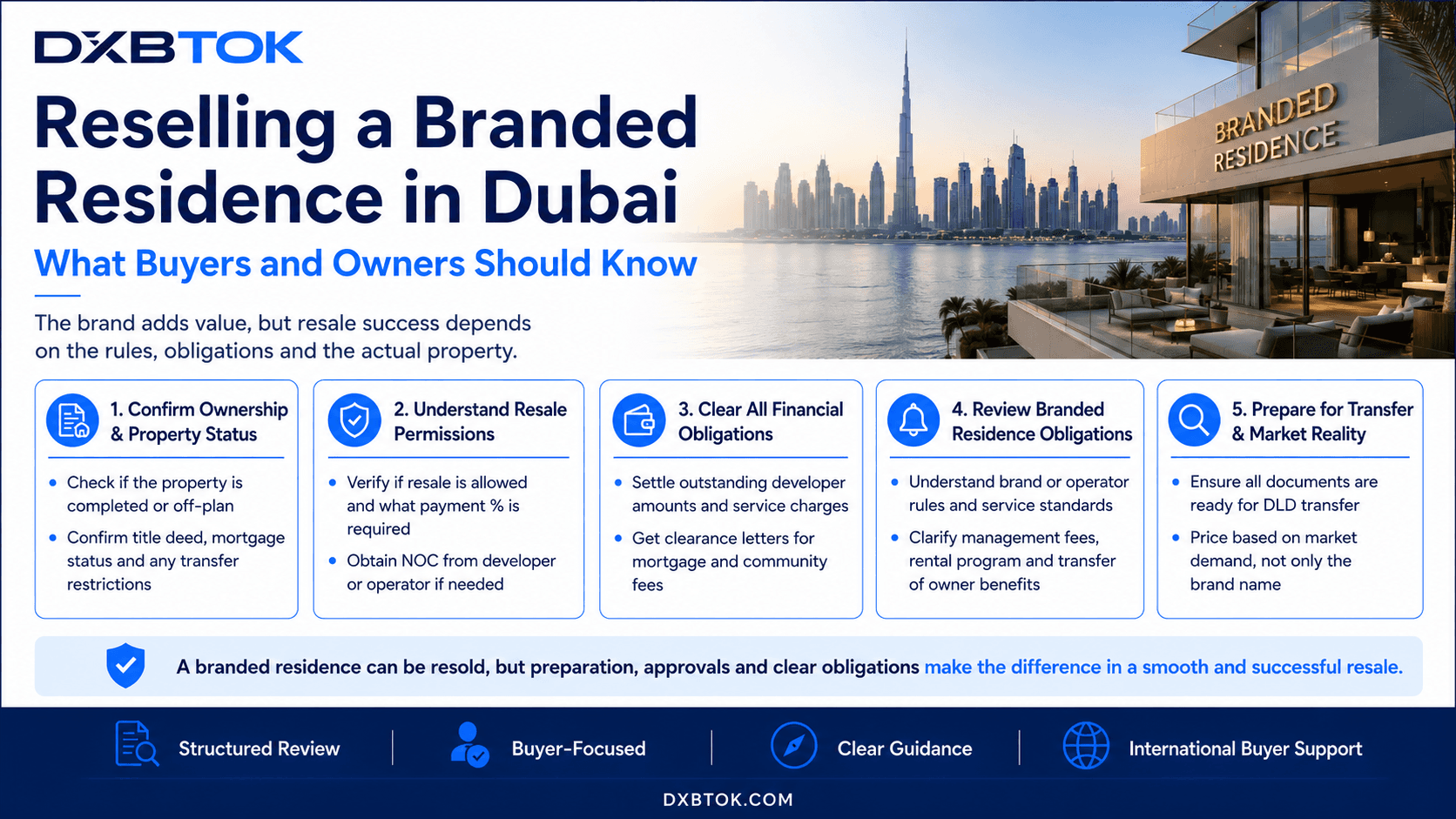
ownership status → resale permission → financial clearance → branded-residence obligations → buyer due diligence → transfer
1. Start by confirming what you actually own
Before thinking about resale pricing, confirm the legal and practical status of the property.
Ask:
Is the property completed?
Has the title deed been issued?
Is it still off-plan?
Is the property mortgaged?
Is there any restriction on transfer?
Are there outstanding developer or service-charge obligations?
If the property is completed, review how the title deed records the ownership before preparing the resale.
The resale route can differ depending on these answers.
2. Completed and off-plan resale are not the same
A completed branded residence with an issued title deed is generally handled as a secondary-market property.
An off-plan property may involve additional developer conditions before assignment or resale.
Dubai Land Department guidance states that resale or assignment before final registration can be possible after obtaining a No Objection Certificate from the developer.
Do not assume that because you bought the property, you can transfer it at any time without checking the exact project rules.
3. Check the developer's resale requirements early
Before advertising the property seriously, confirm:
whether resale is permitted
whether a minimum payment percentage must already have been made
whether an NOC is required
whether there are outstanding amounts
whether specific forms must be used
whether an administration fee applies
These conditions can vary by project.
Get the current requirements directly from the appropriate developer or transaction party.
4. Understand the role of the NOC
For completed freehold property sales, Dubai Land Department's current sale-registration information lists a developer e-NOC among the required documents.
The NOC is important because it helps confirm that the property can proceed toward transfer under the relevant process.
Before relying on a resale timetable, ask:
who issues the NOC
what must be cleared first
how long it normally takes
whether it expires
what documentation is required
5. Clear outstanding property obligations
A resale can become delayed if unresolved charges appear late in the process.
Review:
service charges
developer balances
management charges
utilities where relevant
mortgage obligations
administration charges
other property-related liabilities
The seller should understand what must be cleared before transfer.
6. Branded residences can have an additional ownership layer
A branded residence may involve more than the apartment itself.
Depending on the project, the ownership experience may include:
branded services
operator involvement
management arrangements
hospitality services
owner privileges
rental-program arrangements
restrictions or conditions connected to the project
Not every branded residence uses the same structure.
That means resale buyers should review the exact project documentation rather than assuming all branded properties work alike.
7. Verify what happens to branded benefits after resale
A key question is:
Do all owner benefits automatically transfer to the next buyer?
Some benefits may be connected to the property.
Others may depend on:
specific ownership agreements
membership structures
operator rules
rental-program participation
current project terms
The seller should not advertise benefits as transferable unless this has been confirmed.
8. Separate the brand from the legal ownership
The brand may influence the property's positioning.
But the resale transaction still depends on the underlying property rights and documents.
The buyer should review:
title
unit details
ownership structure
project documentation
management obligations
sale contract
Use the broader Branded Residences in Dubai buyer guide for the general ownership framework.
9. Check whether a management agreement affects resale
For an owner managing the property from abroad, review the wider property management for overseas owners process as well.
Some branded residences may have mandatory or optional management arrangements.
Before selling, determine:
whether an agreement exists
whether it continues after transfer
whether the buyer must accept it
whether notice is required
whether fees remain payable
whether rental participation is attached to it
Do not leave this question until the transfer stage.
10. Review any rental-program obligations
If the residence participates in a hotel or rental program, resale may require additional review.
Ask:
Can the owner leave the program?
Does the agreement transfer to the buyer?
Is there a notice period?
Are there outstanding operating balances?
Are there furnishing or use restrictions?
Does the buyer need to sign a new agreement?
These are contract-specific questions.
11. Do not market projected returns as guaranteed resale value
A branded property may have been originally marketed using:
lifestyle positioning
rental projections
premium branding
expected demand
Those points do not guarantee future resale value.
The resale buyer will still examine:
asking price
competing units
current market supply
ownership costs
condition
exact view
layout
management quality
building operation
Keep the resale discussion grounded in verifiable property facts.
12. The exact unit matters more in the secondary market
When a project first launches, buyers may focus heavily on:
developer
brand
masterplan
brochure
In the resale market, buyers can often compare actual units more directly.
That brings greater attention to:
floor
view
orientation
layout
privacy
balcony
condition
furniture
proximity to lifts
noise
parking
Two units in the same branded residence can have different resale appeal.
13. Condition becomes more important after handover
Once a property has been occupied or used, buyers may inspect:
finishes
appliances
furniture
bathrooms
flooring
air-conditioning
joinery
maintenance history
The seller should understand whether the property is being sold:
furnished
unfurnished
as inspected
subject to repairs
Document the condition clearly.
14. Check what is included in the sale
A branded residence can contain expensive furniture, appliances or interior packages.
Do not assume everything visible during a viewing is included.
Create a clear inventory where relevant.
Confirm:
furniture
appliances
artwork
electronics
accessories
storage
parking
other unit-specific items
The sale agreement should reflect what the parties actually agreed.
15. Review recurring ownership costs
Future buyers may pay close attention to recurring costs.
These can influence the total ownership decision.
Review:
branded-service charges where applicable
management fees
utility structure
maintenance
insurance where relevant
Use the dedicated service charges guide to separate normal recurring building costs from other property expenses.
16. High service levels can also mean higher recurring commitments
Branded residences may provide enhanced services.
But those services can create ongoing costs.
A buyer should ask:
What services am I receiving, and what am I paying for them?
A seller should be ready to provide current information rather than broad marketing statements.
17. Compare the property with current competing supply
The property is not resold in isolation.
A buyer may compare it with:
another unit in the same building
another branded project
luxury non-branded apartments
newer developments
resale units with better views
developer inventory
Before setting expectations, review what buyers can currently choose instead.
18. Check whether the original developer still has inventory
If similar units remain available directly from the developer, this can affect the resale environment.
A resale buyer may compare:
price
payment plan
incentives
handover status
furnishing
fees
unit position
The seller should understand this competition before setting an asking price.
19. Resale price should not be based only on the original purchase price
A common mistake is:
I paid X, therefore I should sell at X plus Y.
The market does not necessarily price the property that way.
A resale should be reviewed against:
recent comparable transactions
current asking prices
exact unit quality
project maturity
competing stock
buyer demand
Use the broader Dubai property resale guide to review the property's future buyer pool, marketability and exit considerations.
The original purchase price is only one reference point.
20. Asking price and achievable sale price are different
Listings show what sellers want.
They do not always show what buyers eventually pay.
When reviewing resale expectations, distinguish:
asking prices
actual completed transactions
developer inventory
unique unit features
Avoid relying on one online listing as proof of value.
21. Prepare the resale document file before finding a buyer
A clean resale file can reduce unnecessary delay.
Depending on the transaction, this may include:
title deed
passport or Emirates ID
developer NOC
mortgage information
service-charge clearance
unit details
management documents where relevant
supporting ownership documents
Dubai Land Department's current sale-registration process accepts a valid passport for non-resident foreign parties and requires the relevant sale-registration documentation.
22. Non-resident owners can sell Dubai property
An owner does not necessarily need to be a UAE resident to hold or transfer property.
Dubai Land Department's title-transfer information expressly includes passport documentation for non-resident owners.
However, remote execution may require additional coordination.
Confirm the exact process before assuming that every step can be completed from abroad.
23. Power of attorney may be relevant for remote sellers
If the owner cannot attend required transaction steps, a properly structured power of attorney may be relevant.
The exact form and acceptance requirements should be confirmed with the licensed transaction professionals and relevant authority.
Do not assume a general foreign power of attorney will automatically be accepted without the required formalities.
24. Mortgaged property needs its own transfer plan
If the branded residence has a mortgage, the seller should establish early:
outstanding balance
settlement process
lender requirements
release timing
buyer financing structure if applicable
Dubai Land Department maintains a separate process for sale of mortgaged property, so the transaction should not be treated like an unencumbered cash resale.
25. Understand the official transfer costs
Dubai Land Department's current completed-property sale-registration service lists the transfer fee as 2% for the seller and 2% for the buyer, plus applicable title, map and service-partner fees.
Fees and procedures can change.
Confirm the current amounts before completing the transaction rather than relying on an old percentage or online estimate.
26. Agree clearly who pays which transaction costs
The parties should understand responsibility for:
DLD transfer costs
NOC costs
brokerage fees
trustee/service-partner fees
mortgage costs where applicable
outstanding property charges
Do not leave fee allocation vague.
27. Buyer due diligence still matters
A resale buyer may ask for more information than the original owner reviewed when buying off-plan.
That can include:
current property condition
actual service charges
building operation
management
owner obligations
rental restrictions
title
NOC
branded-service structure
A seller with clear answers is easier to assess.
28. Do not hide project-specific restrictions
If there are relevant restrictions connected to:
leasing
short-term use
owner occupation
rental program
furnishings
management
brand standards
they should be clarified before the buyer commits.
A problem discovered late can disrupt the transaction.
29. Check whether the brand relationship itself has changed
A branded residence may have been purchased partly because of a particular operator or brand relationship.
Before resale, verify whether that relationship remains exactly as originally presented.
Do not assume the original brochure is still current.
Confirm the present operating and management reality.
30. Keep marketing claims separate from transaction facts
Marketing may say:
prestigious brand
premium services
exclusive lifestyle
The resale transaction needs more concrete information:
exact unit
current ownership
current fees
current management
current benefits
transfer requirements
property condition
The resale buyer should make the decision using current facts.
31. Review the exit before accepting an offer
Before accepting a buyer's offer, confirm:
sale price
deposit
payment method
mortgage status
transfer timetable
NOC timing
outstanding charges
what is included
seller and buyer responsibilities
This helps prevent a commercially attractive offer from becoming an operationally difficult transaction.
32. Use the branded-residence resale test
Before marketing or buying a resale branded residence, answer six questions:
1. Ownership
What exactly is registered and transferable?
2. Permission
What NOC, developer approval or contractual step is required?
3. Financial clearance
What balances must be cleared before transfer?
4. Brand structure
Which services, agreements or benefits continue after resale?
5. Property reality
What is the exact unit condition, view, layout and cost structure?
6. Transfer
Are the seller, buyer, documents and funds ready to complete?
If these are clear, the resale process is much easier to evaluate.
Branded Residence Resale Checklist
Property status
Completed or off-plan status confirmed
Title or registration status checked
Mortgage status checked
Transfer restrictions reviewed
Developer / project
Resale rules confirmed
NOC requirement checked
Outstanding developer balances reviewed
Current brand/operator status verified
Ownership obligations
Service charges reviewed
Management arrangement reviewed
Rental-program obligations checked
Owner benefits and restrictions confirmed
Exact property
Condition reviewed
Furniture/inclusions documented
Parking and storage confirmed
View and layout verified
Resale market
Current competing listings reviewed
Recent comparable evidence considered
Developer inventory checked
Asking price separated from completed-sale evidence
Transaction
Seller documents ready
Buyer funding understood
Fees allocated
NOC timetable confirmed
Transfer route confirmed
Payment process verified
How DXBTOK Approaches Branded Residence Resale
A branded-residence resale should not be reduced to:
brand name + asking price.
The more useful process is:
verify ownership → understand resale conditions → clear obligations → document the branded structure → compare the exact unit → prepare the transfer
That gives both buyer and seller a clearer view of the transaction.
Final Takeaway
A branded residence can carry a strong identity, but resale still depends on the fundamentals.
Before selling or buying one on the secondary market, review:
ownership status
transfer permission
developer NOC
outstanding charges
mortgage position
management or brand-related obligations
exact property condition
recurring costs
competing supply
transaction documents
The key question is not:
“Is this a branded residence?”
It is:
“Is the exact property, ownership structure and resale process clear enough for the next buyer to complete the transaction?”
Need Help Reviewing a Dubai Branded Residence?
DXBTOK helps international buyers review Dubai branded residences, compare the exact property and understand the practical questions that should be resolved before moving forward.
Contact DXBTOK and let us help you review the property and buying process more clearly.
Related DXBTOK guides
Branded Residences in Dubai: Buyer Guide →
Dubai Property Resale: What Buyers Should Think About Before Buying →