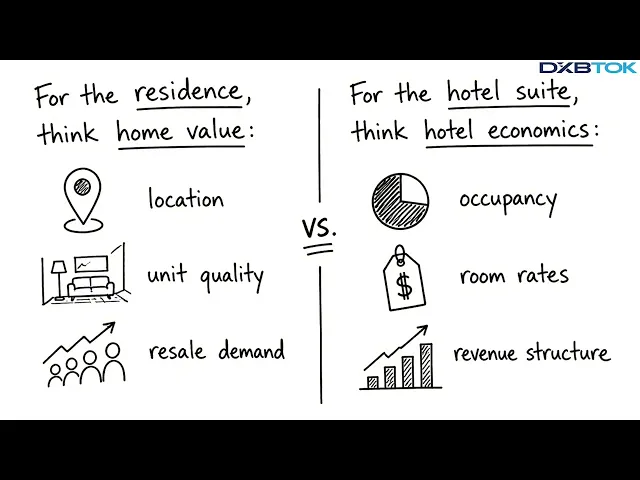
Hotel Suite Investment in Dubai: What Buyers Should Check Before Purchasing


A Dubai hotel suite can function as both a property purchase and an operating investment product. This guide explains what buyers should review before purchasing, including the ownership structure, compulsory hotel participation, personal-use rights, rental-income calculation, operator deductions, furniture and refurbishment reserves, exit rights and the restrictions that may affect future resale.
Hotel Suite Investment in Dubai: What Buyers Should Check Before Purchasing
A Dubai hotel suite can look attractive because the investment proposition is simple on the surface: buy a unit, let the hotel operate it, and receive income.
The real structure is usually more complicated.
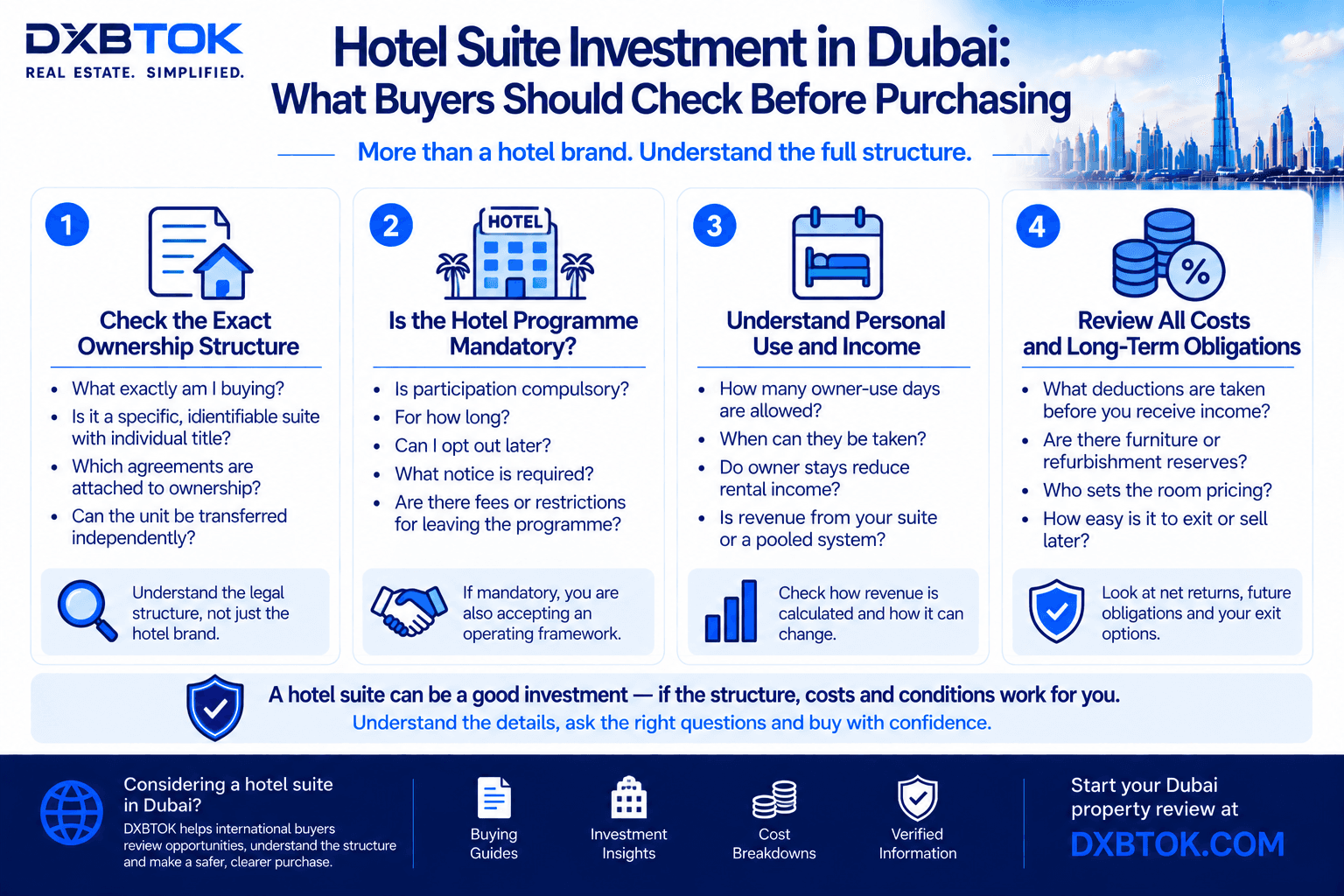
Before purchasing, buyers should understand exactly what they own, whether participation in the hotel programme is compulsory, how personal use works, how revenue is calculated, which deductions come out before the owner is paid, what reserve obligations apply, and what happens if they later want to exit or sell.
The key question is not whether the hotel is well known. It is whether the operating structure works for you as an owner.
1. Start With the Exact Ownership Structure
Do not begin with the hotel brand or projected return.
Begin with:
What exactly am I buying?
Confirm:
how the unit is titled or registered
whether you own a specific identifiable suite
whether ownership is individual or part of another investment structure
whether the unit can be transferred independently
which agreements are attached to ownership
The ownership document and the hotel operating agreement should be read together.
For the wider residential side of branded ownership, review our Branded Residences in Dubai buyer guide.
If the legal structure is unclear, do not rely on marketing language such as “hotel investment,” “income unit” or “managed suite.”
2. Check Whether the Hotel Programme Is Mandatory
This is one of the most important questions.
Some hotel-suite investments require the owner to place the unit into the hotel’s operating or rental programme.
Others may allow more flexibility.
Ask:
Is participation compulsory?
For how long?
Can I opt out later?
Is there a minimum commitment period?
What notice is required to leave?
Does leaving the programme trigger fees or restrictions?
If participation is mandatory, you are not simply buying property. You are also accepting an operating framework.
3. Understand Your Personal-Use Days
Owners often assume that because they own the suite, they can use it whenever they want.
That may not be true.
The hotel programme may limit:
the number of nights you can use each year
when those nights can be taken
how far in advance you must book
whether blackout periods apply
whether owner stays reduce distributable rental income
whether hotel charges still apply during personal use
If you want the property partly as a second home, these rules matter as much as the projected yield.
4. Check Whether Revenue Comes From Your Suite or a Pool
Rental income may be calculated in different ways.
One model can allocate income generated by your specific suite.
Another can pool revenue across participating units and then distribute the owner’s share according to a formula.
Ask:
Is revenue unit-specific or pooled?
If pooled, which units are included?
How is my share calculated?
Does suite size, category or view affect the allocation?
Can the formula change?
Do not compare headline yields until you understand the revenue methodology.
5. Review Every Deduction Before Looking at Net Return
Gross hotel revenue is not the same as owner income.
Before money reaches the owner, deductions may be taken for operating and management costs.
These can include:
hotel management fees
operator commissions
booking-channel commissions
housekeeping
utilities
maintenance
marketing
staffing allocation
insurance
service charges
reserve contributions
Ask for the full deduction waterfall.
The correct number to compare is the amount expected to remain after all recurring deductions.
To compare these deductions against the wider premium-property cost structure, review our guide to branded residence fees and ownership costs in Dubai.
For a wider framework, review the full cost of buying Dubai property so acquisition costs and operating costs are not mixed together.
6. Check Whether There Is a Furniture or Replacement Reserve
Hotel suites usually need to remain consistent with the operator’s hospitality standard.
That can create future refurbishment obligations.
Ask whether the programme requires:
a furniture reserve
a refurbishment reserve
periodic replacement of furniture or equipment
mandatory operator-approved upgrades
contributions to common hotel improvement programmes
Also ask how the reserve is funded.
It may be charged separately or deducted from rental income before distributions are made.
This matters because a strong early yield can look weaker once long-term replacement costs are included.
7. Understand Who Controls Pricing
In a hotel programme, the owner may have little or no control over nightly rates.
The operator may decide:
room pricing
discounts
promotions
minimum-stay rules
distribution channels
seasonal pricing
This can be positive if the operator is strong and professionally manages revenue.
But the buyer should understand that ownership does not necessarily mean pricing control.
8. Check What Happens During Low Occupancy
Do not base your decision only on strong-season projections.
Ask how the investment performs when occupancy falls.
Review:
whether costs continue during low occupancy
whether fixed fees still apply
whether revenue pooling cushions or amplifies weak performance
whether owner distributions can fall to very low levels
whether reserve contributions continue regardless of income
A realistic investment test should include weaker periods, not only best-case hotel performance.
9. Ask Whether Returns Are Guaranteed or Merely Projected
Hotel-suite marketing can include return figures.
Buyers should distinguish carefully between:
a contractual guaranteed return
a target
a historical figure
a marketing projection
an illustrative estimate
If a return is described as guaranteed, review exactly:
who guarantees it
for how long
what conditions apply
whether payments depend on owner compliance
what happens after the guarantee period ends
Do not treat a projected number as a contractual entitlement.
10. Review the Operator Agreement, Not Just the Sale Agreement
The sale agreement tells you how you acquire the unit.
The operator agreement tells you how the unit functions after acquisition.
That second agreement may govern:
rental participation
personal use
management fees
revenue distribution
operator powers
furniture standards
termination rights
transfer conditions
Do not review the purchase contract in isolation.
Our guide to what buyers should review in a Dubai SPA is useful for the purchase side, but a hotel-suite investment can require a separate operating-contract review as well.
11. Check Your Exit Rights From the Hotel Programme
Many buyers focus on how to enter the programme and ignore how to leave it.
That is risky.
Ask:
Can I terminate participation?
When?
How much notice is required?
Are there penalties?
Can the operator refuse termination in certain periods?
Does leaving affect the unit’s use or resale value?
If there is no practical exit route, the operating agreement can become one of the most important long-term restrictions attached to the property.
12. Check Whether the Buyer of Your Suite Must Join the Same Programme
This can affect resale.
If a future purchaser must accept the same hotel programme, the pool of potential buyers may be narrower.
Ask:
whether the operating agreement transfers automatically
whether the new buyer must sign a fresh agreement
whether operator approval is required
whether transfer fees apply
whether outstanding reserve obligations transfer with the property
A restriction that seems acceptable to you today may reduce flexibility when you later sell.
13. Compare Resale as an Investment Product, Not Just as Property
A conventional residential buyer may value layout, location and view.
A hotel-suite buyer may also scrutinise:
operator performance
net distributions
remaining contract term
personal-use restrictions
reserve balance
programme exit rights
This makes resale partly an operating-business question.
If you are assessing future liquidity, use our Dubai property resale considerations guide as the broader exit framework.
14. Check What Happens If the Operator Changes
The operator is central to the investment structure.
Ask what happens if:
the hotel brand changes
the operator is replaced
the management agreement expires
service standards change
the rental programme is restructured
Also check whether the owner has any approval rights or whether those decisions sit entirely with the developer, hotel owner or management structure.
Do not assume the current brand remains attached forever.
15. Compare Net Income Against the Restrictions You Accept
A hotel-suite investment can be attractive if the operating model works.
But return should be compared with control.
Ask what you are giving up in exchange for the hotel to manage the unit:
pricing control
personal-use flexibility
rental-manager choice
furniture choice
exit flexibility
Then compare that against:
expected net distributions
operator quality
hands-off management
brand reach
operational convenience
The investment only makes sense if the economics justify the restrictions.
16. Use a Hotel-Suite Investment Checklist
Before purchasing, answer these eight questions:
Ownership: What exactly do I own?
Programme: Is hotel participation mandatory?
Use: How many personal-use days do I actually have?
Revenue: Is income unit-specific or pooled?
Deductions: What comes out before I receive money?
Reserve: What furniture or refurbishment obligations exist?
Exit: Can I leave the programme?
Resale: What restrictions transfer to the next buyer?
If those answers are not clear, the investment structure is not clear enough to judge.
Final Takeaway
A Dubai hotel suite should be assessed as both a property purchase and an operating investment structure.
The headline price and projected return are not enough.
Before buying, understand the ownership title, mandatory hotel programme, personal-use limits, revenue methodology, operator deductions, reserve obligations, programme-exit rights and resale restrictions.
The right question is not “How much can this hotel suite earn?” It is “What structure am I accepting in order to earn it?”
DXBTOK helps international buyers review selected Dubai property opportunities with clearer information around ownership, contracts, costs, verification and the wider buying process.
Start your Dubai property review at DXBTOK.com.
Related DXBTOK guides
Branded Residences in Dubai: Buyer Guide →
Branded Residence vs Serviced Apartment in Dubai: What Buyers Should Compare →
Full Cost of Buying Dubai Property: What International Buyers Should Budget →
Dubai SPA Explained: What Buyers Should Review Before Signing →