

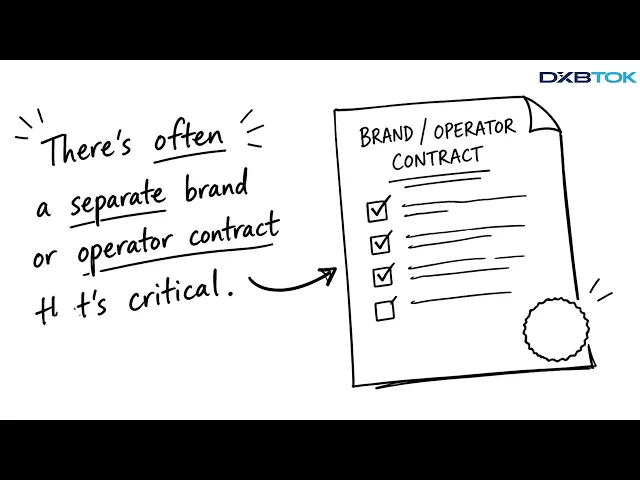
Learn what to review in a Dubai branded residence purchase, including the SPA, brand and operator relationships, management agreements, recurring fees, owner benefits, rental terms, handover obligations and resale conditions.
Branded Residence Contracts in Dubai: What Buyers Should Review
Buying a branded residence in Dubai can involve more than reviewing the price, floor plan and payment schedule.
The property may also sit within a wider structure involving:
the developer
the brand
an operator or hotel manager
building or community management
service standards
owner-use rules
rental arrangements
recurring fees
handover obligations
The exact documents vary by project.
That is why an international buyer should not assume that every obligation connected to a branded residence appears in one contract.
A useful review framework is:
property → parties → brand relationship → services → owner obligations → fees → use restrictions → handover → resale
1. Start by identifying every document you are being asked to sign
Do not review only the document called the SPA.
Ask for the complete document set relevant to the purchase.
Depending on the project, this could include:
reservation or booking form
Sale and Purchase Agreement
payment schedule
disclosure documents
management agreement
rental-program agreement
owner-services agreement
community or building rules
furnishing specifications
brand-related terms
handover documentation
Not every branded residence uses every document.
The first job is simply to understand:
What documents create obligations for me as the buyer or future owner?
2. Confirm which document actually governs the property purchase
The main purchase contract should clearly identify:
buyer
seller or developer
exact property
purchase price
payment structure
completion or handover obligations
contractual rights and responsibilities
For off-plan transactions, Dubai Land Department's current provisional-registration process requires a copy of the sale and purchase contract as part of the initial sale registration.
Use the dedicated Dubai SPA guide when reviewing the general property-purchase agreement.
3. Verify the exact property description
The contract should match the property you believe you are buying.
Check details such as:
project
building or tower
unit number
property type
floor
area
parking where applicable
balcony or terrace
storage where applicable
Marketing material should not be used as a substitute for the contractual property description.
4. Separate the developer from the brand
A branded residence may carry a globally recognized hotel, hospitality, fashion or lifestyle name.
But the brand may not be the party selling the property.
Identify:
who the developer is
who the seller is
who owns or licenses the brand
who operates the property
who manages common areas or services
These can be different entities.
Use the broader Branded Residences in Dubai buyer guide to review the full ownership model before focusing on the contract structure.
Do not assume that because a brand name appears prominently in the marketing, that brand is legally responsible for every aspect of the property.
5. Ask what the brand relationship actually is
A buyer should understand the contractual basis for the branded identity.
Possible questions include:
Is the brand licensed to the project?
Is the brand also the operator?
Is another company managing the property?
What services is the brand actually responsible for?
Are there separate brand or management agreements?
The important question is not:
“Which brand is on the building?”
It is:
“What does the brand relationship legally and operationally mean for the owner?”
6. Check whether the brand relationship can change
A property may be marketed around a specific brand.
A buyer should therefore understand whether the documents address:
termination of the brand relationship
replacement of the operator
changes in management
changes in services
consequences for owner benefits
Do not assume the same operator or brand arrangement must continue forever unless the documents support that conclusion.
7. Understand who controls the common areas
Branded residences can include:
lobby
pool
gym
concierge
valet
restaurants
lounges
beach facilities
hotel spaces
shared residential facilities
But access and control may differ.
Ask:
Which facilities belong to the residences?
Which belong to a hotel?
Which are shared?
Which require additional charges?
Can access rules change?
A brochure image of an amenity does not automatically establish an ownership right.
8. Review owner benefits carefully
Branded-residence marketing may refer to owner benefits such as:
hotel discounts
concierge support
preferred reservations
club or loyalty privileges
spa access
food and beverage benefits
global brand privileges
Check whether these are:
contractual
discretionary
transferable
time-limited
subject to availability
subject to additional conditions
Do not treat a marketing benefit as permanent unless the documents make that clear.
9. Identify mandatory and optional services
Some services may be included within normal property operation.
Others may be optional.
Separate:
Mandatory
Services or charges the owner cannot normally avoid under the ownership structure.
Optional
Additional services the owner chooses to purchase.
Possible examples could include:
housekeeping
rental management
concierge upgrades
maintenance packages
furnishing support
The exact structure is project-specific.
10. Understand every recurring fee category
Do not ask only:
“What is the service charge?”
A branded residence may potentially involve several recurring cost categories.
Ask for a written breakdown of:
service charges
management charges
branded-service charges where applicable
hotel-related charges where applicable
maintenance responsibilities
optional management fees
rental-program fees
utilities
insurance where relevant
Use the dedicated service charges guide to review general Dubai property service-charge mechanics separately.
11. Ask what can change after purchase
A buyer should distinguish between:
costs fixed by contract
costs calculated annually
costs subject to approved budgets
optional charges
charges that can change under the relevant agreement
Do not assume that today's quoted ownership cost will remain identical throughout ownership.
12. Review the payment schedule against the contract
For off-plan property, check:
reservation amount
SPA payment schedule
construction-linked payments where applicable
fixed-date instalments
handover payment
post-handover payments if applicable
Make sure the payment schedule in the contractual documents matches the commercial offer you accepted.
Do not rely only on the salesperson's payment-plan graphic.
13. Check what happens if a payment is late
The contract should be reviewed for consequences of buyer default.
These may involve:
notices
cure periods
penalties or charges
contractual remedies
cancellation provisions
The exact consequences depend on the agreement and applicable law.
For material contractual questions, obtain qualified legal advice rather than relying on a sales explanation.
14. Check what happens if the project is delayed
Do not look only at the advertised handover date.
Review how the contract addresses:
estimated completion
contractual completion
extensions
force majeure
notice
delayed handover
buyer remedies
Marketing language and contractual wording may not be identical.
15. Understand the handover conditions
A handover clause may address when the buyer is expected to:
make final payment
inspect the property
accept possession
complete documentation
begin paying ownership costs
Ask what must happen before handover is considered contractually complete.
16. Check whether furnishing is part of the contract
Branded residences are often presented with strong interior design and furnishing packages.
Confirm whether the purchase includes:
loose furniture
built-in furniture
appliances
lighting
curtains
decorative items
artwork
kitchen equipment
If furnishing matters to the purchase decision, it should be supported by the contractual specification or approved schedule.
17. Review specification-change rights
Off-plan projects can evolve during construction.
The contract may contain provisions dealing with:
materials
finishes
layouts
specifications
equivalent substitutions
Understand what changes are permitted.
Do not assume every image or finish shown in marketing is contractually fixed.
18. Check the rules around personal use
If you plan to occupy the property yourself, review whether there are any relevant rules concerning:
owner occupation
guest access
hotel services
facility access
residence rules
short-term absence
housekeeping
This becomes particularly important when residential and hospitality operations are closely connected.
19. Review rental rights separately from ownership rights
Owning the property does not automatically answer how it can be rented.
Check:
whether long-term leasing is permitted
whether short-term use is permitted
whether a rental program exists
whether participation is mandatory or optional
who controls pricing or availability if a program is used
what fees apply
whether the owner can leave the program
Do not assume branded residence automatically means hotel-managed rental.
20. Understand any rental-management agreement before signing it
A rental-management agreement can create separate obligations from the property SPA.
Review:
term
renewal
termination
fees
revenue allocation
expenses
owner-use periods
furnishing requirements
booking control
maintenance responsibilities
This agreement should be evaluated on its own terms.
21. Check restrictions on alterations
Branded projects may apply standards intended to maintain a consistent appearance or operating environment.
Review whether there are restrictions on:
renovations
flooring
furniture
external appearance
balcony use
signage
combining units
This matters particularly if you want to personalize the property later.
22. Check whether brand standards affect the interior
Some branded residences may require certain finishes or furniture standards, especially if the property participates in a rental or hospitality program.
Ask:
Are specific furniture packages mandatory?
Can furniture be replaced?
Must replacements meet brand standards?
Who approves changes?
Do not assume that private ownership always means unrestricted interior changes.
23. Review management powers
A management agreement may give the manager authority over parts of building operation.
Understand who can make decisions regarding:
services
maintenance
common areas
staffing
operations
building standards
The buyer should understand not only what services are promised but also who controls their delivery.
24. Ask who is responsible if a service changes
If the property's appeal depends heavily on:
concierge
valet
housekeeping
hotel access
branded amenities
then ask what the documents say if those services are changed or discontinued.
A buyer should avoid assuming that every marketing feature is an unconditional lifetime entitlement.
25. Review the contract from a resale perspective
Even if you plan to hold the property long term, review the exit structure before buying.
Ask:
Can the property be resold before completion?
Is developer approval required?
Is an NOC required?
Is there a minimum payment threshold?
Do management agreements transfer?
Do brand-related benefits transfer?
Are there outstanding obligations that must be cleared?
Use the dedicated branded residence resale guide for the secondary-market process.
26. Check what transfers to the next owner
Not everything connected to the original buyer necessarily follows the property.
Separate:
property ownership
management obligations
membership privileges
owner benefits
rental agreements
furnishing packages
personal incentives
This becomes important both when buying and when planning eventual resale.
27. Check termination provisions
If the buyer signs additional agreements, review how they can end.
Ask:
Is the agreement fixed-term?
Does it renew automatically?
Can the owner terminate?
What notice is required?
Are termination costs involved?
Does the agreement end automatically when the property is sold?
Do not sign a management or rental agreement without understanding the exit route.
28. Understand dispute provisions
Contracts may specify:
governing law
jurisdiction
arbitration
dispute procedures
notice requirements
These clauses matter if a disagreement occurs.
International buyers should know where and how disputes are intended to be handled.
For legal interpretation, use qualified legal counsel.
29. Check which document wins if two documents conflict
A branded-residence purchase can involve several documents.
If two documents appear inconsistent, determine:
whether one has contractual priority
whether an annex forms part of the SPA
whether the management agreement overrides anything
whether marketing documents are expressly excluded
Do not try to resolve a material contradiction through assumptions.
Get it clarified in writing.
30. Do not rely on verbal explanations for important obligations
A salesperson may explain:
fees
owner benefits
resale rules
rental conditions
management arrangements
But if the point materially affects your decision, confirm it through the appropriate written document or official party.
Use the property-offer verification process to separate the documented offer from marketing or verbal representations.
The stronger question is:
“Where is this stated in the documentation?”
31. Keep every version of the documents
International buyers should maintain a clean digital transaction file.
Save:
reservation form
signed SPA
annexes
payment schedule
receipts
management agreements
specifications
correspondence confirming material terms
handover documents
Do not rely on being able to retrieve everything years later.
32. Confirm registration separately from signing
Signing a contract and registering the property interest are related but separate parts of the transaction.
For off-plan sales, DLD's current initial-sale registration service operates through the provisional register and requires the sale and purchase contract among the supporting documents.
For completed-property sales, DLD's current registration process identifies the buyer and seller, requires an e-NOC from the developer in freehold areas, and results in an electronic title deed.
The buyer should understand which registration stage applies to the exact property.
33. International buyers should ask who handles each step
A clear transaction should identify who handles:
buyer documentation
developer documentation
registration
payment confirmation
NOC
handover
management onboarding
title documentation
Do not leave these responsibilities implied.
34. Use the contract-review test
Before signing a branded-residence purchase, answer seven questions.
1. Property
Is the exact unit and specification clear?
2. Parties
Do I know the developer, brand, operator and manager?
3. Money
Are the purchase payments and recurring costs clear?
4. Services
Which branded services are contractual, optional or discretionary?
5. Use
Can I occupy, rent and manage the property the way I expect?
6. Change
What happens if the operator, brand, services or project details change?
7. Exit
What happens if I later want to resell, terminate an agreement or leave a rental program?
If one of these remains unclear, resolve it before signing.
Branded Residence Contract Checklist
Property documents
Exact unit confirmed
SPA received
Payment schedule checked
Specifications reviewed
Furnishing schedule reviewed where applicable
Parties
Developer identified
Seller identified
Brand identified
Operator identified
Manager identified
Brand structure
Brand relationship understood
Operator role understood
Owner benefits documented
Brand-change provisions reviewed
Costs
Purchase payments confirmed
Service charges reviewed
Management fees checked
Branded-service fees checked where applicable
Optional fees separated
Use
Personal-use rights understood
Rental rights understood
Rental-program terms reviewed
Alteration restrictions checked
Handover
Completion provisions reviewed
Delay provisions reviewed
Inspection process understood
Final payment requirements confirmed
Exit
Resale rules checked
NOC requirements checked
Agreement-transfer rules reviewed
Termination clauses reviewed
How DXBTOK Approaches Branded Residence Contract Review
A branded-residence contract review should not be reduced to:
SPA signed → purchase complete.
The more useful process is:
identify every document → understand every party → confirm property and payments → separate brand promises from contractual rights → review recurring obligations → understand use → understand exit
You do not need to become a property lawyer.
But you should know which questions need a documented answer before you commit.
Final Takeaway
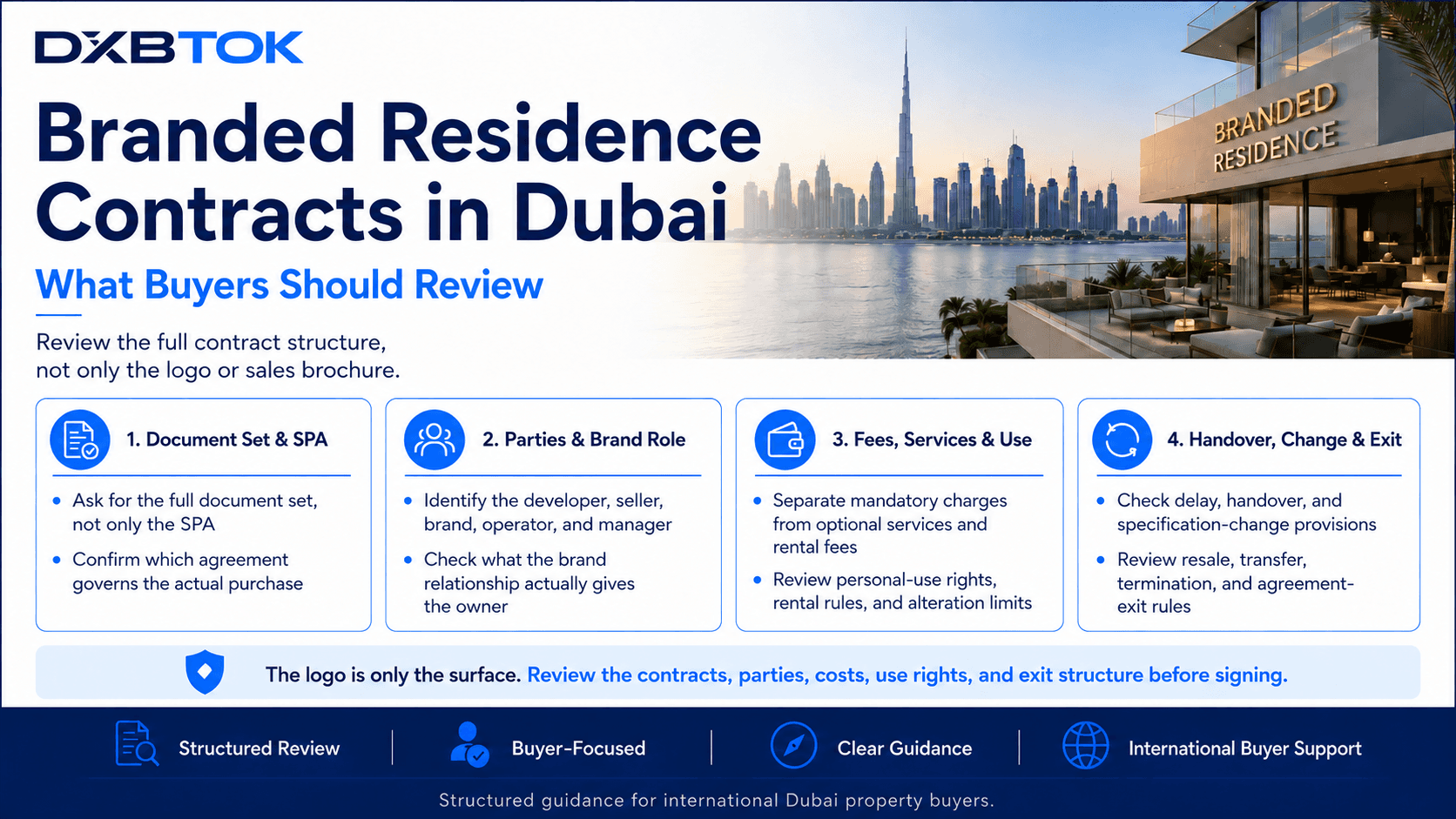
The most important part of a branded residence contract is not the logo on the first page.
It is the structure underneath it.
Before signing, understand:
what property you are buying
which parties are responsible for what
what the brand relationship provides
which services are guaranteed by contract
what you will pay during ownership
what restrictions apply
how management works
how rental arrangements work
what can change
how you can eventually resell
The key question is not:
“Is this a branded residence contract?”
It is:
“Do I understand every agreement that affects how I buy, use, pay for and eventually exit this property?”
Need Help Reviewing a Dubai Branded Residence?
DXBTOK helps international buyers compare Dubai branded residences, understand the transaction structure and identify the practical questions that should be resolved before moving forward.
Contact DXBTOK and let us help you review the property and buying process more clearly.
Related DXBTOK guides
Branded Residences in Dubai: Buyer Guide →


