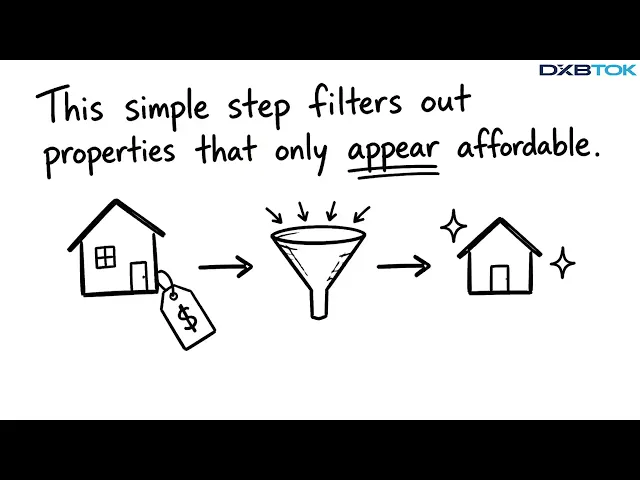
The advertised price of a Dubai property does not automatically represent the amount an international buyer should be prepared to commit to the purchase. The gap between the listed price and the practical purchase requirement can vary depending on the transaction, financing, currency and immediate setup needs. This guide explains how to use the listed price as an early affordability filter before moving into the detailed full-cost calculation.
Why Listed Price Is Not the Full Purchase Cost
A Dubai property listing gives you one important number: the price of the property.
What it does not automatically tell you is whether that property actually fits the amount you are prepared to commit to the purchase.
That distinction matters.
A buyer may search for properties up to a certain budget, find a unit priced comfortably below that ceiling and assume there is enough room to proceed.
But the listed price can leave out other amounts that become relevant before, during or shortly after completion.
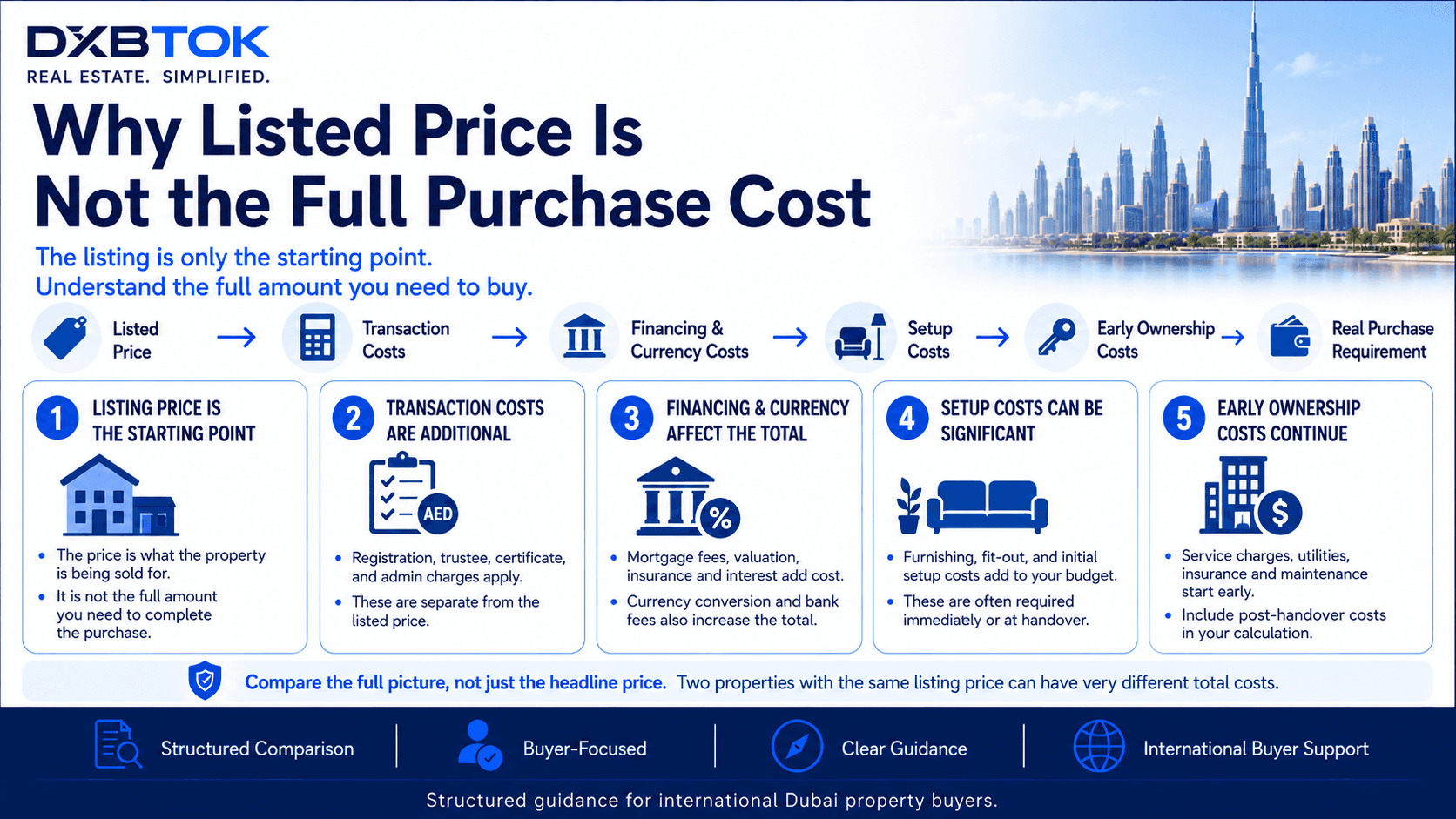
For this reason, buyers should treat the advertised price as a screening number, not as the final amount they will necessarily need.
The key question is not:
“Is the listed price within my budget?”
It is:
“After allowing for the transaction-specific costs around this purchase, is the property still comfortably within my budget?”
1. The listing price is not a complete affordability test
Property portals and sales materials naturally lead with the property price.
That number is useful because it allows buyers to compare:
areas
developments
property types
unit sizes
layouts
competing listings
But a buyer can make a mistake by turning the property-search ceiling into the property-price ceiling.
For example, a buyer who has a maximum amount available for the entire acquisition should not automatically search for properties priced exactly at that maximum.
Doing so can leave no room for the other obligations connected with completing the purchase.
The listed price therefore answers:
“What is the property being sold for?”
It does not necessarily answer:
“What amount should I be prepared to commit to this purchase?”
2. The important issue is the gap between the two numbers
For this article, the most useful concept is the budget gap.
There are two numbers to keep separate.
Listed price
The advertised or negotiated price of the property.
Practical purchase requirement
The amount the buyer may ultimately need to have available once the relevant transaction costs and immediate purchase-related obligations are considered.
The difference between those two figures is the budget gap.
That gap will not be identical for every property.
It may be small in one transaction and materially larger in another.
This is why using a fixed rule such as “just add a certain percentage” can create false confidence.
The correct adjustment depends on the exact property and transaction.
3. Create room in the budget before you shortlist
One of the best times to deal with this issue is before becoming emotionally attached to a property.
Instead of searching all the way up to your absolute financial limit, separate:
Maximum total commitment
from
Maximum property price
Those numbers may not be the same.
This gives you room for transaction-specific items that still need to be confirmed.
It also improves the quality of the shortlist.
A property that looks affordable on the portal but only works if every other cost is ignored may not belong on the serious shortlist in the first place.
4. Different properties can create different budget gaps
Two Dubai properties can carry the same listed price and still require different amounts of money from the buyer.
The surrounding transaction may simply be different.
Differences can arise because of:
ready versus off-plan purchase structure
mortgage versus cash purchase
different payment timing
different setup condition at completion
different recurring ownership arrangements
different buyer funding currencies
You do not need to calculate every category in detail while browsing.
At the shortlist stage, the objective is simply to identify whether something important sits outside the headline price.
If it does, leave sufficient room for it before treating the property as affordable.
5. Do not turn the shortlist stage into a full-cost calculation
Once a property survives the initial budget-gap test, the detailed calculation can happen separately.
The early-stage purpose is narrower.
You are trying to determine whether the property deserves to remain on the shortlist.
At this stage, the buyer does not need to model every future expense.
The buyer needs to avoid assuming that a property listed at the top of the available budget automatically fits the purchase budget.
The deeper reservation-to-ownership calculation should happen after the property has passed this first screening test.
For the complete transaction-level budget, review the full cost of buying Dubai property before committing to the purchase.
6. Financing can widen the gap
If the purchase involves a mortgage, the relationship between property price and available cash becomes more complicated.
A property can fall within the buyer’s headline price range and still sit outside the buyer’s practical financing range.
This can happen because the buyer may need to fund part of the purchase independently, meet lender requirements and retain enough cash for transaction obligations that are not covered by financing.
The detailed mortgage calculation belongs in the specialist financing review.
Non-resident buyers can review the dedicated guide to mortgage options for non-resident Dubai buyers before setting their final property-search ceiling.
For the shortlist stage, the important point is simpler:
Do not assume that being able to finance the property price means the entire purchase comfortably fits the budget.
7. International buyers can also face a currency gap
An international buyer may set a budget in euros, pounds, francs or another home currency while the Dubai property obligation is denominated in AED.
That creates another possible difference between:
the price shown on the listing
and
the amount the purchase represents in the buyer’s own currency
The exchange rate can move while the AED property price stays unchanged.
Again, the detailed currency calculation belongs in a specialist review.
European buyers can examine currency exchange when buying Dubai property from Europe separately when calculating their actual home-currency exposure.
At the shortlist stage, the buyer only needs to recognize that an AED listing price is not necessarily a fixed home-currency commitment.
8. Some properties need more immediate spending than others
The listed price can also create a misleading comparison when one property is immediately usable and another requires additional setup.
A lower-priced property may still require money shortly after completion for things such as:
furnishing
appliances
basic repairs
preparation for occupancy
management setup
This does not mean every buyer should turn all future expenses into one artificial total.
It means obvious immediate requirements should not be ignored when deciding whether the property actually fits the budget.
If the property only works financially before those known requirements are considered, the shortlist may already be too aggressive.
9. Recurring ownership costs are a warning signal, not the main calculation here
Recurring costs matter, but they should not dominate this article.
The purpose of this guide is not to calculate annual service charges, maintenance or management expenses in detail.
The relevant point is simply that some properties come with ownership structures that create more continuing financial responsibility than others.
That can matter when deciding how much room to leave above the listed price.
Detailed recurring-cost calculations belong in the specialist guides.
For the building-level recurring cost layer, review the guide to Dubai property service charges.
Unit-level upkeep should be reviewed separately through the Dubai property maintenance costs guide.
10. The risk increases near the top of your budget
The listed-price misconception becomes more important when the buyer is searching close to the maximum available capital.
Consider two buyers looking at the same property.
Buyer A has substantial room above the listed price.
Buyer B needs almost all available funds just to cover the headline price.
The property is the same.
The budget risk is not.
Buyer B has far less tolerance for any additional requirement that appears during the transaction.
The closer the listed price is to your financial limit, the more important the budget-gap check becomes.
11. Use the listed price as a filter, not a final answer
A useful search process is:
Set the maximum amount you are prepared to commit.
Leave room for transaction-specific costs.
Set a realistic maximum property-search price.
Shortlist properties within that range.
Run the detailed cost calculation on the strongest candidates.
This keeps the early property search simple without pretending that the listing price is the entire financial picture.
You are not trying to calculate every future expense before viewing a property.
You are preventing an incomplete number from driving the shortlist.
12. A lower listed price is not automatically the safer choice
Buyers can also make the opposite mistake.
They may automatically prefer the lower-priced property because it appears to leave more financial room.
But the headline difference between two listings does not always survive once the specific purchase circumstances are reviewed.
One property may have the lower advertised price while requiring more immediate setup or creating a different transaction structure.
That deeper side-by-side comparison belongs in a separate total-cost comparison.
For this article, the lesson remains narrower:
Make sure the advertised price is not being mistaken for the complete amount required to make the purchase workable.
Final takeaway
The listed price is an important property-search number.
It is not automatically your full purchase budget.
Before a Dubai property enters your serious shortlist, separate the maximum amount you are prepared to commit from the maximum property price you should search for.
Leave room for transaction-specific costs that still need to be confirmed.
Then, once the property passes that first affordability test, move into the detailed cost, financing, currency and ownership review.
The objective is not to predict every future expense.
It is to avoid building a property shortlist around a number that was never designed to represent the buyer’s complete financial requirement.
Need help reviewing whether a Dubai property really fits your budget?
DXBTOK helps international buyers review Dubai property options more systematically, including purchase structure, budget fit and the transaction factors that can sit beyond the advertised property price.
Start your Dubai property review at DXBTOK.com.
Related DXBTOK guides
Full Cost of Buying Dubai Property: What International Buyers Should Budget →
How to Compare Total Cost Between Dubai Properties →
Mortgage Options for Non-Resident Dubai Buyers →