

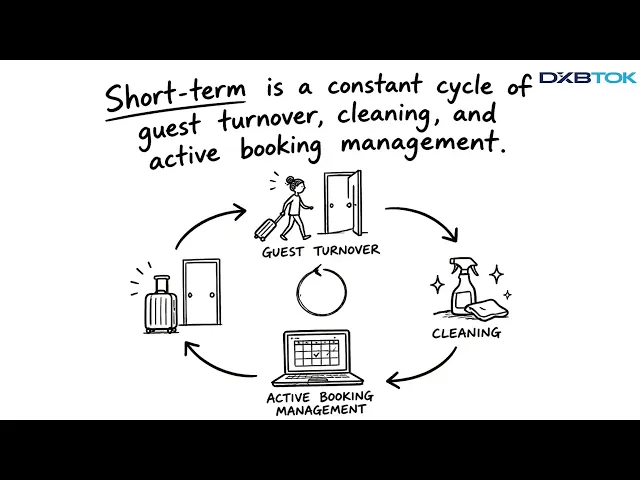
Changing a Dubai property from long-term tenancy to holiday-home use involves more than changing the rental listing. Owners should first resolve the existing tenancy, confirm current unit eligibility, assess the property’s setup and maintenance needs, define management responsibilities and budget the transition before moving into guest accommodation.
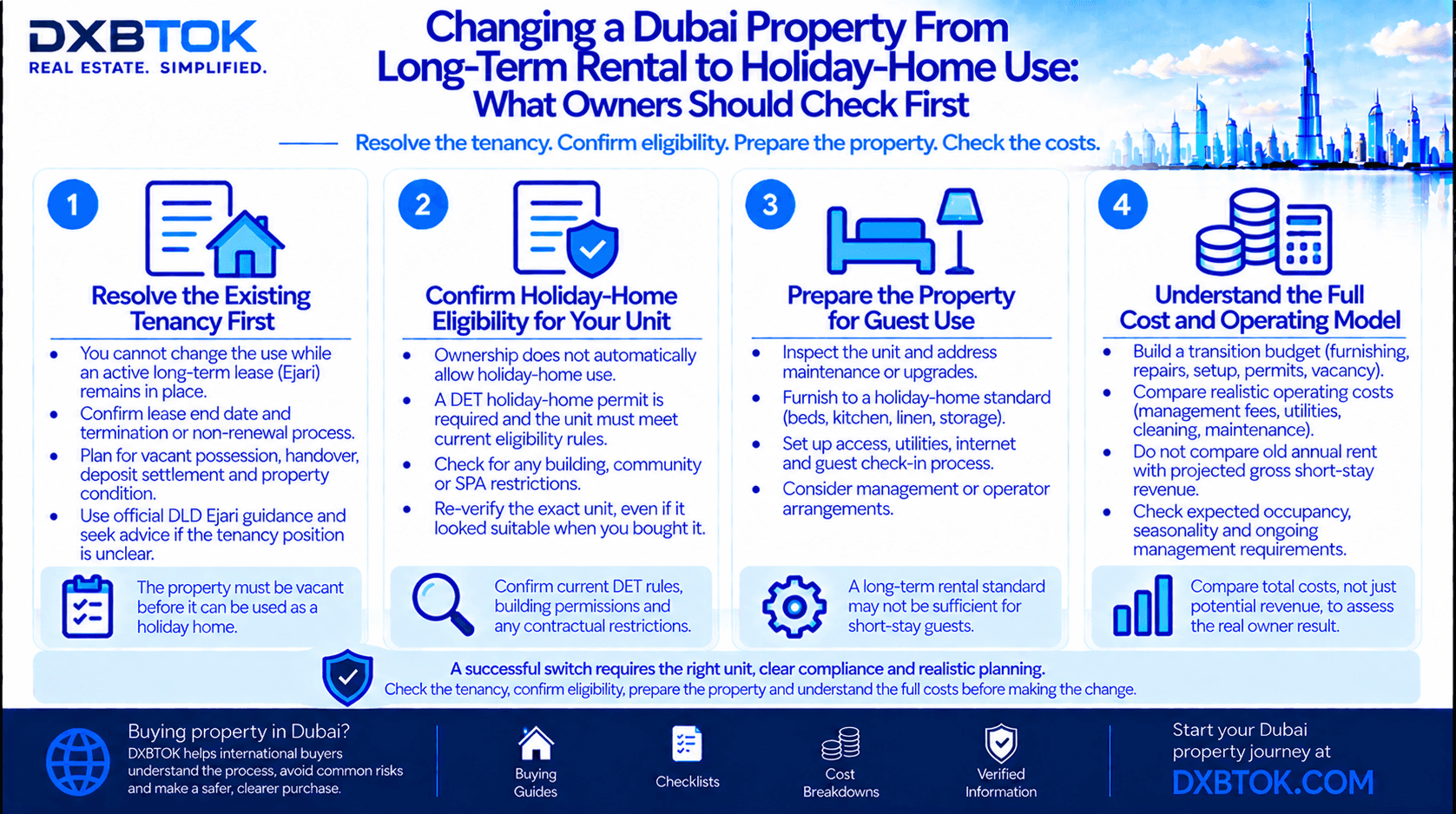
Changing a Dubai Property From Long-Term Rental to Holiday-Home Use: What Owners Should Check First
Changing a Dubai property from a conventional long-term tenancy to holiday-home use is not simply a matter of replacing one listing with another.
The property may need to move from an existing tenant relationship into a different regulatory and operating structure. The owner also needs to confirm that the unit is eligible, that the tenancy position is clear, that the property can be prepared for guest use, and that the management and cost model still makes sense after the change.
If you are still deciding which rental model fits your goals, start with the broader Dubai holiday home vs long-term rental comparison. Once the decision to move toward holiday-home use has already been made, the issue becomes transition readiness.
1. Resolve the Existing Tenancy Before Planning the Change
If the property is currently occupied under a long-term tenancy, that tenancy must be resolved before a holiday-home strategy can realistically begin.
The owner should understand the current lease position, expected timing and whether vacant possession can be achieved before committing to furnishing, launch dates or a holiday-home operator.
An unclear or disputed tenancy can delay the transition and create unnecessary costs if commitments are made too early. Where the tenancy position is uncertain, appropriate professional advice may be required before proceeding.
2. Separate the Transition Decision From the Rental-Strategy Decision
Once you have decided to move away from long-term tenancy, avoid reopening the entire short-term-versus-long-term debate inside the transition process.
The practical question is now narrower:
Can this specific property move cleanly from its current long-term rental state into lawful, workable and financially sensible holiday-home operation?
That keeps the decision focused on readiness rather than projected yield or general market claims.
3. Confirm That the Exact Unit Can Be Used as a Holiday Home
Ownership does not automatically mean that a residential property can be operated as a holiday home.
Dubai's Department of Economy and Tourism requires the relevant holiday-home permit before a residential unit is operated in that format. Current DET guidance also sets unit-eligibility conditions and identifies circumstances where permits will not be issued, including units whose sale-and-purchase terms explicitly prevent holiday-home use.
Re-check the exact unit even if the property looked suitable when it was originally purchased. Contract terms, building rules, management arrangements and the owner's intended operating model all matter.
For the property-level suitability questions, use the Dubai property for holiday-home use buyer checks.
4. Check Whether Anything Has Changed Since You Bought the Property
A property may have been purchased several years before the proposed rental-model change.
Do not rely only on what was true at purchase.
Reconfirm:
current building or community rules;
current access arrangements;
the condition of the unit;
current management contacts;
any relevant contractual restrictions;
the present regulatory position for the intended use.
A transition decision should reflect the property as it exists now, not the assumptions used when it was originally bought.
5. Build a Transition Budget, Not Just a Revenue Forecast
The switch can create one-off costs before the first holiday-home booking is accepted.
Depending on the unit, the transition budget may need to include:
furniture or furnishing upgrades;
linen, kitchen and household equipment;
maintenance and repairs;
deep cleaning and presentation work;
internet and utility readiness;
access-control arrangements;
operator or manager onboarding;
photography or listing preparation;
regulatory and permit-related costs;
vacancy during the transition period.
Do not compare the old annual rent with a projected short-stay gross revenue number and assume the difference is profit.
The correct comparison is closer to:
expected operating revenue − operating costs − management − setup costs − maintenance − transition vacancy = owner result
6. Inspect the Property Before It Becomes Guest-Facing
A unit that was acceptable for a long-term tenant may still need work before repeated guest turnover begins.
Check the practical condition of:
air-conditioning;
plumbing and visible leaks;
appliances;
locks and access cards;
lighting and electrical items;
furniture condition;
paint and visible finishes;
balconies and external areas where applicable.
The purpose is not cosmetic perfection. It is to identify faults that could become repeated guest complaints, emergency call-outs or expensive short-notice repairs.
Keep the deeper ownership-cost question on the dedicated Dubai property maintenance costs page.
7. Decide Who Owns Each Operational Responsibility
A holiday-home transition can fail even when the property itself is suitable if responsibilities are unclear.
Before launch, establish who is responsible for:
property access;
guest communication;
cleaning and turnover coordination;
maintenance approval;
emergency response;
owner reporting;
payments and operating expenses;
permit-related administration where applicable.
If you are appointing a local manager or operator, apply the same due-diligence discipline used when choosing a Dubai property manager: confirm the company, role, written scope, authority, fees, reporting and exit arrangements before handing over keys or decision-making power.
8. Keep Owner Control Even When the Operation Is Delegated
Professional management can reduce the owner's day-to-day workload, but delegation should not mean losing visibility.
The owner should know:
who can enter the property;
who can approve spending;
what requires owner approval;
what reports are provided;
how maintenance decisions are documented;
where booking and expense records are kept;
how the arrangement can be ended and access recovered.
For overseas owners, the broader control framework is covered in Dubai property management for overseas owners.
9. Treat Furnishing as an Operating Decision
Holiday-home furnishing is not only an interior-design exercise.
The setup needs to work for repeated use, cleaning, replacement and maintenance.
Consider whether furniture and equipment are:
durable enough for repeated guest use;
easy to clean and replace;
appropriate for the likely guest profile;
practical for the unit layout;
supported by enough owner storage where needed.
A property that was rented long term unfurnished or with basic furniture may require a meaningful capital reset before holiday-home operation makes sense.
10. Check Access, Security and Building Practicality
Short-stay use creates more arrivals, departures and access events than a stable long-term tenancy.
Review how the building handles:
guest entry;
security or reception procedures;
access cards and replacement access;
parking;
luggage movement;
late arrivals;
contractor access;
use of shared amenities.
A strong property can still be operationally awkward if every guest arrival creates friction with the building or management process.
11. Recheck Insurance and Risk Responsibility
Do not assume that insurance or risk arrangements used during long-term tenancy automatically fit a guest-accommodation model.
Confirm with the relevant insurer, manager or professional adviser whether the proposed use affects the cover or responsibilities connected with the property, contents, liability or guest-related incidents.
The aim is simple: the ownership structure, management agreement and insurance position should reflect how the property will actually be used.
12. Allow for a Real Transition Period
Owners often underestimate the time between the end of a long-term tenancy and genuine holiday-home readiness.
The sequence can include:
tenant move-out and condition review;
repairs;
cleaning;
furnishing or replacement work;
utility and internet checks;
management setup;
regulatory approval;
listing preparation.
Do not model the property as earning short-stay revenue from the day after a tenant leaves unless the unit is genuinely ready.
13. Separate Old Tenancy Records From the New Operating Model
The long-term tenancy should close cleanly before the new use begins.
Keep clear records of the previous tenancy, condition at handover, deposits or balances, keys and access devices, maintenance issues and any outstanding responsibilities.
Then establish a separate operating record for the holiday-home phase.
Mixing the two periods can create confusion over responsibility, property condition, expenses and access.
14. Do Not Choose the Transition Because of One Headline Yield
A decision to switch should be based on the exact property and the owner's operating capacity, not on a general claim that short-term rental always produces a higher return.
Stress-test the assumptions:
How much vacancy is assumed?
What management cost is included?
Who pays utilities?
What cleaning and turnover costs apply?
How much furniture replacement is expected?
What maintenance reserve is realistic?
How much downtime is required during the change?
A higher gross number can still produce a weaker owner result if the operating assumptions are too optimistic.
15. Use a Transition-Readiness Test Before Launch
Before moving ahead, the owner should be able to answer these questions clearly:
Is the existing tenancy fully resolved?
Is the property vacant and available for the new use?
Is the exact unit eligible for holiday-home operation?
Have current building and contractual restrictions been checked?
Has the setup budget been calculated?
Is the property physically ready for repeated guest use?
Has the manager or operator been verified?
Are access and spending authority clear?
Are insurance and owner-risk responsibilities understood?
Has realistic transition downtime been included?
Does the expected net owner result still justify the change?
If several of these answers are still unclear, the property is not yet transition-ready.
Final Takeaway
Changing a Dubai property from long-term rental to holiday-home use is a change of operating model, not simply a change of tenant type.
The owner needs to resolve the existing tenancy, confirm current holiday-home eligibility, prepare the unit, define management responsibility, budget the transition and protect owner control before the property becomes guest-facing.
Start with the legal and occupancy position. Then check the exact property. Then build the operational and financial setup around facts rather than projected yield.
DXBTOK helps international buyers and owners organise the property, cost, management and transaction questions that need to be clear before moving forward.
Related DXBTOK Guides
Dubai Holiday Home vs Long-Term Rental: What Owners Should Compare →
Dubai Property for Holiday-Home Use: What Buyers Should Verify Before Buying →
Dubai Property Management for Overseas Owners →
Choosing a Dubai Property Manager: What Remote Owners Should Check Before Appointing One →


