Choosing a Dubai Property Manager: What Remote Owners Should Check Before Appointing One

Remote property ownership depends heavily on the company trusted to manage access, maintenance, inspections, tenant-related administration and urgent problems. Before appointing a Dubai property manager, owners should verify the company, understand exactly what services are included, define spending and access authority, review reporting and maintenance procedures, check the written management agreement and make sure keys, records and control can be transferred cleanly if the relationship ends.
Choosing a Dubai Property Manager: What Remote Owners Should Check Before Appointing One
Owning a Dubai property from another country often means relying on someone locally for access, maintenance coordination, inspections, tenant-related administration and urgent problems.
That makes the choice of property manager important.
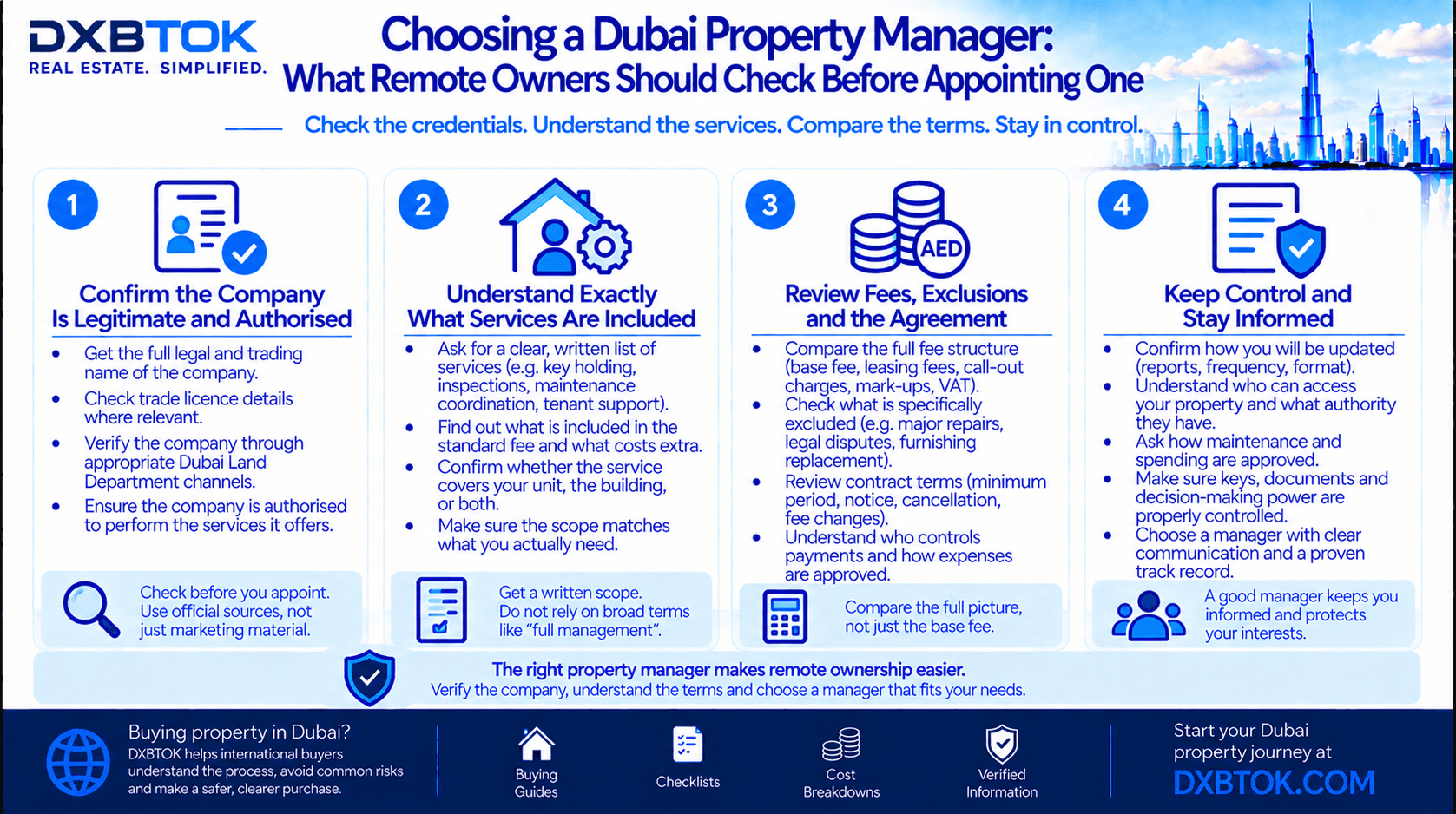
A professional-looking website or a promise of “full management” is not enough on its own. Remote owners need to understand who they are appointing, what the company is authorised to do, what is included in the agreement, how money and access are controlled and how the owner stays informed.
The goal is to choose a manager whose role, authority, reporting and costs are clear before you hand over keys, documents or decision-making power.
1. Keep Manager Selection Separate From General Property Management
Choosing a manager is one decision. Running the property after that appointment is another.
The broader operating framework includes maintenance, access, tenancy administration, inspections, owner reporting and emergency control. For that full ownership process, see our Dubai property management for overseas owners guide.
Before you reach that stage, concentrate on whether the company you are considering is appropriate to appoint.
2. Confirm the Exact Company You Would Contract With
Ask for the full legal and trading name of the company that will sign the management agreement.
Do not assume the brand shown in marketing material is necessarily the legal entity responsible for the service.
Record:
company name
trade licence details where relevant
office contact information
the person responsible for your account
the legal entity named in the proposed agreement
The company named in the contract should match the party you believe you are appointing.
3. Check Whether the Company Appears in the Relevant Dubai Property-Management Channels
Dubai Land Department provides an online service through which owners and tenants can inquire about real-estate management companies for renting or managing properties.
Before appointing a manager, verify the company through the appropriate official channels rather than relying only on a sales introduction or referral.
If the company will carry out regulated activities connected with property management or tenancy administration, confirm that its role and licensing match the work it proposes to perform.
4. Distinguish Private Unit Management From Building Management
A company managing common areas in a jointly owned building is not automatically the company that manages your individual apartment as an owner's asset.
Ask whether the provider will manage:
your individual property
the common areas of the building
both under separate roles
only rental administration
only maintenance coordination
This distinction matters because the responsibilities, agreements and fees may be different.
5. Decide What You Actually Need the Manager to Do
Do not buy a large management package simply because you live abroad.
List the tasks you genuinely need.
They might include:
key holding
routine inspections
contractor access
maintenance coordination
tenant communication
rent collection administration
move-in or move-out coordination
utility or document follow-up
emergency response
regular owner reporting
If you are still deciding whether a property is practical to own while living abroad, use our remote-ownership buyer guide before selecting a management provider.
6. Ask for a Written Scope of Services
Terms such as “complete management” or “full-service management” should be converted into a written list of responsibilities.
Ask which tasks are included in the standard fee and which require additional approval or payment.
A clear scope reduces the risk that the owner expects a task to be handled while the manager considers it outside the agreement.
7. Ask What the Manager Will Not Do
Exclusions are important.
Ask whether the company excludes:
major maintenance
legal disputes
specialist contractor supervision
furnishing replacement
deep cleaning
insurance claims
holiday-home operation
leasing or renewal work
vacant-property inspections
A manager can still be suitable even with exclusions, provided you understand them before appointment.
8. Compare the Agreement, Not Only the Management Fee
A lower fee is not automatically better if the service is narrow or many activities are charged separately.
Compare:
base management fee
leasing or renewal fees
maintenance coordination charges
inspection charges
emergency call-out costs
mark-ups or administration fees
termination charges
For the separate cost of maintaining the property itself, see our Dubai property maintenance-cost guide.
9. Set Clear Spending Authority
Remote ownership can become inefficient if the manager must ask permission for every minor issue.
It can also become risky if the manager has open-ended spending authority.
Agree a practical approval structure.
For example:
minor repairs below an agreed limit may be approved automatically
larger work requires a quotation and owner approval
emergency work follows a separate rule
The exact arrangement should reflect your risk tolerance and the property.
10. Ask How Contractors Are Selected
Find out whether the manager:
uses an in-house maintenance team
uses preferred contractors
obtains competing quotations
allows the owner to nominate contractors
adds a coordination or administration fee
You should know how repair decisions move from problem to quotation to approval to completed work.
11. Ask How Repairs Will Be Evidenced
Remote owners cannot inspect every repair personally.
Ask whether the manager provides:
photographs
contractor quotations
invoices
completion confirmation
before-and-after evidence where useful
Good records help the owner understand what was done and what was paid.
12. Check How Keys and Access Are Controlled
A manager may need legitimate access to the property, but that access should be controlled.
Ask:
who can hold keys
how key handovers are recorded
who can authorise contractor entry
whether access records are maintained
what happens to keys when the agreement ends
Remote ownership works better when responsibility for access is explicit.
13. Agree an Inspection Standard
If the property may be vacant, ask how often the manager can inspect it and what an inspection includes.
Clarify whether inspections are:
scheduled automatically
requested by the owner
included in the fee
documented with photographs
followed by a written condition summary
“We check the property” should have a measurable meaning.
14. Define the Reporting Rhythm
A property manager should not communicate only when there is a problem or an invoice to approve.
Ask how often you will receive an update and what it will contain.
Depending on the property, reporting may include:
open maintenance items
completed work
property condition
tenant or occupancy status
payments administered by the manager
documents requiring owner action
Agree the reporting format before appointment.
15. Test the Communication Process Before Signing
The pre-contract experience can reveal how the company communicates.
Notice whether the team:
answers specific questions clearly
provides documents promptly
distinguishes included and excluded services
explains who will be your day-to-day contact
confirms important points in writing
If communication is unclear before appointment, remote ownership is unlikely to make it easier.
16. Ask How Emergencies Are Handled
Remote owners should know what happens outside normal communication cycles.
Ask:
who receives emergency reports
what qualifies as an emergency
when the manager may enter the property
what spending limit applies
how quickly the owner is informed
The procedure should balance speed with owner control.
17. Review Any Management Agreement Before Appointing the Company
Dubai Land Department provides a process through which real-estate management companies can register or renew management contracts between owners and management companies through the Ejari system, subject to the relevant service terms.
Before signing, check that the agreement accurately reflects the service you were sold.
Review:
contracting parties
property covered
service scope
fees
authority
term
renewal
termination
record and key handover
18. Check Whether the Manager Can Handle Your Intended Rental Model
If the property will be rented, do not assume every manager handles every rental model.
A provider focused on conventional long-term tenancies may not provide holiday-home operation, and a hospitality-style operator may offer a very different service structure.
Choose the rental strategy separately from the manager-selection decision.
19. Do Not Confuse Service Charges With Private Management Fees
The building's service charges and the fee paid to manage your individual property are different ownership costs.
A property manager may coordinate with building management, but that does not mean the private management fee replaces the building's service charges.
If you need to review those building-level costs, use our Dubai property service-charge review guide.
20. Ask How the Manager Handles Owner Money
If the manager will receive or administer money connected with the property, understand the process before appointment.
Ask:
what money the company may receive
which account or payment channel is used
what statements the owner receives
how invoices are approved
how balances are reconciled
how records are delivered if the agreement ends
The level of financial control should match the authority you give the manager.
21. Ask Who Owns the Records
Important property information should remain accessible to the owner.
Keep copies of:
management agreements
inspection reports
contractor quotations
maintenance invoices
access records where available
tenant-related records where applicable
owner statements
If the manager changes, the property should not lose its operational history.
22. Review Termination Before You Review Renewal
Before signing a management agreement, ask how you can leave it.
Check:
minimum term
notice period
automatic renewal
termination fees
outstanding-work treatment
transfer of keys
transfer of tenant and maintenance records
A management arrangement should be practical to unwind if the service no longer suits the owner.
23. Keep Pre-Purchase Management Promises Separate
If management support was part of the reason you bought the property, compare the actual management agreement with what was represented before purchase.
Our management-support verification guide covers what buyers should check before relying on a management package as part of the purchase decision.
After purchase, the focus is different: you are choosing the company and terms under which someone will actually operate or coordinate the property on your behalf.
24. Treat Manager Selection as Due Diligence
Choosing a property manager is an appointment decision, not just an administrative convenience.
Check the company, role, agreement, authority, charges, controls and exit process before handing over keys or responsibility.
Include those checks in your wider Dubai property due-diligence framework where relevant.
25. Use a Property-Manager Selection Checklist
Company: Which exact legal entity am I appointing?
Role: What property-management activity will it perform?
Official check: Can I verify the company through the relevant Dubai property-management channels?
Scope: Which services are included?
Exclusions: Which tasks are outside the agreement?
Fees: What is fixed, percentage-based or charged separately?
Authority: What can the manager approve without asking me?
Contractors: How are quotations and providers selected?
Evidence: How are repairs and inspections documented?
Access: Who controls keys and contractor entry?
Reporting: How often will I receive an owner update?
Emergency process: What happens when urgent action is required?
Money: How are owner funds, invoices and records controlled?
Agreement: Do the written terms match the service offered?
Exit: How can I terminate and recover keys, records and control?
Final Takeaway
Remote property management is easier when the owner chooses the provider carefully before handing over control.
Verify the company, define the service scope, set authority limits, understand the fee structure, agree access and reporting rules, review the contract and make sure the relationship can be ended cleanly.
The important decision is not simply whether to use a property manager. It is whether the specific manager, agreement and control structure are suitable for your property and the way you intend to own it.
Need help organising the information around remote ownership of a Dubai property? DXBTOK can help international buyers and owners structure the key property, ownership and transaction information before moving forward.
Start your Dubai property review at DXBTOK.com.
Related DXBTOK guides
Dubai Property Management for Overseas Owners →
Dubai Property for Remote Ownership →
Dubai Property With Management Support: What Buyers Should Verify Before Buying →
Dubai Property Maintenance Costs: What Buyers Should Expect →


