International buyers can search for Dubai property through a structured remote platform, a traditional broker, or a combination of both. This guide compares how each search route handles inventory discovery, filtering, property comparison, buyer control, personal interpretation, current information and shortlist creation, while keeping the later transaction route as a separate decision.
Remote Buyer Platform vs Traditional Broker Search
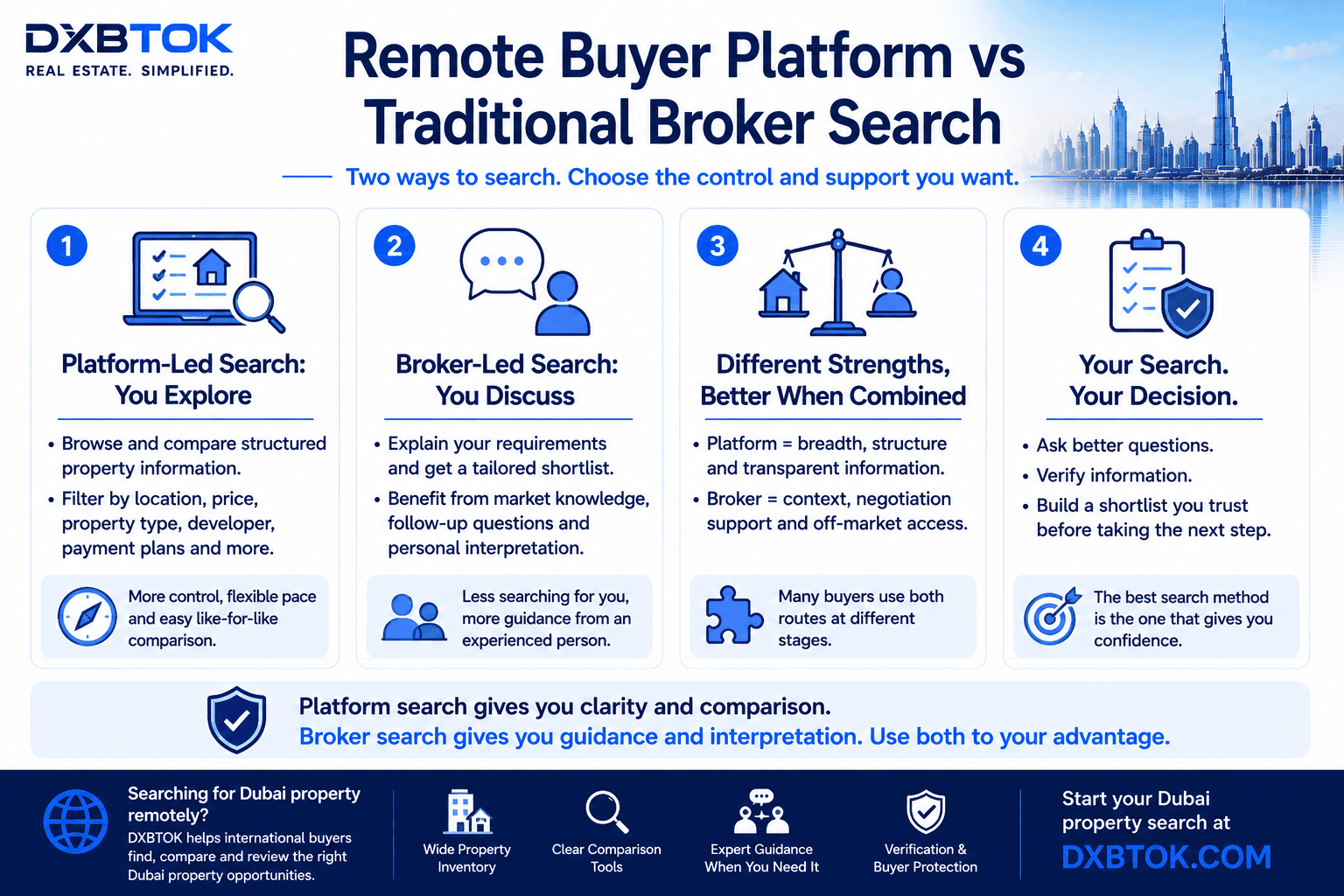
International buyers can search for Dubai property in very different ways.
One route is platform-led: browse structured property information, filter options, compare opportunities and move through the early research stage remotely.
Another route is broker-led: speak with a person, explain the requirement and rely on that broker to search, recommend and coordinate suitable options.
Neither route is automatically better.
The useful comparison is:
How much control, comparison, interpretation and personal coordination does the buyer want during the search stage?
This guide focuses on how buyers can organise the property search stage. The eventual transaction route can be decided separately once a suitable property has been identified.
1. Start by separating property search from property purchase
The way a buyer discovers a property does not necessarily determine how the transaction will later be completed.
A buyer might:
discover a project through a platform and later speak with a broker
receive a broker recommendation and then verify the property independently
compare several projects online before contacting the relevant sales channel
use both platform research and broker support at different stages
For the later route decision itself, review buying direct from a developer versus through a licensed broker.
The important distinction is that the search method and the eventual transaction route are separate decisions.
2. A platform-led search starts with self-directed discovery
A platform gives the buyer a structured place to begin the search.
Depending on the platform, the buyer may be able to review:
locations
property types
price ranges
developer information
payment-plan information
property details
buyer guides
The buyer controls the pace of the initial research.
To see how DXBTOK structures that buyer journey, review how DXBTOK works.
This can be useful for international buyers who want to understand the market before speaking with multiple sales contacts.
3. A broker-led search starts with a conversation
A traditional broker search normally begins with the buyer explaining what they want.
The broker can then interpret that requirement and suggest properties or projects.
This can be useful when the buyer:
does not know which area to start with
wants a shortlist quickly
has complex requirements
wants someone to ask follow-up questions
prefers discussion over independent browsing
The strength of this route depends heavily on the broker’s market knowledge, responsiveness and the quality of the shortlist.
4. Compare how much inventory each route exposes
One important difference is what the buyer can actually see.
A platform may expose a defined set of listings, projects or curated opportunities.
A broker may have access to:
their own listings
developer inventory
broker-network inventory
off-market or recently released opportunities
But broader access does not automatically mean every option is relevant.
The buyer should compare both inventory breadth and inventory quality.
5. Platforms can make like-for-like comparison easier
Structured information can help a buyer compare properties using the same fields.
For example:
price
size
location
property type
developer
payment structure
completion stage
This reduces the risk of comparing one property using detailed information and another using only a sales brochure.
For buyers who like to analyse several options themselves, this consistency can be valuable.
6. Brokers can add interpretation that a platform may not provide
Structured data tells the buyer what is shown.
A good broker can help interpret why one option may fit the buyer better than another.
That can include discussion around:
location trade-offs
developer differences
unit selection
payment-plan suitability
buyer objectives
timing
This human interpretation is most useful when it is based on the buyer’s actual requirement rather than generic sales pressure.
7. A platform gives the buyer more direct control over the shortlist
With self-directed search, the buyer decides what to open, compare, save or reject.
This can make it easier to:
compare several areas
change the budget range
review different property types
return to the same information later
build a shortlist before speaking with anyone
For some buyers, this reduces noise during the early search stage.
8. A broker can reduce the buyer’s search workload
The opposite advantage is delegation.
A buyer can give a broker the criteria and ask them to narrow the market.
This can save time when the broker understands the brief well.
But the buyer should still ask:
Why was this property selected?
What alternatives were considered?
Is the shortlist limited to particular developers or listings?
What important options may not be represented?
Delegating the search should not mean losing visibility over how the shortlist was created.
9. Compare how current the information is
Both platforms and brokers can work with information that changes.
Prices, availability, incentives and payment plans may move quickly.
A platform listing should therefore not automatically be treated as live inventory.
A broker message should not automatically be treated as current simply because it was sent personally.
Buyers should also know how to verify a Dubai property listing before relying on it.
Before a property becomes a serious candidate, the buyer should reconfirm the exact unit and current terms.
10. Compare how easy it is to keep a record
Remote buyers often review many properties before deciding.
A platform can make the search record easier to organise because information may remain in one place.
A broker-led search can generate:
WhatsApp messages
PDF brochures
voice notes
price sheets
links
screenshots
That is not inherently a problem.
But the buyer should create a consistent comparison record so one property is not remembered more favourably simply because its presentation was stronger.
11. Compare how much market context the buyer receives
A search platform may provide guides, filters or structured information that help the buyer understand the market independently.
A broker may provide personal market commentary and explain why they prefer one project or location.
Both can be useful.
But buyers should distinguish between:
factual property information
market interpretation
sales opinion
promotional claims
The more important the claim is to the decision, the more useful it is to verify it separately.
12. Compare incentives and conflicts of interest carefully
Every property-discovery channel has a commercial model.
A platform may prioritise selected opportunities or operate within a defined inventory universe.
A broker may receive commission from particular transactions or have stronger commercial relationships with some developers.
This does not automatically make the recommendation poor.
But buyers should understand:
how the search channel is compensated
whether the available inventory is broad or selective
whether certain projects are being prioritised
whether the buyer can compare alternatives
Transparency about the search model helps the buyer interpret the recommendations.
13. Use the platform for structure and the broker for questions if that works better
The two methods do not have to compete.
A buyer can use a platform to:
learn the market
compare areas
filter projects
create a shortlist
Then use a broker or sales professional to:
answer property-specific questions
check current availability
discuss alternatives
coordinate the next step
Once several projects reach the shortlist, use the guide on how to compare Dubai developers before reserving off-plan property.
For many buyers, a hybrid process can provide both control and human support.
14. Do not let either search route replace verification
A polished platform does not prove that every listing is current.
A trusted broker does not remove the need to verify important property and transaction information.
Before a property moves from shortlist to serious purchase consideration, confirm:
the exact property
current availability
current price
current payment plan
developer or seller information
the next transaction step
Discovery helps find the opportunity.
Verification determines whether the opportunity is ready to progress.
15. Know when the search stage is finished
Buyers can remain in research mode for too long.
The search stage has done its job when the buyer has:
a clear objective
a manageable shortlist
comparable information
a preferred property or small group of finalists
enough clarity to start current-unit verification
At that point, the process should move from broad search toward transaction-specific confirmation.
16. Use a search-route comparison framework
Compare the two approaches across the same questions:
PLATFORM-LED SEARCH
How much inventory can I browse?
How easy is it to compare properties?
How much control do I have over the shortlist?
How current is the information?
What support is available when I need clarification?
BROKER-LED SEARCH
How well does the broker understand my requirement?
How broad is the broker’s search universe?
Why were these properties selected?
How current is the information?
How easy is it to compare the recommendations consistently?
The stronger route is the one that gives the buyer the right balance of control, market access, comparison and support.
17. Choose the search method separately from the transaction route
This is the key boundary.
Choosing a platform-led search does not mean the buyer must complete the transaction through a platform.
Choosing a broker-led search does not mean the buyer should stop comparing or verifying independently.
The search method answers:
“How do I find and narrow the opportunities?”
The later transaction decision answers:
“How do I proceed with the property I have selected?”
For the practical transaction question after the search stage, review what is possible when buying Dubai property without visiting.
Keeping those questions separate produces a cleaner buying process.
Final takeaway
A remote buyer platform and a traditional broker organise the Dubai property search differently.
A platform can provide self-directed browsing, structured comparison and greater control over the early shortlist.
A broker can provide human interpretation, personalised recommendations and direct coordination.
Neither method should replace current-property verification, and neither search route automatically determines how the eventual transaction should be completed.
Choose the search method that helps you find and compare the right opportunities clearly — then verify the property and decide the transaction route separately.
Searching for Dubai property from abroad?
DXBTOK helps international buyers review selected Dubai property opportunities through a structured remote-friendly process, with clearer property information, comparison, verification and next-step guidance.
Start your Dubai property review at DXBTOK.com.
Related DXBTOK guides
Buying Direct from Developer vs Through a Licensed Broker →
How to Verify a Dubai Property Listing →
How to Compare Dubai Developers Before Reserving Off-Plan Property →